Sketches of Pollard’s Performers

Above: University of Washington, Special Collections, JWS24555. (Enlargement) Reproduced with permission. The Commonwealth of Australia was 4 years old when this photo of the Pollard’s Lilliputian Opera Company was taken in the Philippines in late 1904 or early 1905. Close examination of the original (here) suggests the children are posing with chained prisoners. The children include front row, 1st from left: Leah Leichner, 2L Teddy McNamara, 6L Freddie Heintz, 1st from Right: Harry Fraser (later Snub Pollard), 2R Johnnie Heintz, 4R Daphne Pollard. Standing in the rear at left is Oscar Heintz.

On 30 June 1901, The San Francisco Call announced the impending arrival of an exciting troupe of young Australians, Pollard’s Lilliputian Opera Company from Melbourne. While the paper assured readers they were all extremely talented, it explained they were “all children of the poorer classes”, one performer being “picked up on the streets,” it was claimed.

Over the period 1898-1909, Charles Pollard (1858-1942) and his sister Nellie Chester (1861-1944) took travelling troupes of children overseas, overwhelmingly girls and mostly residents of the inner suburbs of Melbourne, to perform musical comedies at colonial outposts in South East Asia and then through the cities of Canada and the USA. One tour was away for over two years. These troupes were always known as Pollard’s Lilliputian Opera Company, although they had a continually changing mix of new and seasoned performers. The children were indentured to the Pollards in a way we would find unthinkable today – and even then, Pollard tours sometimes caused controversy, most notably in 1909-1910 when Arthur Hayden Pollard‘s (1873-1940) tour to India collapsed in scandal.
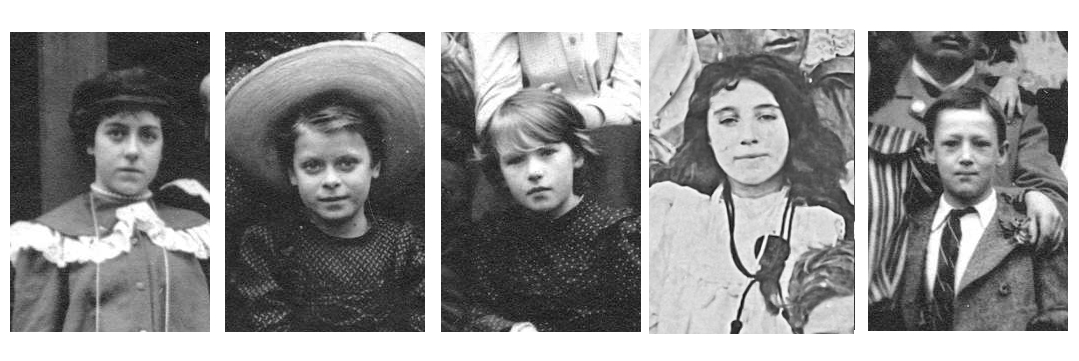

The Pollard’s performers were generally the children of unskilled and semiskilled workers; bakers, boot-makers, tailors, plumbers, ironmongers, carriers, cab-drivers and fruiterers. Several parents were bookmakers, the Trott girls (Ivy Trott and Daphne Pollard) were the children of a french polisher, Midas Martyn‘s father was a bookbinder. They were almost all children from families living in modest cottages built in close proximity to light industry – and they particularly hailed from Fitzroy, Collingwood and Abbotsford. Some lived in such close proximity to each other it is inconceivable they were not acquainted before they signed up.

Here are some short accounts of a few of the Pollard children.


Oscar, Freddie & Johnnie Heintz

Johnnie and Freddie Heintz with their mother Annie, c 1907. Private Collection.

Oscar Heintz was born in 1891, twins Freddie and Johnnie Heintz in 1895. Their father John Heintz was a baker, and he and his wife Annie nee Garland lived much of their life in a modest single storied terrace at 84 Kerr Street, just a few doors from the home of Daphne and Ivy Trott, in the heart of Fitzroy ( although the family lived around the corner at 101 Argyle St, when the twins were born). John Heintz died in 1900 aged only in his late 30s. In September 1901 Oscar joined a Pollard troupe tour of North America and then another in early 1903. In July 1904, the twins joined Oscar on a third lengthy Pollard’s tour of Asia and North America, that finally returned home in February 1907.

Above left: The Heintz family lived at 84 Kerr St Fitzroy, the house with the red door. On New Year’s Day 1913,Freddie was chased into his home by Police, after swearing in the street. He threw a chair at them before being arrested. Photo – Author’s collection. Above right: Freddie and Johnnie Heintz on the July 1904 – Feb 1907 Pollard’s tour of North America. Photo – courtesy Robert Maynard

Above: Freddie and Johnnie Heintz performing in the US, c1908. The San Bernardino County Sun (California), 19 Jun 1908, P4, via Newspapers.com

Remarkably, at the end of the tour in 1907, 16 year old Oscar Heintz stayed on in the US, settling in Portland, Oregon, where with the help of the YMCA, he studied, worked in a bank, married, raised a family and eventually became sales manager for Neon Manufacturing. His was the classic American immigrant made-good story. He returned to Australia to visit his family in 1929. He died quite suddenly in 1939, aged only 48.

Freddie and Johnnie Heintz travelled again with a Pollard’s North American tour that departed later in 1907, and also on the ill-fated Indian tour in 1909. The twins then appeared on stage in Australia for several years, Freddie performing for a time with Tom Liddiard’s troupe. Freddie, probably the more boisterous of the twins, returned alone to the United States in 1914 – performing for a while with Queenie Williams and some of the other former Pollard’s players. He changed his stage name at least twice – to Freddie Garland and later to Freddie Steele, but struggled to build an ongoing stage career of his own. He crossed the border to join the Canadian Army in 1918. He married in 1926 but the marriage soon failed. He died after being hit by a car near the Natick Hotel in Los Angeles in July 1949. His death certificate suggests he was almost unknown to those completing the formalities.

Above: Freddie visiting Oscar, as reported in The Oregonian (Portland Oregan), 25 July, 1922. Via Newspapers.com

His twin brother Johnnie Heintz would have no more of the life of the travelling performer after 1911 and following in his father’s footsteps, became a pastry chef, based in Adelaide. He died of myocarditis in August 1945, aged only 49.

In her 2024 bio of one time Pollard’s teacher Monte Punshon, Tessa Morris -Suzuki records Johnnie and Freddie Heintz admitted to Punshon they had never learned to read and write.


Ethel Naylor

Born in Williamstown, Victoria in 1896, Ethel Naylor travelled on the July 1907- April 1909 Pollard’s tour to North America. In July 1909, she also departed on Pollard’s Indian tour, this time with her older sister Nellie. The girls were the daughters of bookmaker Joseph Naylor and Alice nee Kennedy.

Their family life had been very difficult – Joseph suffered such serious mental illness that he was hospitalised in the asylum at Kew in 1905. He died there in 1907. Of his seven children, only Ethel, Nellie and one other sibling survived childhood – an experience enough to test the sanity of anyone. His widow Alice found life hard, and she drifted between residences. The only contact Truth newspaper could find for her when the Pollard’s Indian tour returned in 1910 was Alice’s workplace address – which was the famous Lucas’ Town Hall Cafe, in Swanston Street, Melbourne, now where the Capital Theatre stands.

The 3 story Town Hall Cafe (centre) and the Talma Photographers building, Swanston Street, Melbourne, from the Town Hall corner, c.1899. State Library Victoria, Gwyn James Collection, H93.466/6. (The Talma Building still stands)

Ethel did perform on stage again, and with significant success. In July 1912 Nelly Chester raised another Pollard’s troupe for touring the US. This time the players were older, and no longer described as Lilliputians, or children, so as to comply with the 1910 Emigration Act. However, many were former Pollard’s players, including Ethel. She did well with the “Pollard’s Juvenile Troupe” that travelled through the United States and Canada. Like many of the performers on this final tour, Ethel stayed on in the US. By the late 1920s she had well and truly changed direction and was working as a registered nurse at the General Hospital in Aberdeen, Washington state. She married in 1932.


Minnie, Nellie and May Topping

Henry Topping was a plumber, and with his wife Mary Ann, nee Plant, they parented seven children. The family lived in and around the northern end of Fitzroy Street, a north-south street that runs the length of the suburb of Fitzroy. They lived a few hundred metres from the Trott and Heintz families in nearby Kerr Street. Minnie (born 1885), Nellie (born 1888) and May (born 1890) Topping all appeared with Nellie Chester and Charles Pollard’s troupes. All three children travelled together on the 1901-1902 tour to North America, and May and Minnie again in 1902-3.

Minnie and May Topping, photographed in 1909. The Gadfly (Adelaide), 20 January 1909, Via the National Library of Australia’s Trove. Photo of the northern end of Fitzroy St, looking south, from the footpath outside the Topping’s now demolished home. Author’s collection.

The Topping sisters moved across to the other Pollard’s Liliputian (consistently spelled with two rather than 3 “L”s) Company in 1907 – this company was run by Tom Pollard and performed exclusively throughout Australia and New Zealand. They are unusual in that respect – as most players did not do this. We can assume they found the extended North American travel with Charles Pollard and Nellie Chester too arduous.

Minnie Topping, who had proved to be a very popular performer, left the Australian stage in 1913, after marrying a Queensland pastoralist. May continued to perform with the Lionel Walsh – Phil Smith company until her marriage in 1923. By this time, the family home (the girls lived here until they married) was at 521 Canning Street Carlton North, a building that still stands. (Left- author’s collection)

We know a little more of the Topping family life because in 1899, a long suffering Mary Ann took Henry Topping to court to force him to support the family, and the Melbourne Herald reported the case. He was a drunken and violent husband and Mary Ann and the children had left him because of this. By way of a somewhat lame explanation, Henry explained that he was not a certified plumber, and had only made 2 shillings so far that week. The court found in favour of Mary Ann and ordered Henry to support his family. Of the black eyes he had inflicted on Mary Ann, the court had nothing to say.

George (born 1881), another of the Topping children, was an Australian Rules Footballer for Carlton, and later an AFL Umpire. The girls’ youngest brother, Albert, was killed soon after arriving on the Western front in August 1916.

Minnie Topping with a daughter, c1923. Private Collection

Nick Murphy
December 2020


Special Thanks

  • University of Washington Special Collections, for permission to use the photos of the troupe. Their collection of photos of the Pollard’s troupes while on tour in North America is invaluable.
  • To Jean Ritsema, in Michigan, for her research efforts in North America.

Fiction
In the absence of meaningful contemporary interviews with these performers, two works of fiction are highly recommended – that help give some sense of the context, motivation and everyday lives of young Australian performers.

  • Kaz Cooke (2017) Ada. Comedian, Dancer, Fighter. Viking /Penguin. A fictional account of Ada Delroy’s life.
  • Kirsty Murray (2010) India Dark. Allen and Unwin. A fictional work inspired by the Pollard Tour of India in 1909-1910.

The Australian Performing Arts Collection, Arts Centre Melbourne, holds an interview with Irene Goulding, a former Pollard performer, made in 1985.

General Reading

  • Gillian Arrighi & Victor Emeljanow (Eds) (2014) Entertaining Children: The Participation of Youth in the Entertainment Industry, Chapter 3, Palgrave MacMillan.
  • Gillian Arrighi (2017) The Controversial “Case of the Opera Children in the East”: Political conflict between popular demand for child actors and modernizing cultural policy on the child”. Theatre Journal 69, (2017) John Hopkins University Press.
  • Kirsty Murray (2010) India Dark. Allen and Unwin.
    [Note: While written as a novel for teenagers, this beautiful book is closely based on the events of Arthur Pollard’s troupe in India and is highly recommended]
  • Justine Hyde’s blog Hub and Spoke which includes an interview with Kirsty Murray about India Dark.
  • Leann Richards (2012) Theatrical Child Labour Scandal  Stage Whispers website.

Birth certificates, Ships manifests, Voting rolls, Census details etc sourced from

Regarding Oscar, Freddie and Johnnie Heintz

  • Via Newspapers.com
    Calgary Herald (Alberta, Can) 9 Oct, 1908 P7
    The Evening News (Penns) 13 Dec 1922, P12
    Oregonian (Oreg) 10 Oct, 1929
  • Via National Library of Australia’s Trove
    Herald (Vic) 3 Jan 1913, P 6

Regarding Alice and Ethel Bennetto

  • Via National Library of Australia’s Trove.
    Advertiser (SA) 29 Nov 1923, P11
  • Andrew Pike and Ross Cooper (1980) Australian Film, 1900-1977. Oxford University Press/AFI
  • Newspapers.com
    The Honolulu Republican 1 Oct 1901.

Regarding May, Nellie and Minnie Topping

  • Via National Library of Australia’s Trove.
    The Herald (Vic) 16 Mar 1899, P1
    The Australian Star (NSW) 3 Sept 1901, P7
    Table Talk (Vic) 16 Feb, 1905, P16
    The World’s News (NSW) 26 Oct 1907,
    Evening Telegraph (Qld) 31 Aug 1908, P4
    The Gadfly (SA) 20 Jan 1909, P8
  • Peter Downes (2002) The Pollards, A Family and its child and adult opera companies in New Zealand and Australia 1880-1910. Steele Roberts, Aotearoa

Australian Accents from Cinema’s Golden Age

Above: Warner Bros photo credited to Schuyler Grail. Feb 1938, NBC radio announcer Buddy Twist interviewing Australian actress Mary Maguire. The interview is lost unfortunately, but Maguire went out of her way to speak with a cultivated accent during her Hollywood career (see audio clip below). Author’s collection.

There are few people who can find fault with US actress Kaitlyn Dever‘s contemporary Aussie accent in the 2025 Netflix series Apple Cider Vinegar. It is masterful.
As Dever has explained, (see this episode of Entertainment Tonight for example) she put in a great deal of preparation and worked with dialogue coach Jenny Kent to perfect a 21st century Australian accent that rang true.

Historically, it has been generally accepted that the origins of the Australian accent are from southern Britain, and the conventional wisdom has been that there were three notable variations to it:

Of course, accents don’t really fall into such easy categories. Those labels might be better thought of as markers on a continuum, with any one accent sitting somewhere along it. Also, unlike the variations in British and US accents – that are sometimes regional, variations in Australian accents are usually attributed to social class – particularly parenting and education. Of course, physical features such as the shape of the tongue and jaw also impacts how people speak.

In a very good survey of contemporary Australian accents for the ABC, John Hajeck (University of Melbourne) and Lauren Gawne (La Trobe University) note that Australians also often accommodate other accents with ease. Perhaps this explains Adelaide actor Damon Herriman‘s great success in adopting Dewey Crowe’s US accent in the TV series Justified, or Melbourne singer Kylie Minogue’s great ease in shifting from a contemporary British accent to a general Australian one.

In the nineteenth and early twentieth centuries, elocution lessons, (sometimes a part of a private school education but also available from private tutors) were designed to remove all vestiges of a colonial accent, be it from Australia, South Africa or somewhere else. In a short article on actor Judith Anderson, and others, Desley Deacon of ANU has pointed out how common elocution lessons were, and how important these were in opening up a performance career. The resulting accent, found all over the British Empire and beyond, dovetailed nicely with the “transatlantic accent” preferred in US 1930s sound films.

Jane E Southcott has written of concern amongst politicians and the efforts made in South Australian schools to improve Australian speech. She cites School Inspector Maughan reporting in 1912 that “a few minutes spent daily in the practice of pure enunciation would to much to eliminate what is known as ‘the Australian twang.'” Similar sentiments were undoubtedly felt throughout the rest of Australia.


1. Samples of classic Aussie accents – tending to broad.

The broader Australian accent still often appears in Australian-made films, continuing as part of a well established comedy tradition that has long worked on stage. It’s also used in contemporary advertising, and much loved by contemporary politicians, alongside acceptable slang words like “mate” and “g’day”. Yet, today, that’s not how most Australians speak – indeed it would take a conscious effort to speak like that all the time.

Broad accents from the 1930s, usually played for comic effect, can be heard in Australian made films such as Frank Thring‘s His Loyal Highness (Aust:1932) and Ken Hall’s On Our Selection (Aust:1932).

The broad accent rarely appeared in pre-war US and British films. Even in the late 1950s, John Meredyth Lucas commented that a distinctive Australian accent made casting very difficult for the TV series Whiplash. It was unattractive, he felt and by implication might have made sales of the series difficult. In a similar vein, when the US trade paper Harrison’s Reports reviewed Smiley (Aust:1956) they felt it was unlikely to be well received in the US because of the Australian accents. But when Jocelyn Howarth was being introduced to US audiences (as Constance Worth) in 1937, Photoplay magazine assured readers she was free of the “caricatured Australian accent.” The distinctive broad Australian accent still had a few outings – such as in MGM’s very self conscious The Man from Down Under (1943). It also occasionally slipped into other films – here are two examples:

Here Sydney-born Brian Norman, in his one and only film outing, forces some con-men to start morning exercises at the health farm. His broad Australian accent is unmistakable. He became a lawyer after returning from Hollywood. Audio from copy of film in author’s collection.

WB Molloy
William Brian Molloy or “Brian Norman” in the Sydney Sun, 1 April 1934.

  • Lotus Thompson’s (1904-1963) one line as a random person at a ball, in Anthony Adverse (1936)

Lotus Thompson from Queensland was briefly a silent star of some standing in Australia and the US, but her career was all but over by 1930. She appeared in some uncredited extra parts in the 1930s. Her few words as an extra here – “Please talk about them” seem to have an noticeable Australian twang. Audio from copy of film in the author’s collection. Available through Warner Brothers Archive.

Lotus3
Photo-author’s collection c.1924.
  • Bill Kerr’s (1922-2014) exaggerated Aussie accent featured in his popular British comedy act The Man from Wagga Wagga. Click here for an example from 1951. But contrast this also with his real voice – as featured in an Australia soap commercial made with Joy Nichols (1925-1992) only a few years before.
Click on the image to go the 1946 commercial at the NFSA

2. Sample accents of former Australian vaudevillians who ended up in Hollywood 

Although none of the following actors appear to have had elocution lessons and each had only limited formal educations, all arrived in Hollywood after very long careers on stage in Australia, the US and the UK – enough experience and time to give them an accent that might have come from anywhere.

  • Daphne Pollard (1891-1978) sings “The Ragtime Germ” for the stage review Zig-Zag! (UK: 1917).
DP c1918

Daphne Pollard (from Melbourne) had a very long career with other Australian child performers in Pollard’s Lilliputian Opera Company before branching out on her own. She first appeared in Hollywood films in the late 1920s. By the mid 1930s she had largely retired. She is credited with composing this song with Cass Downing and John T. Murray.
Audio from recording in the author’s Collection. Photo from author’s collection c 1920.


  • Snub Pollard (1889-1962) also from Melbourne in Just My Luck (US: 1935).
Snub Pollard Exhibitor's Trade Review Dec. 1922 - Feb. 1923

The prolific Snub Pollard also had a long career with Pollard Lilliputian’s before moving into Hollywood films in 1915. In this clip Mr Smith (Pollard) and Homer Crow (Charles Ray) discover they have lost their money, whilst eating at a cheap diner famous for beating up any non-paying customers. With the coming of sound Snub Pollard could only find work as an extra – but worked to the end of his life. Audio from copy of film in the author’s collection. Film is still widely available. Photo – Exhibitor’s Trade Review (Dec. 1922 – Feb. 1923) via Lantern Digital Media Project.


  • Leon Errol (1881-1951) from Sydney and Paul Scardon (1875-1954) from Melbourne in Gentleman Joe Palooka (US: 1946).
Left: Leon Errol at right with (yes, fellow Australian-born) Joe Kirkwood Junior in Gentleman Joe Palooka (1946). At right, Paul Scardon in a screengrab from Today I Hang (1942).

Scardon had an Australian stage career before moving to the US in late 1905, appearing in US films from about 1911. In the audio clip he plays an uncredited role as a clerk whose records are being stolen by Knobby Walsh, played by Sydneysider Leon Errol (1881-1951) Copy of film in the author’s collection. The Joe Palooka films are widely available. Photo – Picture Play Weekly. April-Oct 1915. Via Lantern Digital Media Project.


3. Samples of Cultivated Aussie accents showing the importance of elocution

Wealthy Australians living on the continent’s coastal fringe often sent their children to private schools, the only schools that could provide a pathway to universities and better careers. Today these schools still put resources into a young person’s rounded personal development – now less commonly through “Speech” (elocution) classes, but still through public speaking, debating and by encouraging the performance arts. In the early twentieth century, for these middle class Australians, there was probably a self consciousness about accents, and therefore a desire to speak without any hint of a colonial upbringing. 

  • John Wood (1909-1965) from Sydney and Mary Maguire (1919-1974) from Melbourne and Brisbane in a clip from Black Eyes (UK: 1939).
MAguire and Wood 1938


Wood had attended the prestigious Shore School, (Sydney Church of England Grammar School, at the same time as Errol Flynn) while Maguire had attended the Academy of Mary Immaculate in Melbourne, the city’s oldest Catholic girls’ school. Maguire almost certainly had additional speech and acting lessons in Hollywood, before moving to England in 1938. This film was set in pre-revolutionary Russia, the two young Australians play Karlo and Tanya. 
Interestingly, not long after, Wood told a journalist that Australian accents, presumably his, were preferred by some British producers to an Oxford accent. Copy of the film in the author’s collection. The DVD is widely available. Publicity photo of Maguire and Wood in An Englishman’s Home 1939, author’s collection.


  • Nancy O’Neil (1907-1995) from Sydney in a clip from Something always Happens (UK:1934).
Nancy on a Lux soap card 1933-4


O’Neil had attended Sydney Church of England Girls Grammar School before travelling to London to study at RADA in 1928. She appeared in film and on stage in England in the 1930s and like most of the other young Australian women in British films of the time, she sounds as English as everyone else. Obituaries for these women often claim they “came to England to lose their accent”. But of all Australians, those who had been to private schools probably already had a “drawing room accent”  – meaning they had little accent to lose.
Audio from copy of the film in the author’s collection. The film is available through Loving the Classics. Photo – Lux Soap Famous Film Stars card, c1933-4. Author’s Collection


  • Shirley Ann Richards (1917-2006) from Sydney as an Australian nurse in Dr Gillespie’s New Assistant (US: 1942), with US actor Richard Quine as an Australian doctor from Woolloomooloo (the Sydney suburb’s name is a source of great humour in the film).
Richards


Richards had a private school education at Ascham and The Garden School in Sydney and had the benefit of a mother who was an active member of the English Speaking Union. Later in life she also recalled the importance of the educated women who were close friends of the family. Although she is “laying it on with a trowel” in this clip, this is close to how she really spoke, even after 40 years in California. Audio from copy of film in the author’s collection. TCM currently have a collection of the Dr Gillespie films for sale. Photo – author’s collection.


4. Aussie accents – tending more general

The decline of the cultivated Australian accent in the last 50 years is one marker of change in the way Australian English is spoken. At the same time, the general Australian accent seems to have appeared more often in the post war period. However, as the first example demonstrates, the general Australian accent was well and truly in established use before the Second World War.

  • Jocelyn Howarth (as Constance Worth) (1911-1963) from Sydney in the excruciatingly awful The Wages of Sin (US:1936) .
Howarth on the way to Hollywood


In the sound clip here, Howarth makes no attempt to disguise her accent, which sounds bizarre alongside the broad American accents of her “family members,” who are lazy and won’t get little Tommy his milk. Audio from copy in the author’s collection. This film is still available from specialist DVD outlets. Photo of Jocelyn Howarth on her way to the US, 13 April 1936. Honolulu Star, via Newspapers.com.


  • Patti Morgan (1928-2001) from Sydney in Booby Trap (UK: 1957). In one of her few film roles, Patti Morgan’s voice seems firmly from Sydney.  
Patti Morgan Cover of Pix 1945

Patti Morgan appeared in only a few British films, but continued her modelling and TV career with success. Audio from copy of film in author’s collection. The film is still available from Loving the Classics and Renown pictures. Photo of Patti on the cover of Pix, 6 Oct, 1945. Via National Library of Australia’s Trove.


5. Some other Aussies speak


6. Blended US-Aussie accents

Much harder to find are examples of the blended accents of North Americans who now live in Australia, but here are a few:

Further Reading on Australian accents

Nick Murphy
December 2020

Selected for preservation by the National Library of Australia


Little Dulcie Cooper & her father go to America

Dulcie Cooper (1903-1981), Ashley Cooper (1880-1952)

Above: Dulcie Cooper, “aged eight, in the part of Eva, St. Clair’s daughter in Uncle Tom’s’ Cabin at the Empress Theater, Vancouver, December 1912″. Enlarged from a public domain photo in the collections of the City of Vancouver Archives (See original photo).

The 5 second version
Dulcie Cooper was born Dulcie Mary Robinson in Sydney Australia on 3 Nov 1903. Active on the North American stage for over 50 years, she first appeared in Vancouver in 1910 with her parents Ashley and Emily. She appeared in films in the early 1920s but it was the New York stage where she was best known. She appeared in a handful of Hollywood films in the early 1920s, and one sound film. She died in New York on 3 Sept 1981.
Her father Ashley Cooper was born Cecil Augustus Robinson in Sydney Australia on 16 June 1880. A draftsman with an interest in acting, he arrived with his wife Emily and daughter Dulcie in the US in 1905. He later adopted Ashley Cooper as a name. He was appearing on the US and Canadian stage by 1910 and later in some Hollywood films. Ashley Cooper relocated to New York in 1925 and he became a regular Broadway performer and stage manager. He died in New York on 3 Jan 1952.

Cecil’s sister Eileen was also an actor in Australia, Britain and the US.

Was Dulcie Cooper really an Australian, as was often claimed? At first glance it seems not, as there is no record of anyone matching her name or profile being born in New South Wales at the time. And later in life, Dulcie confused her story by suggesting a birth in 1907, in San Francisco. But the answer is simple – she was born in Australia under another name. All the same, describing her as “Australian” in any way seems misleading, particularly when we consider that she left Sydney forever in 1905, at the age of only 2.

Ashley Cooper NYPL2 Dulcie NYPL

Undated photos of father and daughter, probably taken in the late 1920s. Left – Ashley Cooper, born Cecil Augustus Robinson in Australia. Right – Dulcie Cooper, born Dulcie Mary Robinson. Both photos from the Billy Rose Theater Division, The New York Public Library Digital Collections. (Click name to link to the original photos)

Dulcie Cooper was born Dulcie Mary Robinson in Woollahra, Sydney, to Cecil Augustus Robinson and Emily nee Curr, on 3 November 1903. Cecil was the son of Australian businessman and well known map publisher Herbert Edward Cooper Robinson. We know Cecil took an interest in theatre, as he is listed as a player for Ada Hatchwell‘s Hasluck Dramatic Club in 1901. However, on Dulcie’s birth certificate Cecil listed his profession as draftsman for Sydney’s Gas Company, a sensible career that, perhaps, his father had encouraged him to pursue rather than the stage. Given the inaccuracies in accounts of Dulcie’s life, part of her birth certificate is given here.

Above – part of Dulcie Robinson’s NSW birth certificate. Via NSW BDM
Columns 2 – date and place, 3 – child’s name, 4 – child’s gender, 5 – Fathers name, profession, age and place of birth, 6 – marriage details, 7 – mother’s maiden name, age and place of birth.

In 1905 the young family decided to pack up and move to North America. Precisely what the circumstances of such a dramatic move were, we no longer know. Even today such a move would require sound financial resources and a degree of determination. Cecil, now borrowing his father’s name and calling himself Herbert Robinson, travelled first, arriving in San Francisco on the SS Ventura on 20 June 1905 – his profession still recorded on the ship’s manifest as draftsman. Emily Robinson and little Dulcie arrived a few months later.

We can partly reconstruct the family’s pathway onto the North American stage from existing records.

The Oregon Daily Journal. 20 October 1908, P14. Via Newspapers.com

Sometime in 1908 or 1909, Herbert and Emily saw an advertisement like this, or perhaps this very one. Theater reviews show they were members of the George W. Lowe touring company at about this time. Now calling himself Ashley Cooper, the 1910 US census shows him with Emily and Dulcie and the dozen or so members of Lowe’s company together in the small town of Dayton, Washington, on tour. Other up and coming actors like Bert Hadley were also travelling with their families. But life performing “on the road” was probably hard for young families and in late 1910, the Cooper family settled down in Vancouver, British Columbia. Ashley and Emily joined Walter Sanford‘s stock company based at the Vancouver Empress Theater performing popular favourites like Get Rich Quick Wallingford.

While it is a guess by this writer, it seems possible the couple owed this lucky break to the reputation of Australian players from the old Pollard Lilliputian Opera Company, who were appearing for Sanford at the same time – including Teddy McNamara, Jack Pollard and Willie Pollard. These Australian-born players had stayed on in Vancouver after a Pollard tour wrapped in April 1909. Of course, the city was a first port of call for many Australians arriving in North America.

In December 1910, 7 year old Dulcie Cooper appeared on stage at the Empress Theater for the first time, as the child Jeannie, in the domestic comedy-drama The Little Church around the Corner. It was a great success and over the next two years her performances were increasingly well received. In August 1911, the Vancouver Daily World enthused “… Dulcie is a born actress and… somebody must have devoted a tremendous amount of loving care and time to her training.” At the age of 10, Dulcie took the lead role in a stage version of Oliver Twist, in May 1913. The City of Vancouver Archives photo at left dates from her success at Vancouver’s Empress Theater in the part of Eva, in Uncle Tom’s Cabin, six months earlier.


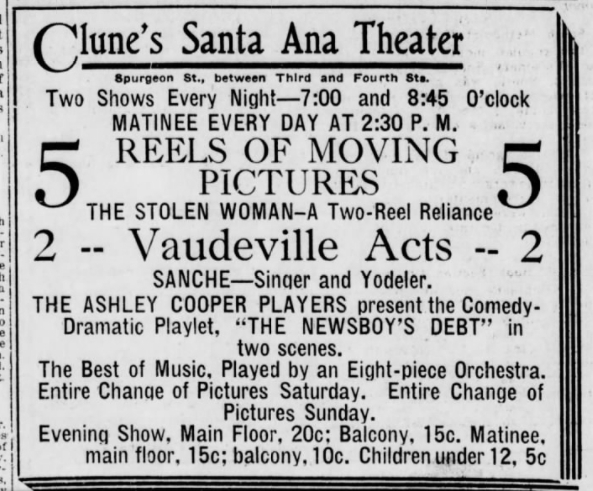
In mid 1913 the family left Vancouver for the US west coast again. The “Ashley Cooper Players” (comprising all three members of the family) then appeared in Los Angeles and subsequently on tour in the Western states of the US, their “playlet” or sketch – The Newsboy’s Debt, reportedly written by Emily (using the stage name Emily Curr), with Dulcie in the lead. Dulcie was “the real life of the sketch” according to The Vancouver Sun. It allowed her “ample chance to show her ability in character work and the touching scene at the final fall of the curtain finds many eyes in the house tear dimmed.” After some prominent publicity about Dulcie being “America’s youngest player,” she suddenly disappeared from all advertising – although the play continued to tour on and off until 1917.

As in Australia and on the US East coast, the age children could appear on the stage was increasingly regulated by education and civic authorities. Pollard’s Lilliputian Opera Company had discovered this ten years before, when they were forced to abandon plans to tour the US east coast because of the influence of New York’s Society for the Prevention of Cruelty to Children.

Above: Typical theater fare of the time. “Moving pictures” and vaudeville acts mixed in on the same program. Santa Ana Register. 30 October 1913. Via newspapers.com

In 1921 and by now aged 18, Dulcie appeared in half a dozen films, several with popular actress Clara Kimball Young. Young was struggling financially at this time, and appears not to have enjoyed making these films. Perhaps Dulcie didn’t either, as she soon abandoned film work for the stage again. In later years she seems to have been inclined to dismiss her outings in film, she was “at the awkward age” or “never felt at home in the movies” she variously explained. There was, again, familiar misleading publicity about Dulcie being “America’s youngest performer.” She was petite, and with her cherub like face she looked younger than her years, so it was believable.

Ashley Cooper also had some brief experiences in film in the early 1920s in supporting character roles – unfortunately most of these early films appear to be lost and details are confused. The Turner Classic Movie database provides the most accurate list – showing six credits for Ashley, while the IMDB lists only three. Norman Dawn‘s Son of the Wolf (1922) is one well documented example of a film that should be credited to Ashley Cooper rather than British actor Edward Cooper.

Ashley also continued on the stage in the mid 1920s, usually in vaudeville, while Emily Curr appears to have retired.

Ashley in PArtners of the Tide 1921  Dulcie Camera mag

Above: Ashley Cooper in Partners of the Tide (1921) Moving Picture World – Jan-Feb 1921. Right 20 year old Dulcie Cooper in 1923. Camera! April 1923-1924, Via Lantern Digital Media Project.

A glance at Dulcie’s stage work in Los Angeles at this time highlights just how intense a career on the stage was. In 1924-25 she appeared in a constantly changing, back-to-back program of light comedies and farces at the Majestic Theater, usually with Edward Everett Horton. These included The First Year (October 1924), The Darlings (December 1924), Just Married (January 1925), Outward Bound (February 1925), Cuckoo Pleases (March 1925), The Alarm Clock (March 1925) and Beggar on Horseback (April 1925). In May 1925 Dulcie left the company to have a well earned rest and to visit her parents in New York. Horton, who had made Beggar on Horseback as a film while also performing it on stage, also left at this time.

dulcie-la-times-1925 Horton and Cooper 1925

Above. Left: Dulcie in Just Married at Los Angeles’ Majestic Theater in early 1925. The Los Angeles Times, 18 Jan 1925, P131. Right: Edward Horton and Dulcie in Beggar on Horseback. The Los Angeles Times, 29 April 1925, P51. Via Newspapers.com

The reviews of these comedies were generally enthusiastic. “Clean wholesome entertainment” reported The Los Angeles Times on 23 November 1924. The paper went on to praise Dulcie’s “excellent acting and charming winsomness.” Barbara Cohen-Stratyner points out that Grace Kingsley, a journalist at the Times was an enthusiastic supporter of Dulcie. Even before Hollywood’s golden years, this support could make all the difference to a young actor’s career. Eight years later, the same journalist at the Times was announcing that Dulcie was about to sign a film contract at Paramount or MGM. She did appear in one sound film that survives, The Face on the Barroom Floor (1932) but no contract was signed.

In February 1925, Dulcie married Stafford Cherry Campbell, the stage manager at the Majestic Theater. For reasons now unknown, but perhaps just following a family tradition of changing names when it suited, Dulcie used the name Mary Robinson when she married. Within a few years the couple had divorced, Dulcie claiming, amongst other things, that Campbell ridiculed her when they rehearsed together.

At about this time, Ashley and Emily Cooper moved across to the US east coast. They owed this to Ashley’s part in the musical Topsy and Eva, which starred popular vaudeville players Rosetta and Vivian Duncan. A retelling of Uncle Tom’s Cabin, Ashley had a supporting role when it opened in December 1923 at the Majestic Theatre and was still in this role when it finally opened at the Sam H. Harris Theatre in New York a year later. Ashley and Emily settled in New York and he went on to develop his reputation as a reliable character actor, and sometimes a Stage Manager. He appeared in a string of plays on Broadway and in US east coast cities, including the drama Tobacco Road, a story of rural poverty in Georgia, where he played Henry Peabody as well as being stage manager for at least part of its run. It was not well received at first, the play being described by The Brooklyn Daily Eagle as “a picture of squalor… too realistic to be palatable.” However, it went on to a very long run and he was involved with it for at least the six years 1933-1939. He continued to be active on stage until well into the 1940s.

Ashley Cooper finally applied for US citizenship in 1941, having lived and worked in the US for more than 35 years. On these documents his various changes of name were revealed.

Above: Dulcie Cooper at the start of her New York career, in The Little Spitfire at the Cort Theater. Daily News (New York) · 26 Dec 1926, Page 154, via Newspapers.com

Dulcie’s 1926 breakthrough role on Broadway, as Gypsy the feisty chorus girl, in the comedy The Little Spitfire, was not easily won. As Barbara Cohen-Stratyner points out, she was the fourth and final choice for the role. But she made it a success. After its run in New York, she reprised the role for a season at the Hollywood Playhouse. The Los Angeles Times welcomed her back with generous coverage. She was in New York again in 1928, to take a leading role in Courage at the Ritz, now well and truly established as a leading player. She was active on stage into the early 1960s, her roles increasingly character parts and she also appeared occasionally on television. In July 1961, The Columbus Dispatch described her performance as the fortune teller in Blythe Spirit as a “scene stealer,” although she was performing alongside film star Zsa Zsa Gabor. Gabor took Dulcie’s hand for the curtain call, an acknowledgement of Dulcie’s skill and reputation.


Above: The Los Angeles Evening Post-Record advertises The Little Spitfire, 24 May 1927, P4. Via Newspapers.com

As previously noted, some of the commentary provided by Dulcie herself in later years only served to confuse her story, although this was not an uncommon phenomenon amongst actors of the era. Was she really in the 1934 film Men in White with Clark Gable and Myrna Loy? Dulcie also suggested she had appeared as a child star with Charles Ray in the 1910s. This claim is difficult to verify and given her known movements, seem unlikely.

Above: Dulcie Cooper still performing in 1957. The Wilmington Morning News,·(Wilmington, Delaware), 20 Jul 1957, P17. Via Newspapers.com.

Dulcie’s voice
Dulcie speaks with a nice trans-Atlantic accent here in The Face on the Barroom Floor (1932). The product of close association and performing with her parents? Perhaps elocution lessons? Another example of an acquired accent?

Source; Bill Sprague Collection – Internet Archive. This is a pre-Hollywood code film about the dangers of alcohol. The author thinks Dulcie is quite successful in this, her last film role.

Dulcie remarried in 1932. Her second husband was Elmer H Brown, an actor and director ten years her senior. Two sons were born of the union. She died in New York in 1981. Ashley Cooper kept working on stage for most of his life. He died in New York in January 1952. Emily Curr had died in New York in December 1944.


Nick Murphy
November 2020


Note 1
Cecil’s much younger sister Eileen Robinson (1896-1955) also acted, working in Australia, England and in the US. For a time she was married to US writer, stage and screen actor Alan Brooks (born Irving Hayward).

Note 2
An Australian dancer and beauty contest winner named Dulcie Cooper was a contemporary of this Dulcie. The song “Hello Miss Aussie, What are you doing now?” by Alfred Jarvis is about Dulcie Cooper the Australian dancer.

Special Thanks
Again to Jean Ritsema in the USA, who again assisted finding sources in the US.


Further Reading

  • Original US archival documents sourced from
  • Text
    • Hal Porter. Stars of Australian Stage and Screen (1965) Rigby
  • National Library of Australia’s Trove
    • The Daily Telegraph (Syd) 23 Nov, 1901, P2
    • The Sydney Mail & NSW Advertiser. 1 March 1902, P559
    • Everyones.Vol.6 No.367 (16 March 1927) P15
    • The Sydney Morning Herald, 18 Jan 1933, P12
    • The Australian Women’s Weekly, 29 Jul 1944 P 12
  • Newspapers.com
    • Enterprise News Record (Oregon) 23 July 1910, P3
    • Vancouver Daily World, 8 Aug 1911, P10
    • The Vancouver Sun, 8 July 1913, P5
    • The Paducah Sun-Democrat (Paducah, Kentucky), 6 Sep 1915, P 8
    • The Los Angeles Times, 3 Aug, 1921. P36
    • The Los Angeles Times, 6 Nov 1924· P 25
    • The Los Angeles Times, 23 Nov 1924, P69
    • The Los Angeles Times, 28 Dec 1924, P52
    • Los Angeles Evening Post, 14 Mar 1925, P10
    • The Los Angeles Times, 29 Apr 1925, P51
    • The Los Angeles Times, 22 May 1925, P25
    • Daily News (New York) · 26 Dec 1926, P154
    • The Los Angeles Times, 15 May 1927, P56
    • The Los Angeles Times, 24 May 1927, P35
    • Los Angeles Evening Post-Record, 15 Jul 1930, P16
    • The Los Angeles Times, 24 May 1932, P7
    • The Brooklyn Daily Eagle 5 Dec 1933 P 24
    • The Daily News (New York) 5 Jan 1952, P23
    • The Wilmington Morning News,·(Wilmington, Delaware), 20 Jul 1957, P17

This site has been selected for preservation in the National Library of Australia’s Pandora archive

Nancy O’Neil (1907-1995)

“Am I Irish? Well, with a name like mine I suppose I ought to be. But I’m a true-blue Australian really, for I was born in Australia and so were my parents.” (Journalist Leslie Rees – January 1934. See Note 1)


The five second version
Born in 1907 as Nancy Muriel Smith, she was another member of the great wave of enthusiastic young Australian women who arrived in London between the wars determined to pursue an acting career. She studied at RADA and built a successful career on the West End and in British films in the 1930s. She then returned to supporting roles in film later in life. Her younger sisters Barbara Smith (born 1911) and Lorraine Smith (born 1915) also pursued acting careers in the UK and Australia. Nancy died in England in 1995.

Nancy Muriel Smith had good reason to choose a different name for stage use – not only was the surname “Smith” not all that memorable for an aspiring actor, but she almost certainly wanted to establish credentials of her own. This was particularly so given who her family were. Her father was noted Sydney physician Stewart Arthur Smith (1880-1961), her uncle was Professor of Anatomy and anthropologist Grafton Elliot Smith (1871-1937) while her third uncle, Stephen Henry Smith (1865-1943), was the Director of Education in New South Wales. They were a formidable trio – and regularly attracted public attention as part of their work – Grafton was knighted in 1934, about the time Nancy was making herself known in Britain. Nancy’s mother, Muriel nee Pitt was a wealthy wool broker’s daughter. It was Muriel particularly who was to be the forceful advocate for Nancy’s interest in the stage, and that of her two younger sisters – Barbara and Lorraine.

Born in Sydney on 25 August 1907, Nancy attended Sydney Church of England Girls’ Grammar School from 1921-1925. She may have appeared in some amateur theatre in Sydney, but it seems her eyes were firmly on gaining overseas training and experience – and a trip to Britain and North America with her parents in 1927 probably encouraged her interest in acting. In October 1928 she returned to England with Muriel to study at London’s Royal Academy of Dramatic Arts. Extended study at RADA was unusual for Australians in the midst of the Depression, but the family’s resources made a difference. However, Nancy’s pathway to success on the very competitive London stage was as challenging for her as it was for most young Australians – it took five years of hard work before she gained public recognition in early 1934.

Above: 15 year old Nancy Smith at Sydney Church of England Girls Grammar School in 1922, sitting front row, third from the right. In her final year (1925) Nancy was captain of the “A” Tennis Team and a Probationary Prefect. Photograph from the Doreen Higgins collection, used with kind permission of SCEGGS Darlinghurst.

Nancy’s name first appeared in reviews when Somerset Maugham’s The Breadwinner toured English provinces in mid 1931, under the management of theatre impresario Barry O’Brien. It was not uncommon for young actors to understudy roles in London and then take the lead when the play went on tour. This also appears to have been Nancy’s experience – the play had opened in London in September 1930. She also understudied for Winifred Shotter in Ben Travers‘ farce, Turkey Time at the Aldwych Theatre in 1931. And then, only a few months later, the society pages of Australian newspapers announced Nancy’s engagement to Cyril Kleinwort, one of the sons of English merchant banker Sir Alexander Kleinwort. She had met Kleinwort in 1927, whilst crossing the Atlantic with her parents on their way home to Australia. However, Nancy returned to Australia in February 1932, apparently needing to recover from an unspecified illness, or perhaps to escape the engagement. Either way, the romance seems to have petered out. Kleinwort was not mentioned again.

Above: Nancy in Harrison Owen’s Dr Pygmalion with Margaret Rawlings. The Australasian, 3 Sept 1932, via the National Library of Australia’s Trove.

While at home in 1932, she finally appeared professionally in a leading role on the Australian stage – in The Kingdom of God in Sydney, followed by Dr Pygmalion – where she performed with touring British actress Margaret Rawlings in Melbourne. The reviews were very positive and working with Rawlings invaluable – “spade work for the future” she once described such experiences.

In London again in early 1933, she was cast in her first film – Jack Ahoy with comedian Jack Hulbert, for Gainsborough Pictures. Hulbert approved her casting personally, according to journalist Leslie Rees. The film was popular and she was singled out for praise in her ingénue role as the Admiral’s daughter. It was a great breakthrough. Soon after, she was cast in her first lead in a West End play – Man Proposes. It ran at Wyndham’s Theatre for only two weeks in late 1933, but these successes were enough to ensure she was well and truly established. At last, reviewers were seeing beyond her appearance – her petite size (she was 5 feet or 152 cms tall), her “dimpled cheeks and glossy black hair.”

 Jack Ahoy AWW 1934 Nancy on a Lux soap card 1933-4

Left: Nancy and Jack Hulbert in Jack Ahoy (1934) The Australian Women’s Weekly, 30 June, 1934, via the National Library of Australia’s Trove. Right: Nancy on a Lux Soap Famous Film Stars card, c1933-4. Author’s Collection.

Above: This grainy image shows most of the Smith family together in London’s Hyde Park. Nancy O’Neil, Muriel, Stewart and Lorraine Smith. Lorraine had recently arrived to pursue an acting career, following two films in Australia. (See below) The Daily News (WA) 30 Oct 1935. Via National Library of Australia’s Trove.

Not everything she tried was as successful as Jack Ahoy of course. The Secret of the Loch, also made in 1934, concerned what The Bystander called “the Loch Ness problem.” (The problem being the monster – at that time the subject of some publicity). Even for the time, it must have been seen as a silly film. However, watching some of Nancy’s other films today we can see why she was a popular young star. There was a vibrancy to her performances and she was very much at ease before the camera. And she was versatile enough to appear in light comedy, musicals and thrillers. The musical comedy Brewster’s Millions, made in 1935, where Nancy played the ingénue for Jack Buchanan‘s character, was another success.

Above: Ian Hunter (left) and Nancy O’Neil (right) in Michael Powell’s entertaining “quota quickie” comedy Something Always Happens (1934) Screengrab from copy in the author’s collection.

Above – Nancy’s voice from the scene shown above. If she ever had vestiges of a colonial accent, her years in England, including two years at RADA, resulted in a voice identical to that of every other young Australian then working in Britain – and indistinguishable from everyone else. 

Above: Nancy O’Neil in the thriller Headline (1943). Although she is holding the gun she is about to get shot! Screengrab from copy in the author’s collection.

Nancy made at least 18 films in the 1930s, but for a time, the stage remained her priority. Soon after the success of Jack Ahoy she took the role of Blanche in Vintage Wine at Daly’s Theatre, for most of its May to December 1934 run. She then appeared in Someone at the Door at the Comedy Theatre, another play that enjoyed a long run and good reviews.

In early 1938 Nancy quietly married someone completely unconnected with stage and screen – Dermot Trench, a chartered accountant. The press missed the event, or were not informed. A son was born of the union in 1941 and a daughter in 1944. Nancy continued to appear in supporting roles on the stage again in the 1940s and early 1950s, and occasionally returned to film. For example, she appeared as the Town Clerk’s wife in Charles Crichton‘s highly regarded comedy about eccentric small town English life, The Titfield Thunderbolt, made in 1953.

Nancy died in London aged 88, on 5 March 1995. Denis Gifford’s 1995 obituary for Nancy in The Observer describes her British films as “cheap and cheerful,” and these may indeed be her surviving legacy, as they were for other Australians of the era – Lucille Lisle and Judy Kelly.  


Lorraine & Barbara’s careers

Lorraine

Above left: John D’Arcy and Lorraine Smith in Strike Me Lucky. “Everyone’s” 19 Sept 1934, (Vol.14 No.760). Via the National Library of Australia’s Trove. Right: Barbara Smith in Melbourne in 1938. Photo by Jack Cato, courtesy Libby White.

Lorraine Smith appeared on stage in Australia and in two local films – Harry Southwell’s When the Kelly’s Rode (1934) and Ken Hall’s Strike Me Lucky (1934). And a year later, as Lorraine Grey, she appeared in just one British film, Sexton Blake and the Mademoiselle (1935). Publicity of the time suggested a much more fulsome career, but following this she apparently gave up acting. (The IMDB currently confuses Lorraine Smith’s career with several others).

Taking an interest in the stage after finishing school in 1928, Barbara Smith also attended RADA in 1933-34, and appeared on repertory company tours in England. However she left London in 1935 and returned to a career on radio and the stage in Australia – performing to the mid 1940s. This writer is unable to verify the claim she appeared in British films. She married Australian actor Lloyd Lamble in 1945, but the couple divorced soon after.


Note 1
West Australian novelist and journalist Leslie Rees enthusiastically documented the successes of Australian actresses in London in the 1930s, where he also reviewed drama for “The Era”. See also his article “Antipo-deities: How Australian Girls have captured British Stage and Screen” in “The Era”, April 4, 1934.

Note 2
US actor Nance O’Neil (1874 – 1965) apparently pronounced her first name as “Nancy,” hence there has sometimes been confusion between the two women.


Nick Murphy
November 2020


References

Thanks:

  • Patsy Trench, Nancy O’Neil’s daughter, for her assistance and encouragement. Her website is here.
  • Libby White, daughter of Barbara Smith and Lloyd Lamble, for her assistance and encouragement.
  • Prue Heath, Archivist, SCEGGS Darlinghurst.

Text:

  • Ross Pike and Andrew Cooper (1980) Australian Film 1900-1977. Oxford University Press.
  • Michael Powell (1987) A Life in Movies. Alfred A Knopf
  • J. P. Wearing (2014) The London Stage 1930-1939: A Calendar of Productions, Performers, and Personnel. Rowman and Littlefield
  • Angela Woollacott, (2001). To try her fortune in London. Australian women, Colonialism and Modernity. Oxford University Press

Web:

  • National Library of Australia’s Trove
    • Evening News (NSW) 29 Nov 1927, P14
    • The Sun (NSW) 7 Oct 1928, P4
    • The Australasian 17 October 1931 P11
    • The Herald (Vic) 29 Feb 1932 P14
    • The Sun (NSW) 3 Mar 1932, P25
    • The Herald (Vic) 16 Aug 1932, P14
    • The Herald (Vic) 22 Aug 1932, P10
    • The Australasian 3 Sept 1932
    • The Truth (NSW) 17 Dec 1933 P21
    • Western Mail (WA), 18 Jan 1934 P29
    • Everyone’s 24 Jan 1934 P11
    • The Herald (Vic) 19 April 1934, P30
    • The Sun (NSW) 29 April 1934, P11
    • The Sydney Morning Herald 24 May 1934
    • News (SA) 17 July 1934, P6
    • Labor Daily (NSW) 2 Aug 1934 P 10
    • The Sun, (NSW) 28 Oct 1935, P1
    • Advertiser (SA) 30 Oct 1935, P12
    • Mirror (WA), 30 Nov 1935, P 20
    • The Bulletin Vol. 56 No. 2910 (20 Nov 1935)
    • The Sun (NSW) 1 Dec 1935., P 26
    • Australian Women’s Weekly 8 May 1937 P54
    • Daily Telegraph (NSW), 25 May 1938, page 9
    • Barrier Miner (NSW) 25 Jan 1947, P3
  • British Library Newspaper Archive
    • The Stage 27 Aug 1931, P18
    • The Sketch 28 Feb 1932, P384
    • The Era 6 Dec 1933, P6
    • The Era 6 April 1934, P3
    • The Bystander 8 May 1934, P 256
    • The Daily Mail 28 May, 1934 P26

This site has been selected for archiving and preservation in the National Library of Australia’s Pandora archive

Lucille Lisle (1908 – 2004)

Above; Lucille Lisle. The Australian Women’s Weekly, 4 June, 1938. Via National Library of Australia’s Trove.

The five second version
Lucille Lisle was born Lucille Hunter Jonas in Melbourne, Australia on 16 May 1908. She first appeared on stage in Australia at the age of about 11. From 1930-32 she performed on Broadway and in 1932 moved to Britain. She appeared in two Australian and about ten British films, but the stage remained her preference and the West End was where she experienced her greatest successes. She worked in radio in the 1940s before retiring. She died in Kent, England on 23 September 2004.

Lucille Lisle in 1938, at the height of her British stage and screen career. The Age (Melbourne) 16 July 1938. Via National Library of Australia’s Trove..

The oft repeated story that 21 year old Australian actress Lucille Lisle had to abandon ship at night and then help bail out a leaky lifeboat was actually true. It is one of those rare occasions when an entertaining story about an actor has a solid basis in fact. Lucille was one of 18 performers in Wyrley Birch‘s American Comedy Company, travelling on the 4500 ton ship Manuka en-route from Melbourne to Dunedin, New Zealand. In thick fog on the night of 16 December 1929, the ship ran into a reef near Long Point, and became a total wreck. All 250 passengers and crew were saved but their personal belongings and the cargo, (including the company’s scenery and costumes) were lost. But new scenery was rushed to New Zealand from Sydney, and in the best antipodean tradition, the people of Dunedin donated clothes. The show must go on.

She was born Lucille Hunter Jonas in Richmond, a suburb of Melbourne, Australia on 16 May, 1908, the only child of David Henry Jonas and Caroline nee Hunter. From an early age, the family lived in Sydney where her father was a company manager. Caroline, or Cissie Hunter, was an actor herself, well known from her time touring in the 1900s with the John F Sheridan company. Lucille attended Sydney’s Sacred Heart Convent, Kincoppal, although for how long seems unclear. From a very early age, she was also appearing on the stage, with the consistent encouragement and support of her mother Caroline. For at least some time in the early 1920s Lucille was also a pupil of Miss Mary MacNichol, a Sydney elocutionist and drama teacher. At the same time she was appearing in pantomimes and charity events, in company with the likes of Ena Gregory and Esma Cannon.

A very young Lucille being used to advertise the services of a children’s nursery in Sydney. The Theatre Magazine, 1 October 1914, P10. Via State Library of Victoria

“Give your children Heenzo” Lucille’s mother was responsible for her appearance in this advertisment for a cold and flu preparation, and she also provided a testimonial. Sunday Times (Sydney) 9 May 1920. Via National Library of Australia’s Trove.

In 1924 Lucille, now using the stage name Lucille Lisle, was lucky enough to be cast by filmmaker Beaumont Smith for a part in Hullo Marmaduke, a (now lost) “funny pommy in Australia” film, starring established English comedian Claude Dampier. She was also in a role in F. Stuart-Whyte‘s Painted Daughters, a sophisticated and successful film described by Ross Pike and Andrew Cooper as “a romantic melodrama about high society and the flapper generation” – segments of this film still exist. Aged only 16, Lucille Lisle was developing an impressive acting career.

Above: Lucille (left) as a Tivoli chorus girl. Table Talk. 5 November 1925. Via the National Library of Australia’s Trove.

Although there were no more films for her in Australia, for the next five years Lucille was never out of stage work and her public profile in Australia steadily rose. Her second lead role in J.C. Williamson’s pantomime Aladdin was followed by a supporting role in the popular new American farce Cradle Snatchers. She also earned praise for having taken on a role in the play Old English with very little notice, in October 1926. Enthusiastic Australian journalists called her “Australia’s Mary Pickford,” although the same description was regularly applied to other young women, including Mary Maguire. She was in enough demand to gain work alongside a wide variety of actors, including contemporary song and dance man Fred Conyngham and visiting US actor Noel (Nat) Madison. Ten years later she would appear in the British film The Melody Maker with Fred.

At the same time, as Theatre historian Frank Van Straten notes, the arrival of talkies in Australia in Christmas 1928 had a dramatic impact on live theatre – it would never be the same again. So Lucille’s place with the popular Wyrley Birch company, touring Australia and New Zealand (with a repertoire of new plays) in early 1929 was probably her own response to the uncertainty of working in theatre in the Great Depression. But then, in May 1930, despite the trauma of the adventure on the Manuka, Lucille and her mother departed for the US on the SS Sonoma.

Lucille Lisle in 1927, while appearing in Cradle Snatchers with Fred Conyngham and Molly Fisher. From Table Talk, 22 Sept, 1927. Via National Library of Australia’s Trove.

After visiting Noel Madison in Hollywood, Lucille and Caroline headed for New York, posting updates home along the way, for the benefit of Australian newspapers. With extraordinary good fortune, she quickly gained a role in Stepdaughters of War and she was then continuously performing on the US east coast. In early 1931 she joined G.P. Huntley Junior and Jane Cowl in the comedy Art and Mrs Bottle, for a tour of the US and Canadian east coast cities. In her 18 months in New York she also took roles in A Widow in Green and A Night of Barrie. She wrote to the Sydney Sun newspaper that she loved New York, although it was expensive. And she also cautioned interested Australian girls – they should always have “lots of money, and your fare back home, paid in advance.” But money was something Lucille and her mother didn’t seem to have to worry about, because in July 1932 she packed up and moved on to London and again, quickly found work.

It was not uncommon for Australian newspapers of the 1930s to provide readers with long lists of Australian actors now working successfully in Britain and Lucille was soon prominent amongst these. The lists were not always very accurate – as they regularly included New Zealanders, or others who had really only spent a short part of their life in Australia, or in the case of Merle Oberon, none of their life at all. It made for great reading all the same, and in an era of emerging Australian national icons (think racehorse Phar Lap and cricketer Don Bradman), these success stories resonated with audiences. And there is evidence that at least a few actors – like Molly Fisher, Fred Conyngham, Judy Kelly and John Wood – felt some sense of being an Australian rather than simply a member of the greater British Empire. But much of the film work listed for this group was in underwhelming “quota films” – and this was also to be Lucille’s first acting experience in Britain.

Above; Lucille Lisle. The Australian Women’s Weekly, 4 June, 1938. Via National Library of Australia’s Trove.

Quota films or “quota quickies” were a result of the 1927 Cinematograph Film Act – designed to protect the British film industry by forcing the big, mostly US owned distribution companies to subsidise the production of British films. Interviewed by Brian McFarlane years later, British filmmaker Freddie Francis insisted quota films were shown to the cinema cleaners in the mornings, thus easily and cynically fulfilling the legal obligations of the quota! Cheaply and quickly made, most ended up as “second” or supporting features or B films, although there is now a body of literature reappraising the era of quota films.

Lucille’s role in Fox’s After Dark, directed by Al Parker, was announced only 6 weeks after her arrival in Britain. Like so many of these films, it was adapted from a play, but at only 45 minutes in length, it did not sustain a coherent or memorable plot. It concerned a jewel theft followed by a denouement in a (very restrained) un-spooky house. Contemporary British film reviews tended to praise all local film content, but in far off Australia, the Sydney Morning Herald felt it could truthfully critique Expert’s Opinion, Lucille’s second British quota film. It was dismissed as “a quickie of very ordinary pretensions… The direction is indifferent and [the] actors…do not impress on the screen. Australian Lucille Lisle is equally uninteresting.”

There could not have been a starker contrast between the few films she appeared in and her stage work. Although she was never interviewed about her work, it is likely that Lucille realised her career would not be made in quota films. By the end of 1932 she was understudying the role of Stella Hallam in Rose Franklin‘s play Another Language, “a first rate tragi-comedy” at the Lyric Theatre. She then played the role while it toured England. By May 1933 she had a leading role in Emlyn Williams‘ satire The Late Christopher Bean, which opened at St James’s Theatre in May. This role established her as a young actor of note and ability on the London stage. The cast also included Cedric Hardwicke, Barry K Barnes and Edith Evans. The show ran for 487 performances, a record for that theatre, with Spectator magazine praising it as “a brilliant comedy”.

Above: Lucille (right) with some of the leading players of The Late Christopher Bean. The Stage 18 May 1933. Copyright The Stage Media. Via The British Library Newspaper Archive.

As one would expect, there were hits and misses on stage too. In early 1935 she appeared at the Phoenix Theatre in A Knight in Vienna, a play about a young man’s romantic adventures in Vienna, written by an Australian, Archie N. Menzies. After one performance, it was banned by the Lord Chamberlain, for reasons we can only guess today. Ole George Comes to Tea saw three performances, Sexes and Sevens also only three performances (the Times newspaper described the latter as “feeble even in its own kind” ). There was an interesting variety of topical contexts in some of her plays – Juggernaut at the Aldwyth Theatre in early 1939 dealt with Jews living in contemporary Vienna. But popular comedies were clearly preferred by pre-war British audiences. Anthony and Anna ran for over 700 performances at the Whitehall Theatre and for much of it Lucille took the leading part of Anna.

Above: Lucille Lisle in 1935, at the time she was appearing in Anthony and Anna at the Whitehall Theatre. Program in the author’s collection.

In 1942, Lucille married an officer in the Royal Navy Reserve, Lieutenant Nicholas Harris, the youngest son of Sir Percy Harris, deputy leader of the British parliamentary Liberal Party. A son was born of the union in 1943. During the war years, Lucille’s performances were confined to radio drama, in adaptations of popular works like The Ghost and Mrs Muir. Her last performances were in the early 1950s and may have included some television, but this is difficult to verify as so much early TV was not recorded. She had, by this time, been performing for almost 35 years.

In later years Nicholas and Lucille lived in Kent. Nicholas Harris was an art collector with a particular interest in traditional Chinese paintings and Lucille seems to have shared these interests. She never returned to Australia – both her parents having relocated to England to be near her. She died in Kent in 2004.

Not all Australians who tried their luck in 1930s Britain stayed on. Lucille’s contemporaries, Fred Conyngham and Molly Fisher, returned to Sydney, Australia in early 1948 and pursued non-theatrical interests. Fred became a quality-control inspector.


Nick Murphy
24 October 2020


Further Reading

Web

Text

  • Ray Edmondson and Andrew Pike (1982) Australia’s Lost Films. National Library of Australia.
  • Brian McFarlane (1997) An Autobiography of British Cinema. Methuen
  • Robert Murphy (Ed)(2009) The British Cinema Book. 3rd Edition. BFI/Palgrave Macmillian
  • Ross Pike and Andrew Cooper (1980) Australian Film 1900-1977. Oxford University Press.
  • Matthew Sweet (2006) Shepperton Babylon. Faber and Faber
  • Frank Van Straten (2003) Tivoli. Thomas Lothian
  • J. P. Wearing (2014) The London Stage 1930-1939: A Calendar of Productions, Performers, and Personnel. Rowman and Littlefield.

State Library of Victoria

  • The Theatre Magazine, 1 October 1914, P10

National Library of Australia’s Trove

  • Sunday Times (Syd) 6 Mar 1904
  • The Australian Star (Syd) 17 June 1905
  • Townsville Daily Bulletin, 6 July 1907
  • The Bulletin, 11 Sept 1919, Vol 40, Issue 2065
  • Sunday Times (Syd) 5 October 1919
  • Everyone’s 28 Feb 1923, Vol 3 No 156
  • Table Talk, 5 Nov 1925
  • Table Talk, 12 Nov 1925
  • Table Talk, 4 Feb 1926
  • Table Talk, 22 Sept 1927
  • Sydney Mail, 5 Oct 1927
  • Advocate (Melb) 11 Oct 1928
  • Sun (Syd) 26 Mar, 1929
  • Truth (Bris) 22 Sept 1929
  • Daily News (Perth) 4 Nov 1929
  • Sun (Syd) 27 Dec 1929
  • Table Talk, 1 May 1930
  • The Sydney Morning Herald, 17 May 1930
  • Sun (Syd) 24 Aug, 1930
  • Sun (Syd) 12 Oct 1930
  • Sun (Syd) 28 Dec 1930
  • Smith’s Weekly 15 October 1932
  • The Herald (Melb) 27 Feb 1933
  • Examiner (Tas) 22 Sept. 1937
  • The Age (Melb), 16 Apr 1938
  • The Australian Women’s Weekly, 4 June 1938
  • The Sydney Morning Herald, 5 Sept 1938
  • The Daily News (Perth) 2 Nov 1938
  • Table Talk, 12 Jan, 1939
  • The Herald (Melb) 25 Mar 1942
  • The Sun (Syd) 27 June, 1942

Papers Past

  • Christchurch Cargo, 18 Dec 1929. Vol LXV, Issue 19805
  • Hawera Star, 6 Jan 1932, Vol LI
  • Nelson evening Mail, 5 Sept 1934, Vol LXVI,
  • Evening Post, 9 April 1943 Vol CXXXV, Issue 84
  • Hutt News, 28 May 1947, Vol 20, Issue 47

British Library Newspaper project

  • The Era, Wednesday 14 September 1932
  • The Stage, 18 May 1933
  • The Tatler, 31 May 1933.
  • Eastbourne Gazette, 3 Jan 1940
  • Hartlepool Northern Daily Mail, 2 Dec 1940
  • Eastbourne Gazette, 3 Jan 1940
  • Dundee Evening Telegraph, 28 Feb 1942
  • Dundee Evening Telegraph, 28 Feb 1942
  • The Tatler and Bystander, 1 April 1942
  • The Stage, 11 Jan 1951

This site has been selected for archiving and preservation in the National Library of Australia’s Pandora archive

Elsie Mackay (1893-1963) – The Pilbara, Lionel Atwill & Max Montesole

Main: A photo of part of outer Roebourne from the top of Mount Welcome, 11 June, 2019. Author Samwilson/photography, via Wikimedia Commons. The original is here. Shared under a Creative Commons Attribution-Share Alike 2.0 Generic license. Enlargement of Elsie Mackay from Theatre Magazine (US), Vol 33, P333, 1921. Photo credited to Nickolas Muray. Via the Hathitrust.

The five second version
Between 1913 and 1925 Elsie Mackay appeared on the London and US stages with great success. Born in remote Roebourne, Western Australia in 1893, she was the daughter of a wealthy pastoralist. She is most famous now for abandoning her marriage to Lionel Atwill in late 1925, a decision that seems to have side-tracked her career for good. She returned to Australia with her second husband in December 1933 and continued to perform on radio and the stage. She died in Hawthorn, Victoria Australia in 1963. She made one US film in 1920.

West Australian born Elsie Mackay was unusual for her time, in that she narrated a short and reasonably frank article to journalist Walter James regarding her life. It appeared in the literary magazine Southerly, in 1950, 16 years after her return to Australia. She was revealed as modest, witty, and unusually honest in recounting her professional successes. Hers was not a long acting career, but it was successful and she met and mixed with some of the theatre world’s best between 1913 and 1925.

Elsie Mackay posing uncomfortably in front of a ship’s crew. Enlarged from a photo in the Library of Congress Bain News Service collection. (She is mistakenly recorded as Elsa). Taken while Elsie was performing with Herbert Tree, c 1916.

A girl from Roebourne

Born in the town of Roebourne (now part of Karratha) on the north-west coast of Western Australia on 20 February 1893, Elsie Gertrude Mackay was the oldest of three children born to Samuel Peter Mackay and Florence nee Taylor. To the casual observer today, this area appears to be unproductive dry scrub country. However, it continues to be an area of great mineral wealth, pastoral interests and is traditional home to the Ngarluma people. In the nineteenth century it was an important civic centre between Perth and Darwin, servicing the pearling and pastoral industries and the nearby goldfields. Elsie’s father Sam Mackay held the pastoral lease for a huge and remote area of land that was named Mundabullangana Station, about 100 kilometres from the town. Exactly how the Mackays amassed their fortune was alluded to in his 1923 obituary – he was an extremely wealthy land owner and keen race horse breeder by the time of his death. Australians would call him a Squatter.

Roebourne, c1909. The horse tram connected the town to the nearby port of Cossack. The Victoria Hotel building is still standing. State Library of Western Australia Image number 008282PD.

Elsie spent some of her infancy at the very solid but modest homestead at Mundabullangana, which she later fancifully described as “the backwoods” of North-west Australia. I really passed a very uneventful childhood… I must say that I was never kidnapped by bushrangers or anything of that sort” she told a journalist. (See Note 1 below)

She later attended the Queen’s School, a girl’s school in inner city Perth, 1500 kilometres to the south. It was run by a Miss Ethel Simpson and despite its grand title, carried on in her two-story home in Mount Street, surrounded by large houses built for affluent families. Attended by only about 30 students, most of whom were borders, the school specialised in developing a girl’s passion for the arts, music and languages. Newspaper reports of prizes awarded show Elsie was particularly successful at French. The school closed in 1916 and most of the students were absorbed by PLC Perth, but young Elsie had left in 1908 – to attend a finishing school in Lausanne, Switzerland, run by a Mademoiselle Reuy. The contrast between Switzerland and the red earth of the Pilbara region could not have been more dramatic.

This appears to be an early photo of Elsie, and was used in The Sun (Sydney), 5 June 1921 to celebrate her ongoing success in the US. Via the National Library of Australia.

While Elsie was studying in Europe, Sam and Florence moved to Victoria, where their son Keith was attending Melbourne Grammar school. They had several properties in Victoria – they built a large home in Berwick, east of Melbourne (while also maintaining a home in central Melbourne’s St Kilda) but kept their significant property interests in Western Australia. However the comfort brought by their considerable wealth and social position did not avoid a collapse in their marriage. Elsie recalled that her parents quarrelled constantly. In 1910 they finally divorced acrimoniously and very publicly. Only a few months later, Sam Mackay married British actress “Fanny Dango,” and honeymooning in Europe, they collected Elsie to join them.

Elsie Mackay’s step-mother Fanny Dango while in The Girls of Gottenburg, in Melbourne Australia. The Theatre Magazine 2 Jan 1908. Via State Library of Victoria.

An English stage career, 1912-1915

After a short sojourn back in Australia, Elsie arrived in England on the SS Morea in late 1912, ready to start her career – her dream had always been to act. Her entree to the British stage was at least partly due to the good connections of her step-mother. Fanny Dango was really one of five Rudge sisters who had all gone on the stage – their equally colourful stage names being Letty Lind, Millie Hylton, Adelaide Astor and Lydia Flopp. In addition, Adelaide, (real name Elizabeth Rudge), was married to actor – manager George Grossmith Junior, another important connection into the London theatre world. Fanny was, Elsie recalled, a kind step mother, who helped overcome her father’s objections to a life on the stage.

Elsie’s first stage experiences were in The Girl on the Film at the Gaiety Theatre in 1913 – when she had just two words to say, followed by two lines in After the Girl. Her breakthrough role came in 1914, when she understudied Mrs Patrick Campbell as Eliza, in Pygmalion, opposite Sir Herbert Tree as Henry Higgins. The play was well received in London and Elsie’s work heralded as a success whenever Mrs Campbell was indisposed. Elsie said that she had to audition for the part in front of George Bernard Shaw himself, and Tree. She “was rather nervous” she admitted – which was hardly surprising – these two were leading figures in the British theatre world. She later claimed Shaw asked where she had picked up her perfect cockney accent. “I am an Australian!” she answered. (That seemed to explain it). Following some study at RADA, she brought “charm and tact” to a leading role in Grumpy at the Savoy – (“Grumpy” played by Cyril Maude, being an old criminal lawyer who solves a diamond robbery). Elsie was now established.

Cyril Maude and Elsie Mackay performing Grumpy, 19 September 1915, New York Times. Via Newspapers.com

Performing in the US, 1915+

Elsie briefly returned to Australia in 1915 – money for travel was never an issue for her, and then she headed to the US, to join Cyril Maude in a tour of Grumpy. Following this, she was re-engaged by Herbert Tree to tour in the US playing in Henry VIII and The Merry Wives of Windsor. Over the next few years, her busy US career brought her in contact with numerous well known actors, including George Arliss and Lionel Atwill.

Left: Lionel Atwill, The Theatre Magazine, 1 December 1910. Via State Library of Victoria. Right Daily Register, New Jersey, 12 June 1918. Via Newspapers.com

Not all of her plays were hits. Her first performance with Lionel Atwill was Another Man’s Shoes in June 1918 at New Jersey’s Broadway Theatre. It lasted only twenty performances in New York in September 1918. But Clarence, a light American family comedy about a handyman who enters the neurotic Wheeler family circle, written by popular US author Booth Tarkington, ran for nine months at New York’s Hudson Theatre in 1919-1920.

Above: The play Clarence, with Elsie playing the Wheeler family’s governess. Illustrated in the New York Herald 16 Nov 1919. Via Newspapers.com

Enter Lionel Atwill, 1918

Lionel Atwill would become an important figure in Elsie’s life – albeit relatively briefly. They apparently met in 1918, in rehearsals for Another Man’s Shoes. We can only guess as to what attracted the couple to each other. At 27, Elsie had a reputation for knowing her own mind. 33 year old Atwill was a talented and extremely popular actor, having arrived in the US in 1915. One newspaper syndicate report even described him as “the young man American women choose for the Prince Charming of their dreams.” (The Independent Record, Helena, Montana, 2 May 1926) However, Atwill had married fellow actor Phyllis Relph in England on 19 April 1913 and they had a son. He did not defend himself in court when Phyllis launched divorce proceedings because his affections had strayed to Elsie. Phyllis won custody of their son John and ongoing child support. Meanwhile, as soon as they could, Elsie and Lionel married on 7 February 1920, in Chicago. Fortunately, Elsie was not named in the divorce proceedings.

Another change occurred at about the same time – when her first (and apparently only) film Nothing But the Truth was released. Perhaps Lionel encouraged her to do this – he had already appeared in several films himself. Unfortunately, her experience was not very successful. Motion Picture News of Jan-Feb 1920 noted it was her first film but reported that she “does not register…a screen personality. She appeared somewhat camera conscious…and did not photograph well.” (See Note 2 below)

Lionel and Elsie performed together in a number of plays with much greater success, including David Belasco’s production of Deburau – a telling of the nineteenth century French mime that ran for six months at the Belasco Theatre, famously moving audiences to tears in the final act.

Elsie and Lionel performing together. Left in Deburau, Dayton Daily News, 22 Mar, 1921. Right, in The Comedian. Daily News, (New York), 25 March 1923. Via Newspapers.com

In July 1922 Elsie returned briefly to Australia again. Her father Sam was extremely unwell – one of his legs had been amputated and he was struggling to recover. She was back in the US in September having given no statements to the Australian press. Sadly Sam did not recover, he died in May 1923, leaving a large estate – Elsie being one of the beneficiaries. Tragically, her younger brother Keith was killed in an aircraft accident only 14 months later. This left Elsie with only one step – sibling; Peter, the son of Sam and Fanny, born in 1911.

Enter Max Montesole

Above: The Inglenook. Lionel and Elsie’s home on Long Island. Theatre Magazine, Vol 33, Jan -June 1921. Via the HathiTrust Digital Library.

Of Lionel and Elsie’s life together we know little, except that they lived together in a mansion called “The Inglenook” at Douglaston on Long Island. Elsie told Walter James about the grand weekend house parties and the bootleg liquor she and Lionel bought. So what went wrong with the marriage? Unfortunately Atwill’s reputation has been so tarnished by a sensational 1942-3 court case, and coloured by his later career in Hollywood specialising in mad doctors and unsympathetic noblemen, that one might easily conjure up all sorts of reasons for the failure the marriage. It might be that they were never suited.

Newspaper accounts show that sometime in mid 1925 Elsie began rehearsals on the play, The New Gallantry. Amongst the cast was Max Montesole, a 38 year old English actor and director. Atwill seems to have been responsible for the later suggestion Montesole was an “unknown” actor at the time, but nothing was further from the truth. Max Montesole had been active on stage for over twenty years, was a Shakespearean specialist, had experience with the likes of Herbert Tree and Ellen Terry and had arrived in the US in 1911. Like Elsie he had dabbled briefly in film but the New York stage was obviously his preference. He had seen wartime service in the Canadian army and later the Royal Flying Corps. But he was also a complex man – he had three marriages and several children to his name by the time he met Elsie, the most recent marriage being to New York actress Mary Fowler in May 1923. In her 1950 narrative with Walter James, all Elsie could say was that within a few minutes of meeting Max, she knew her marriage to Lionel Atwill was over. “He and I were predestined” she said. Both Elsie and Max were confronted by their spouses. Elsie indignantly denied any impropriety and publicly announced she would challenge Atwill’s impending suit.

In mid December 1925, Max and Elsie packed up and left for England together on the SS Samaria, departing through Boston to draw less attention. (She needed to be in England to attend to estate matters, anyway, she said). But for the next two years, US newspapers ran endless stories of the scandal, often full page – with such unusually accurate information they could only have been fed by the deeply aggrieved Lionel Atwill or Mary Fowler.

Elsie and Max Montesole on the Samaria. The Daily News (New York) 1 Jan 1926. Via Newspapers.com

Sojourn in France and England, 1926 – 1933

Following the couple’s departure from the US, Elsie Mackay disappeared from the public record for a number of years. In conversation with Walter James in 1950, Elsie revealed they spent four years living very happily on the French Riviera – almost half of her interview for Southerly magazine recounts this joyful time. They were probably also “lying low” after the scandal – with the added complication being that they were not yet married. But by 1930 they had moved back to London and then later moved to Cornwall. In 1933 The Guardian newspaper reported Elsie and Max Montesole living in Cawsand, near Plymouth, when they were apparently also caring for one of Max’s children. Montesole also undertook some London theatre work at this time – both as a producer and actor. Notably, he appeared in the 1930 Savoy Theatre production of Othello, with Paul Robeson in the title role. (Martin Duberman cites Peggy Ashcroft’s opinion – that Max had saved the deeply troubled production from being a complete disaster). Max also produced a short London season of performance and music for Robeson. Max and Elsie married at St Germans in Cornwall in late 1933, after presumably, Mary Fowler finally agreed to divorce Max, something she had indicated she wasn’t very keen to do eight years before. And within weeks of the wedding, Elsie and Max were on the ship Hobson’s Bay, arriving in Australia in late December 1933.

Work in Australia, 1933 +

Above: Elsie and Max after their return to Australia. Left – The Wireless Weekly, 20 November 1936. Right – Max in costume, The Wireless Weekly 13 November 1936, Via National Library of Australia’s Trove.

Soon after arriving and settling in Western Australia, Max and Elsie began a recital program on Western Australia’s 6WF and 6WA, part of Australia’s national radio network, the ABC. Their program included a diverse range of selections – from Shakespeare and Oscar Wilde, with the couple working in partnership throughout. They also toured widely, giving popular stage recitals throughout Australia, although the accompanying resumes of their professional careers became more creative as time went by. Max wrote poetry and wrote for newspapers. He made commentary on the importance of elocution and provided an opinion about the Australian accent that was probably less well received. He would have held a radio discussion on censorship with Australian artist Norman Lindsay in September 1936, had a bureaucrat at the ABC not lost his nerve and cancelled the show.

Max Montesole’s 1935 book Little Memories of Big People. These collected monographs on interesting people also appeared in newspapers. Author’s collection.

Max died in 1942, aged only 55. Elsie felt he had never really recovered from injuries he sustained in World War One. In the 1940s she continued with some fundraising recitals, but after the death of her mother Florence in August 1945, made no further appearances. Elsie was living in the Melbourne suburb of Hawthorn (a very long way from the Pilbarra) when she died in 1963, aged 70. She had apparently remarried in the 1950s, and was called Elsie Smith at the time of her death.


Nick Murphy
October 2020


Note 1
There is a website devoted to Mundabullangana (or Munda) station here, including a photo of the historic main house. The Thompson family are the current leaseholders and since 1986 the property has run cattle rather than sheep. The website notes that Mundabullangana means “end of stone country” in the local language.

Note 2
The IMDB currently muddles up Elsie Mackay with British actress Poppy Wyndham (born Elsie Mackay in British India in 1893, who died in a plane crash in 1928). This same error was sometimes made in Elsie’s lifetime, as the two women resembled each other.
(Note: Since this was written both Wikipedia and the IMDB have been updated, apparently using some of this material)


Further Reading

Text

  • Gerald Bordman (1995) American Theatre: A Chronicle of Comedy and Drama 1914-1930. Oxford Uni Press.
  • Martin Duberman (2014) Paul Robeson, A Biography. Open Road Media.
  • William Grange (2020) The Business of American Theatre. Routledge.
  • Walter James. “Elsie Mackay” . Southerly, the magazine of the Australian English Association, Sydney. Vol. 11, No. 1, Mar 1950: 7-19 [online]
  • Max Montesole (1935) Little Memories of Big People. Imperial Printing Co, Perth.
  • Eric Porter (1965) Stars of Australian Stage and Screen. Rigby Ltd
  • Marjorie Waterhouse (1965) “Looking Back” The Kookaburra PLC Jubilee Edition, 1965, P83-84. via PLC Perth media releases
  • J. P. Wearing (2014) The London Stage 1910-1919 : A Calendar of Productions, Performers, and Personnel. Rowman and Littlefield.
  • J. P. Wearing (2014) The London Stage 1920-1929 : A Calendar of Productions, Performers, and Personnel. Rowman and Littlefield.
  • J. P. Wearing (2014) The London Stage 1930-1939 : A Calendar of Productions, Performers, and Personnel. Rowman and Littlefield.

Australian National Centre of Biography

Library of Congress, USA
Bain Collection

State Library of Western Australia

State Library of Victoria

  • The Theatre Magazine

Victorian Heritage Database

Other Websites

National Library of Australia’s Trove

  • Western Mail (WA) 29 Dec 1906 P13
  • Evening Star (WA) 10 Aug 1910 P3 
  • Table Talk, 16 Sept 1909
  • Table Talk, 15 Sept 1910
  • Evening Star (WA) 10 August 1910
  • Leader (Vic) 22 Aug 1914
  • West Australian, 29 Aug 1914
  • The Lone Hand. Vol. 2 No. 10, 1 September 1914
  • Melbourne Punch 17 Dec, 1914.
  • Winner (Vic) 28 Feb 1917
  • The Sun (Syd) 5 June 1921 P 21
  • The Herald (Vic) 31 Jul 1922, P 12 
  • West Australian 21 Feb 1924, P10
  • The Home 1, Vol 4, No 4, Dec 1923
  • Sunday Times (WA) 31 March 1935, P1
  • Kalgoorlie Miner (WA) 3 Aug 1935 P4
  • The Daily Telegraph (Syd) 16 July 1936
  • The Wireless Weekly, Vol 28, No 20, 13 Nov 1936
  • The Wireless Weekly, Vol 28 No 21, 20 Nov 1936

Newspapers.com

  • New York Times,19 Sept 1915
  • The Gazette (Montreal Canada), 14 Nov 1916
  • The Kansas City Times, 20 Dec 1916
  • The Kansas City Star, 28 Dec 1916,
  • Daily Register (New Jersey), 12 June 1918.
  • The Brooklyn Daily Eagle, 22 Oct 1919
  • The Sun (NY) 16 Nov 1919
  • New York Herald 16 Nov 1919
  • Fort Worth Record, Jan 11, 1920
  • The Standard Union (NY) 1 Nov 1 1920
  • Dayton Daily News, 22 Mar, 1921
  • Fort Worth Record-Telegram, 13 Mar 1921
  • The Daily News (NY) 25 Mar 1923
  • The San Francisco Examiner, 5 Nov 1925
  • The Daily News (NY) 17 Dec, 1925
  • The Evening News (PEN), 18 Dec 1925
  • The Daily News (NY) 20 Dec 1925
  • The Daily News (NY) 27 Dec, 1925
  • The Daily News (NY) 1 Jan 1926
  • St. Louis Post Despatch 10 Jan, 1926
  • The Palm Beach Post, 31 Jan, 1926
  • Star Tribune (MN) 7 Feb 1926
  • Helena Daily Independent (Montana) 2 May 1926
  • The Daily News (NY) 16 Jan 1927

Lantern Digital Media Project

  • Motion Picture News, Jan-Feb 1920
  • Variety, Sept 1925

British Newspaper Collection

  • The Era, 2 Sept 1914
  • The Guardian, 2 Feb 1933

Original documents sourced from


This site has been selected for archiving and preservation in the National Library of Australia’s Pandora archive

Joy Nichols (1925-1992) – from the Tivoli to the West End

Joy Nichols at the height of her success in the British radio show Take It From Here, c1950. Fan card in the Author’s collection

The Five Second version
Born in Sydney on 17 February 1925, singer, impressionist and comedian Joy Nichols became a favourite on stage and radio in wartime Australia from a very young age. She made the transition to performing in postwar Britain with apparent ease, and is most often associated with the BBC’s long running radio show,Take It From Here. She seemed destined for stardom, but her 1953 Australian return show was a disaster. She scored some later success with the London season of The Pajama Game and in supporting roles on Broadway, but her later career was fitful and she might really be a case of an actor who reached her peak too early. She died in New York on 23 June 1992. She had appeared in several Australian and British films.

[Since this was published see also Richard Fotheringham and Roberta Hamond: Introducing Joy Nichols in Theatre Heritage Australia’s On Stage, 1 December 2023]

Looking back on her career in 1965, Joy Nichols admitted that she was “too young” to realise what was happening when she became such a quick success in England. She told Australia’s Bulletin magazine that in 1948 she “rather took if for granted and didn’t think much of what was going to happen in the years ahead.” It was remarkably candid, as she was acknowledging a 25 year career that seemed disjointed and ultimately may not have been very rewarding.

She was born Joy Eileen Nichols in Sydney on 17 February 1925, the youngest of four children of Cecil William “Bill” Nichols, a wholesale butcher, and Freda nee Cooke. Her brother George Nichols also pursued a career on the Australian stage with some success, but two older brothers had no such interest, and following their father’s footsteps became meat inspectors in New South Wales.

George and Joy Nichols photographed while performing on the Tivoli circuit, c 1945. Mitchell Library, State Library of New South Wales, Tivoli Theatre Collection. PXA 808, IE1050864.

On the basis of her early academic efforts, Joy was awarded a scholarship to Fort Street Girls High School in 1937 and while she apparently went on to excel academically, her appearances on radio and stage started at about the same time. Her name is found as a singer in various eisteddfods and as a comedian in charity concerts as early as 1935. Later accounts would claim she was encouraged in her interest in music and comedy by her mother and was performing from the age of 8. Her breakthrough seems to have been when she gained a regular place on the Macquarie radio network’s “Youth Show” in 1940. She was heralded as the program’s “outstanding radio discovery.”

15 year old Joy contributing to the war effort in 1940. Left – The Sun (Sydney) 2 June 1940. Right – Daily News (Sydney) 9 March 1940. Via National Library of Australia’s Trove.

In a world war where newspapers and radio were the only source of news and patriotic performances were vital to maintaining morale, Joy Nichols was soon in great demand. She was an entertaining and very accomplished singer. Her young age – she was only 15 years old, did not seem to effect her popularity or qualify in any way the language of journalists who enthused about her. In September 1941, the Brisbane Truth reported on her part in a show called Ballyhoo, running at the Cremorne Theatre: “When pretty Joy Nichols gets done up in khaki and sings her ‘Victory Vee’ number, we think any recruiting sergeant would get quite a few inquiries from enthusiastic males in Cremorne’s ‘Ballyhoo’ audiences.” Perhaps she hoped her first film role in Alf Goulding‘s A Yank in Australia (1942) would be received the same way. Unfortunately the film was never given a release and while it still exists today, is impossible to find outside the vaults of Australia’s National Film and Sound Archive.

Her wartime career brought her in close contact with other well known Australian performers. Evidence of this includes a surviving Rinso soap commercial made with Bill Kerr, for release in cinemas.


In early 1941, she appeared for the first time with 33 year old Dick Bentley, in an Australian Broadcasting Commission community concert. Bentley, a talented musician and comedian, had returned to Australia with several years of British radio experience under his belt. Eight years later, Joy would be teamed with him in Britain, in the very successful radio program, Take it from Here.

In 1943, Joy gained further positive publicity when she sang Jack O’Hagen‘s new song about a wartime romance between a US serviceman and an Australian girl – When a boy from Alabama meets a Girl from Gundagai.

In the midst of many stage and radio performances, she also promptly did just that herself – in late 1944 after a whirlwind courtship, she married Lieutenant Harry Dickel, a US serviceman then in Australia, who had some connection to the theatre. Like a number of such wartime romances, the relationship did not last.

In early 1946, Cinesound director Ken G Hall cast Joy in a supporting roll as Kay Sutton, an American girl, in Smithy (aka Pacific Adventure), his bio-pic about aviator Charles Kingsford-Smith. As the sound clips on this page suggest, a vaguely North American accent was something Joy had already been working on. One of her specialities was impressions of movie stars, and she was, she said, a great admirer of Bing Crosby. The film completed, Joy and brother George joined the great wave of Australian actors determined to try their luck overseas after the war. They arrived in England on the ship Dominion Monarch on 30 October, 1946.

Screengrab of Joy in Smithy, 1946.

George and Joy soon appeared successfully as a double act on tour together in the UK, but George found the going tough. By April 1949 he was back home in Australia. “The BBC’s audition list is very long” he said, by way of advice to aspiring Australian actors. For Joy, there seem to have been nothing but more work on offer. Bob Hope reportedly chose her for a lightning tour of US bases in Europe in 1947, while back in England there were roles in pantomimes, and touring shows like Follow The Girls.

Above: Joy Nichols in the stage revue Take it from Here, based on the radio program, at the Winter Gardens Pavilion, Blackpool 1950. Photos from a George Black Ltd brochure, author’s collection.

Theatre Historian Eric Midwinter has provided the most succinct account of the origins of the BBC radio show Take It from Here. It emerged in 1948 – partly born of previous radio programs and combining Joy and Dick Bentley (now back in Britain) with popular British comedian Jimmy Edwards, and with Wallas Eaton in a supporting role. Producer Charles Maxwell brought in writers Frank Muir and Denis Norden – and a success was born. As surviving broadcasts show, the 30 minute program had a three part format, musical numbers (sung very well by Joy and Dick and reasonably well by Jimmy) separating the three main comedy sketches, that were often built around current events. The program was remarkable in that while topical for British listeners, it was equally popular when broadcast in countries like Australia. This was in part thanks to Muir and Norden’s writing, which went on to influence a new generation of British comedy.

Joy can be heard in the following clip with Dick Bentley, playing the very silly Miss Arundel, whose deep giggle and references to boyfriend Gilbert were a regular feature. After Joy left the show in mid 1953 she was replaced by June Whitfield. Whitfield played “Eth” in The Glums, an ongoing sketch in the show by late 1953 (the character often mistaken for one of Joy’s).

Joy as Miss Arundel, giggling and telling Detective Dick Bentley about her boyfriend Gilbert. Via the Internet Archive. Joy also gives this trademark throaty giggle here in a 1950 Radio awards ceremony – at 6.15 (click to follow link)
The cast of Take it from Here appeared in a live review at the London Adelphi in 1950-51. The show ran for 570 performances. Program in the author’s collection

Frank Muir’s entertaining autobiography, A Kentish Lad, recalls an anecdote from Take It From Here, that gives some insight into her sense of humour and the wicked Australian banter that went on behind the scenes. He describes Joy chatting before one show with Jimmy Edwards, Dick Bentley and Wallas Eaton, and turning to a recent gynecological exam she had endured, describing the event to the others in such “candid detail,” that bachelor Wallas Eaton began to “turn green.” Dick Bentley then threw in “you poor thing. And my (dog’s) got diarrhoea …”

In 1949, Joy married US actor-singer Wally Peterson, one of the principals of the London cast of Oklahoma! and later South Pacific. At the same time, her professional life remained very busy, it included a live theatre spin-off of Take It From Here, appearances at Royal Command Variety Performances and a Max Bygraves revue, all the while appearing on radio. But, in the midst of all this success, she, Wally and their 16 month old daughter packed up and left England for Australia. She was engaged to appear in her own show on the Tivoli circuit in September 1953, but the trip seems primarily to have been to see her family. The story that Wally wanted to leave England because he could not get work is wrong – like Joy he was a well established broadcaster, actor and singer and was regularly in demand – he was also a popular recording artist for the Decca and Parlophone labels.

Photos of Joy relaxing and in rehearsal in Australia appeared in the Australian Women’s Weekly, 14 October 1953. But by the time these were published she had already withdrawn from the show. Via National Library of Australia’s Trove.

Unfortunately, although the anticipation created by Joy’s return to Sydney was great and the initial reviews were positive, the 1953 Tivoli show entitled Take It From Me turned out to be a disaster. She managed a few performances, but then suffered a nervous breakdown. Her mother Freda wanted to reassure audiences, and told the Sydney Sun that Joy was just “overwhelmed by the wonderful reception” Australians had given her. In language so typical of the era, she added; “Joy is a very highly strung girl and a good sleep will soon fix her up.” But it didn’t. She spent two weeks in hospital, and rested for another three months before departing by air for the US, in December 1953, to spend time with Wally’s family in Boston.

One of Joy’s greatest successes came in London again, in 1955, when she took a role in The Pajama Game. Comparing it to the often modest British musicals, The Guardian newspaper described the play as the latest “clumping great Broadway musical”. Most reviewers welcomed Joy’s return to the West End, and The Stage reported she played the part of Babe Williams with “humanity and real charm.” It hit a spot with London audiences, running for 580 performances. She also appeared in a few films at this time – most notably a cameo role, singing, in Charlie Chaplin’s A King in New York (1957). After she and Wally had finally settled in New York in the late 1950s, she also appeared in a few roles on Broadway, most notably in the musical Fiorello!


Joy in Not So Dusty (1956) – a British B film about two dustmen (garbage collectors) featuring Bill Owen and Leslie Dwyer. This screen grab from a clip on Youtube.

In 1965 she returned to Australia again, to show off her 3 year old twins to the family and perform in the musical, Instant Marriage at the Tivoli. This time, there was much less publicity – although Joy did her best to stir up interest. “I want to make people laugh like I do” she said. But variety theatre like the Tivoli had struggled to maintain audiences against the challenge of television, and this play, “about a girl trying to find a marriage bureau and mistakenly getting involved with a strip joint,” was hardly sophisticated fare, even with the imported addition of Wallas Eaton in the cast. The show flopped. Theatre historian Frank Van Straten describes it as “a frantic, unfunny farce without a single singable song.”

It is rare for an actor to pose with their entire family for the press. But on 21 July 1965, during Joy’s final visit to Australia, The Australian Women’s Weekly ran this photo of the entire Nichols family together. Via National Library of Australia’s Trove.

Joy continued to appear in occasional supporting roles on the New York stage, but fate and circumstance seemed against her. In 1969 it was announced she would appear in an expensive new London musical, Two Cities. But she didn’t – only a few weeks before opening night she walked out on rehearsals, reportedly after disagreements with leading actor Edward Woodward. She was replaced by Nicolette Roeg.

Above: Joy advertised as appearing in the musical Two Cities. But soon after this advertisement appeared in The Observer on 2 Feb 1969, she was replaced by Nicolette Roeg. Via Newspapers.com.

Joy’s marriage to Wally came to an end in 1977, and she subsequently moved back to England again. She took out a large advertisement in The Stage in March 1979 to announce that she was back and looking for work. But sadly, there wasn’t very much work for her. She was in her mid-50s, and had well and truly lost her currency. She finally turned to fairly mundane retail work, being spotted working in a Mothercare store in Oxford St. This sort of riches to rags story, as always, attracted some media attention – but Joy simply said she needed the money.

Joy succumbed to cancer, aged only 66 in 1992. In a lifetime of moving around, she had moved back to New York at the end. Her obituaries reminded readers of the great pleasure Joy had brought listeners in post-war Britain, then a time of austerity and recovery.

Only a year after Joy’s 1965 visit, Jimmy Edwards came to Australia to feature in the Tivoli circuit’s final shows in Sydney and Melbourne. His shows brought large-scale variety theatre to a close in Australia.

Wallas Eaton, who had turned green when hearing Joy’s gynecological story, moved to Australia in 1975, where he continued acting. He died in Sydney in 1995. Dick Bentley died in England the same year.

Joy at the height of her fame on a British “Turf” cigarette box. c1950 Author’s collection.

Nick Murphy
September 2020


Further Reading

Audio

Film

Text

  • Eric Midwinter (undated) Take It From Here. Britishmusichallsociety.com
  • Frank Muir (1997) A Kentish Lad. The Autobiography of Frank Muir. Bantam Press.
  • Frank Van Straten (2003 ) Tivoli. Thomas C. Lothian
  • J.P Wearing (2014) The London Stage, 1950-1959, A Calendar of Productions, Performers, and Personnel. Rowman & Littlefield Publishers

British Newspaper Archive

  • The Stage, 10 July 1947
  • The Stage, 4 Dec 1947
  • The Scotsman, 24 Dec 1947
  • The Daily Mirror, 30 Dec 1947
  • Manchester evening News 16 March 1948
  • The Stage, October 20, 1955
  • Illustrated London News, 29 October 1955
  • Daily Herald, 1 June 1962
  • The Stage, 19 August 1965
  • The Stage, 29 March 1979
  • The Stage, 15 October 1992

National Library of Australia’s Trove

  • The Australian Women’s Weekly, 22 June 1940
  • Mudgee Guardian & North Western Representative, 15 July 1940
  • The Australian Women’s Weekly, 20 July 1940
  • The Argus (Melb), 25 Oct 1943
  • The Age (Melb), 2 Sept 1949
  • The Age (Melb), 29 July 1953
  • The Sydney Morning Herald, 3 Sept 1953
  • Sun (Syd), 11 Sept 1953
  • Daily Telegraph (Syd), 17 Sept, 1953
  • The Australian Women’s Weekly, 14 Oct 1953
  • The Australian Women’s Weekly, 14 Sept, 1960
  • The Bulletin, 17 July 1965, Vol 87, No 4455
  • The Australian Women’s Weekly, 21 July 1965
  • The Bulletin, 14 Aug 1965, Vol 87 No 4459

Newspapers.com

  • The Sydney Morning Herald, 31 Aug 1954
  • The Sydney Morning Herald, 4 Nov 1965
  • The Sydney Morning Herald, 23 Jan 1969
  • The Observer, 2 Feb 1969
  • The Age (Melb), 2 July 1992
  • The Guardian, 3 July 1992

The Independent

  • June Averill, Joy Nichols Obituary 7 July 1992

Variety

  • Wally Peterson Obituary, April 3, 2011

The Times

  • Joy Nichols Obituary 29 June 1992
This site has been selected for archiving and preservation in the National Library of Australia’s Pandora archive

Anona Winn (1904-1994) Who did it all without trying.

A very glamourous Anona Winn on an Ardath cigarette card c 1932. The postcard in the background shows the Sydney Post Office in Pitt Street, about the time she was born. Author’s collection.

The five second version
Born in Sydney, New South Wales, on 5 January 1904, Anona Winn moved to the UK in 1926 after establishing herself on the stage in Australia. In her long British career she appeared on stage, wrote and recorded popular songs, and enjoyed a very successful career on British radio, until aged well into her 70s. Scottish comedian Renée Houston once said Anona “does it all without trying.” Clever, creative, popular with her colleagues and loyal to her many supporters, she was awarded an MBE for charity work in 1954. She died in Bournemouth in February 1994.

Anona Wilkins in The Theatre Magazine, 1 March 1923. She had just placed second in a “stage and society” contest and had a role in Sally. Via State Library of Victoria.

What was it like to be a young woman fronting up for an audition in the 1920s, grappling with parental expectations and the pressure to perform? We know Anona Winn’s view, because she left a short humorous account in April 1925, about a year before she departed Australia for England. While it is a fictional account, it is safe to assume the short story “The Voice Trial” is at least partly based on her own experiences as an emerging singer. “Jennie develops a few high notes, and the family a still higher opinion of Jennie’s vocal abilities. Jennie shall go on the stage! She shall become one of the galaxy of gleaming stars whose manner of living has been so severely censured by father every Sunday after dinner…” Of course, Jennie does not succeed at her audition. (See Note 1 below regarding her short stories)

Born in 1904 in Sydney, New South Wales, Anona was the only child of Lillian Barron nee Woodgate. Lillian endured an unhappy marriage to book keeper Andrew Balfour Barron, that ended in divorce in San Francisco in late 1907. Anona took Wilkins as a surname after her mother remarried in 1909. (See Note 2 below regarding her parentage)

Despite claims the name Anona is a native American one, it actually has Latin origins – it was the name of a Roman divinity. As an adult, we know Anona was short and slight. She stood 155 centimetres (5 foot, 1 inch). She had fair hair and brown eyes – we know all this thanks to the very thorough details collected by US customs when she went to New York in 1939.

19 years old but looking even younger, Anona Wilkins posing with a baby from St Margaret’s Maternity Hospital, for The Sun (Sydney) 17 August 1923, via National Library of Australia’s Trove

The Wilkins family had located themselves in Young Street, Cremorne on Sydney’s north shore by 1915, and Anona attended nearby Redlands School, then under the inspired Principalship of Mrs G.A. Roseby. It appears Anona thrived in this creative school environment and quickly made a name for herself as a capable academic student, a gifted pianist and singer. She joined the school’s debating team, won academic prizes and gave solo singing performances. Years later it was claimed she could sight-read music from the age of about 8, which in the light of events, may well have been true.


Having also won a number of public music competitions through her teenage years, on leaving school she was accepted into the Sydney Conservatorium of Music in 1920. Her teachers included Madam Goosens-Viceroy and Nathalie Rosenwax, with her developing ability demonstrated at Sydney concerts in late 1921. We can also see evidence she was in Melbourne and performing there in 1922. Did she sing for Nellie Melba, as is claimed? It is quite possible, and Melba was famous for encouraging talented young singers. But not every singer was attracted to a classical career or won over by the encouragement. Nellie McNamara (or Nellie Mond in 1910-12) explained to Everyone’s magazine that she also had been taken to meet Madame Melba, who had advised her to “get rid of that accent” and in doing so “nearly scared me out of my wits.” By early 1923, Anona Wilkins also seems to have decided against a purely classical singing career, although the training was of immense value. In February 1923 she was in the chorus of the new Jerome Kern musical Sally and by July 1923, a featured player in visiting US performer Lee White‘s new show Back Again, at Sydney’s Theatre Royal.

Touring Western Australia in 1925, Anona now chose Wynne as a new surname. She also appeared on Western Australian radio 6WF, then in its infancy. And after three years of performances in musicals, reviews and pantomimes around Australia with the likes of George Storey and Ada Reeve, she finally decided it was time to try her luck overseas. There were friends who had already done this and undoubtedly plenty of encouraging words from experienced performers like Clay Smith and Lee White. “London needs the fresh youth and talent which Australia can give,” said Smith before departing with Anona’s contemporary Billy Lockwood.

On her way to London in 1926, Anona stopped off in India, with a touring company performing some well known musical comedies, including Maid of the Mountains and Rose-Marie. The details of this tour are scant, but Australian papers reported her performances as a “personal triumph.” By December 1926 she was in England, appearing as “a charming Iris” in the musical comedy A Greek Slave, touring the United Kingdom for twelve weeks with José Collins. She then toured the UK with a Daly’s Theatre company production of The Blue Mazurka.

Anona Winn with José  Collins in A Greek Slave. Nottingham Evening Post 12 Feb 1927. Copyright of this image is held by Reach Plc, via British Library Newspaper Archive.

Despite stories that she struggled to be noticed at first in London’s competitive theatre scene (it was claimed she threw her book of press cuttings into the Thames in frustration), Anona was later to confirm that being able to sight-read music and sing well was a great advantage in auditions. Her first credited part in a London show was as Looloo Martin in the US musical Hit the Deck at the Hippodrome in late 1927, after another player took ill. Her career never looked back.

As with much of Anona’s life, the precise timing of her achievements have become a little hazy over time and in some cases, details have changed in the telling. However, it is clear that in addition to continuing to appear on stage, Anona also appeared on British radio from about 1928 – her first performance being in a program called Fancy Meeting You! She was heard as a regular radio performer from early 1930, presenting You Ought to Go on the Wireless for the BBC followed by a string of other radio shows. The Bungalow Club of 1938 was Anona’s own concept – a mock riverside club, with cabaret turns, comedy and Anona as hostess. At the same time, as well as recording popular works (at one stage with her own dance band –Anona Winn and her Winners), she also wrote original songs – her records being well received in the UK and Australia. Her repertoire was broad; Theatre Historian Peter Pinne notes that in the early 1930s Anona performed works by composer and fellow Australian Dudley Glass, inspired by several children’s books, for the BBC Children’s Hour. In 1935 The Guardian commented that she never seemed content with just one style of broadcast. There was always some attractive variety, frequently a novelty- perhaps an impression of a “popular type” or someone else. At the same time, “her pleasantly informed microphone manner (was) a distinct asset in…light…entertainment”.

Anona Winn on the cover of the Radio Times Television Supplement (UK), April 16, 1937, via http://downloads.bbc.co.uk/historyofthebbc.

In 1933, in the early days of experimental TV broadcasting, she was in at least one TV show called Looking In, that apparently still survives. And six months after the BBC began regular TV broadcasting in 1936 she was there again, performing in another revue. In 1934 she had her first and only part in a feature film – a supporting role in British Lion’s On the Air. “Variety” magazine found little to say about it, other than describing it as essentially a revue of “acts of well known and popular artists… surrounded by a modicum of story,” a not uncommon plot device in sound films of this time.

Anona Winn 1938 anona-1940-

Above – Left: Anona continued to appear on stage well into the 1940s. Left; The Radio Pictorial 23 September 1938, via Lantern Digital Media Project. Right: on stage with fellow Australian Florrie Forde in Portsmouth. Portsmouth Evening Herald 24 Feb 1940 via British Library Newspaper Archive, Johnston Press PLC.

In January 1947 the BBC announced their new quiz Twenty Questions, based on an old parlour game with a radio format purchased from the US. It was a runaway success and Anona was on the panel for most of its 29 year run, demonstrating an uncanny ability to regularly guess the show’s “mystery object.” In 1965 she hosted another radio program of her own devising, entitled Petticoat Lane. A chat show featuring a panel of well-known women discussing issues raised by listeners, it was also very successful and despite appealing to an older and declining radio demographic, lasted until the late 1970s.

Her creative contributions beyond stage and radio were many, and unfortunately not all seem to be accurately recorded. In the mid 1930s she worked on a film script with Australian Marjorie Jacobson Strelitz, and it is also claimed she “voiced” actors who couldn’t sing for film, and to have composed for film. In an obituary, Peter Cotes noted that in later life she also had an interest in the dress-design firm Bernice and Partners. And she counted the likes of pioneer British producer-director Wendy Toye amongst her friends.

Above: Anona – fan photo c 1950. Author’s collection.

The early 1950s were an exciting time to be an Australian actor in London, and there were plenty working there to benefit from being part of the greater British Commonwealth – close enough to the home country to be part of it, but also confident and at enough of a remove to be able to stand back and gently send it all up, from time to time. Australians could celebrate this period (a final coming of age perhaps) not just through the shared confidence brought about by victory in the recent war, but also with the excitement of the 1956 Olympics, and the many benefits brought on by a booming economy at home. A seasoned performer like Anona shared in the enthusiasm and was often invited to speak publicly of her perspective of Britain, as an Australian. “Be proud of Britain,” she urged one audience. But like many, she worried about some of the changes she saw in 1960s Britain – the increasingly poor use of language, and dramatic changes in fashion – “what with our kinky boots and tights, and such short, short, skirts…”

She returned to Australia at least once, in March 1957, where she appeared on Australia’s fledgling ABC TV, in a quiz show called Find the Link, did other things that went unreported, then flew home to Britain on QANTAS, a true child of the Commonwealth.

Anona married Fred Lamport, a theatrical agent, at the Marylebone Registry office in July 1933. Sadly, the marriage was very short-lived. Both Fred and Anona were suffering pneumonia in early 1935. Anona recovered, but Fred did not – he died on 1 February 1935. She never remarried. Anona’s mother Lillian had joined her in London in the late 1920s, and lived with her and acted as her secretary and dresser for many years. Having lived much of her adult London life in a mock-Tudor apartment in Maida Vale, in the late 1980s she moved to Bournemouth where she died in 1994.

Her British obituaries were heartfelt, a voice that had been with Britain for so long, had gone.


Note 1 – Her Writing.
Between late 1924 and mid 1925 Anona Wilkins wrote a few very witty short stories for Australian newspapers, including the Sydney Evening News. These can be read online at Trove. Only two deal directly with the stage – The Voice Trial and 25 Years After. They are worth reading as a testimony to her sophisticated skills as a writer. These seem to have given rise to the idea she was a journalist, but there is no doubt she stayed on stage at the same time.

Note 2 – The enigma of her Birth.
English-born Lillian May Woodgate had married Scottish-born bookkeeper Andrew Balfour Barron in Sydney on 5 April 1902. Soon after this, Andrew Barron travelled to the United States to become head book keeper for Buckingham and Hecht, a large San Francisco shoe-manufacturer. In August 1907 he was charged with embezzling and his affair with a typist was uncovered during court proceedings. By this time Lillian was also in the US and she stood by him until his infidelity was revealed. The San Francisco Call of 22 August 1907 noted that she was accompanied in court by “2 year old daughter Anona.” Barron was sentenced to three years in San Quentin Prison and Lillian sued for divorce, returning to Australia soon after.

Anona’s original Australian birth certificate for January 1904 does not list any father, nor refer to Lillian and Andrew’s marriage. Did Lillian return to Australia to have the child? Did she have Anona by someone else? In 1919, Anona’s step-father William Wilkins made a declaration listing himself as Anona’s foster-father. The document also incorrectly suggested Lillian May Woodgate/Barron/Wilkins was Anona’s foster-mother. The ambiguities of these documents hint at turmoil and great personal unhappiness across two continents, and help explain why Anona was characteristically vague about her birth.

Fortunately, Lily and William’s marriage (1909) appears to have been a happy one, until his sudden death in October 1924.

Relevant Birth, Deaths and Marriages NSW – certificates

  • Lillian Woodgate and Andrew Barron, NSW Marriage Certificate, 5 April 1902, #2732/1902
  • Anona Barron, NSW birth certificate, 5 January 1904, #153/1904
  • Lillian Barron and William Wilkins Marriage Certificate, 21 April 1909 #3392/1909
  • Registered declaration regarding Anona Wilkins birth, 5 May 1919, #1687/1919

Nick Murphy
September 2020


References

Thanks
* Special thanks to Ms Marguerite Gillezeau, Archivist at Redlands school for her assistance.

Websites

Film clips

Radio clips

Music clips
There are a number of Winn’s songs to be found on social media. Here are a few:

Text

  • Simon Elmes (2009) And Now on Radio 4: A Celebration of the World’s Best Radio …Arrow Books.
  • John Hetherington (1967) Melba. F.W.Cheshire
  • David Hendy (2008) Life on Air. A History of Radio 4. Oxford University Press
  • Barbara MacKenzie & Findlay MacKenzie (1967) Singers of Australia, From Melba to Sutherland. Lansdowne Press
  • Seán Street (2009) The A to Z of British Radio. The Scarecrow Press
  • J. P. Wearing (2014) The London Stage 1920-1929 : A Calendar of Productions, Performers, and Personnel . Second edition. Lanham : Rowman & Littlefield Publishers
  • J. P. Wearing (2014) The London Stage 1930-1939 : A Calendar of Productions, Performers, and Personnel. Second edition. Lanham : Rowman & Littlefield Publishers

The Independent (UK) Obituaries

  • June Averill, Anona Winn Obituary, The Independent, 18 Feb 1994
  • Peter Cotes, Anona Winn Obituary, The Independent, 14 March 1994

Australian Dictionary of Biography, National Centre of Biography, Australian National University

Lantern – Digital Media Project

  • Variety, Tues 13 Feb 1934

State Library of Victoria

  • The Theatre Magazine, 1 March 1923.

National Library of Australia’s Trove

  • The Mail (SA) 4 August, 1923.
  • The Sun (Sydney) Sat 1 Sept, 1923
  • The Daily News (WA) 18 Sep 1925
  • Everyones. Vol. 5 No.330, 30 June 1926
  • The Bulletin.Vol. 57 No. 2920, 29 Jan 1936
  • The Wireless Weekly, 29 May 1938
  • ABC Weekly Vol. 2 No. 42, 19 October 1940
  • ABC Weekly, 6 April, 1957

Newspapers.com

  • The San Francisco Call, 22 Aug 1907.
  • The San Francisco Examiner, 7 Nov 1907
  • The Guardian, (UK) 8 June 1935.
  • Sydney Morning Herald, (Syd) 28 July 1938.
  • The Guardian, (UK) 8 Feb 1994.

British Library Newspaper Archive

  • The Stage, 25 Nov 1926
  • Nottingham Evening Post, 12 Feb 1927
  • The Stage, 31 March 1927
  • Daily Herald (London), 2 Feb 1935
  • Sheffield Independent, 22 April 1938
  • North Wales Weekly, 28 Jan 1960
  • Liverpool Echo 1 Nov 1962
  • Coventry Evening Telegraph 17 Mar 1966
  • Coventry Evening Telegraph 18 Mar 1966
  • The Stage, 24 Feb 1994


This site has been selected for archiving and preservation in the National Library of Australia’s Pandora archive

Suzanne Bennett (1893-1974); From Walhalla to Broadway

Cropped undated image of Suzanne Bennett, The New York Public Library Digital Collections, Billy Rose Theatre Division. The remoteness of the town of Walhalla can be seen in the background photo, author’s collection, June 2022. Her family home in the settlement of Maiden Town was on the now forested ridge to the right.

The Five Second Version
Suzanne Bennett is amongst the best known of the Australian actors who sought a career on stage in New York in the 1920s. She grew up in a remote mining town before moving to Melbourne Australia, as a young adult. She endured deep personal unhappiness, including the loss of a child and an unhappy wartime marriage, followed by a battle to be recognised as a young actor-singer. Following a move to the US in 1922, a successful career on the New York stage blossomed. A second marriage to fellow Australian Sir Hubert Wilkins (1888-1958) in 1929 marked a new phase of her life. Lady Suzanne Wilkins lived most of her later life in New York, but died in California 1974.
Billy Rose Theatre Division, The New York Public Library. Suzanne Bennett, (undated photo) The New York Public Library Digital Collections.

She was born Susannah Catherine Evans in Walhalla, Victoria, Australia in January 1893,[1]Birth Certificate, Susannah Catherine Evans, 8187/1893, 3 January 1893 the second of five children of John Evans and Alice nee Whitlow, a local Walhalla girl. John Evans was variously described on his children’s birth certificates as a miner or mine engine driver, but on his 1913 death certificate he was described as a mine manager. The family home was actually in Maiden town, a settlement on the ridge east of, and overlooking Walhalla.[2]The family home in Maiden town was repeatedly noted in John Evans’ will and probate documents

At the time of Susannah Evans’ birth, Walhalla was a bustling gold-mining town of 3000 people, set in a narrow valley in mountainous country. The town was remote and access was difficult. Even when the narrow gauge railway finally arrived in Walhalla in 1910, it still took 3 hours of slow train travel up steep gradients and around sharp corners to cover the 50 kilometres to Moe, the nearest mainline station.[3]Watson (1980) Part 1 The surrounding eucalyptus forests were so dense that when a USAAF fighter crashed near Walhalla in March 1942, the wreckage was not found for seven years. [4]The Argus (Melb) 1 Jan 1949, p1

Mains electricity finally arrived in the town at the end of the twentieth century and mobile phone service finally reached the area in 2018.[5]Personal information, Star Hotel Walhalla, 2022 But in other respects the town was fortunate. When the last local mine closed in 1917, an extraordinary 75 tonnes of gold had been recovered from Cohen’s reef, that ran under the valley.

Brass band and procession in Walhalla, outside the Star Hotel, about 1905. The rebuilt Star Hotel can be seen in the header photo for this article. The Long Tunnel Extended Mine was on the denuded hill in the background. State Library of Victoria photo: Lee, W. H. (1905).

Walhalla 1949. Unidentified children walking home from school[6]State Library of Victoria photo

Suzanne’s mother Alice had died of pneumonia in Walhalla in 1901, four months after the birth of her youngest child, Arthur. Although Suzanne’s own early experiences in Walhalla are lost to us today, a tantalising glimpse is given in one letter she wrote as a 10 year old to The Weekly Times. She and her siblings attended Walhalla Primary School No 957 and her letter describes the challenge of schooling near to a constantly operating quartz stamper battery. She wrote of her favourite subjects at school – reading, writing and geography. She explained that one of her duties was milking the family cow – morning and night, and tending to the family’s chickens.[7]Weekly Times (Melb) 28 Nov 1903, p8


Sometime after 1910, the children of the Evans family began to move out of remote Walhalla and settle in Melbourne. But a birth certificate for a child named Mona Sinclair Evans, born in St Kilda in May 1911, suggests a deeper and more tragic story.[8]Birth Certificate, Mona Sinclair Evans, 15435/1911, 22 May 1911 The document lists Susannah Catherine Evans, a 19 year old from Walhalla, as the mother. Sadly, no father’s name is given – and the difficult consequences of being a single parent newly arrived in a big city from the country can only be imagined. [9]While it is conceivable that there was more than one Susannah Catherine Evans from Walhalla – Births, Deaths & Marriages records do not reveal another person of this name and age Even more tragically however, Mona Evans died 10 months later, of gastro-enteritis and heart failure.[10]Death Certificate, Mona Sinclair Evans, 3139/1911, 27 March 1912 Susannah’s given name does not appear on the death document, but “Evans” is listed and her occupation is listed as a domestic servant. This experience of single parenting in the early 20th century was not uncommon. What is noteworthy is how unsympathetic society was, yet how stoically women often dealt with the situation. Whether it coloured Susannah Evans’ view of parenting we do not know.

Thus the evidence suggests that Susannah’s early life in Melbourne was not as she liked to represent it in later years. Jeff Maynard’s short article Suzanne, Lady Wilkins: The Lost Autobiography includes some of Suzanne’s own unpublished memoir, written in the early 1950s. This states that she moved to Melbourne to study singing at the University of Melbourne in 1912. It is impossible to verify this or her claim that Nellie Melba encouraged her. However, it is quite possible that she met Melba – in fact there are numerous examples of the great singer providing advice to aspiring young singers.[11]The Argus (Melb) 21 Oct 1955, p9

The lives of Susannah’s siblings also help us understand the challenges the family faced as they moved away from Walhalla. In February 1913, her oldest sister Edith married Bert Guy, a butcher, in Gore Street, Fitzroy, an inner suburb of Melbourne. Brother John had a stint at coal mining before working for the New South Wales railways. He became a railway linesman, and died in an industrial accident in 1928. Youngest brother George appears to have been a miner and later a farm labourer. Father of the family, John Evans, whose health had almost certainly been weakened by years of work in mining, succumbed to chronic pneumonia in August 1913, aged only 48. He left a modest inheritance to his children. But he had built no great wealth from years spent gold mining.

In 1915 Suzanne Evans married Sergeant Oscar Bennett.[12]Table Talk (Melb) 7 Oct 1915, p13 See Note 2 below regarding Oscar Bennett.

Bennett had just joined the Australian army and was about to be sent overseas. (She had adopted the spelling Suzanne by this time). It was a whirlwind romance and marriage – she was later to say she had only known Bennett a few weeks before he left for the Great War. Like so many Australian soldiers, he was not to return home until mid-1919. Suzanne lived through the war in boarding houses, including a very grand one at 20 Burnett Street, St Kilda – a building that still stands today. To support herself she sometimes worked as a typist, while appearing on stage at night – reportedly with the Rigo Grand Opera Company, later for Hugh D.McIntosh in the chorus for Tivoli shows.

A grainy image showing some of the Sydney Tivoli’s performers in May 1922. In this photo montage, Suzanne Bennett is standing in the powder box above “Irish” (really English) entertainer Talbot O’Farrell. Belle Leichner, sister of Leah, is at right. [13]Sunday Times (Sydney), 7 May 1922

Unfortunately, Suzanne’s marriage was much less successful than her developing stage career. In October 1920 Suzanne attempted to divorce Oscar, on the grounds he had repeatedly “left her without support. At the time, this claim was apparently stronger grounds for action than his alleged adultery, and alleged violence towards her when drunk. Her action failed, Oscar’s insistence that she “give up the stage” and “live a proper life” apparently found approval in the St Kilda court.[14]The Argus (Melb) 6 Oct 1920, p9 Two years later however, Oscar was named as co-respondent in another suit and a divorce was finally granted.[15]The Ballarat Star, 21 Feb 1922, p3 She had not given up the stage in the meantime, but it had obviously been a difficult seven years. One can only admire her stoicism in keeping on. She kept Suzanne Bennett as her name, in spite of all.

For a time she was a pupil of music teacher Grace Miller Ward (the wife of theatre entrepreneur Hugh Ward, who had also discovered soprano Gladys Moncrieff) and it seems Suzanne had her heart set on a career as a singer.[16]Table Talk (Melb) 19 Oct 1922, p28 With Ward’s encouragement, she planned a future in the US, or Europe, and had saved enough to travel. She departed Sydney for California on the SS Niagara in October 1922. Also on board was Australian soprano Nellie Leach, with whom she “teamed up” for a while.

Nellie Leach and Suzanne Bennett. [17]Los Angeles Times, 17 December 1922

On arrival in California, Suzanne enjoyed a rush of publicity, apparently based on her part in the Melbourne Herald newspaper’s “Beauty Quest” competition. A woman from North Carlton named Betty Tyrrell had won it, Suzanne didn’t even place in the final six.[18]The Herald (Melb) 4 Aug 1922, p13 and 12 Aug 1922, p1 However, on 22 November, the San Francisco Examiner told its readers the pretty Australian woman (accompanied by a large photo) had won the competition from a field of 500. A day later, the San Francisco Chronicle claimed she had won from a field of 1000. By July 1923, the Chicago Tribune was reporting that she had won numerous beauty contests. It was all extraordinary publicity for a 29 year old, although throughout her life she proved adept at self-promotion, and handling the press.

Suzanne Bennett had been “voted the fairest of Melbourne’s daughters” according to a Californian paper.[19]The Californian, 22 December 1922

Another clue to her success might be found in the Niagara’s manifest. Here Suzanne listed Victoria White (Mrs Hyman White), formerly of Melbourne, as her contact in New York. Some of Victoria White’s extended family were immersed in show-business, and included writer/producer Bert Levy, now based in Hollywood, and actor Albert Whelan, working in Britain.

Above: Suzanne Bennett features in advertising for The Dancing Girl in 1923, [20]The Philadelphia Inquirer 16 September 1923

The result of her efforts was a leading role in The Dancing Girl, following the departure of English actress Gilda Leary, to whom she had been understudy.[21]New York Clipper, 11 July 1923 Her career was well and truly launched and for the next six years she appeared in a string of roles in plays. The Broadway Internet data base lists 9 New York performances for her between 1923 and 1929, but contemporary newspapers show there were more – including shows that were toured through cities of the eastern USA. She was well known and extremely busy.

Suzanne Bennett soon after her arrival in the US. She was keen to sing, but there was no mention of Nellie Melba [22]Chicago Tribune, 22 July 1923, p58

These productions were a mix of melodramas and musical revues. It would be nice to report that the reviews of this young Australian’s performances were all wildly enthusiastic, but the truth is, they were as varied as one would realistically expect. However, the performances did bring her into regular contact with influential and well connected figures in the theatre world. For example she appeared in Port O’London, a three act London underworld play, which also featured Basil Rathbone, who remained a life-long friend. The play ran for only a month in 1926 at Daly’s 63rd Street Theatre, despite very positive reviews.

C1928 photo by Underwood and Underwood of Bennett. University of Washington, J. Willis Sayre Collection of Theatrical Photographs via wikimedia commons.

A more important event occurred in her life in mid 1928, when she met the South Australian explorer Hubert Wilkins, fresh from his groundbreaking cross-arctic flight from Point Barrow, Alaska to Norway. Wilkins had already been given a knighthood by the British Government and on arrival in New York was welcomed as a celebrity. Simon Nasht‘s insightful biography of Wilkins explains the context of their first meeting – Suzanne was asked to attend a New York event to help welcome a fellow Australian. At first, she thought him rude and arrogant, until she realized he was just painfully shy. He came to several of her shows, they danced and had dinners, and they fell in love. The couple married in Ohio in August 1929, but not before Suzanne had suffered a debilitating bout of rheumatic fever. Nasht reminds his readers just how serious the disease was before the development of antibiotics, and it seems likely it also meant the end of Suzanne’s active career on the stage. Hubert was continuously by her side during her recovery.

Suzanne with Hubert about the time of their “quiet” marriage at a registry office in Ohio. [23]Daily News (New York) 31 August, 1929

Wilkins’ life is very well documented although the importance of his work is only recently being appreciated in his homeland. A short summary of his extraordinary achievements and life-long interest in world-wide meteorological study is provided by the Australian Dictionary of Biography. But what role was there for Suzanne Bennett in this relationship? There were endless newspaper accounts reporting the amount of time the couple spent apart – and how she coped. It made for very good copy but the truth is probably found in a comment about the marriage cited by Nasht – that she made in a public address given sometime in 1937. “There are many drawbacks…yet there is always a fascination with the work that my husband has given his whole life to create… If in some small way I can be instrumental in helping him to achieve the ultimate goals, I shall not feel my sacrifice has been in vain.” With similarly inquisitive minds, a shared sense of self reliance and adventure, they were probably more suited to each other than reporters would ever know.

While continuing to sing and occasionally to perform, and sometimes to say she wanted “a career of her own,” Suzanne took a great interest in supporting Hubert’s work. [24]The Daily Telegraph (Sydney) 4 Feb 1937, p7 She even suggested (unsuccessfully) a role for herself as cook on the submarine Nautilus in 1929. But she did write to, speak to and perhaps even sing to Hubert via radio.

In 1936 she travelled to Norway to meet Hubert and she joined him on the first trans-Atlantic passenger flight of the airship Hindenburg in May. Suzanne returned twice to Australia, in 1938 and again in 1955, notably spending time with her younger sister Mabel. Later in life she took up portrait painting with considerable success, and continued to show a keen interest in things and people Australian.[25]The Australian Women’s Weekly, 21 Aug 1963, p8 When Indigenous Australian singer Harold Blair visited New York in 1951, she was on hand to greet him.[26]Examiner (Tasmania) 21 March 1951, p10

Suzanne Bennett in 1938. [27]Australian Women’s Weekly 17 Sept 1938, p3

Suzanne Bennett’s biography became muddled late in life, and after her death. For example, The Anaheim Bulletin provided an obituary on 10 December 1974, but her stated age was wildly incorrect and her connection to Nellie Melba much exaggerated. This may not be the fault of the newspapers reporting her death – on her 1929 marriage certificate she claimed to be aged only 28. She was really 36.

Suzanne Bennett (‘Lady Wilkins’) by Bassano Ltd, whole-plate glass negative, 1 June 1933, NPG x150889. National Portrait Gallery, London

Lady Suzanne Wilkins died in December 1974, at the age of 81, at a nursing home in Anaheim, California. Hubert had died suddenly in November 1958, living just long enough to learn that a US submarine had traversed the Arctic under the ice, as he had once tried to do. In both cases, their ashes were scattered by the US Navy at the North Pole, a testimony to the high esteem with which they were held in their adopted country.

Strangely, this writer cannot find any evidence that Suzanne or her husband ever became US citizens, although Hubert worked for the US government in a variety of capacities during World War II (and Suzanne talked of US citizenship in the late 1930s). While based for much of their lives in New York, it seems telling that in 1939, when she and Hubert had purchased a farm in a secluded corner of north-east Pennsylvania, they chose to call it Walhalla.[28]The Argus (Melb) 10 Sept 1944, p7

One can only admire the spirit still evident in Walhalla today. It now has a permanent population of about 20, but while many other Australian goldrush towns have long since disappeared, this little town has survived. It is worth a visit.


Note 1The Prince of Wales?
After they were seen dancing together in New York in October 1924, several US and Australian newspapers associated Suzanne Bennett romantically with Edward, Prince of Wales.[29]Truth (Sydney) Jan 18, 1925 ·Page 5 But this seems to be just another story – there is no other evidence supporting a romantic attachment to Edward.

Note 2 Oscar Bennett and family
Oscar Bennett was youngest son of Solomon Bennett a successful and wealthy merchant, of Toorak, Melbourne. Oscar had attended several elite private schools and was probably, what was regarded (matrimonially) as “a catch.” After joining the army in 1915, he transferred to the Australian Flying Corps in early 1916. At the time of the divorce from Suzanne he worked for Henry Gibson & Co, a large Melbourne real estate firm.

Oscar’s older brother was (Lt Colonel) Gershon Berendt Bennett, a dentist who also had an illustrious military career. Gershon was friend of Bertha Monash, the only child of Australia’s leading wartime General, (Sir) John Monash. Gershon and Bertha married in 1921. Gershon was “treated as a son” by Monash according to his biographer Roland Perry. Suzanne would have been quite aware of this connection, Monash being held in very high esteem by the Australian public.

Walhalla’s former post office (now a museum) in the shaded valley and former hospital (now a private residence) on the sunny ridge above. Walhalla is now a popular tourist destination,

Nick Murphy
28 August 2020
, Revised 11 October 2024


Further Reading

  • Text
    • Malcolm Andrews (2011) Hubert who? War hero, polar explorer, spy : the incredible life of unsung adventurer Hubert Wilkins. ABC Books.
    • Stuart E. Jenness (2004) Making of an Explorer George Hubert Wilkins and the Canadian Arctic Expedition, 1913-1916. McGill Queen’s University Press.
    • Greg Hansford (2018) In Days of Gold: The Pioneers of old Walhalla. G Hansford, Newborough, Vic.
    • Simon Nasht (2007) The Last Explorer: Hubert Wilkins Australia’s Unknown Hero. Hachette Australia
    • Lowell Thomas (1961) Sir Hubert Wilkins, His World of Adventure. McGraw Hill.
    • Stephen E Watson (1980) Rails to Walhalla, Parts 1 & 2. Oakdale Printing.

This site has been selected for archiving and preservation in the National Library of Australia’s Pandora archive


Footnotes

Footnotes
1 Birth Certificate, Susannah Catherine Evans, 8187/1893, 3 January 1893
2 The family home in Maiden town was repeatedly noted in John Evans’ will and probate documents
3 Watson (1980) Part 1
4 The Argus (Melb) 1 Jan 1949, p1
5 Personal information, Star Hotel Walhalla, 2022
6 State Library of Victoria photo
7 Weekly Times (Melb) 28 Nov 1903, p8
8 Birth Certificate, Mona Sinclair Evans, 15435/1911, 22 May 1911
9 While it is conceivable that there was more than one Susannah Catherine Evans from Walhalla – Births, Deaths & Marriages records do not reveal another person of this name and age
10 Death Certificate, Mona Sinclair Evans, 3139/1911, 27 March 1912
11 The Argus (Melb) 21 Oct 1955, p9
12 Table Talk (Melb) 7 Oct 1915, p13
13 Sunday Times (Sydney), 7 May 1922
14 The Argus (Melb) 6 Oct 1920, p9
15 The Ballarat Star, 21 Feb 1922, p3
16 Table Talk (Melb) 19 Oct 1922, p28
17 Los Angeles Times, 17 December 1922
18 The Herald (Melb) 4 Aug 1922, p13 and 12 Aug 1922, p1
19 The Californian, 22 December 1922
20 The Philadelphia Inquirer 16 September 1923
21 New York Clipper, 11 July 1923
22 Chicago Tribune, 22 July 1923, p58
23 Daily News (New York) 31 August, 1929
24 The Daily Telegraph (Sydney) 4 Feb 1937, p7
25 The Australian Women’s Weekly, 21 Aug 1963, p8
26 Examiner (Tasmania) 21 March 1951, p10
27 Australian Women’s Weekly 17 Sept 1938, p3
28 The Argus (Melb) 10 Sept 1944, p7
29 Truth (Sydney) Jan 18, 1925 ·Page 5

Ted McNamara (1893-1928) What Price Glory!

34 year old Ted McNamara from Australia and 26 year old Sammy Cohen from the USA seemed to be a promising comedy team, who appeared together in Raoul Walsh’s What Price Glory in 1925. 3 years later this title was used as a motto on Ted’s grave. Source PicturePlay Magazine, 1927, Via Lantern Digital Media Project.

Teddy in a photo dated to 1914. University of Washington, Sayre (J. Willis) Collection, Public domain images, via Wikimedia Commons

Born September 19, 1893, in a small cottage in the Melbourne suburb of Prahran, Teddy or later just Ted (Edward Joseph) McNamara was the fourth child born to Patrick, a baker, and his wife Eliza nee Butler. He spent a large part of his childhood and adolescence on long overseas tours with Pollards Lilliputian Opera Company, developing and refining a reputation as a skilled character comedian. Two older sisters – Alice, born in 1888 and Nellie (Ellen) born in 1891, also went on the stage with Pollards.

Following 22 years on stage, Teddy enjoyed a prominent but very short Hollywood career. Over the three years 1925-1928 he appeared in a dozen films, mostly made by the Fox studio, and some of which survive today. His sudden death in early 1928 robbed Hollywood of a future film comedy partnership, as Fox had teamed him several times with Sammy Cohen, another comedian also emerging in Hollywood. The two comedians first appeared together in supporting roles in Raoul Walsh‘s film version of the popular play, What Price Glory in 1925.

Teddy enjoying success in the cinema. Motion Picture Magazine, July 8, 1927. Via Lantern Digital Media Project

Growing up with Pollards

Above: Teddy while performing in Vancouver. Vancouver Daily World, 3 Jan 1914, P11. via newspapers.com

Teddy was barely 10 years old when he joined Alice and Nellie on the SS Changsa for his first extended Pollard company tour overseas, in January 1903. Performing through Asia and then onto and across North America, this Pollard troupe did not return to Australia until April 1904. And then, after only three months at home, Teddy joined another Pollard tour, departing Australia in July 1904, without his sisters – who stayed in Melbourne, possibly to care for their ailing mother. This tour was away until February 1907, almost 30 months. The rotating program of musical comedies included HMS Pinafore, A Gaiety Girl, The Lady Slavey and the like. And of Teddy we know that while outwardly shy, he was also a joker, popular with his fellow performers and a favourite with the public.

It is tempting to judge this form of apprenticed child employment by 21st century standards – but it has no equivalent today in the economies of Western democracies. More importantly, we might wonder about the impact of these extended performance tours on the development of a young person.

Above: University of Washington, Special Collections. JWS21402. Teddie stands at the rear, clutching the pole. Taken sometime in 1905 or 1906, not all of Pollards Lilliputian Opera Company are in this shipboard photo.

In the photograph of the 1904-7 troupe shown above, which can be enlarged at its University of Washington Library home (here), we can recognise Teddy and some of the other Pollard performers. Their experiences would end up being very mixed. A smiling 13 year old Teddy McNamara can be seen at the rear, right & holding the pole, behind Harold Fraser (later Hollywood’s Snub Pollard). Willie Thomas leans out to the left at rear. Within a few years Willie had left the stage and become a butcher. The Heintz twins, Johnny and Freddie sitting in the foreground, look bored and disengaged. Freddie later struggled to build a stage career, but Johnny gave it up and became a baker in Australia. Future Hollywood director Alf Goulding, looking very dapper in suit and cap, stands at right; Charles Pollard steadies Daphne Pollard at left. Both Alf and Daphne remained friends and would experience great success on stage and in film later in life. Leah Leichner beams with happiness in the centre front row. Three years later Arthur Pollard would send her home early from his Indian trip.

Like many of the Pollards performers, Teddy saw his future in the United States and he returned again on a third Pollards North American tour departing Australia in July 1907. At the end of this tour, in early 1909, Charles Pollard announced his retirement as manager and came home with most of the company to Australia. But 16 year old Teddy joined a few of the older performers and stayed on in North America for a while. In July 1910, Teddy was performing with some of the old Pollards players in British Columbia. In 1912, Nellie Chester, Charles Pollards sister and one time partner, decided to establish a new company, now with adolescents (as required by the new Australian Emigration laws prohibiting children from travelling outside Australia to perform). Both Teddy and Nellie joined up again. Their mother had died in 1904. It seems sister Alice dutifully kept house for her father in Melbourne, and became a seamstress.

pollards-in-vancouver-1913  Teddie and Queenie Williams in 1916


Pattie (later Patsy) Hill back in Australia. The Call, (WA) 22 July 1927. Via National Library of Australia’s Trove

In 1912 there was a new repertoire of musicals to take on tour across Canada and the western USA – including Sergeant Brue, The Toymaker and later the company’s own original, Married by Wireless. The Australian dominated company was active touring North American cities, on and off, until about 1920, by which time the remaining performers had gone their separate ways and the Chester-Pollard company began to turn to building mechanical amusement machines. Not surprisingly, in the hot-house environment of a touring company, romances between these young Australian actors blossomed. Star performer Queenie Williams married Ernest, one of company manager Nellie Chester’s sons. And in November 1913, while in Edmonton, Canada, Teddy married fellow Melbourne performer Pattie Hill (Phyllis Esther Pattie Hill). In 1914, a daughter was born of the union. Sadly, neither marriage lasted very long. Pattie and her daughter returned to Melbourne in 1915 – a divorce was granted in Australia ten years later. Pattie insisted Teddy had promised to regularly send money and follow her home when he could finish his commitments, but never did.

Pollards advertising in 1912 made much of their Australian performing tradition. The Evening Times, (Grand Forks ND) 2 Nov 1912.

In the US and Canada, Teddy’s reputation as a clever comedian grew with these Pollard performance tours. A lengthy interview in The San Francisco Call of 1906 had revealed Teddy as a reluctant interviewee, alongside Daphne Pollard, the skilled self-promoter. But reviews of his adult performances were universally enthusiastic and became more effusive over the years. 19 year old Teddy had “few peers as a character comedian” reported The Vancouver Daily World in September 1912. By July 1916, The Victoria Daily Times predicted that he would “soon have his name written among the few strikingly clever comedians.” Indeed, it might really have been so.

By the early 1920s Teddy was based in New York. Nellie Chester’s Pollard troupe had finally come to an end and her sons had turned to manufacturing amusement machines. Teddy was now established as a headline act on his own, and he continued to gain roles in variety and a range of musical comedies across the US. In private life he had a new partner, also an actor, and in 1923, a new baby daughter.

Ted McNamara headlines in Battling Butler on the Keith circuit. Evening Star, Washington DC, 27 December, 1925. Via Newspapers.com

To Hollywood

kiper-gives-the-flagg-the-bird lipinsky-denies-all-knowledge

Screen grabs of Ted McNamara and Sammy Cohen on the screen – in Fox’s What Price Glory, 1926. The film is still widely available on DVD. Author’s Collection.

Now known as Ted, he was cast as part of the comic relief in Raoul Walsh‘s filmed version of the popular play What Price Glory in early 1926. (His first film had been Shore Leave, a romance). What Price Glory, a First World War Army – buddy film and a vehicle for Victor McLaglen and Edmund Lowe, was to be Ted’s breakthrough role. Using some easily recognised ethnic stereotypes, his was a supporting role as Irish-American soldier Private Kiper, alongside Sammy Cohen playing the Jewish-American Private Lipinsky. The story goes that Walsh had seen Ted on stage in New York and offered him the part. That is likely, as Ted had completed a long run of Battling Butler at the Selwyn and later Times Square Theatre in New York.

Ted and Sammy Cohen in What Price Glory. Dolores del Rio plays Charmaine tending the bar. Exhibitors Herald, 27 November 1926, P24, via Lantern Digital Media Project.

Seen today, the male stereotypes in What Price Glory appear well-worn at best, but the film was well received at the time and Ted must have been pleased with his work and the change of direction it represented. In his survey of military comedy films, Hal Erickson notes that Fox promoted the two comedians based on the film’s success, and as a response to MGM’s comedy team of Karl Dane and George K Arthur. The partnership was repeated several times, including in 1927’s The Gay Retreat, another film set against World War One, where Sammy Nosenbloom (Cohan) and Ted McHiggins (Ted) join the army to look after their employer.

Ted McNamara and Sammy Cohen in Upstream. Screen grabs from a copy on YouTube.

This writer’s favourite of the surviving Ted McNamara films is John Ford‘s 1927 film Upstream, a copy of which was found in New Zealand in 2009. Set in a theatrical boarding house, Ted McNamara and Sammy Cohen play Callahan and Callahan, two tap dancers, secondary comedic characters. The plot is slight and John Ford purists are unlikely to find much to enjoy in it, but it is one of those silent films that has stood the test of time – with every scene containing some sort of industry in – joke and Ford’s skill as a director already evident. Ted’s skills as a comic are also well displayed here.

Ted McNamara’s final film, Why Sailors Go Wrong, was about two rival cabbies who end up on the tropical island of Pongo-Pongo, again with Sammy Cohen as a foil. The film is a reminder of the very ordinary standard of some film comedies of the day, with its slender plot and “low comedy” situations – including sea-sickness, arranged marriages to unattractive island women, implied nudity and jokes about bird droppings. Within a few years, the Hayes office had been established to rid Hollywood of this sort of unrefined fare.

Ted died in February 1928, before the film was released. The stated cause of death was pneumonia, but as film historian Thomas Reeder notes, film gossip was that alcohol also played a part. Reeder quotes Ted’s contemporary Jimmy Starr as saying “Ted was pretty much of a drunk. Success had merely provided him with more money for booze.” Starr recalled that on a rainy night a drunken Ted had fallen into a gutter. “He just lay there.” Ted’s fondness for drink was also noted by Pattie Hill, who repeatedly mentioned his excessive drinking in her divorce petition.

According to newspaper accounts, Ted McNamara was farewelled at his funeral by many of his old Pollard colleagues – including Daphne Pollard, Alf Goulding and Billy Bevan, a testimony to his popularity with the company. What Price Glory was chosen as a motto for Ted’s monument at the Calvary Cemetery in California.

Sammy Cohen continued appearing in films, although he never established an effective comedy partnership again. Pattie Hill became Patsie Hill in Australia, married baritone Vernon Sellars and enjoyed a very long association with Australian theatre and radio.


Note 1
Nellie McNamara had a lengthy stage career of her own. In addition to travelling with Alice on Pollard tours in 1901-2 and 1903-4, Nellie also trained as a contralto and performed on the stage in Australia between 1909 and 1912, with significant acclaim, using the stage name Nellie Mond. The Victorian Premier Mr Murray heard her sing in April 1910, and declared he was quite sure that if given the chance, “she would distinguish herself and charm the public.” She did charm the public for several years, but in mid 1912 she threw it all away to join Teddy again, and Nellie Chester’s final Pollard tour of the US.

Years later Nellie explained to Everyone’s magazine that while a singer in Melbourne, her teacher had taken her to meet Madame Melba, who “nearly scared me out of my wits. She said ‘The voice is all right but for heaven’s sake, make her get rid of that awful Australian accent.’ ” As well as revealing a sharp wit, this anecdote appears to explain why she did not pursue a career as a classical singer. She married US vaudevillian Don Clinton and in 1920 returned to Australia to perform with him on Harry Clay’s circuit.


Nick Murphy
August 2020


Further Reading

Text

  • Gillian Arrighi (2017) The Controversial “Case of the Opera Children in the East”: Political Conflict between Popular Demand for Child Actors and Modernizing Cultural Policy on the Child. “Theatre Journal” No 69, 2017. Johns Hopkins University Press.
  • Gillian Arrighi, National Library of Australia. Child Stars of the Stage. 
  • Patricia Erens (1984) The Jew in American Cinema. Indiana University Press
  • Hal Erickson (2012) Military Comedy Films: A Critical Survey and Filmography of Hollywood Releases Since 1918. McFarland
  • Thomas Reeder (2017) Mr. Suicide: Henry Pathé Lehrman and The Birth of Silent Comedy. Bear Manor Media

Films

Federal Register of Legislation (Australia)

University of Washington, Special Collections.
Sayre (J. Willis) Collection of Theatrical Photographs.
This invaluable resource contains numerous photos of the Pollard’s Troupes.

The Australian Variety Theatre Archive: Popular Culture Archive, 1850-1930. Clay Djubal and others

Lantern Digital Media Project

  • Fox Folks, 1926.
  • Picture Play, 1927
  • Motion Picture, July 8, 1927

National Library of Australia’s Trove

  • The Age (Melb) 19 April 1910
  • The Prahran Telegraph (Melb) 26 Oct 1912
  • The Age (Melb) 10 Jan 1914
  • The Bulletin (Aust) Vol. 41 No. 2083 (15 Jan 1920)
  • Everyone’s (Aust) 10 March, 1920
  • The Journal (SA) 8 Jan 1921
  • The Telegraph (Qld) 11 May 1926
  • The Call, (WA) 22 July 1927
  • Saturday Journal (SA) 14 Jan, 1928
  • The Daily News (WA) 23 Mar 1928

Newspapers.com

  • The Oregon Daily Journal, 30 Jan 1904.
  • The San Francisco Call, Sun, Mar 4, 1906
  • The Vancouver Daily World, 21 September 1912.
  • Vancouver Daily World,  23 May 1913
  • The Evening Times Star and Alameda Daily Argus (CA), 10 Feb 1914
  • Spokane Chronicle (WA) 18 Sept 1914
  • Marysville Daily Appeal, (CA), 27 Jan, 1916.
  • The Victoria Daily Times, 27 July 1916
  • Spokane Chronicle (WA) 27 Sept 1917
  • Star Tribune (Minneapolis) 21 May 1922
  • Daily News (New York) 15 Sept 1925
  • Evening Star, Washington DC, 27 December, 1925.

This site has been selected for archiving and preservation in the National Library of Australia’s Pandora archive