Marcia Ralston (1906-1988) – finding her place in Hollywood

Above: Marcia Ralston in a Warner Brothers publicity pose, about the time she appeared in Sh! The Octopus in 1937. Her resemblance to Merle Oberon was noted at the time. Author’s Collection.

The 5 second version
Marie Mascotte Ralston
Born Sydney, New South Wales, Australia, 19 September 1906, died Rancho Mirage, California USA, 23 November 1988. Active on the Australian stage 1923-1927. Moved to the US with first husband Phil Harris. She re-booted her career several times in the mid 1930s but only made a few films. From the late 1960s she appeared semi-regularly in the Marcus Welby M.D. TV series.

Above: Marcia Ralston and Mona Barrie (right foreground), in Busby Berkeley’s romantic comedy Men are such Fools made by Warner Bros in 1938. Also in these screen grabs are Humphrey Bogart and Wayne Morris. The two Australian girls have supporting roles to Bogart, Morris, Priscilla Lane and Hugh Herbert. The film is still available for purchase through TCM. Author’s Collection.

Marcia Ralston was born Marie Mascotte Ralston to popular Australian stage performer John Ralston and his wife, former performer Rose nee Everson in 1906. Unfortunately she suffered through a disjointed acting career, circumstances requiring her to restart it several times over. One might imagine that having well-connected show-business parents and, after 1927, a husband who was a well-known band leader, would make for easy success in the US. It was not so. As with so many Australian women who went to Hollywood during its “golden age”, it appears her US career was not without frustrations.

Below: Ralston as Schubert in Lilac Time.”The Australasian,” Jan 30, 1926. Via National Library of Australia’s Trove.

John Ralston as SchubertJohn Ralston, better known to friends as Jack, was a popular singer and comedian who travelled the length and breadth of Australia, often performing for J.C. Williamsons, or “the Firm” as it was known and even appearing in one of their patriotic wartime films. He counted performers like Clyde Cook amongst his friends – apparently staying with him during a visit to California in 1923 and possibly performing as an extra in one of his films. Ralston apparently had no interest in staying there, his observation was that “America …is not a country for a home-loving man.”  He died suddenly in April 1933, at the age of 51, in Perth Western Australia, while on tour. The obituaries were effusive.

Despite newspaper accounts that John Ralston was not keen for his daughters to go on stage and this was the reason he sent his girls to be educated at Bethlehem Convent in Sydney, both Mascotte (her name being inspired by the Opéra comique “La Mascotte”) and Edna went on stage as soon as they could. Pauline also appears to have worked later for J.C. Williamson.

Above: The three daughters of John Ralston. Left to right – Mascotte later Marcia (born 1906), Edna (born 1904) and Pauline (born 1914).  “Table Talk,” 8 June 1933, The Sun”, 28 Sep 1924, The Herald”, 9 May 1936. Via The National Library of Australia’s Trove.

In the few biographies about her, Mascotte Ralston’s list of attributes is long, and for once these accounts of a film star appear to be true. In 1927, Australia’s “Wireless Weekly” magazine reported that the young actress, then appearing on radio, was “lavishly gifted in a dozen different ways” – these included swimming, singing, dancing, acting and apparently even playing the ukelele.

Amongst Mascotte’s first credited outings on stage were several J.C.Williamson’s productions with Gladys Moncrieff and also featuring her father –  The Street Singer and The Maid of the Mountains in 1925-26. She and her sister appear to have been working solidly with the help of their father’s patronage.

Above: Second from right, Mascotte Ralston and right, Edna Ralston in the J.C. Williamson production of Whirled into Happiness, 1924. From the Lady Viola Tate Collection – via the National Library of Australia‘s Trove.

Not only was she talented, she was also beautiful – in early 1926 she came second in the Melbourne Sun Pictorial‘s “Beauty” competition, and in June she placed third in a “Miss Australia” competition.

Wedding photo from Table Talk.In 1927, Mascotte had a leading role in Arnold Ridley‘s new comedy thriller, The Ghost Train, playing successfully around cities in Australia. However, in early September 1927 Mascotte withdrew from the play when she married Phil Harris, a visiting US band leader. Soon after, the couple boarded the Matson liner SS Sonoma bound for the United States. Mascotte never returned.

Above: Phil Harris and Mascotte Ralston as they appeared in the “Adelaide News”, 7 September 1927. Via the National Library of Australia’s Trove.

Mascotte disappeared from the public record for five years, although the travels of the Phil Harris orchestra can be traced across North America in newspaper reports. Then, in 1933 it was announced that Mascotte had signed up to act with MGM. We know her sister Edna had arrived in Hollywood at about the same time – she was probably checking out her chances too.  And from now on,  Mascotte would be Marcia Ralston. Phil reportedly said that “Marcia was very understanding” of his busy career as a band leader. She was, he joked, “willing to live a life of solitude.”

Despite the usual studio publicity, not much happened at MGM, and Marcia only appeared in un-credited roles in a few films. In this, Marcia was not alone. Other actors experienced a great deal of waiting around for roles, including Gwen Munro and John Wood. It was also stated to be the reason Janet Johnston and Margaret Vyner didn’t stay in the US. It must have been thoroughly demoralising, because all this happened about the time John Ralston suddenly died back in Australia.

Marcia Ralston reappeared in late 1936, now “under contract” to Warner Brothers and with another burst of publicity, that made scant reference to her work three years before with MGM. She now seemed to have more luck finding work, and over the next two years she appeared in twelve films – many of these are still widely available today. Sh! The Octopus, a B comedy thriller film made in 1937 is amongst the best known – mostly for the amazing transformation made to Elspeth Dudgeon using makeup and lighting effects. Not withstanding this, it’s a film with a ridiculous plot, as was often a feature of the B film, a program filler. Marcia spends much of this film screaming and fainting.

marcia from australia
Above: Marcia Ralston as featured in “Hollywood” magazine, Jan-Dec 1938. Via Lantern Digital Media Project.

In 1937, 18 year old Australian Mary Maguire was also working for Warner’s. Maguire made three underwhelming B films and had a small part in an a major film with Kay Francis. With high expectations of a booming career and both her parents on hand to advise her, Maguire bravely declined a role in a B comedy thriller called Mystery House, in early 1938. She was immediately laid off, and appeared in only one more Hollywood film. Marcia Ralston was turning 31 at the same time. Talented and experienced though she may have been, Marcia Ralston’s experience in Hollywood’s golden age might be viewed in the same context. The studios had dozens of aspiring young actors to use, and she was a just another commodity.

Marcia and Phil Junior 1940In 1940, Marcia and Phil adopted a child, to be named Phil Junior, known in the family as “Tookie”. Unfortunately, this did not normalise the marriage – it failed soon after. In divorce, Marcia complained that he stayed out too late and that they spent too little time together – those matters he had joked about some years before had become the issues that undermined the marriage.

Above Marcia Ralston with Phil Junior,Sydney Morning Herald,” 27 Feb 1940. Via National Library of Australia’s Trove.

She continued to work, but the roles were less and less significant, perhaps W.C.Fields’ Never Give a Sucker an Even Break is the most intriguing today. She also had extended work in the 1941 Universal spy serial Sea Raiders. Two years later Constance Worth waded through the very similar plot of G-Men versus the Black Dragon for Republic Pictures. These did nothing for either women’s careers.

Above: Screen grabs from her last films: In a minor role as an Air Stewardess in Never Give a Sucker an Even Break (1941) with W.C. Fields, in fleeting roles in Paris Calling, (1941) and in Out of the Blue (1947). These films are still commercially available today. Author’s Collection.

Marcia in 1954

Her last film role appears to have been a small part in the screwball comedy Out of the Blue, in 1947, which newspapers claimed, she had come out of retirement to make.

It is reassuring to this writer to find that at least some of the Australians who travelled to act on screen in the US before the Second World War eventually found some normalcy in their lives. Marcia Ralston appears to have done so.

In 1954, Marcia married John “Bud” Henderson, who was an executive with the Santa Fe Railroad. By this time, she had also established herself as an instructor for Arthur Murray Dance studios, pursuing a passion she had enjoyed since her youth. The grainy photo at left from the California “Desert News”, 8 Feb 1954, shows her with dance partner Claud Sims, with a beaming smile and still looking every inch the movie star.

Good fortune had also connected Marcia to actor Robert Young, who had married John Henderson’s sister Betty, in 1933. This connection led to a small occasional role in the very popular Marcus Welby M.D, a TV series that ran for six years.

Marcia Ralston died at Rancho Mirage, an area of southern California, in 1988. She had no family left in Australia, both Australian sisters having pre-deceased her. She was fondly remembered by those who knew her in the US. Reportedly, her ashes were scattered at sea.

Nick Murphy
January 2020


Further Reading

Online

Text

  • Frank Van Straten (2003 ) Tivoli. Thomas C. Lothian, South Melbourne.
  • Terry Rowan (2016) Motion Pictures From the Fabulous 1940’s. Terry Rowan
  • Scott Wilson (2016) Resting Places: The Burial Sites of More Than 14,000 Famous Persons.  Third Edition. McFarland and Co.

This site has been selected for preservation in the National Library of Australia’s Pandora archive

A list of ships and their actor passengers

Above: Orion departing Sydney in 1947. The Mitchell Library, State Library of New South Wales and Courtesy ACP Magazines Ltd.

These are the first departure dates of some twentieth century Australian actors. Of course, many travelled to the US or UK under other names, but for ease of reading their best known stage name is used.

P&O Ad 1932

Above: A symbol of status and  modernity – a P&O advertisement from The Home, 1 March, 1932, P3. Via National Library of Australia’s Trove. Readers may find Angela Woollacott’s book To Try Her Fortune in London (2001) interesting, particularly Chapter 1.

Maie Saqui
Sailed to the UK in May 1897 on the RMS Orizba 

Alf Goulding, Daphne Trott (aka Daphne Pollard), Madge Williams, Irene Goulding (aka Irene Loftus) and other Pollard Opera Company performers
Sailed to North America in September 1901 on SS Sierra – the first of a number of tours.

Marc McDermott
Sailed to North America in July 1902 on the RMS Miowera

Dulcie Cooper, Ashley Cooper and Emily Curr
Sailed to North America in June 1905 (Ashley) and August 1905 (Emily & Dulcie) on SS Ventura 

Paul Scardon, Mario Majeroni and Giorgio (George) Majeroni
Sailed to North America in December 1905 on SS Sonoma

Oliver Peters (O.P) Heggie
Sailed to the UK in 1906 on the SS Grosser Kurfürst

Snub Pollard (Harold Fraser), Fred Pollard (Fred Bindloss) and Jack Pollard (Jack Cherry)
Sailed to the US in 1909 on the SS Aorangi

“Toots” and Lorna Pounds
Sailed to the UK in April 1911 on SS Suevic

Elsie Jane Wilson and Rupert Julian
Sailed to North America in July 1911 on the SS Zealandia

Queenie Williams, Billy Bevan, Ivy Moore and other Pollard performers Sailed to North America in August 1912 on the SS Makura

Elsie Mackay
Sailed to the UK in November 1912 on the SS Morea

May Dahlberg (As Charlotte M Cuthbert)
Sailed to the US on 5 May 1913, on the RMS Niagara

Ivy Schilling
Sailed to the UK in June 1914 on the SS Otranto

Arthur Shirley
Sailed to the US in November 1914 on the RMS Niagara

Louise Lovely
Sailed to the US in December 1914 on the SS Sonoma

Matson lineEnid Bennett
Sailed to the US in March 1915 on SS Ventura

Lorna Volare
Sailed to Canada in April 1915 on RMS Niagara

Nina Speight
Sailed to the US in April 1916 on SS Great Northern

Tempe Pigott
Sailed to the US in May 1916 on SS Sierra

Dorothy Cumming
Sailed to the US in July 1916 on SS Makura

Sylvia Bremer
Sailed to the US in October 1916 on SS Ventura

Marjorie Bennett
Sailed to the US in December 1916 on SS Ventura

Harry Quealy and Nellie Quealy (Finlay)
Sailed to North America in January 1917 via South Africa on SS City of Lahore 

Judith Anderson
Sailed to the US in January 1918 on SS Sonoma

Gwen Burroughs
Sailed to the US in May 1918 on SS Sonoma

Ena Gregory
Sailed to the US in January 1920, on the SS Ventura

Trilby Clark
Sailed to the UK in July 1920 then to the US in Feb 1921.

Suzanne Bennett
Sailed to the US in October 1922 on the SS Niagara.

Lotus Thompson lotusabouttodepart
Sailed to the US in March 1924, on SS Ventura.

Robert Grieg and Isabelle Holloway
Sailed to the US via the UK in 1925

Blanche Satchel 
Sailed to the UK in May 1925 on RMS Ormuz, then on to the US in August.

Phyllis Gibbs
Sailed to the US in June 1927 on SS Sierra

Marcia Ralston
Sailed to the US in October 1927, on SS Sonoma.

Finis Barton
Sailed to the US in November 1928 on SS Makura

Carol on her way to UK 1930

Fred Stone
Sailed to the UK in May 1929 on SS Benalla.

Lucille Lisle
Sailed to the US on the SS Sonoma in May 1930

Carol Coombe
Sailed to the UK on the SS Moldavia in July 1930

Click to enlarge: This is the menu from the MV Warwick Castle, in 1936.  Clearly aspiring actors had to be careful what they ate from this huge menu! The Union Castle ships ran from South Africa to England, but it is typical of ship board food of the time. Author’s collection.

Judy Kelly
Sailed to the UK in June 1932, on the RMS CathageBlanche and Judy leave Australia

Mary MacGregor
Sailed to the UK in February 1933, on the SS Mongolia

Mona Barrie
Sailed to the US in June 1933, on the SS Monterey.

Gwen Munro
Sailed to the US in September 1933, on the SS Monterey.Gwen on the way home

John Wood
Sailed to the UK in October 1933, on the MV Troja.

Margaret Vyner
Sailed to Europe in late April 1934, on the RMS Orsova.

Margaret Johnston
Sailed to the UK in March 1935, on the SS Mongolia

Agnes Doyle
Sailed to the US in July 1935 on SS Monterey

Janet Johnson
Sailed to the UK in March 1936, on the SS Largs Bay.

Constance Worth
Sailed to the US in April 1936, on the SS Montereyconstance worth returning home by Sam Hood

Mary Maguire
Sailed to the US in August 1936, on the SS Mariposa

Isabel Mahon
Sailed to the US in November 1936, on the SS Monterey

Joan Winfield
Sailed to the UK in late 1936, then to the US in 1939

Murray Matheson
Sailed to the UK in August 1936 on the SS Orsova. 

Enid Hollins
Sailed to the UK (via the USA) in April 1939 on the SS Monterey

Lois Green
Sailed to the UK (via the USA) in April 1939 on the SS Monterey

Shirley Ann Richards
Sailed to the US in late 1941 on the SS Mariposa.

Joy and George Nichols
Sailed to the UK in September 1946 on the Dominion Monarch 

Above: Click to enlarge. The RMS Queen Elizabeth’s menu in 1947. Author’s Collection.

Patti Morgan
Sailed to the UK in March 1947, on the MV Selandia

Allan Cuthbertson
Sailed to the UK in March 1947, on the RMS Rangitiki

Gwenda Wilson
Sailed to the UK in February 1949, on SS Arawa

Dorothy Alison
Sailed to the UK in April 1949, on SS Orion

Michael Pate
Flew to the US via Hawaii in November 1950

Lloyd Lamble
Sailed to Europe on the MS Torrens, Jan 1951

Victoria Shaw
Flew to the US via Hawaii in July 1955

Above: Menu from the SS Orion in April 1947. The austerity of the post war world is still obvious. Author’s collection

departing Melbourne036

The joy and excitement of overseas travel by ship is obvious on this girl’s face. Port of Melbourne, c 1937. Author’s collection.

Photos – from the top
1. Screen grab of Lotus Thompson saying farewell in Sydney in 1924 before departing on the SS Ventura.Source Australasian Gazette newsreel via youtube.
2. Carol Coombe on the SS Moldavia. The Home, Vol 11, No 8, 1 August 1930. Via National Library of Australia’s Trove
3. Judy Kelly and her mother departing for England on the RMS Cathage. Source: The Home. Vol. 13 No. 8. August 1, 1932. Via National Library of Australia Trove.
4. Gwen Munro returning from the US on the SS Mariposa on 26 August 1934. Source uncredited. Photo in the author’s collection.
5. Jocelyn Howarth (Constance Worth) on her return from the US in June 1939 on the SS Monterey.  Via State Library of New South Wales.

Gwen Munro (1913-1970) & the great Hollywood beauty contest

Above: Gwen Munro and Brian Norman, the Australian winners in Paramount’s Search for Beauty competition. Screen grab from the truly excruciating film of the same name (1934) – one of just four she made. Video in the author’s collection.

The 5 Second version
Born Gwendolyn Mina Munro, Hobart, Tasmania, Australia on 30 November 1913, she died in Baton Rouge, Louisiana, USA, 6 April 1970. As a youth, she was involved in amateur theatricals in Melbourne. In 1933, she won a part in the Paramount Search for Beauty competition and appeared in the Hollywood film of the same name. No more films were offered in Hollywood, but she reputedly appeared on stage in California. She returned to Australia, appeared on stage and in Ken Hall’s Orphan of the Wilderness and Let George Do It. She moved to the US again in 1947 when she remarried. Brian Norman, the male prize winner of the competition, also returned to Australia and became a lawyer.
Gwen in Hollywood with her (toy) Koala mascot. Table Talk, 11 Jan 1934. Via National Library of Australia’s Trove.

“Film star” competitions were a feature of the early 1930s. Perhaps inspired by the rise of the studio system and the huge breakthrough that came with sound, newspapers, cinemas and sometimes studios combined to find suitable film “types,” the prizes often being a film test and a subsidized trip to a studio. New South Wales girl Judy Kelly was a recipient of such a prize in 1932 and went on to a successful career in British films. However, by far the grandest competition, with the widest publicity in Australia, was Paramount Studio’s Search for Beauty contest in 1933 and young aspiring actor Gwen Munro was one of the Australian winners.

Gwen Munro was born Gwendolyn Mina Munro in 1914. Her father Horace Bonar Munro (1878-1950) had married Vera Doris nee Tanner in 1912. Horace was the youngest son of a wealthy Queensland family with significant pastoral and pearling industry interests – he was a partner with older brothers in Munro Outridge & Co.  The Munro family were also very well connected, Gwen’s aunt Wilhelmina had married Sir Robert Philp, former Queensland Premier and one of the founders of Burns Philp & Co, in 1898. But Horace and Vera appear to have separated sometime in the 1920s – Vera had packed the girls up and taken them to Melbourne by 1928.


hb-munro.jpg
Above: H.B.Munro in 1912, the year he married Vera John Oxley Library, State Library of Queensland. Original title; H. B. Munro on the passenger ferry S.S. Koopa, Bribie Island

Despite the separation, Horace apparently continued to generously support his wife and daughters, although he disappeared from the family story. Both Gwen and younger sister Mignon Millicent attended St Catherine’s school in Toorak, thus she was a contemporary of Janet Johnson. It also appears the girls attended a finishing school at Sainte Croix, Switzerland around 1930-32.

Table Talk, a Melbourne weekly newspaper that chronicled the doings of those “in society” even through the grimmest years of the Great Depression, regularly reported on the doings of Mrs Horace Munro and her daughters Gwen and Mignon. The following double page spread appeared not long after they had returned from England (a trip, or perhaps the girls were returning from the finishing school) in January 1932.

Table Talk March 10 1932 p24-25

Above: Table Talk 10 March 1932. Gwen Munro – upper row, second from left, Mignon – lower row, second from right, with other socialites. Via National Library of Australia’s Trove

On their return, Gwen and Mignon almost immediately threw themselves into amateur theatricals with the Melbourne Little Theatre (now St Martin’s Theatre), with some positive reviews. The every doings of the Munro girls were extremely well publicized over the next few years, almost certainly their cultural capital helped. But more than many of their contemporaries, the Munro girls showed a willingness to be sketched photographed and interviewed.

Above: Who wouldn’t be interested? It all sounded so exciting. The Search for Beauty Competition advertised in Table Talk, 22 June 1933.Via National Library of Australia’s Trove.

It was in early May 1933 that the Search for Beauty competition was announced and it consumed the Australian press like never before. The Sydney Sun explained the competition thus: “A man and a woman are to be chosen from Australian aspirants, and they will, be sent to Hollywood to appear in the picture with the other winners…The Australian winners will receive: A contract to appear In “The Search for Beauty.” Transportation to and from Hollywood: A salary of 50 dollars… a week for a minimum of five weeks…” Gwen signed up. Each week, Table Talk carried photos of prospective winners.

It was never quite clear how the judging was done, but it involved film tests and heats in some US states and most of the British Empire (but not anywhere in Asia, South America or Europe – it was for white, English speaking countries only).

Above: Table Talk helpfully showed its readers Gwen Munro being tested for the competition – in front of an enormous camera operated by Efftee films chief camera operator, Mr Arthur Higgins. Via National Library of Australia’s Trove.

The winners were finally announced at the end of August, 1933, and Gwen and Brian Norman from Sydney were selected. Were Paramount Pictures trawling for possible actors or was this all just publicity for a film? This writer is inclined to the view that it may have been both, given the very precarious financial situation Paramount was in during the depression.

Gwen announced as a winner by Table Talk. 31 August 1933.

In mid September, Gwen and her mother packed up and sailed for California on the SS Monterey, first stop being Hollywood’s Roosevelt Hotel. The filming was to take five weeks.

Today it requires serious effort to sit through to the end of Search for Beauty, and even more effort to accept the premise of the silly plot. Buster Crabbe and Ida Lupino, play two sporty editors of a health magazine, which we discover is also a front for some sleazy con-men. They hold an international competition (which is where Brian, Gwen and the other real competitors appear, as per the screen grabs below) and perform in a type of fascist-rally inspired “body beautiful” parade. The con-men and their friends are discovered and made to exercise at a health farm. Being a pre-Hayes code film (Hollywood’s self imposed censorship code introduced later in 1934), there is some gratuitous suggestive dialogue and a couple of mildly racy scenes, including one set in a change room where naked men flick each other on the bottoms with wet towels. (All filmed from the rear of course)

Above: Screen grabs from the film. From left – the irrepressible Buster Crabbe, the big parade of beauty, Buster and Colin Tapley of New Zealand. Tapley really did make a career in Hollywood after this film and can also be found in Sylvia Breamer’s final film, Too Many Parents. Author’s collection.

This writer is unable to identify Gwen Munro with confidence in scenes other than the flag scene, although Brian Norman is more easily identified, including in this one:

Here Brian Norman forces some of the con-men to start morning exercises at the health farm. His broad Australian accent is unmistakable. Copy of film in author’s collection.

Brian Norman was amongst the first to leave Hollywood after filming wrapped. His first cautious public comments on the experience appeared in early February 1934,  when he explained that “Hollywood was the world’s most selfish city, where there is more intrigue, more unfounded gossip. and more beauty shops to the square mile than anywhere else.” His otherwise frank accounts disguised the fact that his distinctive Australian accent probably made him less bankable as star material. And he had a few secrets of his own – his real name was William Brian Molloy and he was 25, and a law graduate. Soon after returning he was admitted to the bar in New South Wales. (see Note 1 below)

Above: Male winner Brian Norman (William Brian Molloy) in Table Talk, 31 August 1934. Via National Library of Australia’s Trove.

Gwen stayed on almost a year in Hollywood, during which time not a lot seems to have happened. Apart from performing in a play at the Pasandena Playhouse, or if some accounts are to be believed, seven plays, there were no further film roles. Perhaps her old school friend Janet Johnson accurately summed up the problem with Hollywood  – “you do nothing but hang about while everybody promises you’ll be in the next picture they are doing.” Gwen stated that she needed more acting experience before trying again.

Gwen on the way home
Above: Naturally always conscious of their appearance, actors usually go to some effort to pose and makeup for the camera. This unusual candid photo was taken on the SS Mariposa on 26 August 1934, on Gwen’s return to Australia. Author’s collection

Gwen did get further stage experience. On her return to Australia she went back to J.C. Williamson’s and appeared in Ten Minute Alibi and The Wind and the Rain  under the direction of Gregan McMahon and in company with Jocelyn Howarth, another enthusiastic young Australian who would try her luck in Hollywood herself a few years later. Finally, in late 1934, Gwen admitted to the Brisbane Telegraph what today’s viewer of the Search for Beauty might assume. Of course we all hated the picture…When it was finished there was enough for about three films, and the consequent cutting made it most disjointed.”

Over the next 18 months, Search for Beauty was endlessly peddled around Australian cinemas, trading off the publicity the competition had generated. It was generally shown as a supporting feature, no amount of PR could make it better than it was. In September 1935, Gwen appeared in the play So this is Hollywood, a satire starring a number of Australians with film experience,  including Trilby Clarke, Lou Vernon and Thelma Scott.

Gwen Munro as seen by artists. Left: Stanley Parker sketch in Table Talk. 31 August 1933. Centre: Unknown artist, The Newcastle Sun. 28 August 1936. Right Sydney Mail, 10 June 1936. Via National Library of Australia’s Trove.

In 1936, Gwen was cast in a role in Ken Hall’s Orphan of the Wilderness. Gwen’s work was praised by Hall in his memoirs, but he also acknowledged the film was only ever conceived as a “second feature.” Based in part on a story by Dorothy Cottrell, it concerns the adventures of a Kangaroo named Chut, who appears as a boxing kangaroo in a circus act. Gwen played a circus rider and took the ingenue role. It became a popular release in early 1937, and was sold overseas, although its scenes of mistreatment of Chut seems to have delayed its release in Britain. Table Talk’s reviewers were a little more critical than some – they wrote “Gwen Munro and Brian Abbot put on quite a good show as the young lovers of the film, but they struggled hopelessly in the morass of a vague and completely unconvincing story which gave them no scope.”

In 1937 she performed in a small role in Noel Monkman’s Typhoon Treasure and in 1938 another Ken Hall film- Let George Do it. Of Typhoon Treasure we know little – film historians Andrew Pike and Ross Cooper record that it sank after a few limited outings in Australian cinemas in the later part of 1938.

Let George do it
Above: Gwen and George Wallace in Let George Do It.The Australian Women’s Weekly” 28 May 1938. Via the National Library of Australia’s Trove.

Australian comedian George Wallace was already well established and had appeared in several successful films – with plots strongly connected to his popular stage performances. Let George Do It was another such vehicle for him. Some critics, including the reviewer at Table Talk, felt Gwen was wasted again in this film. If she felt that she didn’t say – she determined to keep working, and during 1938 appeared in several radio plays – Trilby, Little Women and others.

In 1937-38 Gwen Munro repeatedly stated an intention to travel to try her luck in the UK. But rather suddenly, in early 1939, she announced her engagement to businessman and keen yachtsman Hubert “Togo” Middows of Sydney.

Unfortunately Gwen and Togo’s marriage was not a success and it ended in divorce a few years later. At about the same time, Gwen met a US Navy 7th Fleet officer, Commander Dorr Chandler Ralph. As a physicist, his responsibility was overseeing the reduction of the magnetic fields of US navy ships, a process called degaussing. She travelled to North America in October 1946 and the couple married in Montreal Canada, in April 1947. In 1951 they moved to Baton Rouge, where Dorr took up a position on the faculty at Louisiana State University. Two daughters were born of the union.

Aged only 56, Gwen died at Baton Rouge in 1970. It may be hard to believe this well known Australian made only four films and disappeared so quickly, because for a short time, her star was as bright as her contemporaries Mary Maguire and Jocelyn Howarth. The outbreak of war had much to do with it, for it ended the efforts of many Australian filmmakers. Cinesound closed feature production in 1940, and director Ken Hall turned to documentaries. Producer-Director at Efftee Studios, Frank Thing, had died in July 1936.

Melbourne Age 1 April 1970
Above: The Melbourne Age, 1 April 1970. Someone who loved her, possibly Gwen’s sister, placed a death notice for the benefit of old Melbourne friends. Via National Library of Australia’s Trove.

Nick Murphy
December 2019


Note 1 – Brian Molloy on Hollywood
After his one outing as an actor, William Brian Molloy practised law in Port Moresby, before joining the Australian Army in January 1942 and serving in Papua New Guinea. He worked in Sydney after World War Two and retired to a comfortable home in Turramurra, a suburb of Sydney’s upper north shore. Molloy died in 1995. His reviews of working in Hollywood are from the Adelaide News and are available at the National Library of Australia’s Trove:

Hollywood as seen from the inside 30 April 1934
Hollywood as seen from the inside 2 May 1934
Hollywood as seen from the inside 3 May 1934
Hollywood as seen from the inside 4 May 1934
Hollywood as seen from the inside 8 May 1934
Hollywood as seen from the inside 9 May 1934

Note 2:
Brian Abbot, Gwen’s co-star in Orphans of the Wilderness, disappeared at sea after filming Mystery Island, in October 1936. A full account is given here by historian Nicole Cama.


Further Reading

Newspapers.com

British Newspaper Archive

  • Daily Mirror, 27 Jan 1938.

National Library of Australia – Trove

  • Table Talk, 20 July, 1933.
  • The Mail (Adelaide), 26 August, 1933. “Competition winners”
  • Table Talk, 11 January 1934, “One Can Wear anything in Hollywood”
  • Examiner (Launceston)  3 June 1936, “HOLLYWOOD INFLUENCE ON GWEN MUNRO”
  • The West Australian (Perth)  5 June 1936, “AUSTRALIAN PICTURES”
  • The Newcastle Sun (NSW) 11 February 1938,  “Screen Fare”

Web

Text

  • Ken G. Hall (1980) Australia Film the Inside Story. Summit Books
  • Andrew Pike & Ross Cooper (1980) Australian Film 1900-1977. AFI/Oxford.
  • Eric Reade (1979) History and Heartburn. Harper and Row
  • John Stewart (1984) An Encyclopaedia of Australian Film. Reed Books
  • Andree Wright (1986) Brilliant Careers, Women in Australian Cinema. Pan Books.
This site has been selected for preservation in the National Library of Australia’s Pandora archive

John Wood (1909-1965)- Of Hollywood, Ealing studio and Changi prison

Above – Two young Australians exchange smiles on the set of An Englishman’s Home (1939).  Mary Maguire (centre) was 20 and John Wood (right) was 30. Paul Henreid‘s suspicious stare (just visible on the left) gives him away as one of the film’s baddies. Source probably Aldwych films. Author’s collection.
John Wood, undated photo – possibly late 1930s. Courtesy The Marriner Theatre Archive, Melbourne. 

The Five Second Version
Born John Frederick Woods in the central western town of Forbes in New South Wales in November 1909, John Wood briefly became an film star in the mid 1930s and would undoubtedly have stayed one, if World War Two hadn’t intervened. His resume is extraordinary all the same. Like many of the actors profiled on this website, his upbringing was the comfortable one Australians of the time aspired to. Yet Wood stands out from some of his contemporaries, with a strong sense of duty combined with a genuine and unusual modesty in discussing his achievements. And he is one of those few former wartime POWs who felt the need to visit Japan after the war. His death from heart related trouble in 1965, at the relatively young age of 56, seems almost certainly a consequence of his wartime captivity in Singapore.

John’s father, Frederick Michael Woods, was a Chemist in Forbes with property interests in the area. His mother Flora, nee Fitzsimon, had given birth to a daughter, Una, in 1897 – suggesting John may have been a surprise, late-in-life baby for her, in November 1909. In later press interviews, Wood revealed he had attended the prestigious Shore school (Sydney Church of England Grammar School), which means he was most likely a boarder and contemporary of Errol Flynn, who was also at the school before being expelled in 1926. Wood studied and began a career in commercial art, but soon threw this in for acting, which had probably long been a passion. By 1930 he was a good looking young man, 175 cm (5’9″) tall, with blue eyes and dark brown hair.


a very young john wood 1929  adelaide-theatre-royal-1931

Above Left: A very young John Wood aged 20, as he appeared in the play The Family Upstairs in 1929. From The Daily Mercury 21 September 1929.  Via The National Library of Australia’s Trove. Above right: Noel Coward’s Hay Fever at Adelaide’s Theatre Royal in 1931 – John Wood in company with other well known Australians – The News (Adelaide) 21 August, 1931. Via National Library of Australia’s Trove.

Where he trained is a mystery, although he gained some mentoring from established stage and screen actor Nan Taylor. Like so many Australian actors, his first professional stage roles were for the J.C.Williamson’s organisation (so big an organisation it was known as “the Firm”), at the age of only 20. Reviewers over the next few years consistently welcomed him as “a promising and handsome juvenile lead”,  who gave “as polished a performance as any.” His first leading role was in The Family Upstairs, a comedy about middle-class New York life written by Harry Delf in the mid 1920s. Over the next four years, Wood became part of a very talented and creative pool of performers who presented a series of “light comedies” for J.C. Williamsons, all over Australia – amongst them Cecil Kellaway, Mary MacGregor, Coral Brown(e) and Mona Barlee (Mona Barrie). There were visiting British actors to work with too, like Barry K Barnes and Margaret Rawlings – who came out to tour in The Barretts of Wimpole Street.

SMH 27 April 1933

Above: John Wood, Mona Barrie and others in While Parents Sleep in Sydney, late April 1933. The Sydney Morning Herald. April 27, 1933 via National Library of Australia’s Trove.

By about 1930 the Woods family had moved from Forbes to a comfortable home in Wycombe Rd, at Neutral Bay on Sydney’s north shore. And at about the same time, Wood dropped the “s” from his surname. His final play before leaving Australia was Anthony Kimmins’ farce, While Parents Sleep.

Sun 12 DEcember 1933In the early 1930s it was obvious to aspiring actors that Australia simply wasn’t big enough to sustain an acting career. Although there was steady work on stage in Australia (a few had even found work in the occasional Australian film) many of these leading players packed up and set off to try their luck overseas. Mary MacGregor had left in early 1933, Mona Barrie in June, and Coral Browne was to leave in May 1934. John Wood departed for London on a Norwegian passenger/cargo ship, the Troja, in October 1933.

Only a few weeks after his arrival in London he was offered a role in Charley’s Aunt at the Gaiety Theatre. It then toured English towns. Wood’s transition to acting in England had been remarkably smooth.

Above: News of Wood’s success in England reported in The (Sydney) Sun, 12 December 1933. Via National Library of Australia’s Trove.

Later in 1934 he landed a substantial role in British Lion’s The Case of Gabriel Perry (aka Wild Justice), directed by Albert de Courville. Although this film seems impossible to source now, Wood’s performance must have impressed. In December 1934, RKO offered Wood a test, based on reports from a talent scout working in England, and he arrived in the US on the Olympic in January 1935, and rushed to Hollywood. He had a frustrating wait for work until May, when he gained the important role of Flavius (as an adult) in The Last Days of Pompeii, being made by Ernest B. Schoedsack and Merian C. Cooper (of King Kong fame). Studio publicity followed – writing in The San Francisco Examiner Louella Parsons suggested that Wood was known as the “Clark Gable of England.” By October, the completed film had been released in the US, with generally positive reviews for the great spectacle and praise for Wood and Basil Rathbone. But there were some variable performances from other actors and distracting historical errors (the most obvious being that an adolescent Flavius who met Jesus in say, AD30 could not have been aged still in his 20s at Pompeii in AD79). The film was slow to return a profit.

pompeii2  pompeii3

Above: Screen grabs from RKO‘s The Last Days of Pompeii (1935) Left: Wood (Flavius) with Preston Foster (Marcus). Right: Wood and Dorothy Wilson (Claudia or Clodia). The film is still widely available. Author’s collection.

More mysteriously, John Wood made no further films in the US. He appeared in the press for a few months – his good looks, interest in landscape painting and attentiveness to newly arrived friend Mary MacGregor was noted by US gossip columnists, and he is known to have tried out unsuccessfully for a role in George Cukor‘s Romeo and Juliet. But that was it, and by June 1936 he was back in London preparing to appear in the play Lady of La Paz at the Criterion Theatre, with fellow Australian Janet Johnson. Wood once said that although he enjoyed film work, he had never had a role he really liked. Perhaps he shared Margaret Vyner‘s view that Hollywood film work was too insecure.


However, Wood had a great breakthrough in England in 1937. He took a leading role in Stanley Lupino‘s film version of his own very popular musical Over She Goes. Although top billing went to Lupino, Laddie Cliff, Sally Gray and Claire Luce, John Wood was now established as a notable star. (Laddie Cliff’s  sudden death at the end of 1937 cast a shadow over publicity for the film)

Over She Goes 2  Over she goes 1

Above: Screen grabs from Over She Goes (1938). Left; Stanley Lupino, John Wood and Laddie Cliff sing and dance in “Side by Side”.
Right: John Wood, Syd Walker and Claire Luce. (In the bed in the background is Judy Kelly, the naughty gold digger.) Networkonair currently sell this title as part of their “British Musicals of the 1930s – Volume 1”. Author’s collection.

In this production Wood sings and dances with impressive skill and timing. Memorable musical numbers from the film can be seen online, including

Above: Wood and Claire Luce in a love scene from Over She Goes (1937)

The years 1937-1939 were his busiest and most successful in London. He had a nice apartment in Eccleston Mews in Belgravia and was continuously employed on stage and in a string of film roles. These included another musical with Lupino and two films with Mary MaguireBlack Eyes and An Englishman’s Home. Then, on 17 August 1939 he boarded the Rimutaka for the six week journey home to Sydney.  Half-way home passengers heard that Australia had followed Britain’s lead and declared war on Germany. But his reason for returning to Australia was unrelated to the rising tensions in Europe – his mother Flora was ill and he was returning to see her. Sadly she died on 10 September, 1939 about a week before the ship reached Sydney.

john wood

Above: John Wood, at the height of his success in England, sometime between 1936-9. The photo was used by Herbert de Leon, his London agent. Author’s collection.

Now in Sydney again, he gave talks and a few interviews, and appeared at Sydney’s Minerva Theatre and in Melbourne  in several productions. Like many Australians anxious about the war, he also joined the Militia. Wood was aware of how his friends in London were faring during the Battle of Britain – the war became more serious each day. Like many young Australians, he transferred across from the Militia to the regular Army in late 1940. He was disembarked at Singapore in March 1941, now a Signalman of the 8th Division. In December 1941 the Japanese launched their offensive in South East Asia and the Pacific. The Malaya Campaign to repel the Japanese was a disaster and the forces under British commander General Percival fell back to Singapore.

3798756

Above: Painting of Wood by Murray Griffin. From the collection of the Australian War Memorial. (Click to follow link) Item now in the public domain. Dated 1943, but more likely to have been painted in 1941. The War Memorial also holds other sketches of Wood, listed in further readings below.

On 15 -16 February 1942 the British surrendered at Singapore, and about 80,000 British, Australian and Indian soldiers went into captivity. Wood was not the only performer to be incarcerated in Changi Prison – indeed he was amongst many well-known prisoners – however his work for the Australian Concert Party is very well referenced by those who were there. Fellow POW Russell Braddon described him “the greatest source of stage anecdotes and comic songs that Changi knew.”

Other accounts of the Australian Concert Party appear in the collection of reminiscences called The Changi Book, written by an author now unknown. “30… members of the party produced a new show every fortnight, with new music, and new scenery…and without a break, for almost three years.” And John Wood, who developed great skills as a female impersonator – “on some occasions as a hair-raising blonde, on others as a hot blooded senorita,” apparently deserved special acknowledgement. “Enough credit can never be paid him for the fact that by his superb acting, he educated Australian audiences…from an attitude of ribald hilarity to one of grateful appreciation of feminine charms whenever he played a female role. It will never be forgotten by 10,000 faded, starved, half dead POWs that John Wood… gave a performance of Judith in Hay Fever…as worthy of any of the great actresses who ever played Coward.” 

The impact of years of internment took their toll on many of the former POWs and coloured an entire generation of Australian attitudes to Asia, and Japan in particular. Repatriated before the end of 1945, John Wood threw himself back into performing as did other actors from Changi – Slim De Grey and Doug McKenzie. Russell Braddon suffered a severe breakdown but turned to writing to appease himself. Wood also volunteered to join a group of performers planning to appear for the British Occupation Forces in Japan, with While the Sun Shines and The Hasty Heart. Perhaps this was Wood’s effort to come to terms with the awful experience of the recent past. While there in 1947, he reportedly sought out and met one of the Japanese Army interpreters, “a decent Jap” from Changi, whom he called Jesuki Terai.

John Wood The Hasty Heart 1946.jpg

Above: Gwenda Wilson (Left), John Wood (centre) and others in J.C. Williamson’s production of The Hasty Heart – being performed in Australia before the Japan Tour. Source: National Library of Australia

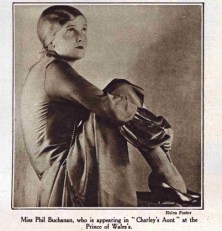
In 1946, John was joined in Australia by Phyllis Buchanan, a British actress he had met before the war. She had spent her war years driving ambulances, and apparently waited patiently for John for almost 7 years. Newspapers represented that they had  “quietly married” in Melbourne, but there seems no corroborating evidence of this.

Phyl buchanan the graphic 1926     The Herald 21 june 1946

Above left: Phil (Phyllis May) Buchanan in her early English career, The Graphic , 16 January 1926. Above Right; John and Phil lighting up in Melbourne in 1946. The Herald 16 June 1946. Via The National Library of Australia’s Trove.

Phil and John departed Sydney for London on the rather creaky pre-war ship Moreton Bay, in late September 1948. Wood found roles on stage again, including a long run in His Excellency with Eric Portman at the Princes then Picadilly Theatres. Wood tried to raise interest in a London production of Sumner Locke Elliot‘s Rusty Bugles, without success. His final role on stage was in Carrington VC at the Westminster Theatre in mid 1953. Also in the cast was Western Australian Allan Cuthbertson, making his signature role of Colonel Henniker.

He made one last British film in 1952. Stolen Face was made by Hammer films in London, directed by Terence Fisher. Paul Henreid, struggling to find work after being “semi-blacklisted” (his words) in Hollywood, found some work in France and England, including this film. It is the story of a plastic surgeon (Henreid) who remakes the face of a criminal to resemble his lost love (Lizabeth Scott plays a double role). Wood played Henreid’s assisting doctor. The trailer can be viewed here.

Stolen face2  Stolen face1

John Wood and Paul Henreid in Stolen Face (1952). Screen grabs from a copy in the author’s collection.

In the mid 1950s Wood suffered some serious but unspecified heart trouble. His old battalion newsletter noted that he and Phil had moved from their Chelsea flat to the Spanish island of Mallorca – breeding dogs, painting the scenery and enjoying the sun. John Wood made two return trips to Australia by air, alone, in 1963 and 1964. After the second trip home he did not return to Mallorca again. He died alone at his apartment at 25 Waruda Street Kirribilli, some time around 1 March 1965. There were no public notices – sadly he was completely forgotten, even in his homeland. His sister had died in 1963.


Note 1.
The IMDB incorrectly claims Wood was involved in a court case arising from a practical joke on the set of Laurel and Hardy’s March of the Wooden Soldiers/Babes in Toyland (1934). But he wasn’t. He was not in the US when that film was made. This was clearly an actor named John D Wood, and the matter went to court in June 1936, by which time this John Wood had returned to England. See The Los Angeles Times, 10 June, 1936.

Nick Murphy
November 2019

References

  • The Marriner Theatre Archive, Melbourne Australia

Text

  • Russell Braddon (1955) The Naked Island. Pan Books.
  • William Bryden (1981), Errol Leslie Flynn (1909–1959) Australian Dictionary of Biography, Volume 8, Melbourne University Press. (also online)
  • Slim DeGrey (1991) Changi The Funny Side. A Writer’s World Book
  • Midge Gillies (2011) The Barbed-Wire University. The real lives of Prisoners of War in the Second World War. Arum Press.
  • Lachlan Grant (Ed) (2015) The Changi Book. New South/Australian War Memorial.
  • Unknown. (1937)  RKO Players Biographies @ Internet Archive
  • Makan 2/30 Battalion Home Page The Battalion newsletter contains several references to Wood in later life.
  • J.P. Wearing (2014) The London Stage. Rowman and Littlefield.

Australian War Memorial art

Sergeant John Wood –  painting by Murray Griffin.
Men of AIF Concert party  – sketches by Murray Griffin
Men of AIF Concert party (2nd set) – sketches by Murray Griffin
Pantomime Production Changi – sketch by Murray Griffin
AIF Theatre Changi – sketch by Murray Griffin

National Library of Australia’s Trove

J.C. Williamson’s Collection of Photographs.

Newspapers:
The Daily Mercury 21 September 1929.
The News (Adelaide) 21 August, 1931
The Sydney Morning Herald  27 April, 1933
The Sun (Sydney) 12 December 1933
The Sun (Sydney) 16 Sep 1945
The Herald (Melbourne) 16 June 1946
The Sun (Sydney) 6 Nov 1946
The Sun (Sydney)  21 Jan 1948 

National Archives of Australia

Service Record, Signalman John Wood, NX65819.
Incoming Passenger records.

British Newspaper Archive.

The Graphic , 16 January 1926
Daily Mirror, 12 December 1961

Newspapers.com

The San Francisco Examiner 15 June 1935
The Los Angeles Times, 10 June, 1936.

Marc McDermott (1871-1929) – the Sydney hairdresser who went to Hollywood

Above: The dashing Marc McDermott, with particularly well kept hair, in about 1916. From Motography magazine, April-June 1916, p 1146. via Lantern Media History project. 

Marc McDermott Picture Show Mag Nov 5 1920
The 5 second version.
Born Marcus Patrick McDermott (sometimes MacDermott) Goulburn, New South Wales, Australia, 24 July 1871, Died Glendale, California, USA, 5 January 1929. He was active on the Sydney stage as an amateur, then by late 1890s, performing as a professional. He toured Australia with George Rignold, and in 1902 left for the US. He joined Mrs Patrick Campbell, touring the US and UK. His first film was for Thomas Edison in 1909. Thereafter, he appeared in 200 films before his death in 1929.
Left: A pencil drawing of “Marc MacDermott” in Picture Show magazine, November 5, 1920, P7.  This was one of several that dealt with his skills in make-up. Via Lantern, Media History Project.

In a career lasting the thirty years 1899-1929, Australian-born Marc McDermott appeared on stage in numerous productions and in over 200 US films, becoming an extremely well recognised and popular performer in the early years of cinema. In the occasional discussions about who was “the first Australian” to succeed in Hollywood, or “which Australian actor has made the most films”, Marc McDermott should rank highly. But apparently, to emphasize his serious acting credentials, he was keen to disassociate himself from his colonial upbringing as quickly as possible. So keen in fact he contributed to or approved of, a variety of preposterous stories about his origins – that have coloured his biographies to this day.

An example of this is the 1916 Motography magazine account that accompanies the photo above. This romantic story claims he was born in the affluent London suburb of Knightsbridge, and was a descendant of an ancient Irish King of Munster. He was “taken to Australia” by his parents at the age of four, it was claimed. But as the article also celebrates his move to the Vitagraph studio after 6 years at the Edison studio, it has all the hallmarks of a made-up publicity story. Twenty years later, Errol Flynn‘s life story was given almost identical studio PR treatment, he too, being “born in Ireland”, rather than far off and unfamiliar Tasmania. And in the absence of any meaningful later-in-life interviews (McDermott died in 1929) these studio stories have had a mighty influence on the modern and wildly inaccurate accounts of his life.

Motion Picture Story mag Feb - July 1911

Above: Forty year old Marc McDermott in 1911, Motion Picture Story Magazine Feb-July 1911. Via Lantern Media History Project

Marcus Patrick McDermott was born in the regional town of Goulburn, in southern New South Wales, in July 1871. His parents were Patrick James McDermott and Annie Massy nee O’Shaughnessy. The Irish born couple had met in Australia and married in Sydney in early 1870. A sister, May (or Mary), was born in 1881. Patrick, occasionally described as a “senior civil servant” was in fact a Prison Warder – first at Goulburn Gaol, and later promoted to Senior Prison Warder at Bathurst Gaol. It appears young Marc boarded at Saint Ignatius School, Riverview, on Sydney’s lower north shore. (see Note 1 below)


Evening News 11 Oct 1897   Sunday Times 20 Feb 1898

Marc McDermott’s first experience performing was through organised amateur theatricals provided by the Sydney Idlers Club, as these newspaper reports indicate. Left – Evening News Oct 8 1897 and right – The Sunday Times, Feb 20, 1898. Via National Library of Australia’s Trove.

If later biographies are to be believed, Marc’s father did not approve of his childhood interest in acting, and on one occasion burnt his toy theatre. Marc persisted and by his mid-twenties was actively involved in amateur theatricals, through membership of the Sydney Idlers Musical and Dramatic Club,  while during the day he was a city hairdresser in Elizabeth Street running a salon near the corner of King Street. Not only is this surprising fact borne out by newspaper references, it is also shown in several years of Sands Directory entries for Sydney, in 1896-98.

Macdermott in the Sands Directory 1898

Above – left column: Marc McDermott, hairdresser, operating at 77 Elizabeth Street, in the 1898 Sands Directory of Sydney.

In 1926, former amateur Sydney performer Jack Glover provided some reminiscences of Marc McDermott, by then very well established in Hollywood. Recalling the late 1890s, Glover told Everyone’s Magazine “I often smile and wonder whilst watching him on the screen if he ever thinks of the little barber’s shop in Elizabeth Street in which he used to lather and shave whilst we discussed the drama, for he (McDermott) was always ambitious to go on the stage.”  McDermott’s imitations of popular actors were apparently his specialty.

Others remembered him too – Harry P. Stewart, who had brought a theatrical version of Around the World in Eighty Days to Sydney in early 1899, recalled giving McDermott a part. And there is evidence of McDermott trying out humorous songs in vaudeville in a company travelling through New South Wales.

McDermott 1898

Above: Marc McDermott in Elsie Lander’s ( Charlotte Hazlewood Hannam’s) vaudeville company. This advertisement is from a Parramatta (NSW) newspaper in April 1898. Via National library of Australia’s Trove

But his great breakthrough was to be employed in George Rignold‘s company, sometime in 1899, and embarking on an Australia-wide performance tour.

Zeehan Gaiety 1900  445px-George_Rignold_Henry_5_1877

Above left: At 29, Marc McDermott was finally performing professionally. Here is evidence he was in George Rignold’s travelling company, in a featured role. The location was the Gaiety Theatre in  the Tasmanian mining town of Zeehan, and it still stands today. The Zeehan and Dundas Herald, 25 December 1900, Via National Library of Australia’s Trove.
Above right: George Rignold as Henry V, via Wikipedia commons and State Library of New South Wales.

By mid 1901, the Rignold company tour of Australia had wrapped up, and Rignold returned to Sydney to care for his ailing wife. Following some further acting and at least one experience directing a Sydney play himself, in late July 1902 Marc McDermott sailed for Vancouver, Canada, on the RMS Miowera. By 19 August 1902 he was at the Grand Union Hotel in New York, explaining to a New York Tribune reporter that some Australians with convict ancestry now had significant wealth, and telling witty stories about Australian children in drought ravaged districts – who had so far grown up without seeing rain. “Oh mummy what’s rain? Is it like the circus?” And this seems to have been his last public commentary about Australia.

Only a few months later, he joined British actress Mrs Patrick Campbell‘s productions of Magda, The Joy of Living and The Second Mrs Tanqueray in New York. For the next nine months he was on tour with Campbell through the larger cities of the United States and from mid 1903 he performed with her company in the United Kingdom. In just five years he had made an extraordinary journey from barber shop to the international stage.

Mcdermott drawn by Harry furniss 1913

Above: Actor, writer and director Harry Furness drew this caricature of McDermott in 1913 for The Bioscope, 25 December 1913. Via The British Library Newspaper Archive.

In July 1906 he travelled back to the United States and settled in New York. He then appeared with Richard Mansfield‘s company on their final tour of North America with Peer Gynt (Mansfield died later in 1907). Also in 1907, his mother Annie and sister May joined him in New York. Sadly Marc’s father Patrick, a victim of serious ill-health, had taken his own life in Sydney in August 1904 .

In so far as we can tell, his first films were for the Thomas Edison studio in New York, in 1909. And there, began a long and successful career on the screen.

motionpicturesto07moti_ FEb-Mar 1914

Above: The Thomas Edison Studio lineup from Motion Picture Magazine, Feb-March 1914. The 43 year old Marc McDermott is at top left. Via the Lantern Media History Project 

The reader today may wonder about his great success, particularly when so many others struggled for so long to establish themselves. In part – the answer must be the great names he was associated with from the early days of his acting career – Rignold, Campbell and Mansfield. But there is no doubt he was also a skilled and very versatile actor – who could play sleazy villains and romantic leads as easily as a bent and wizened Ebenzeer Scrooge in A Christmas Carol (1910).

When she was about 16

Above: Marc McDermott (left) in character as the old farmer, in a screen grab from When She Was About Sixteen (1912) with Bessie Learn and Margery Bonney Eskine. The entire Edison film – and several others featuring McDermott – can be watched online at Amsterdam’s Eye Channel on YouTube.

He Whe gets Slapped 1924 The Sea Hawk

Above left: Marc McDermott as the nasty Baron – a screen grab from MGMs He Who gets Slapped, 1924. Via the Internet Archive. Above right: A screen grab showing Marc McDermott as Sir John Killigrew (centre) and fellow Australian Enid Bennett as Lady Rosamund (right) in The Sea Hawk, 1924. The Silent Hall of Fame channel on YouTube currently shows the entire film.

Fellow actor Harry Furness, who knew McDermott well, wrote an unusually long piece on him for The Bioscope in December 1913. While acknowledging his versatility, Furness also thought he was “at heart, an intense actor” with the benefit of being “tall, handsome, fascinating, quiet, well dressed…in fact he is in reality a well-bred Briton.”

Well-bred Briton or not, McDermott’s film output at Edison’s New York studio was impressive. In 1910 he appeared in twenty titles, in 1911 – thirty, and by the time he left Edison in late 1916 he had completed almost 130 titles. While each of Edison’s films were only 15-20 minutes long, it must have been an exhausting work load. Not surprisingly, by 1917 his output had slowed. However over the next ten years he performed in numerous full length feature films beside some of the best known actors of the day – Greta Garbo, Dolores Costello, John Gilbert, Ramon Novarro, Tim McCoy, Dolores Del Rio, Joan Crawford, Lionel Barrymore, Ronald Colman, Norma Talmadge as well as fellow Australians Enid Bennett, Trilby Clark and Alf Goulding. His Directors included Alexander Korda, Fred Niblo, Raoul Walsh and John Ford.

McDermott’s other contributions to the cinema are worthy of note. Apparently a competent make-up artist himself, he was credited by some correspondents with pioneering the use of yellow grease paint to reduce lighting inconsistencies on the face in (black and white) films. In 1912 he appeared in the lead in the first US serial – What Happened to Mary, made in twelve parts by the Edison studio. He also appeared in the sequel, and at least one other serial. Although these did not end with the stereotypical “cliffhanger” of later serials, they were still designed to lure audiences back to the theatre again and again.

What_Happened_to_Mary_(1912)

Above:  Miriam Nesbitt, Mary Fuller, and Marc McDermott in Edison’s What Happened to Mary (1912). Via Wikipedia Commons

McDermott married fellow Edison actor and regular screen partner Miriam Nesbitt in April 1916 but by 1922 she had taken him to court, seeking a divorce. Miriam’s list of complaints included his “wildly ungovernable temper” and his wandering affections. She also claimed that his annual income had been as high as $35,000. Following the divorce, he briefly took to the stage again and then settled in Hollywood. Several of his later films – The Whip and Glorious Betsy had sound effects and several talking sequences added in the rush by studios to respond to the challenge of sound. Had McDermott lived a little longer, we might be able to source an example of his voice.

Marc_McDermott 2

Above: McDermott about the time he appeared in MGM’s The Temptress (1926) with Greta Garbo and Antonio Moreno. He was in his mid fifties at the time.  Photo via Wikipedia Commons

But sadly his career came to an end in 1928. US Newspapers of the time reported the sudden decline in his health in October, his hospitalization in December and his death in January 1929, a result of cirrhosis of the liver. His mother Annie was reportedly with him when he died. Australian newspapers, probably by now thoroughly confused about his identity, generally overlooked his death. He was remarkably quickly forgotten – but through no fault of his own. His silent films were simply thrown out, or at best shelved, in the exciting new era of sound.

Nick Murphy
October 2019


Note 1
Very little that has been written about Marc McDermott’s early years is accurate. Contrary to some accounts, he had no US-based older brother. He appears to have remained a US alien all his life – and did not need to become a British subject during his brief acting experience there, because in keeping with the thinking of the time, as an Australian, he was already regarded as being “British”.

The most constant error is his date of birth. There is no doubt McDermott was born in 1871, not 1881. His official birth record at the New South Wales Births Deaths and Marriages, his sister’s birth certificate and his early US immigration records are all easily searchable and all confirm this. At least one US newspaper – The Detroit Free Press, reported a more accurate age at the time of his death.

McDermott birth certificate

Above: Part of Marc McDermott’s 1871 birth certificate, via New South Wales Births Deaths and Marriages. His parents provided slightly different ages for themselves on his sister’s birth certificate. The wedding date is consistent however.
Key
Column 2 Date and place of birth of child

Column 3 Name 
Column 4 Sex
Column 5 Father’s name, occupation, age and birthplace
Column 6 Date and place of marriage, any previous issue
Column 7 Mother’s name and maiden surname, age and birthplace

Note 2
McDermott or MacDermott? Both spellings were used in his lifetime. This random spelling of surnames can also be found elsewhere in the late nineteenth and early twentieth – for example Mary Maguire’s uncle Andy used the spelling McGuire. There was also a popular but mistaken belief that Mac designated Scottish ancestry while Mc indicated Irish.


Further Reading

Text

  • Kevin Brownlow (1968) The Parade’s Gone By… University of California Press.
  • Leonhard Gmür (2013) Rex Ingram: Hollywood’s Rebel of the Silver Screen. epubli GmbH
  • Kalton C Lahue (1968) Bound and Gagged: The Story of the Silent Serials. Castle Books/A.S.Barnes
  • John T. Soister, Henry Nicolella, Steve Joyce (2012 )American Silent Horror, Science Fiction and Fantasy Feature Films, 1913-1929. McFarland & Co

ADB Online

LA Daily Mirror

Via National Library of Australia’s Trove

  • Evening News (Sydney) 8 October, 1897.
  • The Sunday Times, 20 February, 1898.
  • The Zeehan and Dundas Herald, 25 December 1900.
  • The Australian Star, 27 August, 1904.
  • The Bulletin, 13 September, 1921.
  • Everyone’s, 12 May, 1926.
  • Everyone’s, 2 June 1926.
  • The Sun (Sydney), 13 August 1947.

Via Newspapers.com

  • New York Tribune, 19 August, 1902.
  • Arizona Daily Star, 18 August 1922.
  • The Los Angeles Times 17 February 1923.
  • Detroit Free Press, 6 January, 1929.
  • The Los Angeles Times, 6 January 1929.
  • The Los Angeles Times, 17 August 1932. (Death of McDemott’s mother Annie)

Via British Library Newspaper Archive

  • The Bioscope 25 December, 1913

City of Sydney Sands Directories on-line See 1896 – Part 9; 1897 – Part 11; 1898 – Part 1.

Via Lantern History Digital Library – Internet Archive

Wikipedia Commons holds a large collection of public domain photos of Marc McDermott. 

YouTube Channels. A number of his films are in the public domain.

Margaret Vyner (1914-1993) – a very modern Australian woman

Above: Margaret Vyner C 1940. Photo enlarged from a very small Gaumont British card, possibly a cigarette card, otherwise unmarked. From the author’s collection.

Margaret Leila Vyner was born in the large northern New South Wales town of Armidale, in 1914, to Robert Vyner and Ruby nee Nicholson. In the 1930s, Margaret Vyner would develop a reputation for stylish fashion and glamour, in addition to appearing in films and on stage. She remained a perennial favourite with the Australian press for many years. As an adult she was above average height, standing about 172 cms (or 5’8″), and had blue eyes and fair hair. She was well-read, witty and beautiful.

Margaret Vyner while working in Paris for Jean Patou in 1934. Table Talk (Melb) 6 Dec 1934, via State Library of Victoria.

Her father, Robert Vyner, was manager on a pastoral station near Armidale, the oldest son of Robert Thomas Vyner (1858-1930), who had built a successful pastoral dynasty after moving to the area in the 1890s. Margaret was the only child of the union and it would seem the small family had moved to inner Sydney by the early 1920s after Robert Vyner ran into financial difficulties. Margaret attended Ascham School, a private girls’ school that pioneered and still follows an innovative teaching approach known as the Dalton Plan. She then attended Miss Jean Cheriton‘s very well known finishing school “Doone” at Edgecliffe. In later years she acknowledged how much she owed Miss Cheriton. By 1930 she was performing in amateur theatricals at Doone, while newspapers presented her as an eligible young woman, doing interesting things about town, as well as modelling clothes and often with something witty to say to journalists.


Above: Margaret Vyner appeared regularly in Sydney newspapers in the early 1930s  – for example – left;The Sydney Daily Pictorial, 25 October 1930,right;The Sydney Sun 21 Sept, 1930. Via National Library of Australia’s Trove.

By the end of 1930 she had made a remarkably easy transition into some chorus work for J.C. Williamson’s in Sydney – performing in When Knights were Bold, followed by a part as one of the chorus of “English girls” in a re-run of the popular musical Florodora – and then in Blue Roses, Hold My Hand and Our Miss Gibbs – all being performed up and down the eastern Australian coastShe was “beautiful”, “decorative”, “charming” and “vivacious” reported reviewers. Although not yet 18, she was also doing well enough to be offered advertising work for “Charmousan” powders and creams. By early 1934, on the back of all this local success, she had made the decision to travel to London and she departed at the end of March. Her biographer Kate Dunn states she left the Orsova in Naples and then made her way overland to Paris, where she was picked up as a mannequin very quickly by French fashion designer Jean Patou. Hal Porter suggested she worked her way up from “general dog’s body” for Patou whilst learning French and dressmaking at night. Perhaps both accounts are true. It was the Australian paper Smith’s Weekly that carried many of the reports of her work as a mannequin in 1934-35, Margaret being the author of many of these accounts herself. Did she really pioneer Australian women not wearing a hat to formal events? It seems possible!

Above: Margaret Vyner advertising Ardath cigarettes, c1935. Courtesy The Marriner Theatre Archive, Melbourne.

Smiths Weekly 1935
Above: Smith’s Weekly article by Margaret Vyner 25 May, 1935. Presumably, the headline was added by an editor. Via National Library of Australia’s Trove.

Margaret returned to Australia in December 1935, reportedly for a summer holiday. In early 1936 she won a small role in The Flying Doctor, being made by the fledgling Australian film company National Productions, directed by British actor/director Miles Mander and starring US import Charles Farrell. While some of the dialogue is well written, today there is the distinct impression the film was cobbled together in a great rush. Melbourne’s The Argus was amongst those not impressed, their reviewer commenting; “it is unlikely that Charles Farrell’s episodic wanderings in the Australian outback will appeal strongly to non-Australian audiences…”

Margaret Vyner’s short and forgettable role in the film is as an unhappy wife – Betty. Eric Colman, on the other hand, does a very memorable job as her overbearing husband.

Flying Dr 1936 screen grab
Above: Screen grab from The Flying Doctor (1936) , showing Eric Colman (brother of Hollywood’s Ronald Colman) Charles Farrell and Margaret Vyner. This short cricket sequence is easily found online, as it also features Don Bradman in his only film role, as himself. Source; National Film and Sound Archive. (The entire film is also held by the NFSA)

Whilst in Australia, Miles Mander went out of his way to be an affable visitor, making himself available for interviews and telling the Australian press all the things they liked to hear. These included his observation that Australian men were at least twenty-five percent “better developed” physically than Englishmen. British scriptwriter J.O.C Orton added his own tribute, commenting that there was a strong belief in England that “the most beautiful girls in the world were to be found in Australia… Mary Maguire and Margaret Vyner were splendid examples of Australian girlhood.” 

The Age 3 Oct 1936
Above: From The Age 3 October 1936. Although Vyner’s part was minor, her local fame saw her headlined with the two leading players in Australian advertisements for The Flying Doctor. Source Newspapers.com

At the end of April 1936, Margaret packed up and headed overseas again, this time travelling on the Matson liner Mariposa for California. She may have been encouraged by Mander to “try her luck” in Hollywood, because he appears to have told Mary Maguire and Jocelyn Howarth the same thing and was about to move there himself. But Margaret Vyner didn’t stay there for long.  She later explained that she had been offered a test at Universal, but said; “I‘d hate to feel I had to spend my life there …  never quite sure of good parts. So I turned (the contract) down and felt even more pleased with myself for being able to resist it.” She arrived in London again in July 1936.

During 1936 she gained some attention for sometimes using Michael as a modelling name. She explained that she had done this because she didn’t want to be known in Paris as Marguerite – or some variation of Margaret. So she chose the name Michel – which soon became Michael. At about the same time, at least one newspaper suggested she was following the influence of Marlene Dietrich , who had famously dressed in masculine attire in the 1930 film Morocco. In the following photos from Australia’s The Home magazine perhaps Margaret was enjoying making a statement. She almost certainly knew it was technically still illegal for women to wear trousers in France. The law was finally removed in 2013.

Vyner in Home mag 2 Aug 1937
Above: Margaret Vyner in The Home, Vol 18, No 8, 1937. The text accompanying claims she was on the way to La Touquet, a French seaside town. Source; National Library of Australia’s Trove.

Margaret always claimed she had seen future husband Hugh Williams perform in Australia in 1927 when he was on the final tour of the Dion Boucicault Company. The couple met in person some time in 1937 and in early 1938 they travelled together to the US with a British cast to perform in the Frederick Lonsdale play Once is EnoughThey were soon in a relationship; Hugh Williams’ first marriage to Gwynne Whitby having come to an end several years before. By this time, Margaret had made an appearance in British films – including Sensation with John LodgeMidnight Menace with Charles Farrell again and Carol Reed‘s Climbing High. Hugh Williams’ many films of the late 1930s included Wuthering Heights, made in Hollywood in late 1938 (with Miles Mander and pretend-Australian Merle Oberon in the cast). Margaret modelled Norman Hartnell‘s fashion collection in North America at the same time it was filmed.

Sensation
Above: Who would not fall in love with Margaret Vyner? This screen grab is from her first scene in a British film, Sensation (1936), with John Lodge. Ignore the ropey rear-projection. Author’s collection.

Margaret had a long tradition of providing witty commentary to the press. One famous example occurred in 1939, when after modelling clothes in the US, she told British journalists; “Americans are slaves to fashion. They blindly follow a lead without considering whether their clothes suit them. They are far less individualistic than English women.” But she could also make jokes – at her own expense. And in 1950 she described New York as “Gay, fantastic, but, oh, so expensive.” She had hoped to buy clothes while there, but found they were “expensive beyond belief. What makes it harder, is that the loveliest department stores stay open at night and lure me in while Hugh (Williams) is at the theatre”.

Margaret Vyner as Mary Stevens in Midnight Menace 1937. The man on the phone is right, it is dangerous! She soon gets captured by the (heavily accented) middle-european international arms dealers who are intent on starting a war. Author’s collection.

The_Montreal Gazette_Fri__Apr_14__1939_
Above: Margaret Vyner appearing in person at Henry Morgan’s in Montreal. The Montreal Gazette, 14 April 1939. Via Newspapers.com

Unfortunately, back in Australia, Margaret’s parents marriage came to a very public end in the late 1930s, and the divorce and subsequent arguments over support payments were dragged out in excruciating detail in almost every Sydney newspaper. Robert Vyner was an oil company salesman by 1938, and apparently he felt hard pressed to support ex-wife Ruby, as well as his new wife Irma. In May 1940, Ruby scraped together enough money for a fare and sailed to England on the Strathnaver, on what was the ship’s final voyage before being converted to a troopship. Like Margaret, she never returned.

Above: The Australian Women’s Weekly, 18 March 1939. A stunning photo of Margaret Vyner at the height of her popularity. Via National Library of Australia’s Trove.


Mississippi paper report of wedding dress

Margaret and Hugh Williams married on 21 June 1940. Kate Dunn’s quite moving collection of wartime letters between the couple (Always and Always, Wartime Letters of Hugh and Margaret Williams) gives some idea of the depth of their devotion. Dunn’s book also reproduces a well known photo from the wedding. In it, the couple appear to glow in a burst of sunlight, having apparently just stepped out of a darkened chapel. Margaret wrote of the wedding; “It was such a desperate time for England and France but so glorious for Hugh and Margaret.” Hugh (or Tam as he was nick-named) was already in uniform and the British had just evacuated most of their army from Dunkirk. These were very dark days for Britain.

Left:  An artist’s (fairly accurate) impression of Margaret Vyner’s wedding dress, as reported by the US paper The McComb Daily Journal, Mississippi, 6 August 1940. Perhaps it got such widespread publicity because it was seen as unusual. Via Newspapers.com

Margaret Vyner’s and Hugh Williams’ wartime letters provide an extraordinary insight into the stress of war on a newly married couple, who were deeply in love and had much in common. Hugh Williams somewhat reluctantly joined the British Army in 1939, because he felt it was the right thing to do. For the next five years he and Margaret lived largely separate lives, as did so many wartime couples. It is a testament to Margaret Vyner’s character that she maintained a cordial relationship with Williams’ first wife Gwynne Whitby, and helped care for the two daughters of that marriage, while maintaining her own career and driving cars for the home service. In 1942 she and Hugh welcomed their own son, Hugo and in 1946, another son, Simon. A third child, Pollyanna was born in 1950.

Margaret Vyner 1940
Above: Margaret Vyner entertaining Australian soldiers, newly arrived in London in June 1940. Doubtless they were all asked to sing “Waltzing Matilda.” Via State Library of Victoria.

Kate Dunn, Hugh Williams’ granddaughter and editor of their wartime correspondence, comments on how difficult the postwar period was for the young family. By 1946 Hugh Williams found he had lost his currency, and he struggled to re-establish himself on the stage and screen. Margaret was also making fewer appearances. In 1950, Hugh was declared a bankrupt and to deal with the crisis, the couple decided to turn to writing their own plays. Their partnership was, fortunately, a great success with audiences. Their first play was Plaintiff in a Pretty Hat and eight more followed. Two were made into films – The Grass is Greener (1960) and The Flip Side (1967), while the musical Charlie Girl ran for over 2,000 performances at London’s Adelphi Theatre. Their success as a writing team restored their fortunes.

Journalist Lynne Bell, reporting from London for The Sydney Morning Herald in early December 1969 (and ironically, only a few days before Williams sudden death), observed that despite some criticism of their work, “…the Williams’ ingredients of love and marriage, within a safe middle-class structure, continue to draw the crowds.” Bell noted that during 1967, three of their plays were running in the West End at the same time. Hugh’s obituary in The Guardian stated that their plays “though not fashionable, angry or sordid, gave civilized pleasure and had a great deal of theatrical skill”. 

Above: Hugh Williams and Margaret Vyner in a feature on their life and collaboration for The Australian Women’s Weekly, 30 December, 1959. Via the National Library of Australia’s Trove.

Margaret Vyner died in October 1993. Beyond their own body of work, Margaret and Hugh’s legacy has also been through a creative dynasty shared with their children and many of their grandchildren. Simon Williams is an actor, as was Polly Williams (1950-2004). Hugo Williams is a poet and writer. Grand children Tam Williams, Amy Williams and Kate Dunn, are actors and great-granddaughter Lily Dizdar is a director and writer.

Vyner035
Above: Margaret Vyner’s signature c 1939. Author’s collection.

Note 1
Before meeting Hugh Williams, the press associated Margaret Vyner romantically with several men. The question of a romance with Charles Farrell was the topic of gossip in 1936 after The Flying Doctor but Margaret categorically denied it and Farrell remained married to Virginia Valli until her death in 1968. There is no evidence to support the claim except that they acted together in another film.

Note 2
It’s regularly claimed that Cole Porter included a reference to Margaret Vyner in the lyrics of the song “You’re the top”, from the musical Anything Goes. However, she is not mentioned in the original lyrics. As the play was written in 1934, when she was still in Australia or Paris, the reference to Vyner could only have been added in one of the many later versions of the song, probably after 1937. Unfortunately, so far, this writer cannot find a later version of the song that includes the reference to Vyner.

Nick Murphy
September 2019


References

Online footage

Texts

  • Kate Dunn (Ed) (1995) Always and Always; Wartime Letters of High and Margaret Williams. John Murray.
  • Brian McFarlane (2003) The Encyclopedia of British film. Methuen/BFI
  • Hal Porter (1965) Stars of Australian Stage and Screen. Rigby
  • Hugo Williams (2010) Dock Leaves. Faber and Faber
  • Angela Woollacott (2001) To Try her fortune in London. Australian Women, Colonialism and Modernity. Oxford University Press

Digital resources

This site has been selected for archiving and preservation in the National Library of Australia’s Pandora archive

Judy Kelly (1913-1991)- From the outback to Elstree Studios

Above: Judy Kelly in a publicity photo of the early 1940s – and a long way from Narrabri, New South Wales. Author’s collection.

Judy Kelly made a name for herself performing on the stage and on screen in England between 1932 and 1949. She is unusual in some respects because her pathway to becoming a recognised actor seems – at first glance – to have been achieved with remarkable ease, when compared to the trials and tribulations of others. She had no professional acting experience in her native Australia and yet by 1949 she had almost fifty film credits behind her and she had emerged as a competent actor.

She was born Julie Aileen Kelly at Narrabri, an inland town of New South Wales, about 500 kilometres north west of Sydney, in 1913. An older brother Owen Arthur had been born in 1911. Judy’s mother Blanche Esse nee Davis belonged to a well connected farming family, from the more prosperous southern area of the state.

At the time of his marriage to Blanche in 1911, Eugene Gerald Kelly, had been appointed a teacher at a one teacher school. Mogil-Mogil was remote – a town with a tiny population but supporting two pubs and a butcher, with uncertain school enrolments , uncertain rainfall and a reputation for hitting 114 degrees Fahrenheit in the shade in summer (45.5 degrees C). Perhaps the reason they had moved to the relative comfort of Narrabri in 1913 was because remote life was so hard. But by 1916 Blanche had moved again, taking the children with her to the pastoral property of her brother, H. M. Davis, near Robertson, in the green rolling hills of the southern highlands. Here, another daughter, Betty, was born in 1917. Eugene joined the Australian Army in 1916, in the great enlistment surge after Gallipoli, being posted overseas soon after.

Judy and her siblings spent much of their childhood growing up on another Davis family farm at Lockhart, in the Riverina district. Of Judy’s childhood we know little, except that she had adopted the name “Judy” well before she travelled to England, and she may have dabbled in some amateur theatricals while at Wagga Grammar School. Blanche and Eugene were finally divorced – acrimoniously and publicly – in 1923.  (See Note 1 below)

In April 1932, 19 year old Judy won a “Talkie Quest,” a drawn out competition run by the short-lived Sydney newspaper “The World” in collaboration with the Capital Cinema and British International Pictures (BIP).

Reportedly, 1,200 young women entered the competition, whose judges included director Ken Hall and actor Bert Bailey. The prize was very attractive – it included three months training at Elstree in England and a try-out in films. Judy was described as a teacher by several newspapers, but if that was so she  must have been unqualified, given her age. But most later accounts stated she was a cinema usher.

Above:  Blanche and Judy departing for London. The Home, An Australian Quarterly. Vol. 13 No. 8. August 1, 1932.

After extraordinary publicity and many farewells, Judy and her mother departed for England on the P&O ship Cathage, arriving on 29 July, 1932. She was set to work for BIP almost immediately and the transition to British film actor all went remarkably well. But not surprisingly, in the British Pathe newsreel made soon after she arrived, she still looked very young and uncomfortable in front of the camera. She acknowledged how hard it was at first, when she told a journalist I have only made one friend. Molly Lamont — fellow Colonials they call us, since she is South African. There is a terribly impersonal atmosphere about a studio. Directors look right through you and murmur: ‘What are we going to call this young woman?'” 

Judy Kelly and Molly Lamont in 1933. New Zealand Dramatic and Sporting Review, April 30, 1933.

Judy claimed her first experience of film was with Molly Lamont, as an extra in Lord Camber’s Ladies (other sources state it was Sleepless Nights), but her first credited role in a film for BIP was in Money Talks. This was a 70 minute BIP quickie comedy, a vehicle for popular vaudeville and radio comedian Julian Rose and produced by the prolific Walter C Mycroft.  Judy had a small role as the daughter of Abe Pilstein (played by Rose). Thereafter, she appeared in a string of mostly program fillers – or B-films, often mysteries and crime dramas such as Crime on the Hill (1933), The Four Masked Men and The Black Abbot (1934). But at the same time, she can also be seen in a few supporting and un-credited roles in quality films, such as Alexander Korda‘s The Private Life of Henry VIII (1933) and The Rise of Catherine the Great (1934).

Left and centre: An early photo of  a very young Judy Kelly. The short bio on the card may confuse the casual reader today – reflecting the reality that many people considered Australians of the time to be “British born”. Right: A still of Judy from Everyone’s Magazine, May 10, 1933. It is reportedly from the BIF film Their Night Out. In later years she explained she took every role offered to her.

Judy developed a reputation for working hard. She judged competitions, appeared at openings, modeled clothes and sought out every acting opportunity she could. (Click here for a British Pathe newsreel of Judy judging some laundry sports in 1937). Doubtless this also had something to do with advice from her agent – the well known Herbert de Leon, who also represented Margaret Lockwood, Greer Garson and numerous others.

Back in Australia, sometime in March 1933, Judy’s sister Betty managed to accidentally shoot herself in the arm. She was trying to shoot a sting-ray, she said, and the injury, although minor, might delay her plans to travel to England to become an actor like her sister. About a year later, she and older brother Owen finally arrived in England on the SS Barrabool. All three Kelly children settled into life with Blanche in an apartment in London’s Paddington. None of them ever returned to Australia. The contrast between a quiet life in rural New South Wales, and London, the bustling capital of the Empire, must have been stark.

On 21 April, 1934, The Australian Women’s Weekly compared Judy (left), who had now lost a great deal of weight, with a photo of her sister Betty (right), photographed while en-route to England. 

It was no wonder Betty thought she, too might become an actor. Judy Kelly was now well established (and was much more at ease in front of the camera) as the following British Pathe newsreels suggest.

But as the 1930s wore on, some of Judy Kelly’s feature films continued to be like her first. British films of the 1930s were often made on a limited budget, sometimes produced to fulfil the exhibitor’s obligations under the Cinematograph Films Act (1927) – which was to show a certain proportion of British films in their programs. But this era of filmmaking doesn’t necessarily deserve the bad reputation it has sometimes been given – the films were a “mixed bag” that included great successes amongst the forgettable and underwhelming. Judy’s repertoire reflected this diverse range of films. It included light romantic comedies, mysteries and even a few jaunty musicals, including Charing Cross Road (1935) with John Mills and Over She Goes (1937) with Sydney-born actor John Wood

Above: a screen grab of Judy Kelly as Anne Mayhew, with fellow Australian John Wood (1909-1965) as the eligible Lord Harry in the musical Over She Goes. She plays Harry’s gold-digging former fiancee. This rarely screened film can be purchased from networkonair.com. Author’s collection. 

It was Margaret Lockwood who said “The British star who waits for the ideal role… will do a lot of waiting” and one can’t help but feel Judy Kelly might have sometimes felt the same way. Perhaps this explains why from the late 1930s, she was also found performing on the stage, with some success. In 1937, she went on a tour of South Africa, performing in Barre Lyndon‘s crime drama The Amazing Doctor Clitterhouse. The play had been a hit in London, and like so many new plays of the 1930s it was quickly made into a film – by Hollywood in this case. Judy also appeared on stage in light comedies and musicals such as (Australian writer) Alec Coppel‘s Believe it or Not in 1940, Stanley Lupino‘s musical Lady Behave in 1941, Vernon Sylvaine‘s farce Women Aren’t Angels in 1941 and his comedy-thriller Warn that Man in 1943.

Two of Judy Kelly’s stage appearances. Lady Behave (1941) was a musical, Warn That Man (1943) a thriller. Author’s collection.

One striking feature of Judy Kelly’s story is her consciousness of being an Australian at work in England. She wrote a few articles for popular Australian paper “Smith’s Weekly” that expressed that awareness – including an unusually frank comment about England’s class system; “The English are a curious people—so curious, indeed, that I, an Australian, sometimes feel a foreigner among them…To anyone reared in the Australian democratic tradition, (the) alignment of social forces is inexplicable.”  It was doubtless coincidental, but she appeared in a number of films with fellow Australians busy working in England – amongst them Coral Browne (Charing Cross Road in 1935) Betty Stockfeld and Edward Ashley (Under Proof in 1936), Frank Leighton ( The Last Chance in 1937),  John Wood (Over She Goes in 1937 and Luck of the Navy in 1938), Ian Fleming (The Butler’s Dilemma in 1943) and John Warwick (Dancing with Crime in 1947). She reported that at times she bought her friends Australian presents and sometimes she mixed with other Australians – including Patti Morgan, whose 1949 wedding she attended.

Judy kelly 2
Judy Kelly in a publicity photo c 1945 and looking every bit the movie star. Author’s collection 

Like many of the actors profiled on this website, Judy Kelly also made her contribution to British propaganda in several films – including Luck of the Navy (1938) and Tomorrow We Live (1943). This genre of British films is also interesting for the liberal use of refugee actors from Nazi- Europe,  in the case of the latter film – this includes Herbert Lom, Karel Štěpánek and Fritz Wendhausen.

Judy Kelly in Tomorrow we Live 1942
Above: This is a screen grab from Tomorrow We Live, re-titled At Dawn We Die for the US market. Judy plays Germaine from the bar. She looks a little sad because the man she is keen on – Jean Baptiste – has just said “goodnight little cabbage” before dismissing her. Author’s collection.

Her final films are perhaps her most notable. In 1945 she appeared in a small role in the well received British horror film Dead of Night. But it was in John Paddy Carstairs’ film-noir crime thriller Dancing With Crime (1947) that she most demonstrated her ability. Set in a perpetually wet and dark post-war London, she played Toni, a hard drinking dance hostess for a dodgy Dance Hall, really a front for black market operations. Richard Attenborough plays Ted Peters – a salt of the earth taxi driver, while Joy, played by Sheila Sim, is his perpetually worried girlfriend. It’s the sort of film where the characters say cheerful things like “Don’t worry about me Ducks” and “I’m off to see a man about a fortune” between fighting or shooting at each other. In the end, Toni cooperates with the Police Inspector, played by Australian John Warwick, while Ted and Joy are sent off home to enjoy the rest of their lives.

Judy Kelly in Dancing w crime
Here is Judy Kelly as Toni, giving her boss (one of the gangsters, played by Barry K. Barnes) a piece of her mind, in Dancing with Crime (1947). Author’s collection.

In 1949 Judy appeared in Warning to Wantons, where she plays the mother of the insufferable Renee (Anne Vernon), a sixteen year old who is determined to use her feminine guile to manipulate the dopey eligible Count Max (David Tomlinson) on the eve of his wedding, plus any other men she meets. It’s well acted but the plot is so unpalatable it makes tiresome viewing today. It is worth noting that Kelly was only 36 while playing a mother in this, her final film. It was based on a novel with the same title by Australian novelist Mary Mitchell.

Above Left: Eric Summer photographed in 1966. Illustrated London News, 17 September 1966. Copyright ILN Group.
Above Right: Judy Kelly and her baby in 1952. Birmingham Gazette, 31 May 1952. Via British Newspaper Archive.

In April 1946 Judy married Eric Summer, a businessman, lawyer and former British Army colonel. Amongst Summer’s later accomplishments was his Chairmanship of Royston Industries, makers of the first Black box flight recorders. A son was born of the union in 1952.

Betty Kelly did not develop an acting career. But from 1938-1949 she was married to popular English comedian Michael Howard. Judy’s older brother Owen Arthur Kelly served in the British Army in World War II. He married Vera Felix (Kempner) in 1941.

Judy Kelly retired from acting in 1949 and lived much of her later life in the Surrey countryside. Unfortunately this talented actor left no further commentaries about her work or life. She died in London in 1991, aged 77.


Note 1 – Regarding her father.
Judy’s father, Eugene Gerald Kelly was never mentioned in her biographies. At best, it was inferred her father had been a pastoralist, occasionally it was stated he was dead.  The reason for his disappearance from the family story is hinted at by examination of his colourful wartime military record in the 45th Battalion, Australian Imperial Forces (AIF) – available online in the Australian National Archives. In addition, a clumsy attempt by Eugene to pretend to be dead in 1920, apparently in an effort to avoid paying Blanche child support, was reported by “Truth” newspaper. Clearly Eugene’s relationship with his wife and children fractured irrevocably. It is a testimony to their fortitude that they successfully rebuilt their lives in Britain without further contact.

Note 2 – Regarding claims of work in the US.
The IMDB lists Judy as appearing in a British film Adam’s Apple/Honeymoon Abroad  in 1928 and in the US in the Jack Benny TV show in 1954. These are different people. There is no record of her travelling to the UK at the age of 15 to play a “Vamp” and the woman in the Jack Benny show was a well known US-born dancer, who had also worked with Bob Hope.


Nick Murphy
September 2019


References

Text

  • Kurt Gänzl (1986) British Musical Theatre Vol. 2. Oxford University Press.
  • Brian McFarlane (1997) An Autobiography of British Cinema. Methuen
    (Produced too late to interview Judy Kelly, this wonderful book contains interviews with many of her contemporaries)
  • Robert Murphy (2009) The British Cinema Book. BFI Palgrave Macmillan.
  • Vincent Porter (Ed) (2006) Walter Mycroft: The Time of My Life. The Scarecrow Press.
  • Jeffery Richards (Ed) (1998) The Unknown 1930s. An Alternative History of the British Cinema, 1929-1939. I.B.Taurus
  • J.P. Wearing (2014) The London Stage 1940-1949: A Calendar of Productions, Performers, and Personnel. Rowman & Littlefield.

Online

  • Ancestry.com
  • NSW Police Gazettes 1919-1923
  • UK Shipping records
  • UK Census records

National Library of Australia – Trove

National Archives of Australia

  • Eugene Gerald Kelly #2263, Service record, 4/45 Battalion, AIF.

University of NSW, AIF Project.

This site has been selected for preservation in the National Library of Australia’s Pandora archive

Thanks, links & some sources

Constance Worth (Jocelyn Howarth of Sydney) as Lita gets the drop on Sheldon Leonard as Sometime Smith in Columbia’s 1943 western, Klondike Kate. Ten years before, she had taken the leading role in the Australian film The Squatter’s Daughter.

Thanks to…

My lecturers so long ago – Tom Ryan, Arthur Cantrill and Ken Mogg.

And special thanks to:

These groups on the net

And these Individuals

  • Sandra Joy Aguilar, Warner Bros Archives, University of Southern California regarding Mary Maguire
  • Julie K Allen, Brigham Young University, regarding Saharet
  • Melissa Anderson, regarding Lotus Thompson
  • Norm Archibald, regarding Mary Maguire
  • Alan Black regarding Jenny Golder
  • Richard Bradshaw, regarding Fred Stone
  • Dianne Byrne, regarding Mary Magurie
  • Sophie Church, Geelong Grammar School regarding Joan Lang
  • Catherine Crocker, regarding Midas Martyn and the Pollards
  • Simone Cubbin, regarding Mary Maguire
  • Jane Cussen
  • Bill Egan, regarding Daphne Pollard & Jolly John Larkins
  • Jim Eldridge, regarding Saharet
  • Lina Favrin, Yarra Libraries regarding the Pollards
  • Katie Flack, State Library of Victoria.
  • Claudia Funder, Australian Performing Arts Collection, Arts Centre Melbourne
  • Emeritus Professor Richard Fotheringham
  • Alan Garner, regarding Norma Whalley
  • William Gillespie regarding German representations of Australia
  • Marguerite Gillezeau, Archivist at Ascham College regarding Shirley Ann Richards, and also Archivist at Redlands, Sydney Church of England Coeducational Grammar School regarding Anona Winn.
  • Martin Goebel, regarding Saharet
  • Robert Gott
  • Dan Gulino, at radiowasbetter.com,
  • Julie Hansen, regarding Shirley Ann Richards and the Garden School
  • Prue Heath, Archivist, SCEGGS Darlinghurst regarding Nancy O’Neil
  • Joe Henderson, National Archives in Kew, England
  • Barry Humphries, regarding Saharet
  • Alexandra Jackson regarding Maie Saqui
  • Joe Jordan, regarding The Desert Rats (1953)
  • Elisabeth Kumm, at Theatre Heritage Australia
  • Stephen Langley regarding Reita Nugent/Janet Lind
  • Margaret Leask regarding Eileen Robinson
  • Mark Lepp, regarding Saharet
  • Elaine Marriner, at the Marriner Theatre Archive, Melbourne
  • Robert Maynard regarding Willie Thomas and the Pollards
  • Michael McCullough regarding Saharet
  •  A J McKirdy
  • Joyce Mostyn regarding Mary Maguire
  • Jock Murphy, former Director of Collections at the Baillieu Library, University of Melbourne,
  • Ingrid Purnell, editor
  • Kate Rice, inaugural Frank Van Straten Fellow, Performing Arts Collection, Melbourne. See Performing the Past.
  • Jean Ritsema, regarding Saharet, Wanda Radford, Leah Leichner, Dulcie and Ashley Cooper
  • Sister Helen Salter, Loreto Convent in Brisbane, regarding Mary Maguire
  • John Shrimski, regarding Maie Saqui
  • Robbie Stockfeld
  • Tony Tibballs, Cinema and Theatre Historical Society of Australia
  • Patsy Trench, regarding her mother Nancy O’Neil. Her website is here.
  • Mary Vanderfeen, regarding Saharet
  • Trish Van Der Werff, regarding Shirley Ann Richards
  • Marita Warner regarding Adrienne Brune
  • Dorothy Weekes, former Archivist at Academy of Mary Immaculate in Fitzroy, regarding Mary Maguire
  • Jeffrey Weissman, regarding Hal Roach and Lotus Thompson
  • Stephanie Welsh, regarding Jocelyn Howarth
  • Libby White, regarding Barbara Smith and Lloyd Lamble
  • John Armine Wodehouse, Earl of Kimberley regarding Mary Maguire
  • Brenda Young, regarding Elsie Morris
  • Charles Zhang, regarding Saharet

And these very useful texts that I often turn to

  • Julie K Allen (2024) Screening Europe in Australasia: Transnational Silent Film Before and After the Rise of Hollywood. Exeter Studies in Film History. University of Exeter Press.
    This book is on open access and can also be downloaded here : https://library.oapen.org/handle/20.500.12657/54077
  • Stephen Alomes (1999) When London Calls. The expatriation of Australian creative artists to Britain. Cambridge University Press.
  • Gillian Arrighi & Victor Emeljanow (Eds) (2014) Entertaining Children. The Participation of Youth in the Entertainment Industry. Palgrave Macmillan
  • Kaz Cooke (2017) Ada. Comedian, Dancer, Fighter. Viking /Penguin. A fictional account of Ada Delroy’s life  [funny, extremely well researched and valuable in the absence of interviews with so many early Australian performers.] Her website is here
  • Peter Downes (2002) The Pollards. A family and its child and adult opera companies in New Zealand and Australia 1880 -1910. Steele Roberts
  • Ray Edmondson and Andrew Pike (1982) Australia’s Lost Films. National Library of Australia.
  • Richard Lane (1994) The Golden Age of Australian Radio Drama, 1923-1960. A History through Biography. Melb University Press
  • Brian McFarlane (2003): The Encyclopedia of British Film. Methuen Publishing Ltd- BFI
  • Kirsty Murray (2010) India Dark. Allen and Unwin. [A fictional work inspired by the Pollard Tour of India in 1909-1910.]
  • Phillipe Mora, Peter Beilby, Scott Murray (eds) and others (1974-2001): Cinema Papers (Magazine) Cinema Papers P/L, Richmond, also MTV Publishing  and Niche Media. See digitised collection at the University of Wollongong Archives
  • John Parker (Ed) (1947) Who’s Who in the Theatre. A Biographical record of the contemporary stage. Tenth Edition. Sir Isaac Pitman & Sons Ltd
  • Andrew Pike and Ross Cooper (1980 & 1998): Australian film, 1900-1977 : a guide to feature film production. Oxford University Press.
  • Hal Porter (1965) Stars of Australian Stage and Screen. Rigby Ltd
  • Graham Shirley & Brian Adams (1989): Australian Cinema: The First Eighty Years. Currency Press
  • Frank Van Straten (2003) Tivoli. Lothian Books
  • J.P. Wearing (2013) The London Stage 1890–1899: A Calendar of Productions, Performers, and Personnel, Rowman & Littlefield.
    And companion volumes: The London Stage 1900–1909(2013), The London Stage 1910–1919 (2013), The London Stage 1920–1929 (2014), The London Stage 1930–1939 (2014), The London Stage 1940–1949 (2014) & The London Stage 1950–1959 (2014).
  • Andrée Wright (1986) Brilliant Careers; Women in Australian Cinema. Pan Books Australia.
  • Adrian Wright (2020) Cheer Up! British Musical Films 1929-1945. The Boydell Press.
  • Angela Woollacott, (2001). To try her fortune in London. Australian women, Colonialism and Modernity. Oxford University Press
  • Angela Woollacott (2011) Race and the Modern Exotic. Three ‘Australian’ Women on Global Display. Monash University Publishing.

Fred Stone (1908-1995) – The man who influenced Tony Hancock & “The Boy Friend”

A young Fred Stone from Sydney doing the splits in London in 1929 – an impressive skill only sometimes achieved by male dancers even today. Photo courtesy Richard Bradshaw.

At the age of 21, Fred Stone left Depression era Sydney on the P&O ship Benalla, arriving in London in May 1929. He never returned to Australia. In the United Kingdom he became a well known favourite on stage, sometimes also appearing in supporting roles in films and TV. Fred’s attitude to his country of birth was at best, ambivalent. While he stayed in regular contact with his Australian family until his mother died in 1956, he seems, by accident or design, to have often added to the confusion about who he was, and where he was from. This is probably reflected in the wildly inaccurate Internet Movie Database entry that currently states he was born in Derby, England!

He was born Frederick George Stone in a terrace house in Liverpool Street, Paddington, an inner suburb of Sydney, on 9 July 1908. His parents were Frederick Stone and Margaret Calder nee Nixon, both of whom had been stewards on ships. Fred and his older sister “Lalla” (Agnes), spent their childhood in a large airy home their father had built at 19 Balfour Rd, Kensington, perhaps as a consequence of his success as a punter. Both children attended the nearby Kensington Public School. At some point in his childhood, Fred discovered the pleasure of performing on stage, an interest his mother had encouraged. In his mid teens he worked for two years at Farmer’s Department Store, Sydney, but left to pursue his passion. In 1925, while attending the Harry Thomas School of Elocution, he came in for praise in the part of Paris, in Romeo and Juliet. Fred’s first professional roles were in the choruses of musicals.  On 1 March 1927, Fred appeared in the chorus of “Sunny,” a new musical by Jerome Kern, Oscar Hammerstein II and Otto Harbach at Sydney’s Empire Theatre. He also appeared (as Freddie Stone) in the chorus of Good News, a musical about US college life that opened at St James Theatre on 10 November 1928. A slightly sniffy reviewer for “The Sydney Morning Herald” described it as something that would be popular with those, who like  “American jazz comedy“.


GN1 GN2

Above: Good News program courtesy Richard Bradshaw.

Fred and sister 1929 fred-stone-cropped

Left: Fred and his sister Lalla (and two of her children) shortly before Fred departed for England in 1929.
Right: Fred Stone in Wellington, New Zealand, in the late 1920s while he was in the chorus of the new musical “Sunny”.  Photos courtesy Richard Bradshaw.

Fred was a good looking and talented young actor, so it is not surprising he found regular stage work soon after arriving in England. In late 1929 he had landed a role in Mr Cinders at the Prince’s Theatre, Bristol, the play being a clever inversion of the Cinderella story. He went on to appear in a number of musicals and comedies in the 1930s, including The White Horse Inn, The Flying Trapeze and Tulip Time. He now called himself Frederic Stone, probably to avoid confusion with the US cinema star of the same name.

Making up - the flying Trapize Richard Hearne, Robert Gordon, Fred  Fred in Be careful Mr Smith

Above Left: Richard Hearne, Robert Gordon and Fred Stone making up for The Flying Trapeze at the Alhambra Theatre in 1935. Courtesy Richard Bradshaw. This was a musical set in a circus, starring Jack Buchanan and fellow Sydney-sider Fred Conyngham. Fred’s supporting role was the Ballet Master.
Above Right: A screen grab of Fred in Be Careful Mr Smith, released in 1935.

In 1935, he appeared in the film Be Careful Mr Smith as a performer who sings the old music hall favourite, “The Man who broke the Bank at Monte Carlo.” He is on screen with leading actor Bobbie Comber for a full five minutes, which makes the lack of credit for the role he played surprising, even for a “quota quickie,” as these types of movies were characterised.

The un-credited Fred Stone sings the first verse and chorus until interrupted by Mr Smith (Bobbie Comber) who insists it be sung slowly in the traditional musical hall manner. Clip from Be Careful Mr Smith courtesy Peter Charlton.

His successful stage career in the 1930s saw him perform throughout the UK and beyond – in 1937 he joined the George Clark company tour of South Africa, performing a review called Let’s Join George. On the outbreak of World War II he was appearing in a bedroom farce called Room for Two, and not long after that, another one, called High Temperature, advertised as “a play for the broad-minded.”

By early 1940, Fred, like numerous other actors, had joined the Entertainments National Service Association (ENSA). By a sequence of events no longer known, in early 1942 he had ended up in the RAF and was performing in one of Ralph Reader‘s Gang Shows. With more than ten years stage experience, Sergeant Fred Stone #1223414 was leader for one Gang Show group entertaining troops in Europe. Joining him, from about 1944, was a very young Tony Hancock, who can clearly be seen in the following photos. There were at least fifteen gang show groups performing for British and Allied forces.


FS6 Sleepwalker
Above Left: Fred in drag (second from the left) for a undated Gang Show sketch. Hancock is second from the right.
Above Right: A Gang Show sketch with John Beaver as the sleepwalker at right. Hancock is fourth from the left, while Fred is fifth from the left with buck teeth. The astute reader will note that Fred marked himself in photos with a small cross, for the benefit of his mother. Courtesy Richard Bradshaw.
FS9
Above: Another Gang show with Hancock second from the left and Fred third from the left. John Fisher’s biography of Hancock may describe this sketch: “In one sketch entitled ‘Rumours’ Tony found himself in a skirt alongside John Beaver and Fred Stone…as three charladies caught up in an air-raid …until the arrival of a Duchess played by Robert Moreton”. Photos courtesy Richard Bradshaw.

The Gang Shows are famous for giving a number of British actors valuable stage experience – amongst them comedians Peter Sellers and Dick Emery. Interviewed about his Gang Show experiences in 1963, Tony Hancock had this to say;

“My first overseas posting was with Ralph Reader’s Gang Show to Africa –  not that I really knew where I was going at the time; the R.A.F didn’t really keep me very well informed… From North Africa we moved to the front line in Italy.  Well not actually to it.  We got about three miles behind it once, but that was the closest we ever did.

When our show came back to England it was great to see that it was still tightly disciplined.  And that was entirely due to Fred Stone who later appeared in ‘The Boy Friend.’ He was a very strong personality who managed to keep 11 men who were living as closely as we were in reasonable shape.  And I realise now that this was because he would have nothing wrong with the show.

No matter what he felt personally about anything, it couldn’t interfere with a performance.  I was only 20 or so at the time and it was a great example to me.”
(Tony Hancock in the TV.Times [U.K.], 11 January 1963)

In 1949-50 he reprised his 1932-33 role as Leopold the waiter in  The White Horse Inn on tour in the U.K. for theatre impresario Prince Littler.

Fred had first performed at the Players’ Theatre Club in 1939, and after World War II he returned  – appearing there (between other commitments) in their nightly show, until the 1980s, often acting as Chairman (the traditional music hall term for Master of Ceremonies) who ad-libbed with the audience and introduced sketches.  Many other well known British actors appeared at Players’ Theatre, some that today’s readers may recognise include Hattie Jacques, Peter Ustinov, Clive Dunn, Ian Carmichael and Joan Sterndale-Bennett.

In her entertaining autobiography, British Actress Ada Reeve recounted being taken to the Player’s Theatre for her 80th birthday in the early 1950s; “here, on the very stage where I had made my first West End appearance as a girl of fourteen, I once more had the thrill of being announced by a chairman – handsome Fred Stone, in appropriately Victorian garb.” 

In 1953, Players’ commissioned Sandy Wilson to write a 45 minute piece to end the evening show – which became the genesis of The Boy Friend. It was so well received, that after four weeks, he was asked to expand it, and this became the musical so well known today.

Fred’s contribution is noted in Sandy Wilson’s own autobiography:

“Freddy’s presence in the show turned out to be another invaluable asset, since his experience went back to the Twenties themselves and he had actually been in the chorus of the kind of show we were trying to recreate. “

Wilson also acknowledged that he based ‘The Riviera’ dance’ in The Boy Friend on the ‘Varsity Drag’ from the musical Good News. Wilson recalled “Fred Stone’s advice was again invaluable because he had been in the chorus of that show.” Producer Vida Hope also incorporated many of Fred’s experiences – he reportedly said; “She made no bones about using everything I suggested…But, being an actor, I did far too much… So Vida would cut it down. She would let me do it for about twenty-four hours, and then she said, ‘Now, darling, we’ll tidy this up.'”

Fred in The Boyfriend

Fred as Percy Browne, the millionaire father of the heroine, in The Boy Friend, with Joan Sterndale Bennett as Madame Dubonnet, sometime in 1954. Photo courtesy Richard Bradshaw. Hugh Paddick also played this role. 

BF1  BF2

The hugely popular musical The Boy Friend opened at the Wyndham Theatre in January 1954. This is the modest program from around that time. Author’s collection. 

Fred’s other well known role was playing various pantomime dames, in fact a contract to perform as one took him away from The Boy Friend for a short period. Fred’s 1995 obituary in “The Daily Telegraph” includes a mid 1960s photo of Fred en point in ballet shoes, with tutu and makeup, as “Madame Stonaskaya” and clearly enjoying the outrageous role.

Ever versatile, in 1959 Fred Stone finally took on the role of a villain, Captain Herbert Skinner, in a new version of a once popular Victorian melodrama The Silver King performed by The Players’.

Fred in 1959

Fred playing the villain Captain Skinner, with Madeleine Dring and 27 year old Prunella Scales, in The Silver King. The Stage, 1 January 1959 via the British Library Newspaper Archive.

Between November 1961 and June 1962, a troupe of the Players’ club regulars travelled to New York to appear at the Strollers Theatre Club, where Fred performed as Chairman. A New York “Daily News” reviewer described that “delightful Englishman Fred Stone” as “a cross between (designer/photographer) Cecil Beaton and (actor) Cyril Ritchard. The journalist was unaware apparently, that like Fred, Cyril Ritchard was Sydney born.


Pan Am 1 Pan Am 2

(Click to enlarge) A troupe from the Players’ club arrives in New York, as shown in two publicity photos taken for Pan Am’s in-flight magazine “Clipper,”c 1961.

In the group photos with bicycles are, left to right: Fred, Jean Rayner, Anthony Bateman, Margaret Burton, Archie Harradine, Joan Sterndale Bennett, Sheila Bernette, and Geoffrey Webb. The review was called Time, Gentlemen Please.

Fred continued to be active to the end of his life. British director Lindsay Anderson recalled meeting Fred while making a Ronson shaver commercial in May 1965. His published diary records that at the time, Fred had just finished performing in Divorce Me Darling, the sequel to The Boy Friend.  It also confirms Fred’s reputation as the consummate professional;

“Called wearily to St John’s Wood Studio at 8:30 for Ronson Shavers commercial …
Fred Stone turns out [to be] excellent casting: the (only slightly) camp father from ‘The Boy Friend’ – has just closed in Sandy’s ‘Divorce Me Darling’. A trouper, and good. On hearing me sing ‘Spread a Little Happiness*’ remarks ––”I was in that show ––Mr Anderson’!”

(*This was a song in “Mr Cinders”)

Fred’s last theatre appearance may have been with the Players’ Theatre in 1990, when a dozen of the original performers in The Boy Friend reprised their roles. A reviewer for “The Stage” reported “At the end, a roaring surge of affection rewarded this great and gallant troupe of performers for providing an occasion at once historic, enthralling and deeply touching.” Fred Stone was 81 at the time, and he had been performing for over sixty years.

Late in life, Fred lectured and provided witty after dinner speeches about the great days of music hall entertainment. He also toured community centres in London, in entertainments organised by Peter Charlton.  Always keen on physical fitness, he recovered quickly from a stroke which hit him during a performance later in life. He lived much of his life in a flat at 116 Great Titchfield Street in London, not far from the theatres of the West End. He died at Denville Hall, a retirement home for actors in Northwood, London, on 8 July, 1995. He had no partner and no strong ties to Australia. The obituaries were effusive – one spoke of a “marvellous man, full of vitality and a fabulous character…when he was up there on stage, there was nobody to touch him.”

For some years after his death, Fred was still introduced at the start of the second half at the Players’ Theatre with words to the effect “It gives me particular pleasure tonight, ladies and gentlemen, because the next artiste is none other than your own, your very own, Fred Stone!” There would then be an apology to explain he was not available tonight. Fred would have enjoyed the joke.

Special Thanks
The Australian puppeteer Richard Bradshaw (OAM), former Artistic Director of the Marionette Theatre of Australia, is a nephew of Fred Stone. The author thanks him for generously providing so much information about Fred’s life and sharing so many of the photos Fred posted home to his mother.

Nick Murphy
August 2019

Further Reading

  • John Fisher (2008) Tony Hancock: The Definitive Biography. Harper
  • Jean Anderson, Leonard Sachs (Eds) Archie Harradine (1943) Late Joys at the Players’ Theatre. Staples Press.
  • Reeve, Ada (1954). Take It for a Fact: A Record of My Seventy-Five Years on the Stage. Heinemann.
  • Paul Sheridan (1952) Late and Early Joys at the Players’ Theatre. T. V. Boardman and Co
  • Paul Sutton (2005) The Diaries – Lindsay Anderson, Methuen.
  • Sandy Wilson (1975) I could be Happy: An Autobiography. Joseph.
  • The Daily Telegraph (UK) Fred Stone Obituary. 25 July 1995

National Library of Australia – Trove

British Library – British newspaper Archive

  • The Stage (UK) The Boy Friend in Concert. 8 February 1990
  • The Stage (UK) Fred Stone Obituary 10 August 1995

Websites

Harry Allen (1877 – 1951) – a long journey to Hollywood

This screen grab shows Harry Allen as the photographer inElla Cinders”, a 1926 Colleen Moore film. He was 47 by this time this film was made. Source – author’s collection. The film is now in the public domain.

Born in Carlton, Melbourne, in 1877, Henry “Harry” Radford Allen’s story is a familiar one. (See Note 1 below) A stage actor who worked hard to establish his name, Harry found himself in the later part of his career working in Hollywood, taking on minor supporting and often un-credited roles, generally as a cockney cabman, a doorman, a butler or similar. Harry had at least 100 film credits of this type, unfortunately many of these quite forgettable. It was an experience shared by other Australian actors in Hollywood, including Charles Coleman, Robert Greig, Clyde Cook and Snub Pollard, who had also arrived there after long and successful careers on stage – usually in vaudeville.

THe earl of Chicago Allen and Pollard
Above: A bald Harry Allen in his small speaking scene from The Earl of Chicago (1940), with fellow Melbourne actor Snub Pollard as an extra clearly in the background. The two children may be Allan’s own. Australians Billy Bevan and Frank Baker also appeared in the film. MGM and Warner Home movies re-released this film on DVD in 2011.

Harry was born in Barkly Street in the inner Melbourne suburb of Carlton, near the busy intersection of Johnson and Nicholson Streets, on 10 July 1877. Harry’s parents were Cordelia Potter, a singer and pianist from Fitzroy, and Robert Owen Allen, from Tasmania, a sometime storeman and clerk, who appears also to have been a comic singer. Although many of the small cottages in this area have been demolished, those surviving give us an idea of the area in the time Harry was born.

At left -Harry as profiled in Melbourne Punch, March 1912. Via National Library of Australia’s Trove. At right – the remaining cottage near the site of his birth place in Barkly Street, Carlton. It is possible that with house renumbering and demolitions in the area, this WAS the family home. Photo – Author’s collection.

Harry was almost certainly encouraged onto the stage by his parents, but of his upbringing we know little except that a sister, Georgina Ethel, died in infancy in 1880.  It is difficult to trace Harry’s stage career in the late 1890s and early 1900s. We do know that by his late twenties, Harry had stage experience with J. C. Williamson’s in Australia, although curiously, unlike so many of his contemporaries, he consistently avoided publicity. In June 1910, he married a fellow actor – Marjorie Josephine Condon, at the Brisbane registry office. Here, on a remarkably inaccurate marriage certificate, he gave his age as “27” (he was 32) and his birth place as “New York”. (See Note 2 below) In March 1912, Harry managed a J. C. Williamson’s fund- raising “monster theatrical carnival,” held at the Melbourne Cricket Ground. But soon after this, he abandoned Australia and Marjorie forever. In May 1913 he set off for New York via Vancouver on the SS Marama, in company with well known comic Sam Rowley, who had considerable experience working in North America. On the ship’s manifest Harry again claimed he had been born in the United States – much easier to claim then in a world with few formal documents required for travel.

While Sam Rowley continued to make a name for himself as “the little man with the big voice” in Canada, Harry settled into work for prolific producer William A. Brady in New York. His breakthrough role came in early 1919, when he was cast as Bert in the new British musical comedy, The Better ‘Ole. The play was based on three popular cartoon soldier characters – Old Bill, Bert and Alf, drawn by Bruce Bairnsfather for the British weekly The Bystander under the title “Fragments from France.” It was such a great success that several companies performed the show across the US and Canada at the same time.

Above left: Australian performer Sam Rowley, who travelled with Harry to North America. But once they were there, they seem to have parted company. The Saskatoon Daily Star. 25 Oct 1913.
Above Right: Harry Allen in character as Bert in The Better Ole. The Buffalo Times. 19 January 1919. Via Newspapers.com

Following this success Harry was offered a string of important roles in musicals, comedies and farces  – including June Love, For Goodness Sake and Her Temporary Husband. The path to success had been a long one – he was 40 years old, but now an established character actor. At the same time, he made a decision to stay in the US for good. In 1917 he began the process of applying for citizenship – his application noting he lived with his “wife Sue” and that the small finger of his left hand was missing.

The 1915 New York census also suggests Harry had married, or at least cohabited with, a woman named Susan W.

Harry Radford Allen

Part of Harry Radford Allen’s Application for US citizenship, April 1917 (enlargement) Note the annotation “my wife name Sue she lives with me”. Via US National Archives, via Ancestry.com

Sometime in April 1920, Susanne Westford  (Susan Beatrice Leonard 1865-1944) of New York, the second youngest sister of the famous actress and political activist Lillian Russell (1860-1922), announced publicly that vaudeville actor Harry R Allen was “no longer regarded as a member of my family”. The problems were his straying affections and also a matter of money borrowed and not repaid. Susan (also known as Susanne and sometimes using the surname Russell), was performing at the time in the play Clarence at the Hudson Theatre. This writer has not found a marriage certificate for Susanne and Harry R Allen, but The Daily News of New York suggested at the time they were married and the matter was going to court. Today it’s easy to dismiss this as a mixed-up newspaper story.

Left: Lillian Russell in The Evening Statesman. Washington, 20 May 1907.Via Newspapers.com
Centre: Susanne Westford in The Daily News. New York, 19 April, 1920. Via Newspapers.com.
Right: Owen Westford and Susanne Leonard (Westford) performing together in Washington in 1902. Note the heading -“Polite Vaudeville.” IS there such a thing!?  The Washington Times, 21 December 1902. Via Newspapers.com

And yet… there was a real connection. Susanne Westford had been married to actor Robert Owen Westford (1858 – 1908), a native of Tasmania, from the mid 1880s until his sudden death in Washington in February 1908. Owen Westford first appears as an actor in Australia in 1879-80, and was almost certainly Harry’s own father. Regularly praised for his versatility as an actor, Westford sometimes added Allen to his surname and had performed often with Susanne and Lillian Russell, having arrived in the US with the William Horace Lingard company c. 1880. The 1900 and 1905 US census from New York shows Susanne and Owen Westford living with Leona Ross, another sister, and her theatre – manager husband Fred.

When Harry died in 1951, his death certificate clearly listed an Owen Westford as his father. The reader will thus be wondering – did Harry really marry or cohabit with his step-mother? Or was this just all an arrangement to smooth his transition into the US that went horribly wrong?

Saskatoon Daily Star 18 March 1922

The Saskatoon Daily Star advertises Harry’s first film. 18 March, 1922. Via newspapers.com

Harry’s first film role was for Ralph Ince in After Midnight, made in 1921 – reviewers describing it as “finely staged, and highly acted, and …a thrilling story”, apparently set in New York’s Chinatown. Being quite well known he was listed as one of the film’s “popular players.” At the same time, he was still active in theatre – appearing in a string of light comedies and musicals.

In 1923 he married another actor, Dorothea Hyde, and in 1925 they moved to the Van Nuys area of Los Angeles in California. There, he began to appear regularly in entertaining character roles in a series of silent films. Two children were born of the union in the late 1920s.

Left to right: Harry as the photographer in Ella Cinders (1926), as Riggs the butler in The Enchanted Cottage (1924), and as Dad Mason, in The Adorable Cheat (1928). These films are widely available on the net and now in the public domain. (Click to enlarge)

As the 1920s came to an end, and as sound films arrived, the roles he found were more perfunctory.  This was hardly surprising – given his age and the fact that Hollywood was changing again. The impact of the depression and the rise of the Hollywood studio system saw thousands of small producers and independent theatres go under and fledgling national cinemas (like Australia’s) crippled. In this environment, film making became more formulaic and the opportunities for the old vaudevillians like Harry, were fewer. Thus many of his later roles hardly register on the screen. In 1943’s massive patriotic effort by Britons in Hollywood, Forever and a Day, when he plays an air raid watcher, or in 1945’s Hangover Square, his presence is so fleeting he is hard to notice.

The Internet Movie Database notes that Harry appeared in several Best Picture Academy Award winners and nominees in the 30s and early 40s. However, because he didn’t ever comment on his choice of role – we can’t assume this was anything more than good luck. Yet again – many of these roles are entirely unnoticeable. In Of Human Bondage (1934) for example, he apparently plays the taxi driver at the very end of the film – but its definitely a case of “blink and you would miss it.”

In 1951, Harry’s Melbourne contemporary Snub Pollard provided some perspective on the work he was now doing as an extra. “I have no…regrets, not a one. I get plenty of work and I live comfortably and sensibly. I am in good health and have lots of friends. The fact that I am not on top now does not bother me. Most people never get there at all.” Hopefully Harry Radford Allen shared this view.

Harry’s two children, Radford and Paula, sometimes made brief appearances in Harry’s later films but they did not pursue acting as a career. Harry died in Los Angeles in December, 1951 at the age of 73. He worked almost until the end of his life. As was often the case, his passing was reported in US newspapers, but in Australia it went completely unnoticed.


Note 1: Normally this writer does not weigh down articles with primary source documents. However, given the uncertainty surrounding some aspects of his life, three are included here.

Harry’s date of birth was 10 July 1877. The confusion on various websites may relate to freely existing documents that are not accurate and like many performers at the time, Harry may have contributed to this. There are various claims he was born in 1876 (citing his 1917 US naturalization application) and 1883 (citing his WWII registration card). However, his Victorian birth certificate is quite clear:

Harry Radford Allen birth cert July 10 1878

Above: Part of Harry Allen’s birth certificate, 10 July 1877. Via Births, Deaths and Marriages, Victoria. NB: The birth was not registered until 2 Jan 1878.

Note 2: Harry Allen and Marjorie Condon’s 1910 wedding certificate.

Harry Radford Allen & Marjorie Condon Marriage

Above: already some inaccuracies have slipped in. He was 33, not 27, and was not born in New York. Via Queensland BDM.

Note 3: Harry Allen’s 1951 Death Certificate.

Harry Allen death certificate 1951

Above: Again, on his death certificate, an inaccurate date of birth and vague place of birth are given. Via Familysearch.com

Nick Murphy
July 2019, Dec 2020.

Further Reading

Texts

  • Gerald Martin Bordman (1978) American Musical Theater: A Chronicle. Oxford University Press.
  • George Kemp Ward (1910) reprinted 2017. Andrew Warde and his descendants, 1597-1910. Forgotten Books.
  • Mark Evan Swartz (2000) Oz before the Rainbow. L. Frank Baum’s the Wonderful Wizard of Oz on Stage. John Hopkins University Press.
  • J.P. Wearing (2013) The London Stage 1890-1899: A Calendar of Productions, Performers, and Personnel. Scarecrow Press.

Newspapers.com

  • The Washington Times, 21 December 1902.
  • The Evening Statesman (Washington) 20 May 1907
  • The Saskatoon Daily Star. 25 Oct 1913
  • The Buffalo Times. 19 January 1919.
  • The Daily News (New York) 19 April, 1920.
  • The News (New York) 21 June, 1920
  • The Saskatoon Daily Star,  18 March, 1922.
  • The Daily News (New York), 16 June 1944

National Library of Australia – Trove

Australian Variety Theatre Archive – Clay Djubal

Internet Archive

  • The Argonaut, Vol 84, January 1919. Review of The Better ‘Ole.
  • The Billboard, 24 June 1944. Susanne Westford obituary.

Original documents sourced from