Reita Nugent (1905-1986) – “the girl with the smile in her voice”

Above: A very glamorous looking Reita Nugent – now with blonded hair and using the stage name Janet Lind – in London in 1936 and under the management of “Madame Cecilia Arcana”. Spotlight Directory 1936, Author’s collection


The five second version
Reita (actually Margaurite) Nugent,[1]while this spelling is unusual, it is what appears on her birth and death certificates born 1905, began her career on the Australian stage in 1916, aged just 11. She gained a reputation for impressive “acrobatic dancing” in Australia, Europe and Britain, in variety and musical comedy. After an unsuccessful attempt to establish herself on the US stage in the early 1930s, she rebooted her British career in 1935 as singer, using the stage name “Janet Lind,” performing and recording with Louis Levy (1894-1957) and on a few occasions with Webster Booth (1902-1984). She became a regular singer on BBC radio and also appeared in early television. Short and vivacious, she had a stage charm that delighted audiences and although she was not given leading roles she became a close friend and associate of other actors – like Australian Cyril Ritchard (1898-1977). In 1940 she returned to Australia with her husband, and after wartime work for ABC radio, she disappeared from the public eye. She became an interior decorator and later in life ran a second hand shop in Fitzroy, where famously, she occasionally sold some of her records to collectors. She died in Fitzroy, Melbourne in July 1986.
24 year old Reita Nugent at her glamorous best – singing and dancing in Mr Cinders at the Adelphi Theatre in London in 1929. [2]Illustrated Sporting and Dramatic News, 16 March, 1929. Copyright held by the Illustrated London News Group. Via British Library Newspaper Archives

When 75 year old “Janet Lind” was interviewed as a guest on a Melbourne nostalgia radio programme in 1978, the audience must have wondered what all the fuss was about. While Alex Kenworthy’s programme played plenty of her music, she said little that informed listeners about her achievements, and Kenworthy was poorly prepared – even to the point of not being aware she was Australian born. One must conclude she had either forgotten these achievements, or really didn’t want to discuss her working life.[3]Thanks to Stephen Langley the 1978 interview has been preserved and uploaded to Youtube and can be heard here

15 year old Reita, in a large spread on Yes Uncle! [4]The Theatre Magazine 1 Sept 1920, via State Library of Victoria

This is surprising, because her reputation as a dancer on the Australian stage was an impressive one – even before she was an adult. In 1920 the Sydney Referee reported 15 year old Reita as “One of the pleasant surprises awaiting the visitor to [the play] Yes Uncle!, at Her Majesty’s… [Her] terpsichorean abilities not possessed by many of her profession.”[5]Referee (Syd) 29 Sep 1920 P7, via National Library of Australia’s Trove

19 year old Reita (standing centre and at her full height of 5 foot or 150 cms tall) with Albert Frith and Cecil Kellaway in an Australian production of Cabaret Girl, 1924. [6]Photo by Monte Luke, Lady Viola Tait Collection, via National Library of Australia‘s Trove

Reita’s Australian career 1909-1926

Born Margaurite Olive Nugent in South Melbourne, Australia in 1905,[7]Victoria Birth Certificate, Margaurite Olive Nugent, 24 February 1905,12141/1905 “Reita” or “Rita” was the fifth child of Margaret nee O’Shea and Michael Joseph Nugent, a Victorian Railways employee. The two oldest children of the family – Ella (born 1894) and Patrick (born 1896) both performed in the ill-fated Pollards Opera Company tour of India in 1909-1910. Despite the experience, both continued performing for some time. Brothers Len (born 1902) and Ray (born 1900) also became performers.[8]Len also became a recording artist in the 1920s and 30s, by this time calling himself Terrance Nugent – hear one of his songs here, thanks to Stephen Langley

Reita’s earliest appearances on stage began when she was only five years old – she was noted as being in the chorus of Sweet County Kerry at Melbourne’s Bijou Theatre, in July 1909.[9]Table Talk,15 Jul 1909, P24, via National Library of Australia’s Trove This suggests that the Nugent family, by now living in Gore Street in the inner Melbourne suburb of Fitzroy,[10]Australian Electoral Roll, Division of Batman, 1909 had made a conscious decision that all their children should pursue careers on the stage. As this writer has noted elsewhere, this was not simply a matter of obliging an early interest by a child. It was a pathway to opportunity and wealth that was otherwise not possible for working class families. In the case of Ella and Patrick,[11]aged 15 and 13 years respectively the Nugent parents were party to an agreement with Arthur Pollard, who was taking the children on an overseas performance tour with other juveniles – and intending to be away for a year or more. The Nugents were paid via a trust fund.[12]For an example of a similar contract see Peter Downes (2002) The Pollards, P212, Steele Roberts

Reita and her regular Australian dance partner Jack Hooker. c1924[13]Enlarged from Sheet music, The Cabaret Girl, author’s collection

In later life, Reita was inclined to suggest that she was self-taught as a dancer and singer, and in her 1978 radio interview she made no reference to tutors or mentors.[14]Also see her March 1941 interview in The Wireless Weekly: the hundred per cent Australian radio journal Vol. 36 No. 12 (March 22, 1941) P3, Via National Library of Australia’s Trove However, contemporary newspaper reports confirm that she was a student of Melbourne dance teacher Jennie Brenan for most of the ten years 1916-1926.[15]The Herald (Melb) 30 Oct 1926, P22, Via National Library of Australia’s Trove

The Ausstage Live Performance Database lists at least twenty-five Australian performances for her – the names Reita and Rita were used interchangeably.[16]As they were in life – Theatre programmes also spelled her first name both ways The lists also indicate that she began a serious stage career at the age of 11 or 12, and then worked almost continually – for JC Williamsons’ troupes – as a featured dancer, often in partnership with Jack Hooker. Interviewed in 1923, she stated a wish to become a singer and move into roles in musical comedy.[17]The Herald (Melb) 2 June 1923, P13 Via National Library of Australia’s Trove She did so – at the end of 1924 she had her first major speaking part in Betty, while a few months later she was dancing AND singing in Primrose, “with charm.”[18]The World’s News (Syd) 3 Oct 1925, P6, REITA NUGENT’S RISE, via National Library of Australia’s Trove One newspaper reviewer asked “Why, why doesn’t some enterprising producer make a star of Reita? She is a magnificent dancer, and can sing and speak pleasingly. The dancing was superb.”[19]The Australian Jewish Herald (Melb) 24 Sep 1925, P22, via National Library of Australia’s Trove

Reita in Europe and Britain 1926+

Reita in the Empire Theatre lineup, Paris, April 1927. Programme in author’s collection

Clearly ambitious, when a chance to perform overseas arose in 1926, Reita took it. She left Australia in June 1926 with a contract to perform in a touring variety show in Berlin, Vienna and Paris, alongside Australian dance partner Charlie Brooks – although this was, again, in specialist dance numbers and part of a larger show.[20]The Argus (Melb) 22 Jun 1926, P12, via National Library of Australia’s Trove Reita’s footsteps across Europe in 1926-1927 are faint, but the variety tour she joined, likely began in Berlin. When the show reached Paris in March 1927, Paris-Midi provided a rare critical review of her performance which may also have highlighted a challenge she was experiencing: “Reita Nugent has at least as much talent as [Brooks] and she dances just as well. [But] it seems quite inaccurate to consider their complicated exercises as a dance. A dance has a rhythm… Certainly, Charlie Brooks and Reita Nugent are excellent acrobats, but… without rhythm… Moreover, they seem to forget that comedy is born of observation and simplicity. The complexity of the act… evokes the idea of ​​a terribly concerted effort. I don’t think effort, toil and application have ever provoked laughter.[21]Paris-Midi, 14 April 1927. Via Gallica, Bibliothèque Nationale de France. Translation is the responsibility of this author The reader can view Reita’s unique and acrobatic style of dancing here, in the short British Pathe newsreel entitled “India Rubber Muscles,” filmed in 1928. Perhaps, while popular with some audiences, a career in acrobatic dancing[22]or “eccentric dancing” as it was sometimes called was hard work, plus – as a niche area of performance, not likely to lead to anything else.

Madge and Cyril, 1928, So this is Love[23]Theatre programme – Author’s collection

Back in London her ability as a dancer and singer saw her in the supporting role of Peggy in the new George and Ira Gershwin musical about bootlegging, Oh Kay! in late 1927. While The Times felt the plot was “incomprehensible” and the music “commonplace,”[24]See J. P. Wearing (2014) The London Stage 1920-1929: A Calendar of Productions, Performers, and Personnel. P539, Rowman and Littlefield it was a success with audiences, running for over 200 performances at Her Majesty’s Theatre. In April 1928, she appeared in a long run of Stanley Lupino’s So this is Love with old colleagues from the Australian stage, Cyril Ritchard and Madge Elliott. Ritchard and Elliott were good enough friends to attend Reita’s wedding to English businessman William Fairbairn Hall in August 1931.[25]In fact, Ritchard gave Reita away at the wedding. See Table Talk, 27 August 1931, P1. Via National Library of Australia’s Trove

Sylvia Leslie, the petite Reita, Cyril Ritchard and Madge Elliott in So this is Love, in 1928.[26]Theatre programme – author’s collection

Then, following a long run at the Hippodrome in Mr Cinders, Reita went to Berlin with a German version of the play. Years later her young Australian dance partner Renee Murphy recalled that performing this gender-reversed version of the Cinderella story, in German, was “heavy weather” because of cultural differences in humour.[27]ABC Weekly May 5 1945, P38, via National Library of Australia’s Trove However, German reviews of Reita’s “extraordinary dancing” were enthusiastic.[28]Sport Im Bild Issue 21, 1930. Via Österreichische Nationalbibliothek

Reita was well enough known in Britain to be advertising Lux soap at the time of Mr Cinders.[29]The Nottingham Evening Post, 27 Mar 1930, P6 via British Library Newspaper Archive

Reita tries the US 1931-2

Reita and her husband travelled to the US soon after her wedding, and she did not return to London until December 1932. On her return to Australia ten years later, she gave some accounts of what she had done in the US. She said she had appeared in a 1931 tour of the play Gay Divorce[30]When made into a film by RKO it became The Gay Divorcee with Fred Astaire and Clare Luce. She also claimed she used the names Judy Kent, Janet Lorraine and Janet Faye, because of problems with Actors Equity.[31]The ABC Weekly, 22 March 1941, P9. Via National Library of Australia’s Trove Perhaps. However, there is no evidence of a person going by any of these names in the touring cast, or when it opened on Broadway on November 29 1932. In her 1941 Australian accounts, Reita also claimed that she had trained in dance while in the US, which is plausible. She also mentioned performing in unspecified “variety,” but what this work entailed seems impossible to verify.[32]The Home, an Australian Quarterly, Vol 22, No 6, 2 June 1941. P60-61 Via National Library of Australia’s Trove

Becoming Janet Lind 1935 +

On her return to London Reita appeared in another musical, the spectacular Ball at the Savoy, at the Drury Lane. However, at the same time she was increasingly involved with BBC radio, and appeared as a singer and dancer in some of the very early televised programmes,[33]See for example, News Chronicle, March 23, 1934, P13. Via British Library newspaper Archive. Also see BBC Programme index available only to the handful of people with television receivers at the time, and unfortunately lost to us today.

Sometime in September 1935 Reita signed up with agent Cecilia Arcana, or Madame Arcana as she liked to be called. A former singer and now also a voice coach (see Note 1 below), Madame’s management coincided with the start of Reita’s serious singing career and possibly it was she who helped Reita find a new stage name and made connections.[34]Reita herself said she took the new stage name from a Bond Street store In October 1935 Madame announced Janet Lind as her new “find,” performing in a radio version of the comic opera Veronique.[35]Evening Standard (London) 8 Oct 1935, P18 via Newspapers.com The name Reita Nugent disappeared overnight. But it was not until August 1936, five months later, that there was public acknowledgement Janet Lind really was the well known Reita Nugent.[36]See for example Birmingham Gazette, 4 August 1936, P4. “Janet Lind, radio’s mystery vocalist…is a mystery no longer” via British Library Newspaper Archive and The … Continue reading

It is difficult to be certain how much influence Madame had on Reita, particularly as neither made reference to the other in later years. However, it is the case that the glamorous studio photos (see top of article and below) date from this time, as does Reita’s first appearance, now as Janet Lind, performing in the BBC programme Music from the Movies with conductor Louis Levy and the Gaumont British Orchestra.[37]The first performance by Janet Lind with Levy and the house orchestra for Gaumont British Studios is mentioned in British newspapers in March 1936. Levy was also music director for the studio In various interviews, Reita suggested she auditioned several times as a singer before she was successful. Given that Reita’s singing voice had already been heard and remarked upon in 1924, it appears that she was indeed, naturally very talented. However, it would be unusual for an Australian who had finished formal education at age 12 to have developed the singing voice we hear in her surviving recordings without some training.[38]The refined Australian accent we hear in her 1978 radio interview might have evolved in her 14 years in Britain and Europe, but is unlikely to have survived the 46 years 1940-86 in Australia without … Continue reading

As Janet Lind, Reita performed for the BBC almost continuously between 1936 and 1940. In addition to singing (most famously music from films), she appeared in radio versions of musical comedies, varieties and apparently also dramas. By 1939 she was also compering radio programmes for the armed forces.[39]See BBC Programme Index The slogan “The girl with the smile in her voice” also dates from this busy pre-war period.[40]Daily News(London) 17 July, 1936, P14. Via British Library’s Newspaper Archive

A very glamorous Janet Lind photo accompanying a very inaccurate 1941 article in The Home. The photo, probably taken in Britain, is a reminder of the skills of studio photographers at the time. [41]The Home, an Australian Quarterly, Vol 22, No 6, 2 June 1941. P60-61 Via National Library of Australia’s Trove

Surviving recordings of her performances with Louis Levy in the late 1930s are easily found – a number are listed at the end of this article. Also existing (click here) is one of her performances with Webster Booth (1902-1984), which collectors Stephen Langley and Jean Collen suggest showcases her singing at its best.

Janet Lind returns to Australia 1940

In August 1940, Reita and her husband decided to leave Britain for Australia, via the USA.[42]Jean Collen has reminded me that this move was quite dramatic and remains unexplained. Why would she leave a successful career in Britain? They departed Liverpool, bound for New York on the SS Samaria. In the US, Reita sang several times for radio stations, but the couple were in Sydney by early October. A performer newly returned to Australia from the London scene, and of Reita’s prowess, was a novelty in 1940 and there were numerous newspaper reports.[43]not all of which seem to match what is otherwise known of her activities – but some might be, such as her story of her luggage being on a different, torpedoed ship

Janet Lind, looking different again, on the cover of an Australian magazine in 1941. [44]The ABC Weekly Vol 3, No 12, 22 March 1941, Page 1 Cover. Via National Library of Australia’s Trove

In April 1941, Reita joined ABC radio’s Out of the Bag, a light entertainment style programme featuring Australian comedian Dick Bentley,[45]Daily Advertiser (Wagga Wagga), 11 June 1941, P4. Via National Library of Australia’s Trove who had also recently arrived home from London. It had been devised by another recent returnee – Harry Pringle (1903-1985), whom Reita had known in London, ten years before.[46]National Film and Sound Archive, Title No: 793604, collection photo of Reita with Pringle in London in 1930-not digitised

As for so many people, the Second World War seems to have changed Reita’s fortunes. Her husband joined the Army,[47]it was brief, presumably due to health issues while she continued performing on Australian radio, however there were fewer live performances – the last possibly being a US forces musical in 1944.[48]The Courier-Mail (Brisbane) 11 Nov 1944, P4, via National Library of Australia’s Trove By 1948, it seems she had drifted into an entirely new career, as Australian newspapers reported that she was now an interior designer,[49]The Mercury (Hobart) 27 Sept 1948, P3. Via National Library of Australia’s Trove and now used the name Jane Hall.[50]The Argus(Melb) 25 Jan 1950, P6, via National Library of Australia’s Trove

Although she lived in the Melbourne suburb of Toorak in the late 1960s and 1970s, she appears to have moved above the second hand shop she ran in Fitzroy soon after her husband’s death in 1984. Her death certificate clearly states her place of residence was 345 Brunswick Street, Fitzroy, and that she also went by the name Jane Hall. While Australian newspapers appear to have missed her passing, British newspapers did not. The London Daily Telegraph ran an obituary reminding British readers of her past success as a singer, with her “light, well-articulated voice of refreshing clarity”, and stating that she had taken up singing under the guidance of Madame Arcana.[51]The Daily Telegraph, 5 Aug 1986, P10, via Newspapers.com

345 Brunswick Street Fitzroy in 2022. The vegan shoe shop was once Reita’s shop. At the time of her death in 1986, she lived upstairs. Author’s collection.

Note 1

Madame Cecilia Arcana (Olive or Mary Clifton c1887-1969) had a career on the English stage as a singer before becoming a teacher of voice and elocution. She ran her own agency in London from about 1930 until 1940 when she moved to the US and attempted to reestablish herself. In the early 1950s she settled in Kings Cross, Sydney, where she again took up teaching voice and elocution. She died in Sydney in May 1969.[52]NSW Births, Deaths & Marriages, Madame Cecilia Arcana, Death Certificate 23075/1969 To the end of her days she remained proud of the performers she had mentored and convinced of her almost mystic ability to predict success – although she did not mention Janet Lind again after the initial announcement noted above. In 1967 she predicted “Mark my words! Don Lane will become an international film star of the first water”[53]The Sydney Morning Herald, 11 Jan 1967, P6, via Newspapers.com US born Don Lane (1933-2009) did become a popular Australian TV presenter but not a film star. She was inclined to speak about herself in a most grandiloquent way, as this advertisement in The Era illustrates.

Madame Arcana advertising her skills in 1934. [54]The Era 28 March, 1934, P2. Via the British Library Newspaper Archive.

Madame Arcana still at work, ABC weekly, 1956
[55] ABC Weekly Vol. 18 No. 25, 23 June 1956 via National Library of Australia’s Trove
 

Special thanks

to Stephen Langley for assistance with this account.

Further Reading

  • Text
    • Peter Downes (2002) The Pollards, Steele Roberts
    • Kurt Ganzl (2001) The Encyclopedia of the Musical Theatre. Schirmer Books
    • J. P. Wearing (2014) The London Stage 1930-1939: A Calendar of Productions, Performers, and Personnel. Rowman and Littlefield
    • J. P. Wearing (2014) The London Stage 1920-1929: A Calendar of Productions, Performers, and Personnel. Rowman and Littlefield
  • Newspaper & Magazine Sources
    • National Library of Australia’s Trove
    • State Library of Victoria
    • Newspapers.com
    • British Library Newspaper Archive
    • Österreichische Nationalbibliothek-Austrian National Library, digitised newspapers
    • Bibliothèque Nationale de France -National library of France, digitized newspapers
  • Primary Sources
    • Familysearch.com
    • Ancestry.com
    • Victoria, Births, Deaths and Marriages
    • General Register Office, HM Passport Office.

This site has been selected for preservation in the National Library of Australia’s Pandora archive


Footnotes

Footnotes
1 while this spelling is unusual, it is what appears on her birth and death certificates
2 Illustrated Sporting and Dramatic News, 16 March, 1929. Copyright held by the Illustrated London News Group. Via British Library Newspaper Archives
3 Thanks to Stephen Langley the 1978 interview has been preserved and uploaded to Youtube and can be heard here
4 The Theatre Magazine 1 Sept 1920, via State Library of Victoria
5 Referee (Syd) 29 Sep 1920 P7, via National Library of Australia’s Trove
6 Photo by Monte Luke, Lady Viola Tait Collection, via National Library of Australia‘s Trove
7 Victoria Birth Certificate, Margaurite Olive Nugent, 24 February 1905,12141/1905
8 Len also became a recording artist in the 1920s and 30s, by this time calling himself Terrance Nugent – hear one of his songs here, thanks to Stephen Langley
9 Table Talk,15 Jul 1909, P24, via National Library of Australia’s Trove
10 Australian Electoral Roll, Division of Batman, 1909
11 aged 15 and 13 years respectively
12 For an example of a similar contract see Peter Downes (2002) The Pollards, P212, Steele Roberts
13 Enlarged from Sheet music, The Cabaret Girl, author’s collection
14 Also see her March 1941 interview in The Wireless Weekly: the hundred per cent Australian radio journal Vol. 36 No. 12 (March 22, 1941) P3, Via National Library of Australia’s Trove
15 The Herald (Melb) 30 Oct 1926, P22, Via National Library of Australia’s Trove
16 As they were in life – Theatre programmes also spelled her first name both ways
17 The Herald (Melb) 2 June 1923, P13 Via National Library of Australia’s Trove
18 The World’s News (Syd) 3 Oct 1925, P6, REITA NUGENT’S RISE, via National Library of Australia’s Trove
19 The Australian Jewish Herald (Melb) 24 Sep 1925, P22, via National Library of Australia’s Trove
20 The Argus (Melb) 22 Jun 1926, P12, via National Library of Australia’s Trove
21 Paris-Midi, 14 April 1927. Via Gallica, Bibliothèque Nationale de France. Translation is the responsibility of this author
22 or “eccentric dancing” as it was sometimes called
23 Theatre programme – Author’s collection
24 See J. P. Wearing (2014) The London Stage 1920-1929: A Calendar of Productions, Performers, and Personnel. P539, Rowman and Littlefield
25 In fact, Ritchard gave Reita away at the wedding. See Table Talk, 27 August 1931, P1. Via National Library of Australia’s Trove
26 Theatre programme – author’s collection
27 ABC Weekly May 5 1945, P38, via National Library of Australia’s Trove
28 Sport Im Bild Issue 21, 1930. Via Österreichische Nationalbibliothek
29 The Nottingham Evening Post, 27 Mar 1930, P6 via British Library Newspaper Archive
30 When made into a film by RKO it became The Gay Divorcee
31 The ABC Weekly, 22 March 1941, P9. Via National Library of Australia’s Trove
32, 41 The Home, an Australian Quarterly, Vol 22, No 6, 2 June 1941. P60-61 Via National Library of Australia’s Trove
33 See for example, News Chronicle, March 23, 1934, P13. Via British Library newspaper Archive. Also see BBC Programme index
34 Reita herself said she took the new stage name from a Bond Street store
35 Evening Standard (London) 8 Oct 1935, P18 via Newspapers.com
36 See for example Birmingham Gazette, 4 August 1936, P4. “Janet Lind, radio’s mystery vocalist…is a mystery no longer” via British Library Newspaper Archive and The Queenslander, 6 August 1936, P11 via National Library of Australia’s Trove
37 The first performance by Janet Lind with Levy and the house orchestra for Gaumont British Studios is mentioned in British newspapers in March 1936. Levy was also music director for the studio
38 The refined Australian accent we hear in her 1978 radio interview might have evolved in her 14 years in Britain and Europe, but is unlikely to have survived the 46 years 1940-86 in Australia without conscious effort
39 See BBC Programme Index
40 Daily News(London) 17 July, 1936, P14. Via British Library’s Newspaper Archive
42 Jean Collen has reminded me that this move was quite dramatic and remains unexplained. Why would she leave a successful career in Britain?
43 not all of which seem to match what is otherwise known of her activities – but some might be, such as her story of her luggage being on a different, torpedoed ship
44 The ABC Weekly Vol 3, No 12, 22 March 1941, Page 1 Cover. Via National Library of Australia’s Trove
45 Daily Advertiser (Wagga Wagga), 11 June 1941, P4. Via National Library of Australia’s Trove
46 National Film and Sound Archive, Title No: 793604, collection photo of Reita with Pringle in London in 1930-not digitised
47 it was brief, presumably due to health issues
48 The Courier-Mail (Brisbane) 11 Nov 1944, P4, via National Library of Australia’s Trove
49 The Mercury (Hobart) 27 Sept 1948, P3. Via National Library of Australia’s Trove
50 The Argus(Melb) 25 Jan 1950, P6, via National Library of Australia’s Trove
51 The Daily Telegraph, 5 Aug 1986, P10, via Newspapers.com
52 NSW Births, Deaths & Marriages, Madame Cecilia Arcana, Death Certificate 23075/1969
53 The Sydney Morning Herald, 11 Jan 1967, P6, via Newspapers.com
54 The Era 28 March, 1934, P2. Via the British Library Newspaper Archive.
55 ABC Weekly Vol. 18 No. 25, 23 June 1956 via National Library of Australia’s Trove

Marjorie Bennett (1896-1982), from bathtubs to character roles

Above: Marjorie Bennett onstage and in the bath in Australia, in Parlor, Bedroom and Bath (1922).[1]Table Talk (Melb) 3 Aug 1922, P25 Via State Library of Victoria
NEws Pilot 1924
The Five Second version
Marjorie Bennett, the younger sister of actress Enid Bennett, was born in York, Western Australia, in 1896. She travelled to the US in December 1916 to join Enid. Famous in later years for “cheerful, white haired woman” roles, by the time of her death she had over 200 film and TV appearances to her credit. (TCM and the IMDB provide lists of her screen appearances after 1946.) Much less well known is that before 1946 she had already enjoyed a long career as a stage actress, including a successful twenty-eight month performance tour back to Australia, where she  developed something of a reputation for “saucy theatre” in the process. When she died in June 1982, she was so well known that almost every notable US newspaper carried her obituary.[2]Australian papers did not report her death
Younger sister Catherine Bennett also briefly appeared in Hollywood films.  
Left: Marjorie Bennett as an ingenue, in the play The Taming of Bab, at the Royal Playhouse, California, 1924. [3]News-Pilot (San Pedro, CA)  4 Oct 1924, P5. Via Newspapers.com

The Bennett family

The Bennett girls from Western Australia – Enid (born 1893)[4]Western Australia, BDM document 1325/1893, Marjorie (born 1896)[5]Western Australia, BDM document 2741/1896 and step-sister Catherine (born 1901)[6]Western Australia, BDM document 5122/1901 all ended up living and working in California’s booming film industry. However all three women had a different experience – Enid preferred screen work, Marjorie spent twenty years on stage before returning to film, while Catherine briefly tried stage and screen and then rejected both.

Enid Bennett was the first to go the United States – in June 1915, appearing on stage in New York later that year.[7]Cock O’ the Walk opened in New York at George M Cohan’s Theatre on December 27 1915, but it appears to have opened as early as October in Scranton, Pennsylvania This followed several years performing in Australia with the Fred NibloJosephine Cohan Troupe, and appearances in two Australian films directed by Niblo. Her Australian story is told here.

Enid Bennett and Fred Niblo, about the time of Marjorie’s return from Australia. c1923. By this time the couple were married and well established in Hollywood – Enid as a popular screen player, and Fred as one of its leading directors. Author’s collection.

While Enid’s path to the stage and screen is well documented, Marjorie’s is less so. It was US film critic Kevin Thomas of the Los Angeles Times who gleaned much information from Marjorie while she was alive.[8]See Kevin Thomas articles in The Akron Beacon Journal (Ohio) 28 Aug 1977, P49 and The Journal Herald (Ohio) 3 Jan 1978, P30, via Newspapers.com Reading these accounts today, one gains the impression she was a woman with a strong sense of self, a healthy sense of humour and held in high esteem by many in the industry. In 1977, Rick Rosner, a producer and writer for the popular TV series CHiPs told her “you are the sun on a cloudy day. When you arrive everything becomes beautiful.” A nice compliment for an 80 year old, still hard at work.[9]Kevin Thomas (Los Angeles Times) via Asbury Park Press (New Jersey), 4 Sept 1977, P52, via Newspapers.com

Enid, Marjorie and Catherine’s mother was Nellie nee Walker. After the death of her first husband Francis Bennett in 1898 and second husband Alexander Gillespie in 1903,[10]Both husbands were school principals Nellie Gillespie moved her family from Western Australia back to Sydney, to the comfortable suburb she had been born in – Woollahra, where she apparently ran a boarding house at No 20 Newcastle Street, Rose Bay.[11]Now No 34 according to the 1917 Sands Directory of Sydney In response to letters from a homesick Enid in Hollywood, Marjorie was sent to keep her older sister company. Marjorie arrived in the US in December 1916 on the SS Ventura, accompanied by just two pieces of luggage and on a tourist visa. She recalled that she didn’t want to go to the US and certainly “didn’t want to be an actress.”[12]Kevin Thomas, The Journal Herald, (Dayton Ohio), 3 Jan 1978, P30, via Newspapers.com By this time, Enid had already appeared on stage and in her first Thomas Ince film, A Princess of the Dark and her star was rising.[13]Motion Picture News, 21 October 1916, P2523, Via Lantern Media History Digital Library The sisters lived together in an apartment in Los Angeles and there is some evidence they had a jolly time of it, socialising with various celebrities and sometimes the other Australians working in Hollywood.[14]see for example a photo of the Bennetts with Sylvia Breamer in Ralph Marsden’s (2016) Who Was Sylvia? There are also reports of the Australian girls forming a “Kangaroo Club” for … Continue reading Soon after, Marjorie was also convinced to appear in a film for Ince, reportedly The Girl, Glory, where Enid had a leading role.

Marjorie and Enid reunited in late 1916. This newspaper report suggested the sisters were twins.[15]San Francisco Call, Volume 100, Number 153, 26 December 1916, via UCR California Digital Newspaper Collection

The family together in the US

The Bennetts together for Enid’s marriage to Fred Niblo in 1918. The Green Room magazine, 1 June 1918, P34. Via State Library of New South Wales

Nellie Gillespie arrived in the US in January 1918, with her younger children Catherine and Alexander. Several dramatic events had impacted the family at this time. One was the tragic death of Francis or “Reg”, the oldest of the Bennett children and a Lieutenant in the Australian Army, killed in action in Belgium in October 1917[16]The location of Reg Bennett’s grave was lost soon after his burial in the field, a fact that must have caused the family great distress. See https://www.guildfordanzacs.org.au/anzac/45 The second, a happier piece of news, was the impending wedding of Enid and Fred Niblo. The couple married in February 1918.[17]Josephine M Cohan had died in July 1916 Niblo went on to become one of Hollywood’s leading directors while Enid’s fame as a star soared. By the early 1920s the couple were very well known figures in the industry – perhaps “Hollywood royalty” might be the term.[18]See for example, a very inaccurate profile piece on Enid in Picture Show Jan 8, 1921, P8. Via Lantern, Media History Digital Library

An ad for for the film Naughty Naughty in late 1918.[19]The Bulletin (Pomona, CA) 13 Oct 1918, P10. Via newspapers.com

Touring with Julian Eltinge and a return to Australia

Unlike Enid, it is difficult to find Marjorie showing any interest in acting while growing up in Australia. It appears she owed her entree to Hollywood films entirely to her sister Enid and the counsel of Fred Niblo.[20]In this 1921 report in Australia, Marjorie specifically mentioned Niblo giving career advice to her – Table Talk (Melb) 8 Sept 1921, P39, Via National Library of Australia’s Trove Marjorie appeared in three films in 1918, including Naughty Naughty with Enid. Motion Picture directories of the time listed her as a suitable ingenue type.

Marjorie or Rosemary Theby being ravished in Thomas Ince’s The Midnight Patrol (1918)[21]Advertising in The Theatre Magazine, 1 March 1921, via State Library of Victoria

And then at the end of 1918, as she recalled when interviewed by Kevin Thomas, she gave up the screen to try the stage.[22]The Journal Herald (Dayton Ohio) 3 Jan 1978, P30 via Newspapers.com In fact, for the next eight months she performed with famous female impersonator Julian Eltinge(1881-1941), touring throughout the US.

Marjorie (left) heads off on tour with Julian Eltinge in 1919 [23]The San Francisco Examiner, 10 Jan 1919, P11, The Seattle Star, 1 Feb 1919, P10, Los Angeles Evening Express, 22 Dec 1918, P37. Via newspapers.com

Eltinge was very well known in the US and had appeared successfully in vaudeville, several films and musical theatre by the time of the tour.[24]Mark Berger’s short documentary on Eltinge can be seen here, which also explains the origins of Eltinge’s act. In vaudeville, Eltinge spectacularly “revealed his male identity at … Continue reading His 1919 revue was firmly in the vaudeville tradition and included Marjorie and fellow Australian Arthur Shirley (1886-1967) in the cast. Historians Cullen, Hackman and McNeilly estimate that Eltinge may have been earning $3,500 per week before the tour, an enormous sum for a performer at the time,[25]About $65,000 per week in 2022 money which possibly indicates how lucrative working with him was for Marjorie. But given that female impersonators soon came to be regarded as thoroughly improper entertainment, it is hardly surprising that later biographies of the careers of Marjorie Bennett and Arthur Shirley don’t make mention of this lengthy tour, while the memory of Julian Eltinge has also been buried.[26]As Mark Berger indicates, Eltinge’s act was part of a long tradition that disappeared with the decline of vaudeville, and is far removed from what we might expect from a female impersonation … Continue reading

Marjorie Bennett in Nightie Night in Australia in 1921.[27]Critic (Adelaide) 2 Nov 1921, P12, Via National Library of Australia’s Trove

In the later part of 1920, the Australian theatre firm JC Williamsons, enticed Marjorie back to Australia to perform with another import – Joseph Coyne (1867-1941) – in farces including Nightie Night, My Lady Friends and Wedding Bells. Clearly someone representing Williamsons, probably Hugh Ward, had seen her perform in the US and thought highly enough of her to bring her back.

The Coyne company tour of major cities in Australia and New Zealand was a success. Coyne left for England in December 1921, but Marjorie stayed on. She then performed in another string of farces and comedies – Johnny Get Your Gun, The First Year and Parlor, Bedroom and Bath, in company with other visiting actors brought in by JC Williamsons, including Louis Bennison and Phillips Tead.

Although she often spoke to reporters of her “home” now being in California, in August 1922 she told Table Talk that she didn’t want to go back to the US just yet. “All the rest of the family is in California, and mother keeps writing to ask when I am going back; but I want to make good in my native country before I leave it. I never realised how fascinating Australia is until I left it… There’s nothing like seeing other countries to make one appreciate one’s own.” The comment was the sort Australians liked to hear and was shared nationwide.[28]Table Talk (Melb) 17 Aug 1922, P17, Via National Library of Australia’s Trove Significantly, she also expressed her preference for the stage very clearly, despite Enid’s success on the screen back in Hollywood.[29]Table Talk (Melb) 8 Sept 1921, P39, Via National Library of Australia’s Trove

In Australia, Marjorie felt confident enough to speak publicly occasionally about Hollywood matters – including the death of Virginia Rappe in September 1921, after news broke.[30]She claimed to know both Rappe and “Fatty” Arbuckle. This is possible – and Rappe had appeared in a Julian Eltinge film in 1920. See Newcastle Sun (NSW) 21 Sept 1921, P7 via … Continue reading Finally, in late March 1923, she boarded the SS Sonoma for California.

Trouble with Getting Gertie’s Garter

If Australian newspapers thought Parlor, Bedroom and Bath was a bit “saucy,”[31]The Daily Telegraph (Syd), 12 Jul 1922, P10, SYDNEY SHOWS, via National Library of Australia’s Trove this was not the case with Marjorie’s first play on returning to Los Angeles. While the reports surrounding the court appearance of the cast of Getting Gertie’s Garter created a blaze of publicity – and what wonderful publicity – it seems likely the play really was pulled for “indecency” several weeks after the start of its run at the Frank Egan Theatre in 1923.[32]The Los Angeles Times 6 Sep 1923, P19, via Newspapers.com Changes were apparently made to the script by order of the court.[33]The Los Angeles Evening Post Record, 27 Oct, 1923, P5, via Newspapers.com

The cast, not looking very worried about a court appearance, with Marjorie, fourth from the right. Note fellow Australian cast member Gwen Burroughs in the big hat,[34]The Los Angeles Times 7 Sep 1923, P9, via Newspapers.com

Of course, this was an era of publicity stunts and outrageously silly stories – all in the interests of self-promotion. For example, reports about Marjorie’s newly arrived Australian friend and costar Gwen Burroughs (1888-1968) made much of her reputation as a film star “vamp” (and impending divorce from Lewis Willoughby),[35]The San Francisco Examiner 10 Apr 1923, P13, via newspapers.com yet she had only appeared in one Australian film and none in the US. Consider also the very dramatic story about Lotus Thompson and the “acid” on her legs stunt, which surfaced in early 1925 and continues to dominate accounts of her life, even 100 years later.

Marjorie back on the US stage as a “scarlet woman.” [36]Los Angeles Evening Post Record, 16 Feb 1924, P16, via Newspapers.com

Only a few months later, another newspaper report suggested that Enid was concerned with a part Marjorie had taken in the play The Adding Machine, as a “scarlet woman,” and insisted she withdraw. Possibly. But the story has all the hallmarks of another publicity stunt.

Marjorie’s stage performances over the next twenty years were many – and in a variety of theatre styles, but they reflected the popular tastes of the time, such as the romantic comedy Loose Ankles, which opened at Los Angeles’ Playhouse Theatre in early 1927. In the 1930s she was also in one act plays for the Writers Club [37]Daily News (LA)16 December 1930, P20 via, radio dramas and occasionally more traditional plays – including a stage version of A Tale of Two Cities in 1933 and the drama The Shining Hour at the Beverley Hills Little Theatre in 1937. Comedies and bedroom farces prevailed however – as a quick survey of titles suggest – Wedding Night (1941), Two in a Bed (1944) and Motel Wives (1945).

Marjorie with Nancy Carroll in Loose Ankles in 1927. [38]The San Francisco Examiner, 29 Jan 1927, P11 and Los Angeles Evening Post Record, 8 Jan 1927, P9. Via Newspaper.com

Unfortunately, we have few clues regarding the reason for her steady twenty-year preference for the stage whilst living in the midst of Hollywood’s thriving film industry – or her sister Catherine’s rejection of both stage and screen as a career in 1926 (see Note 1 below). It is noteworthy that in the 1940 US census she described herself as a “motion picture actress.” By contrast, in the 1930 US census, she had stated her occupation and industry as the “legitimate stage.” Unfortunately, US journalists, even the diligent Kevin Thomas, tended to brush over Marjorie’s activities for the entire period 1924-46. Perhaps Marjorie did some very mundane extra work in films in the later 1930s and early 40s, that has yet to be discovered.

Marjorie Bennett in a brief role in Universal’s Dressed to Kill (1946). Screengrab from a copy at the Internet Archive.

200 screen characters

Marjorie Bennett’s first known later-in-life film role was an uncredited appearance as a shop assistant in Universal’s Sherlock Holmes film Dressed to Kill (1946). Here, she portrayed a cheerful white haired woman character for the first time. With her white hair usually tied in a distinctive “crown braid,” she repeated this role numerous times over the next thirty years. Why she re-embraced the screen as a career at this time is unknown, but it was a successful move and by the 1970s – with more than 200 appearances behind her, she was so familiar for US audiences that she was also being used in television commercials – for Ford cars and Kentucky Fried Chicken.[39]Kevin Thomas, The Akron Beacon Journal (Ohio) Aug 28, 1977, P49, via Newspapers.com

On her passing, Kevin Thomas wrote that she was the “classical little old lady with a mischievous gleam in her eye.[40]The Philadelphia Inquirer, 20 Jun 1982, P88. Via Newspapers.com But this writer is of the view her success was not simply because she was effective at playing a stereotyped older woman. She was also versatile – as shown by her appearance at the end of Have Rocket, Will Travel with the Three Stooges. Here, she dances cheerfully with Joe and then neatly pulls a punch thrown at Nadia Sanders. All those years learning stagecraft had paid off.

Marjorie Bennett in the 3 Stooges film Have Rocket, Will Travel (1959) with Larry Fine and Joe DeRita. In the party scene shown at right, Marjorie’s character is about to slap a tall girl, played by Nadia Sanders. Via the Internet Archive.

Marjorie also displayed versatility with her accent. In Limelight (1952), her second film with Charles Chaplin, she played landlady Mrs Alsop, sporting (what sounds like) a broad Australian accent. Set in London but filmed in Hollywood, most viewers probably heard Mrs Alsop as a working class Londoner. Yet in her many TV guest roles of the 50s and 60s, such as Lassie, The Real McCoys and The Many Loves of Dobie Gillis her accent had changed to sit comfortably alongside a variety of American accents.

At left – Marjorie in The Real McCoys, Episode “Three is a Crowd”(1958). At right, as the troublesome customer in The Many Loves of Dobie Gillis, Episode “Deck the Halls”(1959) Screengrabs from copies mounted on Youtube.

Of the examples of her screen work reviewed by this writer, the trademark of her performances seems to have been an irrepressible good humour.

According to her many obituaries, she had finally retired in 1980, aged 84, due to failing health. She died two years later in June 1982. In May 1933, in Tijuana, Mexico, she had married Bill Cady, a singer, with whom she had occasionally performed. The couple had no children of their own but seem to have enjoyed close relationships with their nephews and nieces.

Marjorie’s recollections of Hollywood in the late 1910s, 1920s and 1930s appear in the press interviews she gave in the 1970s and her obituaries. Her accounts of meeting the likes of Valentino, Mary Pickford, mentoring a young Robert Taylor, and working with Charles Chaplin are generally based on real events, even if there are some errors in detail and timing.[41]See for example Dion Thompson’s obituary in The Los Angeles Times, 21 June 1982, P28

Marjorie Bennett late in life.[42]The Philadelphia Inquirer 20 Jun 1982, P88 via Newspapers.com

Note 1: Catherine Bennett (1901-1978)

Catherine Fanny Bennett (or Gillespie) was a step sister to Enid and Marjorie Bennett. Born in Perth, Western Australia on 17 January 1901, she arrived in the US with her mother and brother Alexander in early 1918.[43]Alexander was born in 1903. Western Australia BDM document 6179/1903. Confusingly, both Catherine and Alexander variously adopted Bennett as a surname

Catherine Bennett with Stan Laurel in When Knights Were Cold (1923). Screengrabs from a clip on youtube. The film is part of a compilation available from http://www.flickeralley.com

After some extra work in Robin Hood in 1921, Catherine appeared in a leading role in a Stan Laurel short, When Knights Were Cold in 1923. But her few public comments reveal an ambivalence about a career in acting and suggests that she had little desire to try to copy Enid’s success.[44]Picture-Play Magazine Sep 1923-Feb 1924, P74. Street and Smith. via Lantern Media History Digital Library Despite showing “a great deal of dramatic talent” [45]Photoplay 1925-12, Vol 29 Issue 1, P84, via Lantern Media History Digital Library and being heralded as a new MGM ingenue, by late 1926 she had left it behind, and taken up secretarial work in a studio – in some accounts she was also described as a scenario writer.[46]Table Talk (Melb) 8 Sept 1921, P39, Via National Library of Australia’s Trove Although romantically associated with producer John Considine for a while, she did not marry. She died in 1978.

Catherine and Enid Bennett, c 1924. [47]Photoplay magazine, July-Dec 1924, P57. Via Lantern, Media History Digital Library

Enid, Marjorie and Catherine’s younger brother Alexander Gillespie (1903-1978) used the surname Bennett for much of his life and married silent actress Frances Lee (1906-2000) in 1933.[48]See his marriage certificate 1933 here via Family Search While he is often described as an Assistant Director in Hollywood, his 1931 US naturalisation papers reveal he was an auditor-accountant.


Nick Murphy
April 2022


References

Text:

  • Kevin Brownlow (1968) The Parade’s Gone By… University of California Press
  • Andrew Pike & Ross Cooper (1980) Australian film 1900-1977, P224-226. Oxford University Press/AFI
  • Eric Porter(1965) Stars of Australian Stage and Screen. Rigby
  •  Charles Fox and Milton Silver’s (eds)(1920) Who’s who on the screen, Ross Publishing, New York. Via the Internet Archive.

Media
Some of Marjorie Bennett’s screen appearances are now in the public domain, including the following;

Newspaper & Magazine Sources

  • National Library of Australia’s Trove
  • National Library of New Zealand, Papers Past
  • Newspapers.com
  • Lantern, the Media History Digital Library

Primary Sources

  • Familysearch.com
  • Ancestry.com
  • Western Australia, Births, Deaths and Marriages

This site has been selected for preservation in the National Library of Australia’s Pandora archive

Footnotes

Footnotes
1 Table Talk (Melb) 3 Aug 1922, P25 Via State Library of Victoria
2 Australian papers did not report her death
3 News-Pilot (San Pedro, CA)  4 Oct 1924, P5. Via Newspapers.com
4 Western Australia, BDM document 1325/1893
5 Western Australia, BDM document 2741/1896
6 Western Australia, BDM document 5122/1901
7 Cock O’ the Walk opened in New York at George M Cohan’s Theatre on December 27 1915, but it appears to have opened as early as October in Scranton, Pennsylvania
8 See Kevin Thomas articles in The Akron Beacon Journal (Ohio) 28 Aug 1977, P49 and The Journal Herald (Ohio) 3 Jan 1978, P30, via Newspapers.com
9 Kevin Thomas (Los Angeles Times) via Asbury Park Press (New Jersey), 4 Sept 1977, P52, via Newspapers.com
10 Both husbands were school principals
11 Now No 34 according to the 1917 Sands Directory of Sydney
12 Kevin Thomas, The Journal Herald, (Dayton Ohio), 3 Jan 1978, P30, via Newspapers.com
13 Motion Picture News, 21 October 1916, P2523, Via Lantern Media History Digital Library
14 see for example a photo of the Bennetts with Sylvia Breamer in Ralph Marsden’s (2016) Who Was Sylvia? There are also reports of the Australian girls forming a “Kangaroo Club” for social events in 1918
15 San Francisco Call, Volume 100, Number 153, 26 December 1916, via UCR California Digital Newspaper Collection
16 The location of Reg Bennett’s grave was lost soon after his burial in the field, a fact that must have caused the family great distress. See https://www.guildfordanzacs.org.au/anzac/45
17 Josephine M Cohan had died in July 1916
18 See for example, a very inaccurate profile piece on Enid in Picture Show Jan 8, 1921, P8. Via Lantern, Media History Digital Library
19 The Bulletin (Pomona, CA) 13 Oct 1918, P10. Via newspapers.com
20 In this 1921 report in Australia, Marjorie specifically mentioned Niblo giving career advice to her – Table Talk (Melb) 8 Sept 1921, P39, Via National Library of Australia’s Trove
21 Advertising in The Theatre Magazine, 1 March 1921, via State Library of Victoria
22 The Journal Herald (Dayton Ohio) 3 Jan 1978, P30 via Newspapers.com
23 The San Francisco Examiner, 10 Jan 1919, P11, The Seattle Star, 1 Feb 1919, P10, Los Angeles Evening Express, 22 Dec 1918, P37. Via newspapers.com
24 Mark Berger’s short documentary on Eltinge can be seen here, which also explains the origins of Eltinge’s act. In vaudeville, Eltinge spectacularly “revealed his male identity at the end of his act…” while in musical comedy and his early films he generally “played a young male hero who had to assume a woman’s disguise in order to prevail or right some wrong.”(Frank Cullen, Florence Hackman and Donald McNeilly(2007) Vaudeville Old and New Vol 1. P353-355. Routledge)
25 About $65,000 per week in 2022 money
26 As Mark Berger indicates, Eltinge’s act was part of a long tradition that disappeared with the decline of vaudeville, and is far removed from what we might expect from a female impersonation act today
27 Critic (Adelaide) 2 Nov 1921, P12, Via National Library of Australia’s Trove
28 Table Talk (Melb) 17 Aug 1922, P17, Via National Library of Australia’s Trove
29, 46 Table Talk (Melb) 8 Sept 1921, P39, Via National Library of Australia’s Trove
30 She claimed to know both Rappe and “Fatty” Arbuckle. This is possible – and Rappe had appeared in a Julian Eltinge film in 1920. See Newcastle Sun (NSW) 21 Sept 1921, P7 via National Library of Australia’s Trove
31 The Daily Telegraph (Syd), 12 Jul 1922, P10, SYDNEY SHOWS, via National Library of Australia’s Trove
32 The Los Angeles Times 6 Sep 1923, P19, via Newspapers.com
33 The Los Angeles Evening Post Record, 27 Oct, 1923, P5, via Newspapers.com
34 The Los Angeles Times 7 Sep 1923, P9, via Newspapers.com
35 The San Francisco Examiner 10 Apr 1923, P13, via newspapers.com
36 Los Angeles Evening Post Record, 16 Feb 1924, P16, via Newspapers.com
37 Daily News (LA)16 December 1930, P20 via
38 The San Francisco Examiner, 29 Jan 1927, P11 and Los Angeles Evening Post Record, 8 Jan 1927, P9. Via Newspaper.com
39 Kevin Thomas, The Akron Beacon Journal (Ohio) Aug 28, 1977, P49, via Newspapers.com
40 The Philadelphia Inquirer, 20 Jun 1982, P88. Via Newspapers.com
41 See for example Dion Thompson’s obituary in The Los Angeles Times, 21 June 1982, P28
42 The Philadelphia Inquirer 20 Jun 1982, P88 via Newspapers.com
43 Alexander was born in 1903. Western Australia BDM document 6179/1903. Confusingly, both Catherine and Alexander variously adopted Bennett as a surname
44 Picture-Play Magazine Sep 1923-Feb 1924, P74. Street and Smith. via Lantern Media History Digital Library
45 Photoplay 1925-12, Vol 29 Issue 1, P84, via Lantern Media History Digital Library
47 Photoplay magazine, July-Dec 1924, P57. Via Lantern, Media History Digital Library
48 See his marriage certificate 1933 here via Family Search

Joan Lang (1911-2003) & Joss Ambler (1900-1959)

Above: Joan Lang as Ilse in the Melbourne production of Children in Uniform,1933. Private Collection, used with kind permission.
The Five Second Version.
As a four year old, Queensland born Joan Lang supposedly told adults that “When I am big I am going to be a… famous actress and the King and all the people will come and see me.”[1]Courier Mail (Qld) 20 Feb 1934, P 17, Via National Library of Australia’s Trove After appearing in one Australian film and a successful play in Melbourne in 1933, she carved out a successful career in British repertory for twenty years. While it seems unlikely Royalty ever watched her perform, she became a well regarded but usually supporting player, sometimes appearing with her first husband, Melbourne born Joss Ambler, but most often in her own right in comedy roles. In the mid 1950s she remarried and moved to the US. She died in Texas in 2003. Joss Ambler died in 1959, having appeared in numerous character roles in British films after 1937.
Joan Lang in Britain in the 1930s. [2]Edinburgh Evening News, 27 June 1939. Via British Library Newspaper Archive.

Reconstructing the lives of those for whom there are limited sources of information is difficult. This is the case with Joan Lang and her first husband Joss Ambler, and it also explains why so much written about them is wrong – most notably the oft-repeated claim that Ambler was married to US actress June Lang (1917-2005). Joan and Joss were both capable actors, but they seem to have been quickly consigned to character roles and passing appearances, and without direct family to preserve their memories, much of their history has been lost.

Joan’s childhood in Australia

Born in Queensland, Australia on November 17, 1911, Joan Olive Agnes Lang[3]Queensland, Births, Deaths & Marriages, Olive Agnes Joan Lang(sic) birth document 1912/B/28649 was the only child of Andrew Lang and Olive nee Hopkins. (Also see Note 1 below) They were not a theatrical family, but it seems that her experiences at the Hermitage, a Geelong girls’ school, helped foster a passion for performing. In 1929, her final year at the school, she was picked out for particular praise for her performance as Mrs Pringle in a production of Marigold.“So excellent a portrayal was given… [bringing] an impression of vivid reality to all the scenes…”[4]Coo-ee, 1929, Magazine of The Hermitage, courtesy Geelong Grammar Archives Reportedly also a good pianist, dancer and vocalist, Joan was the director and a leading actor in a number of charity productions in regional Victoria in 1931-2, in aid of returned servicemen.

Joan in a character role, with Joe Valli, in the film Waltzing Matilda 1933[5]Everyone’s 12 July 1933, P25, Via National Library of Australia’s Trove

Following some work in Melbourne Little Theatre,[6]The Courier-Mail (Bris) 20 Feb 1934, P17
A BRISBANE-BORN FILM ACTRESS, Via National Library of Australia’s Trove
in May 1933 Joan landed a small role in actor-director Pat Hanna‘s newest film Waltzing Matilda, alongside other up and coming Melbourne actors Coral Browne and Joss Ambler. Film historians Andrew Pike and Ross Cooper describe the film as “studio bound and slow,” and it was not a success, despite Hanna’s popularity on stage as a knockabout Australian (or “digger”) comedian.[7]Andrew Pike and Ross Cooper(1980) Australian Film 1900-1977. P217. Oxford University Press/AFI Young women in Hanna’s films (like the very young Mary Maguire in Diggers in Blighty) tended to be relegated to very secondary roles – the humorous narrative was the domain of Hanna and his costar Joe Valli.

A few months later Joan took a role in actor-director Gregan McMahon’s production of Schoolgirls in Uniform. This was an English language adaption of Christa Winsloe‘s boarding school drama Mädchen in Uniform. McMahon is also credited with launching the stage career of Coral Browne, who had a leading role. In a minor role in the cast was a young Janet Johnson, who would also go on to a career in Britain in the 1930s.

Joan (at left) as a school girl Ilse and Coral Browne (centre, standing) as the teacher, in Children in Uniform, which opened in Melbourne, Australia in October 1933. Illustrations from Table Talk by Stanley Parker. Courtesy The Marriner Theatre Archive, Melbourne Australia.

Joan impressed audiences in her role as school girl Ilse, providing some welcome comic relief in an otherwise intense play. Of Joan, Table Talk reported “here is a girl who is a born comedian…indeed at one time it almost looked as though she were going to run away with the play.”[8]Table Talk, Oct 19, 1933, P20. National Library of Australia’s Trove Aged just 22, she made the decision to try her luck in London in late 1933. She had achieved success quite quickly at home, and probably felt the time to go overseas seemed right. She departed Australia on the Swedish cargo ship MS Bullaren, in January 1934.[9]The Daily News (Perth), 2 Jan 1934, P5, TO SEEK SUCCESS IN ENGLAND With her was Joseph Dillon, stage name Joss Ambler, another member of the Gregan McMahon players, with whom she had apparently begun a relationship. The couple married in Wandsworth, a few months after arriving in England.[10]UK Marriage Certificate 1934, Wandsworth, Vol 1d, P1146.

Joss Ambler

The son of a publican and Melbourne City Councillor who had died suddenly in 1915, Joss Dillon was eleven years Joan’s senior.[11]Victoria, Births, Death & Marriages. Birth certificate, 23 June 1900, Joseph Sinnot Dillon 20505/1900 After an indifferent time at school and a spectacularly unsuccessful attempt to join the wartime Australian Army whilst still underage,[12]Read his World War 1 enlistment file at the National Archives of Australia – Dillon, Joseph Sinnot Stanislaus, which includes a letter from his very anxious mother he became a partner in an agency for Norton motorcycles, becoming active in the sport in the 1920s.[13]Sporting Globe (Melb) 24 Nov 1923, P6 MOTOR CYCLING IS EXPERIENCING A BIG BOOM IN VICTORIA. Via National Library of Australia’s Trove Somehow, he also discovered a passion for performing on stage, coming to the notice of Gregan McMahon at the same time as Joan.[14]Ambler was his mother’s maiden name

Left Joss Ambler in Australia in 1933.[15]Johnstone River Advocate, 18 Aug 1933, P3. Via National Library of Australia’s Trove and at right, in Britain five years later, in the play Three Blind Mice.[16]The Sketch, 11 May 1938, P305. Copyright Illustrated London news Group. Via British Library Newspaper Archive

Joan’s “flair for puckish humour”

The newly married Joan Lang and Joss Ambler did not stay in London for long. By the end of 1934 they had moved to Scotland, joining the Brandon-Thomas Repertory Company. As well as performing in Scotland, during 1935 they also established their own drama school (the Modern Theatre Academy) in Edinburgh and Glasgow.

The Brandon-Thomas company’s repertoire generally included comedies and farces – including Harry Wagstaff Gribble’s March Hares (1935), W Somerset Maugham’s Home and Beauty (1935), James M Barrie’s The Admirable Crichton (1936) and Jevan Brandon-Thomas’s (1898-1977) own farce Passing Brompton Road (July 1935). Rep company plays were chosen according to likely audience appeal and, by the early 1930s, faced increasingly stiff competition from sound films. Thus plays would run for a few weeks before being replaced by something new – and hopefully equally as popular.[17]For more on British repertory theatre tradition see – George Rowell & Anthony Jackson (1984) The Repertory Movement; a history of regional theatre in Britain, Cambridge University Press

After almost two years performing in Scotland, in September 1936 the couple returned to London, where Joss had an offer of some film work. In an article that noted Joan was “always most at home playing little girl and maid parts,” the Scotsman newspaper also inadvertently highlighted a problem for actresses of the time – there were fewer roles of substance for women.[18]“She was outstanding as Tweeny in The Admirable Crichton reported The Scotsman, 16 Sept 1936, P9. Via British Library Newspaper Archive Fifteen years later, Dorothy Alison would tell a similar story – the narrow range of work for actresses, despite initial successes and no lack of ability.

An Australian newspaper report of 1936 described Joan’s well established “flair for puckish comedy”, while Joss was “tall, solid, with features magnificently adapted to character work.”[19]The West Australian (Perth) 12 March 1936, P5. Via National Library of Australia’s Trove But despite her ability, Joan did not find roles in films – or perhaps she just preferred the stage. Joss appeared in his first films in 1937.

Joan in Top Secret’s pre-London run.[20]Liverpool Echo 23 Sep 1949, via Newspapers.com

Reviews of Joan Lang’s stage performances from the late 1930s give some idea of her prowess. While generally a supporting player, she was often picked out for positive comment by the press. When she appeared in Noël Coward’s cycle of short plays Tonight at 8:30 at the Kings Theatre in mid 1939, The Stage reported “Joan Lang deserves the reception accorded her for a delightful study of (a) snivelling child.” A few months later, in Coward’s Private Lives at Edinburgh’s Empire theatre, The Scotsman reported that she gave “one of the best performances of the evening.” Over the next few years she shared the stage with well established British actors – the likes of Vivien Leigh, Leo Genn, Torin Thatcher, Cyril Cusack, Gwynne Whitby, Leslie Banks and a very young Claire Bloom. She performed in plays directed by Muriel Pratt (the first wife of producer William Bridges-Adams), including Daleby Deep, Murder by Suggestion and But for the Grace. In May 1939, she was back in another Jevan Brandon-Thomas production, The Return of Peter Grimm, at the King’s Theatre.

Early in World War 2, Joan appeared in this morale boosting British variety show.[21]Peterborough Standard 14 Aug 1942, B7, Via British Library Newspaper Archive

In January 1949 Joan Lang appeared on the radio program Dick Bentley Speaks. Bentley, an Australian musician and comedian who had been in England in the 1930s and returned in 1947, recorded interviews with many of the Australians working in England, in a radio series running in 1948-1950. Joan told him of her work (presumably with ENSA) arranging concerts for ex-POWs. She also sent messages to some of the Australian servicemen she had met. Sadly, the ABC (Australian Broadcasting Corporation) Archives department has assured this writer that Bentley’s radio series no longer exists – our knowledge of what Joan and others had to say is derived entirely from newspaper reports.[22]ABC Weekly, 1 Jan 1949, P11. Via National Library of Australia’s Trove. Joss Ambler was interviewed on 15 Jan, 1949

Like most Australian actors in Britain, Joss and Joan tried to maintain connections to family and friends back home, even during wartime. This notice appeared in an Australian paper over Christmas, 1942.[23]The Age,(Melb) 16 December 1942, P4. Via National Library of Australia’s Trove

Joan gained some further publicity in 1949, when The Sketch ran a series of photos and stories about Alan Melville’s new comedy Top Secret. It opened first in Liverpool, before starting a season in London. The reviews were mixed, but even those who found fault with the play had to acknowledge Joan’s success as Miss Fish, the inefficient secretary whose incompetence threatens the interests of the British Embassy, in an imaginary South American country. It was a story of its time of course, more relevant in an era when Britain was divesting itself of its Empire.

Above: Joan as Miss Fish admiring a brick that has just been thrown through a window, in Top Secret in 1949 – Hugh Wakefield as the Ambassador. “Isn’t it pretty. What is it?” was her line.[24]The Sketch Nov 9, 1949, P422. Copyright Illustrated London News Group. Via British Library Newspaper Archive

Sometime in the late 1940s, Joan and Joss’s marriage came to an end. In June 1952 Joan married a US air force Lieutenant-Colonel, Almon A Tucker, who was based in England at the time.[25]The Minneapolis Star, 17 Jun 1952, P15. Via Newspaper.com Soon after marrying, the couple relocated to the US, and at about this time, Joan left the stage. She lived the rest of her long life in the United States, and died there in January 2003, aged 92.[26]Find a Grave, Joan Olive Tucker

Joss Ambler’s later career

The IMDB lists almost 80 appearances on screen by Joss Ambler between 1937 and his death. He had some standout roles – for example in the two George Formby films of 1939 – Trouble Brewing and Come on George! and a third in 1942. However it has been noted that his roles were often as noisy drunks, stuffy authority figures or vaguely humorous members of the British upper classes – complete with trademark walrus moustache and old fashioned spectacles.[27]See also Brian McFarlane(2003)The Encyclopedia of British Film, P13, Methuen BFI. P13 Even as early as 1940, he indicated he had tired of some of these roles.[28]The Picture Show Annual, 1940, Via Lantern, the Media History Digital Library Typecasting in film could be frustrating, which may explain why he also continued to appear on stage when he could – his last performance in London being in Thirteen for Dinner, at the Duke of York’s Theatre, in December 1953. He had remarried by this time, but he died of cancer in London on 19 September 1959, aged only 59.[29]UK General Register Office Death Certificate Joseph Sinnott Dillon.

Joss’s sister Frances Dillon acted on stage in Australia, sometimes using the stage name Josephine Ambler.

Screengrab of Joss Ambler in a typical character role on the screen – here as a Police Chief in The Peterville Diamond (1943)

Note 1: All those stories about Joan’s family…

At a time when so many performers embellished their profile and fibbed about their ages, it is noteworthy that the stories attributed to Joan Lang and her family are true. Andrew Lang (1844-1912), the famous Scottish writer, poet and collector of fairy tales, really was her paternal grand uncle – from the part of the family that never left Scotland. Her maternal grandfather, Henry “Bull” Hopkins, an experienced Queensland drover, died of thirst on an ill-fated stock-drive near the Rankin River in the searing summer of December 1901.[30]The Tenterfield Intercolonial Courier and Fairfield and Wallangarra Advocate, 2 May 1902, P2, The Hopkins Tragedy. Via National Library of Australia’s Trove. Her own father, Andrew Lang, a former World War One pilot with the Australian Flying Corps and later the Royal Flying Corps, died in a car crash in 1924 while trying to set an Australian motoring record.[31]The Argus (Melb), 22 May 1924, P11, Via National Library of Australia’s Trove A relative in Victoria’s Western District, the well known pastoralist John Lang Currie, then took a role in her care while she attended Geelong’s Hermitage School from 1926-1929.[32]Correspondence, Geelong Grammar Archivist, 25 March 2022


References

Special Thanks

  • Sophie Church, School Historian, Geelong Grammar School

Australian Dictionary of Biography, National Centre of Biography, Australian National University

Text

  • Brian McFarlane (2003) The Encyclopedia of British Film. Methuen BFI
  • Hal Porter (1965) Stars of Australian Stage and Screen. Rigby Limited, Adelaide.
  • Andrew Pike and Ross Cooper (1980) Australian Film 1900-1977. A Guide to Feature Production. Oxford Uni Press/AFI
  • J. P. Wearing (2014) The London Stage 1930-1939: A Calendar of Productions, Performers, and Personnel. Rowman and Littlefield
  • J. P. Wearing (2014) The London Stage 1940-1949: A Calendar of Productions, Performers, and Personnel. Rowman and Littlefield

Newspaper & Magazine Sources

Primary Sources

  • Familysearch.com
  • Ancestry.com
  • Victoria, Births, Deaths and Marriages
  • Queensland, Births, Deaths and Marriages
  • General Register Office, HM Passport Office.

This site has been selected for preservation in the National Library of Australia’s Pandora archive

Footnotes

Footnotes
1 Courier Mail (Qld) 20 Feb 1934, P 17, Via National Library of Australia’s Trove
2 Edinburgh Evening News, 27 June 1939. Via British Library Newspaper Archive.
3 Queensland, Births, Deaths & Marriages, Olive Agnes Joan Lang(sic) birth document 1912/B/28649
4 Coo-ee, 1929, Magazine of The Hermitage, courtesy Geelong Grammar Archives
5 Everyone’s 12 July 1933, P25, Via National Library of Australia’s Trove
6 The Courier-Mail (Bris) 20 Feb 1934, P17
A BRISBANE-BORN FILM ACTRESS, Via National Library of Australia’s Trove
7 Andrew Pike and Ross Cooper(1980) Australian Film 1900-1977. P217. Oxford University Press/AFI
8 Table Talk, Oct 19, 1933, P20. National Library of Australia’s Trove
9 The Daily News (Perth), 2 Jan 1934, P5, TO SEEK SUCCESS IN ENGLAND
10 UK Marriage Certificate 1934, Wandsworth, Vol 1d, P1146.
11 Victoria, Births, Death & Marriages. Birth certificate, 23 June 1900, Joseph Sinnot Dillon 20505/1900
12 Read his World War 1 enlistment file at the National Archives of Australia – Dillon, Joseph Sinnot Stanislaus, which includes a letter from his very anxious mother
13 Sporting Globe (Melb) 24 Nov 1923, P6 MOTOR CYCLING IS EXPERIENCING A BIG BOOM IN VICTORIA. Via National Library of Australia’s Trove
14 Ambler was his mother’s maiden name
15 Johnstone River Advocate, 18 Aug 1933, P3. Via National Library of Australia’s Trove
16 The Sketch, 11 May 1938, P305. Copyright Illustrated London news Group. Via British Library Newspaper Archive
17 For more on British repertory theatre tradition see – George Rowell & Anthony Jackson (1984) The Repertory Movement; a history of regional theatre in Britain, Cambridge University Press
18 “She was outstanding as Tweeny in The Admirable Crichton reported The Scotsman, 16 Sept 1936, P9. Via British Library Newspaper Archive
19 The West Australian (Perth) 12 March 1936, P5. Via National Library of Australia’s Trove
20 Liverpool Echo 23 Sep 1949, via Newspapers.com
21 Peterborough Standard 14 Aug 1942, B7, Via British Library Newspaper Archive
22 ABC Weekly, 1 Jan 1949, P11. Via National Library of Australia’s Trove. Joss Ambler was interviewed on 15 Jan, 1949
23 The Age,(Melb) 16 December 1942, P4. Via National Library of Australia’s Trove
24 The Sketch Nov 9, 1949, P422. Copyright Illustrated London News Group. Via British Library Newspaper Archive
25 The Minneapolis Star, 17 Jun 1952, P15. Via Newspaper.com
26 Find a Grave, Joan Olive Tucker
27 See also Brian McFarlane(2003)The Encyclopedia of British Film, P13, Methuen BFI. P13
28 The Picture Show Annual, 1940, Via Lantern, the Media History Digital Library
29 UK General Register Office Death Certificate Joseph Sinnott Dillon
30 The Tenterfield Intercolonial Courier and Fairfield and Wallangarra Advocate, 2 May 1902, P2, The Hopkins Tragedy. Via National Library of Australia’s Trove
31 The Argus (Melb), 22 May 1924, P11, Via National Library of Australia’s Trove
32 Correspondence, Geelong Grammar Archivist, 25 March 2022

The short, brilliant career of Margot Rhys (1914-1996)

Above: Margot Rhys photographed at National Studios, Sydney in 1935. Mitchell Library, State Library of New South Wales .

The Five Second Version.
Margot Rhys was born in Melbourne Australia in 1914. She showed a passion for performing from an early age, and was exposed to two significant influences while still young – visiting German actor-director Theo Shall in 1933, and pioneer Australian film director Charles Chauvel in 1933-1935, for whom she appeared in several films. She once assured a journalist that the only ambition she had ever known was to “be on the stage.”[1]Table Talk, 21 September 1933, P20, via National Library of Australia’s, Trove For a short time she received great publicity in Australia as an up and coming actor – the equal of her contemporary Mary Maguire, and with an expectation she too, would try her luck overseas. But in 1936 she married and moved to a Western district property – disappearing from the stage and screen completely. She died in Adelaide in 1996.
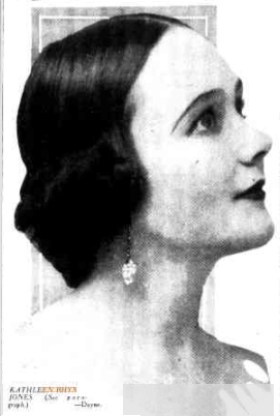
Katie Rhys-Jones in 1931[2]Table Talk 25 June 1931, P25, via Trove

Born Kathleen Margot Rhys-Jones,[3]Victorian Births Deaths and Marriages, Birth Certificate 1632/1914 (Katie to the family), in South Yarra, Melbourne, in 1914 to Philip, variously described as a manager or engineer and Nellie nee Hussey. Katie Rhys-Jones attended St Catherine’s Girl’s School in Toorak, Melbourne, at the same time as Janet Johnson and Gwen Munro, who also went on to acting careers. While still aged in her teens, Katie gained some publicity for appearing in charity fundraising performances. The photograph at left shows 17 year old Katie while performing in the play Prunella, for Melbourne’s Queen Victoria Hospital.

In Late 1931,[4]Table Talk, 29 Oct 1931, P38, Social, via National Library of Australia’s Trove after completing school, she moved to Sydney to attend Miss Jean Cheriton’s Doone finishing school – thus becoming a contemporary of Margaret Vyner.[5]The Daily Telegraph (Syd), 25 Feb 1932, P10, PARTY FOR Margaret FAIRFAX. Via National Library of Australia’s Trove At Doone, languages, dance, music, elocution and performance arts were all part of the curriculum, alongside tennis and fencing, in what Cheriton liked to characterise as a “leisurely” learning environment, for young women who were ready to take their places in society.

Doone finishing school, apparently Australia’s only such school, about the time Katie attended. Left, an advertisement for the school[6]The Home, 1 October 1930, P10. via National Library of Australia’s Trove Right, a photo from the State Library of New South Wales, Sam Hood collection, showing students in1933.[7]Online Digital Collection, Sam Hood Collection, State Library of New South Wales.

For much of 1933, Katie modelled, performed in radio dramas and on stage with the Sydney Repertory Company. But her big breakthrough came in August 1933, when she gained a role in a play with visiting German actor-director Theo Shall, when she also adopted the stage name Margot Rhys.[8]The Age, 4 Aug 1933, P9, THEO SHALL IN NEW PLAY. Via National Library of Australia’s Trove

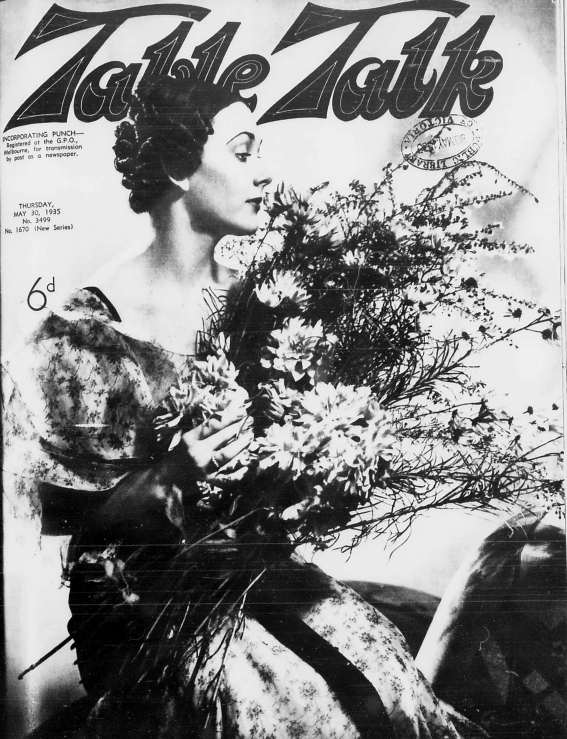
Margot Rhys (Kathleen Rhys-Jones) , photographed by Athol Shmith, at the height of her fame in 1935.[9]Table Talk, May 30, 1935, cover, Via State Library of Victoria

Theo Shall,[10]1896-1955, real name William Guldner, according to the German National Library had arrived in Australia in July 1932 at the invitation of JC Williamsons, the theatre company so dominant in Australia it was commonly known as “the firm.” He spent almost two years (August 1932 – June 1934) bringing “continental” theatre to Australian cities, with mixed success.[11]The Australasian 1 Oct 1932, P7. The Play Is Not The Thing. Via National Library of Australia’s Trove See Note 1 below regarding the Theo Shall tour.

Margot Rhys appearing in the play Fair Exchange with Theo Shall in Melbourne in late 1933. Maria Von Wyl (real name Von Wymental) was Shall’s wife.[12]The Argus (Melb) 12 August 1933., P28. Via National Library of Australia’s Trove

A translated version of Fair Exchange [13]by Viennese writer Bruno Frank found an audience and some enthusiastic supporters when it opened in Melbourne in late August 1933. But not everyone liked it. Several newspaper reviewers found fault with the acting and felt it a poor choice of play. And Table Talk, usually so enthusiastic for new productions, thought 19 year old supporting actress Margot Rhys was too inexperienced.[14]Table Talk, 24 August 1933, P14, Via National Library of Australia’s Trove Shall followed this with the farce Baby Mine, with Margot Rhys again in a supporting role.

Theo Shall and Marie Von Wyl in Sydney in late 1932[15]The Sun (Sydney) 4 Dec 1932, P31, via National Library of Australia’s Trove

We are fortunate in that Katie, as up and coming actor Margot Rhys, left some public thoughts about the experience of working with Theo Shall. In September 1933 she commented: “He arouses and brings something out of you that has been lying dormant and of which you were scarcely aware. By his methods he awakens you to realisation of your possibilities. It is his thoroughness, and his patience, which so impresses you, and which is so wonderful.”[16]Table Talk, 21 Sep 1933, P20, The Stage and the Paint Brush It may well have been wonderful, but not long after this she left Shall’s company. In early March 1934, Margot was announced as taking the leading role of pioneer woman Jane Judd, in Charles Chauvel’s upcoming film Heritage. With her was 16 year old Peggy (later Mary) Maguire, another “find” of Chauvel’s.[17]Chauvel could also lay claim to having discovered Errol Flynn

Margot Rhys, photographed when her role in Heritage was announced.[18]Truth (Sydney) 18 Mar, 1934, P23. Via National Library of Australia’s Trove

Charles Chauvel deserves his reputation as an Australian filmmaking pioneer, however most modern viewers will find Heritage heavy weather. Paul Byrnes at the NFSA suggests “even in 1935, Chauvel’s tendency to preach and berate, rather than dramatise, made the film seem like a tiresome lecture. It was not a success.[19]Australian Screen, National Film and Sound Archive website. Heritage, Curator’s notes. Paul Byrnes In their account of the film, Film historians Andrew Pike and Ross Cooper report that shooting commenced in April 1934 and took almost six months – an extraordinary length of time for an Australian film of the era. However, with its themes of pioneer struggles and nation building, the film struck a chord with political leaders, and won first prize of £2,500 in the Commonwealth Government’s Film competition.[20]Andrew Pike & Ross Cooper (1980) Australian film 1900-1977, P224-226. Oxford University Press/AFI And clearly Chauvel was happy with Margot as an actor, as he cast her again in his next film, Uncivilised.

Franklyn Bennett and Margot Rhys as a pioneer couple in Heritage (1935). Screengrab from a copy in the author’s collection.

Filming of Uncivilised began in late 1935, with English actor Dennis Hoey brought out to play a leading role opposite Margaret.[21]The Age, 10 Oct 1935, P7, AMUSEMENTS. Via National Library of Australia’s Trove Mary Maguire had signed up to appear in National Production’s The Flying Doctor, so despite suggestions she would work for Chauvel again, she was not available.

Margot and Mary Maguire – rising stars popular enough to be advertising. At left – for makeup. [22]in The Hebrew Standard of Australasia, 24 Jan, 1936, P1. Via National Library of Australia’s Trove At right – Margot Rhys announced as Vacuum Oil’s Miss Ethyl.[23]The Daily Examiner, Nov 14, 1935, P14, via National Library of Australia’s Trove

Sadly, Uncivilised has aged even less successfully than Heritage. Paul Byrnes aptly describes it as an Australian version of a Hollywood Tarzan movie. This writer’s view is that Chauvel seems to have wheeled out almost every imaginable jungle film stereotype – including Mara, the white ruler of an indigenous tribe (Hoey); a shifty “half cast” in the best traditions of Tondelayo from White Cargo; drug smuggling; fabulous rubies; and a wicked Afghan. The best that can be said of it, is that it is “of its time.” Margot Rhys is competent in the leading role of Beatrice Lynn, an author, who goes, inexplicably, on her own, in search of Mara.

Screengrabs of Margot Rhys as Beatrice in Uncivilised (1936). The skinny-dipping scene at right was cut for the export edition. Clearly a stand-in was used in some shots – such as this one. Author’s collection.

The film was completed by April 1936, and Hoey went home, after making the usual complements about the wonderful experience of filming-making in Australia, that seem to have become a established tradition for visiting actors even in the mid 1930s.[24]Also see for example, visiting British director Miles Mander, who felt that “the average Australian is 25% better developed than the Englishman”, or his screenwriter JOC Orton, who said … Continue reading The film gained some further fame when Australia’s chief censor banned it for export.[25]This meant it could be shown in Australia uncut, but not exported! See The Courier-Mail (Bris) 22 Sep, 1936, P13, BAN ON AUSTRALIAN FILM. Via National Library of Australia’s Trove The cuts required were scenes of Margot Rhys skinny-dipping and a scene from the final fight, where an Indigenous man is strangled.

A grainy photo of Margot’s 21st birthday on the set of Uncivilised. Charles Chauvel is in the centre of this posed shot, toasting Margot at left. [26]See the original here – Telegraph (Bris), Monday 30 March 1936, P6. Via National Library of Australia’s Trove

In early April, as the film wrapped, another announcement was made. Margot Rhys, now aged 21, would soon marry Dalzell Mein, a grazier. Charles Chauvel said he hoped she would not retire as an actor, but she did. The couple honeymooned in Hawaii, and then returned to run “Toolang,” a large property near Coleraine, in Victoria’s western district.[27]Several newspapers implied the trip to Hawaii might be the start of a US film career Three years later she was more than happy to describe herself “as a complete country bumpkin and proud of it.[28]The Sun (Syd) 21 Jun 1939, P13, via National Library of Australia’s Trove Of course, she was never a country bumpkin and her occasional return visits to Melbourne were still noted with interest in society pages of newspapers.

A very happy Dal Mein and Katie on their wedding day in 1936, from the society page of Table Talk.[29]Table Talk, May 26, 1936, PIV. Via National Library of Australia’s Trove

If Katie Mein ever regretted giving up her career, she never said so. A number of her contemporaries kept working after marriage – Mary Maguire and Margaret Vyner for example. But we cannot assume that the experience of working with Shall and Chauvel was such a thoroughly enjoyable one, it was preferable to life on the land. Perhaps it wasn’t.

Katie Mein died of cancer in Adelaide in June 1996. She was survived by a daughter.[30]SA Geneology – Kathleen Mary (Katie) MEIN (Newspaper Death Notices) 21 Jun 1996 To this writer’s knowledge, she was never interviewed or asked to record her experiences of her three years performing and being continually in the public eye.

Charles Chauvel died in 1959. Arguably his best film was Jedda (1955), also his last, which showed that, twenty years later, he had moved on from his 1930s vision of Indigenous Australians as stock characters in films. The colour film[31]Australia’s first colour film, and made with considerable difficulty concerned a love story between an Indigenous man and woman, and was a fitting finale to his long career.[32]You can read more about Jedda here


Note 1 – The Theo Shall tour of 1932-1934

Theo Shall arrived in Australia with considerable fanfare – he had appeared on stage and screen in Germany, Britain, and had been in a US film with Greta Garbo. Despite his reputation, it was a somewhat tumultuous two years, with several plays cancelled and rescheduled and inconsistent reviews of his work. Shall’s Australian sojourn is worth an entire study of its own, but there are few references to him beyond contemporary newspapers. Writing in 1965 when some Australians could still recall meeting Shall, Eric Porter described him as “handsome but hysterical…” Porter also suggested that Shall was very difficult to work with – his “backstage tantrums outmatched Oscar Asche’s…[33]Eric Porter(1965) Stars of Australian Stage and Screen. P218, Rigby Some evidence supporting this claim exists. In early 1933 Shall’s wife Maria Von Wyl took great umbridge and refused to perform because she was billed beside (rather than above) a young Australian actor called Coral Browne.[34]The Herald 19 Jan 1933, P1. ACTRESS WILL NOT PLAY. Via National Library of Australia’s Trove.

Left: Maria Von Wyl in Australia in 1933.[35]Table Talk, 24 August 1933, P20. Via National Library of Australia’s Trove Right: Theo Shall on the cover of Table Talk, 1933. [36]Table Talk 18 May 1933, Via National Library of Australia’s Trove

Shall departed Australia in something of a hurry in June 1934, cancelling a scheduled performance in Adelaide.[37]The Advertiser 25 May 1934, P14, Production Of “Love’s The Best Doctor” Cancelled. Via National Library of Australia’s Trove He went back to Britain to make films, and then eventually went on to Germany. He is famous today for the wrong reason – for roles in Nazi propaganda films, such as Titanic (1943). He died in East Berlin in 1955. Maria Von Wyl’s later fate remains unknown.

Nick Murphy
March 2022


Further reading

This site has been selected for preservation in the National Library of Australia’s Pandora archive

Footnotes

Footnotes
1 Table Talk, 21 September 1933, P20, via National Library of Australia’s, Trove
2 Table Talk 25 June 1931, P25, via Trove
3 Victorian Births Deaths and Marriages, Birth Certificate 1632/1914
4 Table Talk, 29 Oct 1931, P38, Social, via National Library of Australia’s Trove
5 The Daily Telegraph (Syd), 25 Feb 1932, P10, PARTY FOR Margaret FAIRFAX. Via National Library of Australia’s Trove
6 The Home, 1 October 1930, P10. via National Library of Australia’s Trove
7 Online Digital Collection, Sam Hood Collection, State Library of New South Wales.
8 The Age, 4 Aug 1933, P9, THEO SHALL IN NEW PLAY. Via National Library of Australia’s Trove
9 Table Talk, May 30, 1935, cover, Via State Library of Victoria
10 1896-1955, real name William Guldner, according to the German National Library
11 The Australasian 1 Oct 1932, P7. The Play Is Not The Thing. Via National Library of Australia’s Trove
12 The Argus (Melb) 12 August 1933., P28. Via National Library of Australia’s Trove
13 by Viennese writer Bruno Frank
14 Table Talk, 24 August 1933, P14, Via National Library of Australia’s Trove
15 The Sun (Sydney) 4 Dec 1932, P31, via National Library of Australia’s Trove
16 Table Talk, 21 Sep 1933, P20, The Stage and the Paint Brush
17 Chauvel could also lay claim to having discovered Errol Flynn
18 Truth (Sydney) 18 Mar, 1934, P23. Via National Library of Australia’s Trove
19 Australian Screen, National Film and Sound Archive website. Heritage, Curator’s notes. Paul Byrnes
20 Andrew Pike & Ross Cooper (1980) Australian film 1900-1977, P224-226. Oxford University Press/AFI
21 The Age, 10 Oct 1935, P7, AMUSEMENTS. Via National Library of Australia’s Trove
22 in The Hebrew Standard of Australasia, 24 Jan, 1936, P1. Via National Library of Australia’s Trove
23 The Daily Examiner, Nov 14, 1935, P14, via National Library of Australia’s Trove
24 Also see for example, visiting British director Miles Mander, who felt that “the average Australian is 25% better developed than the Englishman”, or his screenwriter JOC Orton, who said that “the most beautiful girls in the world are to be found in Australia
25 This meant it could be shown in Australia uncut, but not exported! See The Courier-Mail (Bris) 22 Sep, 1936, P13, BAN ON AUSTRALIAN FILM. Via National Library of Australia’s Trove
26 See the original here – Telegraph (Bris), Monday 30 March 1936, P6. Via National Library of Australia’s Trove
27 Several newspapers implied the trip to Hawaii might be the start of a US film career
28 The Sun (Syd) 21 Jun 1939, P13, via National Library of Australia’s Trove
29 Table Talk, May 26, 1936, PIV. Via National Library of Australia’s Trove
30 SA Geneology – Kathleen Mary (Katie) MEIN (Newspaper Death Notices) 21 Jun 1996
31 Australia’s first colour film, and made with considerable difficulty
32 You can read more about Jedda here
33 Eric Porter(1965) Stars of Australian Stage and Screen. P218, Rigby
34 The Herald 19 Jan 1933, P1. ACTRESS WILL NOT PLAY. Via National Library of Australia’s Trove
35 Table Talk, 24 August 1933, P20. Via National Library of Australia’s Trove
36 Table Talk 18 May 1933, Via National Library of Australia’s Trove
37 The Advertiser 25 May 1934, P14, Production Of “Love’s The Best Doctor” Cancelled. Via National Library of Australia’s Trove

Gwenda Wilson (1921-1977) – from ‘Janie’ to ‘the Archers’

Enlargement of Gwenda Wilson, playing Margaret the nurse in the 1946 JC Williamson production of John Patrick‘s The Hasty Heart, with John Wood. Courtesy the Australian Performing Arts Collection, Melbourne Australia.

The five second version
When Melbourne-born Gwenda Wilson died in 1977, fans of the BBC radio series The Archers mourned the actor’s passing. For twenty years she had played Aunt Laura, a “crusty, bossy, but lonely widow,”[1]The Guardian 19 August 1977, P 14 via Newspapers.com a New Zealand interloper who had moved into the village of Ambridge, having inherited Ambridge Hall. One correspondent felt it would be difficult to find a replacement actor “who could exactly imitate (her) distinctive Antipodean whine and put such righteous indignation into the part.”[2]Birmingham City Post 23 August 1977 P4. Via British Library Newspaper Archive
In addition to her role in The Archers, she appeared occasionally on the British stage, on TV and in a handful of British films. Before she left Australia in late 1948, she had enjoyed six busy years on the stage and in radio in Australia. She was aged only 55 at the time of her death.

Gwenda Wilson, undated. Ritter-Jeppesen Studios, 107-111 Lonsdale Street, Melbourne. Frank Van Straten Collection, Melbourne.

Gwenda Olive Wilson was born in September 1921,[3]Gwenda Wilson, UK Death Certificate in Melbourne, Australia, to Albert Wilson, a furniture manufacturer, and Elsie nee Field. She grew up in the inner eastern suburb of Kew, and attended nearby Methodist Ladies College, where she developed a passion for performance. She won a scholarship to study music at the University of Melbourne, (she later said that her father had dreams of her being a soprano) but it is clear that her passion from a young age was acting. While at the University she regularly featured in amateur performances, including with the University’s Tin Alley Players. She also studied with speech and drama teacher Maie Hoban, in company with Patricia Kennedy, Coral Browne and others.[4]The Australasian (Melb), 24 Feb 1945 P16, Via National Library of Australia’s Trove

Gwenda Wilson, photographed by Athol Shmith, 1946. Australian Performing Arts Collection, Melbourne.

In 1942, having saved £20, she moved to Sydney. After some radio performances she won a breakthrough role as Janie, in the new US play of the same name, which opened at the Minerva Theatre in 1943.[5]ABC Weekly, Vol. 10 No. 21, 22 May 1948, P30. Via National Library of Australia’s Trove

Gwenda’s role as Janie was celebrated by Jim Russell, a cartoonist for Smith’s Weekly. [6]Smith’s Weekly 5 June 1943, P19. Via National Library of Australia’s Trove

Janie concerned a small town girl who hosts a party for US servicemen that gets out of control while her parents are absent – perhaps the idea was a novelty for Australian audiences at the time. On stage with Gwenda were well established Australian performers like Fifi Banvard, and new faces including Margo Lee and Betty McDowall.[7]It was directed by Melbourne-born Alec Coppel, who already had experience as a writer in England and had come back home in 1940. He later went on to a Hollywood career – writing numerous … Continue reading The play found an audience and it ran for two months – thus establishing Gwenda’s credentials, but it was generally dismissed by most as lightweight entertainment. One newspaper wrote that it was without “real character development, plot construction… (and had) the appeal…of a nice whopping chocolate soda.”[8]The Daily Telegraph, 9 May 1943, P23, Via National Library of Australia’s Trove

Gwenda repeated her breakthrough character Janie for radio in 1944 [9]ABC Weekly 27 May 1944, P12. Via National Library of Australia’s Trove

In October 1943, she took a leading role in Kiss and Tell, another play about modern youth from the US that had opened on Broadway only a few months before. It enjoyed a record 53 week run in Melbourne, and long runs in other Australian cities.[10]Viola Tait (1971) A Family of Brothers. P165 Heinemann 21 year old Gwenda gave a “finished and charming interpretation” as Corliss Archer.[11]The Argus (Melb) 13 Dec 1943 P6, Via National Library of Australia’s Trove It was while working on this play that she was caught up in the 1944 “theatrical dispute,” between JC Williamsons, the Australian theatrical monopoly, and Actor’s Equity, over conditions and the use of non-union performers. Gwenda was one of the striking performers issued with a writ to prevent them appearing in an Equity fund-raising performance. The strike was resolved after three weeks and the principle of the “closed shop” for the Australian theatre firmly established – so Equity succeeded.[12]For a contemporary account of the strike see The Age (Melb) 29 May 1944, P3. For a management view of the strike see Viola Tait (1971) A Family of Brothers. P172-175

In January 1945, Gwenda married former serviceman and Tasmanian-born actor Don Sharp.[13]Births Deaths & Marriages Victoria, Marriage certificate 1945/4791 The couple announced their plans to go to London to perform, even though the war was still on.[14]The Argus (Melb),13 Mar 1945, P7. Via National Library of Australia’s Trove In the meantime, there was no shortage of opportunity to perform in radio and on the stage, with Gwenda being heralded as “the new find.”(see Note 1)

Left: Gwenda and Madge Aubrey in Kiss and Tell c1943-45. Right: John Wood with Gwenda in The Hasty Heart c1946. J C Williamson Collection of Photos, via National Library of Australia’s Trove.

In mid 1947, Gwenda and Don joined a company formed to take The Hasty Heart and While the Sun Shines, to occupation forces in Japan. Don Sharp used his service connections to help establish the tour, John Wood, 2 years after his release from a Japanese POW camp, produced and took a leading role. Gwenda reprised her role as nurse Margaret. Also in the company was Wood’s English wife Phyl Buchanan. By late 1947 the Japan tour had concluded and the company returned to Australia. However, as Don Sharp explains in his 1993 interview with the London History Project, instead of returning, he made his way to England, by finding passages on various interconnecting cargo ships. Although Gwenda and Don seem to have maintained an cordial relationship in later years, this was apparently the end of the marriage.

Gwenda, as a leading young performer in Australia, had little trouble finding more work in Australia. She appeared on radio again, and in two Fifi Banvard productions at the Minerva Theatre in Sydney in 1948, Ah Wilderness and Philadelphia Story. But the truth was, as Don Sharp remarked, that the choice for post-war Australian performers was stark. They could either stay – meaning they would continue to work for JC Williamsons, or on radio, or if they were lucky in a rare Australian film. Alternatively, they could try their luck overseas – where the opportunities seemed boundless. Not surprisingly, in December 1948, Gwenda boarded the Shaw Saville ship Arawa for England, joining the great post-war exodus of Australian performers.

Gwenda (left) farewells John Wood (rear) and other Australians heading for England in September 1948. [15]ABC Weekly 18 Sept 1948, P14 Via National Library of Australia’s Trove

Newspaper reports of the doings of Australians in London were usually celebratory, sometimes tinged with nationalistic patter. After all, who wanted to read that someone, well known in Australia, struggled to find work in the heart of the Empire. In March 1949, Truth newspaper reported Gwenda as one of a number of “Sydney actors having a busy time in London,” while she lived with old friends John Wood and Phyl Buchanan.[16]Truth (Syd) 20 March 1949, P35. Via National Library of Australia’s Trove[17]For other articles like this see The Sydney Morning Herald, 14 Aug 1950, P3, Australian Actor Praised, The Newcastle Sun, 14 Jul 1951, P4 Film Role For Young Australian Actor, The Sun (Syd) 12 Nov … Continue reading

But an unusually frank report in a 1965 newspaper finally acknowledged that for many Australian actors, finding work in London was a constant challenge. Gwenda’s friend Betty McDowall described it as “tough as hell.”[18]The Canberra Times, 24 Apr 1965, P9. The struggle from Down Under to acting up top. Via National Library of Australia’s Trove All the same, records show Gwenda found small roles in films and on stage not long after she arrived. One of her first outings was a minor role in Ha’penny Breeze (1950). In his 1993 interview, Don Sharp outlined the extraordinary effort required to make this, his very first British film, which he helped write, produce and took a leading role in. Despite the effort, and Sharp’s later reputation as a British director of note, this film met with a mixed response. Gwenda also appeared in rep with Robert Raglan, touring Britain in Summer in December and Born Yesterday. She then had a small role on stage in London as a nurse in the farce To Dorothy a Son at the Savoy Theatre,[19]Theatre World, 1951, Vol 47, issue 313, via the Internet Archive and in the film Gift Horse, where she played a WREN.[20]The Sun (Syd)18 Oct 1951, P36, Film news from Hollywood and London, via National Library of Australia’s Trove

Screengrab of Joan Rice and Gwenda in Gift Horse, aka Glory at Sea (1952)

In May 1952, she married again, to Malcolm Halkeston MacDougal, a lawyer.[21]Chelsea News and General Advertiser, 9 May 1952, P1, Via British Library Newspaper Archive[22]Butterworth’s Empire Law List, 1961, P32. Butterworth’s. Via Google Books MacDougal, an Australian-born man standing well over 6 feet in height, gained some notoriety in 1953 when he was taken to court for “lightly boxing the ears” of several British Union speakers in Chelsea, apparently while in the company of Gwenda.[23]Chelsea News and General Advertiser, 3 July 1953, P1 The Shutterstock Photo Archive holds a photo of Gwenda on her wedding day, here. But it appears this marriage ended sometime in the late 1950s.[24]Eric Lambert’s 1965 book MacDougal’s Farm is apparently based on MacDougal’s experience as a wartime POW. Known in the army as “Big Mac,” MacDougal died suddenly in … Continue reading

There was coincidentally, another role in a film scripted by Don Sharp – Conflict of Wings in 1954, but it appears much of Gwenda’s modest output in the 1950s was on radio and in TV guest roles. While the reviews of her work are sparse, a few film roles are still accessible to us today – including the thoroughly unpleasant character Jean in the enjoyable and well acted B-film Dangerous Afternoon (1961).

Above – screengrabs from Dangerous Afternoon (1961) with Ruth Dunning as Letty and Gwen playing the nasty (and soon to be murdered) Jean. Screen grabs from copy in the author’s collection.

Gwenda first appeared as the character Aunt Laura on The Archers in May 1957. Non-Britons (including the present writer) are at a decided disadvantage regarding The Archers – for the simple reason most of us have not heard it. This radio drama of English rural life in the fictional village of Ambridge began in 1951, and is still running today, in 12 minute daily episodes on the BBC.[25]See the BBC’s website devoted to the Archers The series was broadcast for a while in Canada, Australia and other Commonwealth countries, but appears to have been dropped by most in the late 1960s.[26]William Smethurst (1988) The Archers. The true story : the history of radio’s most famous programme. P97-101. Michael O’Mara, London For those not familiar with the show and who cannot understand its popularity for 70 years, Lyn Thomas from the University of Sussex provides an explanation, here at the Conversation.com

Gwenda’s death from lung cancer in August 1977[27]UK General Register Office, Death Certificate Gwenda Olive Wilson or MacDougal was quite sudden and apparently unexpected. BBC producer Tony Shryane recalled losing a much loved colleague, mid show: “Gwenda and I had been friends for many years, even before she joined The Archers… She was a delightful artiste whose infectious gaiety made her popular with everyone and she had that indefinable Australian quality that kept her going at parties when everyone else was beginning to fade. When she died, I could not believe that her energy and enthusiasm would no longer be there to enliven our rehearsals and recordings.[28]William Smethurst (1988) The Archers. The true story : the history of radio’s most famous programme. P148-149. Michael O’Mara, London

Gwenda Wilson in the early 1970s. Photo from the Gwenda Wilson collection, Australian Performing Arts Collection, Melbourne, Australia. [29]The context and photographer is unknown

Many might have expected Aunt Laura would now be written out of the series, but fans need not have worried. Another Australian born actor, Betty McDowall, the same one who had appeared with Gwenda in Janie back in Sydney in 1942, immediately took over the role. Aunt Laura lived on for another eight years.


Note 1 – Some recipes from Gwenda.

A lengthy article in Melbourne’s Argus newspaper in 1946 presented Gwenda as the “new theatrical find” and reported that her passions were cooking and gardening. Also listed were some of her favourite recipes which are included below. (The author has tried the Ham and Macaroni pie)


“With nightly performances, matinees, and rehearsals, the Don Sharps naturally have little time for entertaining, but they love having people in for Sunday night supper. Here are some of the dishes Gwenda serves her guests on such occasions:

HAM AND MACARONI PIE
Line a pie dish with macaroni which has been cooked till soft. Cover with minced ham (or any meat) and chopped parsley. Season to taste. Then layer of tomatoes. Moisten with a little stock or gravy. Cover with mashed potatoes to which has been added a little butter and milk. Glaze top with beaten egg and bake 15 to 20 minutes in hot oven.

RABBIT IN ASPIC
One rabbit, cut up and cooked with enough water to cover. Add few bacon rashers and small chopped onion. Season to taste. When cooked remove all bones. Measure liquid and dissolve 1 dessertspoon gelatine, 1 cup liquid. Place hard-boiled eggs and green peas around inside mould, then arrange cooked rabbit and pour over liquid, and leave to set. Turn out and garnish with parsley or chopped mint.”
[30]The Argus (Melb) 8 Jan 1946 P8 Young Actress is Hostess at Sunday Night Suppers


Nick Murphy
February 2022 and May 2023


Special Thanks

  • To Claudia Funder at the Australian Performing Arts Collection, Melbourne, who alerted me to their collection of photos and ephemera – that once belonged to Gwenda herself. After her early death, it found its way, via her friends, to the collection.

Further Reading

Text

  • Eric Lambert (1965) MacDougal’s Farm. Frederick Muller Ltd, London.

Media

  • Teddy Darvas and Alan Lawson. (2 November 1993). London History Project – Film, Television, Theatre, Radio. “Interview with Don Sharp” (8 parts)

Australian Dictionary of Biography, National Centre of Biography, Australian National University

Newspaper & Magazine Sources

  • National Library of Australia’s Trove
  • National Library of New Zealand, Papers Past
  • Newspapers.com
  • British Library Newspaper Archive
  • Lantern, the Media History Digital Library

Primary Sources

  • Familysearch.com
  • Ancestry.com
  • Victoria, Births, Deaths and Marriages
  • New South Wales, Births, Deaths and Marriages
  • General Register Office, HM Passport Office.

This site has been selected for preservation in the National Library of Australia’s Pandora archive

Footnotes

Footnotes
1 The Guardian 19 August 1977, P 14 via Newspapers.com
2 Birmingham City Post 23 August 1977 P4. Via British Library Newspaper Archive
3 Gwenda Wilson, UK Death Certificate
4 The Australasian (Melb), 24 Feb 1945 P16, Via National Library of Australia’s Trove
5 ABC Weekly, Vol. 10 No. 21, 22 May 1948, P30. Via National Library of Australia’s Trove
6 Smith’s Weekly 5 June 1943, P19. Via National Library of Australia’s Trove
7 It was directed by Melbourne-born Alec Coppel, who already had experience as a writer in England and had come back home in 1940. He later went on to a Hollywood career – writing numerous screenplays, including Vertigo (1958)
8 The Daily Telegraph, 9 May 1943, P23, Via National Library of Australia’s Trove
9 ABC Weekly 27 May 1944, P12. Via National Library of Australia’s Trove
10 Viola Tait (1971) A Family of Brothers. P165 Heinemann
11 The Argus (Melb) 13 Dec 1943 P6, Via National Library of Australia’s Trove
12 For a contemporary account of the strike see The Age (Melb) 29 May 1944, P3. For a management view of the strike see Viola Tait (1971) A Family of Brothers. P172-175
13 Births Deaths & Marriages Victoria, Marriage certificate 1945/4791
14 The Argus (Melb),13 Mar 1945, P7. Via National Library of Australia’s Trove
15 ABC Weekly 18 Sept 1948, P14 Via National Library of Australia’s Trove
16 Truth (Syd) 20 March 1949, P35. Via National Library of Australia’s Trove
17 For other articles like this see The Sydney Morning Herald, 14 Aug 1950, P3, Australian Actor Praised, The Newcastle Sun, 14 Jul 1951, P4 Film Role For Young Australian Actor, The Sun (Syd) 12 Nov 1953, P39 ACTOR SAYS OPPORTUNITY IN ENGLAND, News (Adel)10 Nov 1954, P2 SA actor gets film contract. Via National Library of Australia’s Trove
18 The Canberra Times, 24 Apr 1965, P9. The struggle from Down Under to acting up top. Via National Library of Australia’s Trove
19 Theatre World, 1951, Vol 47, issue 313, via the Internet Archive
20 The Sun (Syd)18 Oct 1951, P36, Film news from Hollywood and London, via National Library of Australia’s Trove
21 Chelsea News and General Advertiser, 9 May 1952, P1, Via British Library Newspaper Archive
22 Butterworth’s Empire Law List, 1961, P32. Butterworth’s. Via Google Books
23 Chelsea News and General Advertiser, 3 July 1953, P1
24 Eric Lambert’s 1965 book MacDougal’s Farm is apparently based on MacDougal’s experience as a wartime POW. Known in the army as “Big Mac,” MacDougal died suddenly in September 1962, without recounting his experiences himself. Lambert’s book was not well received
25 See the BBC’s website devoted to the Archers
26 William Smethurst (1988) The Archers. The true story : the history of radio’s most famous programme. P97-101. Michael O’Mara, London
27 UK General Register Office, Death Certificate Gwenda Olive Wilson or MacDougal
28 William Smethurst (1988) The Archers. The true story : the history of radio’s most famous programme. P148-149. Michael O’Mara, London
29 The context and photographer is unknown
30 The Argus (Melb) 8 Jan 1946 P8 Young Actress is Hostess at Sunday Night Suppers

Gwen Gaze (1915-2010) The girl in the Westerns from Melbourne

Screen grab of 26 year old Gwen Gaze, with her trademark smile and blonded hair for the film Underground Rustlers (1941). The film can be watched here at the Internet Archive. Note – photos of Gwen Gaze are uncommon, so most of the photos used here are screen grabs or from contemporary newspapers.

Gwen best
The Five Second Version
Gwen Gaze was an Australian born actor who appeared in about a dozen Hollywood films in the late 1930s, mostly Westerns. Born in Melbourne in 1915, her father – singer and actor Leslie Gaze (1880-1957) –  had brought the family to Los Angeles in the early 1920s. She studied for two years at RADA in London before her first role in a B film with John Wayne in 1937. In 1944 she married and mostly retired from films, although she maintained an interest in performing all her life. She became a US citizen in 1940. Her uncle was highly regarded illustrator Harold Gaze (1884-1963)

In 1939, 24 year old actor Gwen Gaze told a journalist in Hollywood that she was eager to return to the land of her birth to appear in an Australian film. “If they would pay my expenses… I would work for buttons” she reportedly said.[1]The Sun (Sydney) 11 June 1939, P12, Via National Library of Australia’s Trove It was a very witty comment, but she did not return to Australia. She had left Australia at the age of 7 with her parents, and grew up in Pasadena in California. Like so many other young women in Hollywood’s golden age, Gwen Gazes film output ended up being very modest – between 1937 and 1949 she had roles in perhaps a dozen or so movies.

25 year old Gwen in her 1940 US naturalisation document. Via Ancestry.com

Alta Gwendolen Gaze was born in Brighton, a southern suburb of Melbourne Australia, in 1915. [2]Births Deaths and Marriages, Victoria, Certificate 18975/1915 Her Adelaide born father, Leslie Gaze (1880-1957) was an actor and singer,[3]The Advertiser (Adelaide) 29 Mar 1912 P8 “THROUGH ADVERSITY.” Via National Library of Australia’s Trove[4]Referee (Sydney) 17 Mar 1915, P15 “THE IDEALS OF LESLIE GAZE” Via National Library of Australia’s Trove her mother Alta May nee Tomlinson (1885-1948) was “a brilliant pianist,”[5]The Bulletin. Vol. 54 No. 2771, 22 Mar 1933. P18 Via National Library of Australia’s Trove born in Chicago.

Leslie Gaze c1918[6]Graphic of Australia (Melb)14 Nov 1918  P10, Via National Library of Australia’s Trove

Judging by Leslie Gaze’s movements and his public comments over time, it seems settling down in the one spot with a consistent career was never a priority. He had lived and performed in Britain, the US and then returned to appear in the operetta The Chocolate Soldier in Australia and New Zealand in 1911. Reviews consistently commented on his good looks, impressive stage presence and beautiful voice.[7]Punch (Melbourne)17 Aug 1911, P16 MR. LESLIE GAZE Via National Library of Australia’s Trove Perhaps Leslie was a restless personality – he stayed in Australia for a decade, sometimes appearing on stage, but also turned to farming squabs (pigeons) in Victoria. In about 1920 the family moved to Sydney where another daughter was born, and Leslie took up teaching singing.[8]Pamela Wentworth Gaze, The Sydney Morning Herald, 3 Mar 1921, P 8 Family Notices. Via National Library of Australia’s Trove Then in late 1922, the whole family departed for the US, via New Zealand, for reasons that were never publicly explained. By April 1923, they were in Los Angeles, where Leslie re-established himself as a real estate agent, while also singing and entertaining Californians with tall stories from Australia.[9]Such as his claim to have escaped a Grey Nurse Shark. Press-Telegram(Long Beach) 1 Jun 1923, P24 Via Newspapers.com[10]Shark attacks DO happen in Australian waters, but are rare. Glen Alyn also claimed she escaped a shark. It’s likely other Australian actors have also made this claim. The family settled in Pasadena, where Leslie again turned to teaching before finally becoming an insurance broker.

Left – Pamela Gaze in the play the Family Upstairs.[11]Pasadena Post 28 April 1932. Via Newspapers.com Right – Gwen Gaze in a Woodrow Wilson Junior High School production.[12]Pasadena Post, 27 Jan 1932. Via Newspapers.com

Gwen – back in the US and ready for films[13]Pasadena Post 17 May 1936. P13 Via Newspapers.com

It is hardly surprising that Gwen and her younger sister Pamela flourished in this family – where the creative arts – singing, acting and music were actively encouraged. By the early 1930s, both girls were appearing on stage in amateur productions, with Gwen spending some time studying at Pasadena College. Then, in September 1934, Gwen travelled to London on her own, to begin study at RADA, the Royal Academy of Dramatic Arts. The experience was clearly worthwhile – in March 1936 Gwen Gaze was noted by The Stage performing with other graduates in a presentation program at London’s Haymarket Theatre. Gwen had a part in selected scenes from J B Priestley’s The Good Performers.[14]The Stage 5 March 1936, P11. Via British Library Newspaper Archive She returned to the US in April 1936, and a few months later RADA listed her as one of their Certificate of Merit winners.[15]The Stage 22 October 1936, P10. Via British Library Newspaper Archive She was, as the supportive staff at The Pasedena Post reported, now “ready for films.”

Soon after this she landed her first film role, perhaps after being seen in Pasadena Little Theatre by a Universal Studios scout.[16]The Los Angeles Times, 12 Apr 1937, P34 via Newspapers.com In I Cover the War! she played a British officer’s niece, the romantic interest for John Wayne, playing tough-guy newsreel cameraman Bob Adams – on assignment in North Africa. As Film reviewer Stephen Vagg notes, director Arthur Lubin was extremely capable, but these “B movies” usually only took a few weeks to film and were churned out to cinemas hungry for product.[17]Stephen Vagg, Diabolique Magazine (Sept 14, 2019) “The Cinema of Arthur Lubin

The film was released in late July 1937 and at a little over 60 minutes it was clearly intended as a second feature. Yet it lived on, to be endlessly replayed years later on TV, as John Wayne’s popularity grew.

An intimate posed scene from I Cover the War! [18]Chattanooga Daily Times 10 Oct 1937, P30. Via Newspapers.com

Interviewed by her family almost 70 years later, Gwen could not recall John Wayne fondly – she thought he was completely preoccupied with his own career. One gains the impression she may have had more to say about Wayne, but probably thought better of it.[19]Gwen’s interview in 2006 can be seen here: Gwen Gaze: Her Life in Her Words@Vimeo

Director Arthur Lubin with Glen, soon after she signed her contract with Universal Studios. [20]The Pasadena Post 14 April, 1937, P5 via Newspapers.com

It should be noted that her experience in Hollywood B films was similar to that of her Melbourne contemporary Mary Maguire. At the same time Gwen was breaking into films, Maguire signed an exciting contract with Warner Bros. with some fanfare, and took ingénue roles in B films with leading players like Ronald Reagan, until so dissatisfied with the experience, she finally declined another such role.[21]And was promptly suspended without pay by the studio Gwen may have found some satisfaction in the slightly more sophisticated female roles she took in the Hopalong Cassidy (William Boyd) Westerns – Partners of the Plains (1938) and Bar 20 Justice (1938), both directed by Leslie Selander for Paramount. In both films she played an outsider new to the West, who Hopalong takes under his wing. There is romance in the air, but of course, being a Hopalong Cassidy film, nothing happens.

At the end of both films, Gwen’s characters leave for the big city life again. The west is apparently no place for a woman!

Screen grabs from Partners of the Plains. In this film Gwen played stuffy Englishwoman Lorna Drake, who has inherited a ranch. She not only learns to love the West but after a lot of banter, takes a shine to Hoppy. Source – Film Detective Channel on youtube.

Here Gwen sings “Moonlight on the Sunset Trail” for Partners of the Plains. It seems this was the only time she sang in a film.[22]The entire film can be seen here on the Film Detective Channel on youtube

Screen grabs from Bar 20 Justice. Gwen plays Ann Dennis, whose goldmine is at risk. In this film Gwen also showed she could competently ride a horse. Source – Video Rider Channel on youtube.

William Boyd starred in more than sixty Hopalong films and later made his fortune by negotiating the use of these by TV stations in the 1950s. Gwen only appeared in these two Hopalong Cassidy films. Her other major film undertaking in 1938 was The Secret of Treasure Island, a 15 part mystery serial made for Columbia – based closely on a story by L Ron Hubbard.

Gwen as Toni Morell, reacting to something scary, in Columbia’s thriller serial The Secret of Treasure Island. These screen grabs are from the TelaclassicTV version on youtube. [23]Episode 1 of the serial can be seen here.

While each twenty minute episode can be watched online and film historian Geoff Mayer has provided a helpful synopsis [24]Geoff Mayer (2017) Encyclopedia of American Film Serials. P253-254. McFarland, the serial is very much of its era, and the plot-holes can be distracting for the modern viewer. Each episode of these cliff-hanger serials was updated weekly at the cinema and human memory being what it is, viewers then were probably inclined to forget or at least be less distracted by the inconsistencies.

Gwen returned to the Western genre for Monogram pictures after 1940, and appeared in four of the “Range Busters” films – which usually featured Ray “Crash” Corrigan, John “Dusty” King and with comic relief provided by Max Terhune and his dummy Elmer (thus a ventriloquist cowboy – a comic device of its time). There were at least 24 Range Busters films made between 1940 and 1943, and a long list of (usually) brunettes who took the leading female roles, all of whom seem to somewhat resemble each other, and resemble Gwen – including Luana Walters, Lita Conway, Dorothy Short and real life horse women Evelyn Finley and Julie Duncan. The films were formulaic and predictable, but apparently popular enough with audiences. Many of these are available today – Underground Rustlers (1941) can be watched at the Internet Archive here.

Left – Gwen, with her characteristic smile in Underground Rustlers and with Crash Corrigan (in hat). Screengrabs via Internet Archive

There is some evidence Gwen sometimes appeared on stage in the 1940s. There is, for example, a reference to her performing in Nancy’s Private Affair in 1943 at the Mayan theatre in Los Angeles,[25]Los Angeles Evening Citizen News, 15 Jul 1943, P15 Via Newspapers.com but, in April 1944, Gwen married businessman Martin Straith and settled in Vancouver, British Columbia. Straith was apparently keen for her to retire.[26]Gwen Gaze: Her Life in Her Words@Vimeo Two children were born of the union in the next few years, but tragically, Straith died in 1948. Gwen was reported to be active on radio in Vancouver at this time, and she was also referred to as a performer with Vancouver Little Theatre, although exactly what roles she took is currently unknown. Her final film appearance – as an extra – was in Universal’s crime drama Johnny Stool Pigeon (1949), which had some scenes filmed in Vancouver.[27]The Province (Vancouver, BC) 9 Mar 1949, P6 Via Newspapers.com Perhaps there were others.

Gwen married twice more – in December 1950, to grain broker Chester Fellowes Burdic and in March 1966 to architect Arden C Steinhard. She died in 2010 in Seattle, Washington, aged 95. Although the 2006 family interview is only short, we gain some sense of what Hollywood’s golden age was like from her comments. However, there is really no evidence that she ever thought of herself or presented herself as “Australian” – in the way Mary Maguire, Constance Worth and others did. Her blended Australian-US family, two years of study in the UK and long period of residence on the US and Canadian west coast contributed to the interesting transatlantic accent heard in most of her films. When interviewed she spoke of having to moderate her accent for film work.

Note 1 Harold Gaze (1884-1963)

Harold Gaze as featured in a 1934 newspaper report [28]The Pasadena Post, 6 May 1934, P13, via Newspapers.com

Gwen recalled being close to her very creative New Zealand born uncle Harold Gaze, a renowned illustrator.

Some the children’s books he wrote and copyrighted while living in Melbourne c1920 are able to be viewed online at the National Archives of Australia, including
* The Wicked Winkapong
* Coppertop
* The Simple Jaggajay
* The Chewg-um-blewg-um
* The Billabonga Bird

Harold Gaze appears to have moved to California in the 1920s, at about the same time as Leslie and his family. Gwen could recall her uncle very fondly, reading to her as a child, and occasionally correcting her English. A few of his works have since been reprinted and many of his illustrations are for sale, although his life story is only partly documented. He lived in California for many years, but late in life he moved to England, living near Gwen’s sister Pamela, who had become a music teacher. He died in 1963.[29]See Independent Star-News (Pasadena) 29 Jul 1962, P42 and Pasadena Independent 12 Nov 1963, P15. Via Newspapers.com


Films


Nick Murphy
February 2022

This site has been selected for archiving and preservation in the National Library of Australia’s Pandora archive

Footnotes

Footnotes
1 The Sun (Sydney) 11 June 1939, P12, Via National Library of Australia’s Trove
2 Births Deaths and Marriages, Victoria, Certificate 18975/1915
3 The Advertiser (Adelaide) 29 Mar 1912 P8 “THROUGH ADVERSITY.” Via National Library of Australia’s Trove
4 Referee (Sydney) 17 Mar 1915, P15 “THE IDEALS OF LESLIE GAZE” Via National Library of Australia’s Trove
5 The Bulletin. Vol. 54 No. 2771, 22 Mar 1933. P18 Via National Library of Australia’s Trove
6 Graphic of Australia (Melb)14 Nov 1918  P10, Via National Library of Australia’s Trove
7 Punch (Melbourne)17 Aug 1911, P16 MR. LESLIE GAZE Via National Library of Australia’s Trove
8 Pamela Wentworth Gaze, The Sydney Morning Herald, 3 Mar 1921, P 8 Family Notices. Via National Library of Australia’s Trove
9 Such as his claim to have escaped a Grey Nurse Shark. Press-Telegram(Long Beach) 1 Jun 1923, P24 Via Newspapers.com
10 Shark attacks DO happen in Australian waters, but are rare. Glen Alyn also claimed she escaped a shark. It’s likely other Australian actors have also made this claim.
11 Pasadena Post 28 April 1932. Via Newspapers.com
12 Pasadena Post, 27 Jan 1932. Via Newspapers.com
13 Pasadena Post 17 May 1936. P13 Via Newspapers.com
14 The Stage 5 March 1936, P11. Via British Library Newspaper Archive
15 The Stage 22 October 1936, P10. Via British Library Newspaper Archive
16 The Los Angeles Times, 12 Apr 1937, P34 via Newspapers.com
17 Stephen Vagg, Diabolique Magazine (Sept 14, 2019) “The Cinema of Arthur Lubin
18 Chattanooga Daily Times 10 Oct 1937, P30. Via Newspapers.com
19 Gwen’s interview in 2006 can be seen here: Gwen Gaze: Her Life in Her Words@Vimeo
20 The Pasadena Post 14 April, 1937, P5 via Newspapers.com
21 And was promptly suspended without pay by the studio
22 The entire film can be seen here on the Film Detective Channel on youtube
23 Episode 1 of the serial can be seen here.
24 Geoff Mayer (2017) Encyclopedia of American Film Serials. P253-254. McFarland
25 Los Angeles Evening Citizen News, 15 Jul 1943, P15 Via Newspapers.com
26 Gwen Gaze: Her Life in Her Words@Vimeo
27 The Province (Vancouver, BC) 9 Mar 1949, P6 Via Newspapers.com
28 The Pasadena Post, 6 May 1934, P13, via Newspapers.com
29 See Independent Star-News (Pasadena) 29 Jul 1962, P42 and Pasadena Independent 12 Nov 1963, P15. Via Newspapers.com

Violet Hopson – the carpenter’s daughter who played a villainess

Above: Enlargement of Violet Hopson on an undated postcard – while working for Cecil Hepworth. Postcard in the author’s collection.
The five second version.
Born in Port Augusta, South Australia in 1887 as Elma Kate Victoria Karkeek,[1]Janice Healey, a British Film Institute librarian, is acknowledged with having first identified Violet Hopson’s real name. See Clare Watson (et al) Women and Silent British Cinema, however her … Continue reading Violet Hopson went on to a spectacular career in the British film industry in the 1910s and 20s. She has been widely recognised as one of the British cinema’s first female film stars, with an impressive 120 film appearances (mostly made between 1912 and 1925) to her credit. She worked with pioneer producer- director Cecil Hepworth and later in partnership with Walter West. In addition to her status as a popular British actor, she was also a producer on several successful films. She died in London in 1973, having obscured an Australian birth and childhood all her life. She was married to actor Alec Worcester from 1909-1918. Her sisters Zoe Karkeek (1879-1967) and Wilmot Karkeek (1880 -1962) were performers with Pollards Opera Company, Wilmot also appearing in India, South Africa and Britain with great success.
Above: Postcard of Violet Hopson c 1920 – while working with Walter West. Author’s collection,

In his 2005 book on the British film industry, Shepperton Bablyon, Matthew Sweet observes that many of Britain’s silent stars have left only fragments of their real, behind-the-screen stories for posterity. Thanks in part to “banal and mendacious publicity… their experiences have been turned and polished until they shine like lies.”[2]Matthew Sweet (2005) Shepperton Bablyon: The Lost Worlds of British Cinema. P35-36. Faber and Faber For up and coming actors, another factor was often in play too. Some had very human experiences they needed to disguise – embarrassing stories of disadvantage, divorce or illegitimacy. This also appears to have been the case for Violet Hopson, one of Britain’s first film stars.

A childhood in Australia… or California?

Throughout her life, Violet Hopson successfully maintained the pretence she was born in places other than Australia, most commonly claiming California. The Californian claim appeared repeatedly in film fan magazines and on official documents such as census returns, and this claim finally found its way into respected texts. We cannot know for certain why she went to such effort to do this, but clues exist in surviving records of her childhood, which suggest periods of turmoil and insecurity.

A popular and early image of Violet Hopson, taken sometime before 1914. Postcard in the author’s collection.

She was born Elma Kate Victoria Karkeek in 1887,[3]South Australia Geneology – Elma Kate Victoria Karkeck (sic), doc 409/139 in Port Augusta, South Australia, (but called Kate by the family) the youngest of four children born to William Charles Karkeek, a carpenter, and Josephine Lauretta nee Reynolds, a master mariner’s daughter from Hobart. Despite their fifteen year relationship, there is no record of a marriage between William and Josephine Lauretta.[4]A decade earler, in October 1867, sixteen year old Josephine had married miner John Henry Whitburn in the goldfields town of Maldon, Victoria. She bore him five children before the marriage failed … Continue reading Elma Kate Karkeek’s older siblings were Ora Zoe (usually just called Zoe, born 1879), Lauretta (sometimes spelled Lauratta, but usually known as Wilmot, born 1880) and Eugene Charles Byron (born 1886).[5]South Australia Geneology, docs 215/45, 252/174 and 369/226 respectively. By 1890 the family had moved to Adelaide – with Wilmot and Ora attending Sturt St Primary School, and their father William being described in the school register as a cabinet maker.[6]Sturt St Primary School. South Australia, School Admission Registers, 1873-1985. Via Familysearch.org Unfortunately, William died later the following year, probably leaving his family in a difficult state financially.[7]The Port Augusta Dispatch, Newcastle and Flinders Chronicle (SA) Fri 6 Nov 1891, P2, Family Notices, Via National Library of Australia’s Trove Sometime after this, Josephine Lauretta, now working as a dressmaker, moved to Sydney.

Josephine’s fortunes changed in January 1898, when she married Nicholas Hopson, a successful draper, property owner and prominent Sydney freemason. But prior to this, Josephine had also reinvented herself – she borrowed her older daughters’ names and now called herself Laura Zoe Karkeek, while claiming she had been born in Cannes, France![8]However Josephine Karkeek can still be identified by her accurately recorded parent names. See New South Wales Registry of Births, Deaths and Marriages, Marriage certificate Nicholas Hopson & … Continue reading If Josephine wanted to impress her new husband with stories of an exotic upbringing it was a wasted effort – less than six months later, Hopson succumbed to pneumonia.[9]The Daily Telegraph (Syd), Thu 23 Jun 1898, P5, PERSONAL, Via National Library of Australia’s Trove

On Hopson’s death, Josephine (and Hopson’s son by a previous marriage) inherited an estate worth £14,600. The estate was mostly in Sydney rental properties, which must have assured her of a steady income and provided some welcome security for the family.[10]NSW State Archives. Nicholas Hopson, Probate, Date of Death 22 June 1898, Lewisham NSW. NRS-13660-4-654-Series 4_15968

Photos of Wilmot and Zoe Karkeek while with the Pollards. Left“Pollard Ladies Cricket Team”. Zoe is back row, third from left, Wilmot is middle row, second from left. Hocken Collections, University of Otago. See also Otago Witness 18 March 1903, P36. RightWilmot Karkeek as Dora Selby in The Toreador, dated 14 Jan 1903. Via Hocken Collections, University of Otago.

At about the same time, both Zoe and Wilmot pursued careers on stage. By 1892, they were regulars in Tom Pollard’s branch of the Pollards Lilliputian Opera Company – they both performed using the surname Karkeek.[11]See The Express and Telegraph (SA) Sat 22 May 1897, P1, Advertising, Via National Library of Australia’s Trove. There is no evidence that Kate Karkeek joined her sisters performing with the Pollards, although it is often claimed she did. There is a single reference to a young Kate Karkeek performing twice in an amateur opera company in Christchurch, New Zealand, but no more.[12]See Otago Witness (NZ), 8 March 1900, P50. Theatrical and Musical Notes by Pasquin. Via National Library of New Zealand, Papers Past This seems to be because in early 1900, shipping records show Zoe departed New Zealand and took her sister Kate to the UK, via New York, to join her mother, who had apparently already left.[13]Zoe and Kate arrived in England from New York on the SS Manitou, on 1 August 1900. Newspaper reports and a US census entry for 1900 suggest they spent some time in New York


On becoming a villainess, and “England’s leading cinema star…”

Violet Hopson’s own brief statements on her childhood also reflect a determination to continue to construct an image of a comfortable middle class upbringing.[14]A 1901 UK census entry exists, listing Violet and her mother visiting music teacher and composer George Eyton in Douglas, the capital of the Isle of Man. The document notes Elma Kate Victoria Hopson, … Continue reading She later claimed that “she was brought to England by her parents when quite small and… educated in a French Convent.”[15]Motion Picture Studio, 3 December 1921. Via Lantern, Media History Digital Library She appeared in the chorus of George Edwardes’ The Merry Widow at Daly’s Theatre and was noted in newspapers in May 1909, when the musical toured through English cities.[16]Rugby Advertiser, 29 May 1909. Via British Library Newspaper Archive Unfortunately, there is almost no other reliable information surviving to confirm where she lived or studied in England before 1909. Exactly when she adopted the stage name Violet Hopson we do not know. However, a very real influence on her in the first years of the new century must have been the success being enjoyed by her sister Wilmot, who was performing around the world with the Maurice Bandmann company.(See below).

With her in the George Edwardes troupe was Alec Worcester (real name – Alexander Worster) , whom she would marry in June 1909, while in Luton. The marriage certificate listed Violet’s father as “Clarence Hopson,” a gentleman. Again, this was a creative interpretation of events apparently designed to obscure her more mundane childhood. Over the next few years, two children were born of the marriage – Nicholas and Jessica.

The autobiography of Cecil Hepworth, the pioneer English producer-director who first employed Violet (and Alec Worcester) has little to tell us about her involvement or her entree to the film industry. She was “a good actress and a very nice woman” was about all he could write in 1951 – although he was less impressed with Worcester as a person and actor. The Umbrella They Could Not Lose (1912) has been identified as Violet’s first confirmed film for Hepworth.[17]Denis Gifford (1986) The British Film Catalogue 1895-1985, a reference guide: 151, David & Charles. It has been suggested that she performed in Mr Tubby’s Triumph, made by Cricks and Martin … Continue reading

Violet Hopson (on the left in both screen grabs) in Hepworth’s 1912 Vivaphone sound film – I do like to be where the girls are– from the Films by the Year Channel on Youtube.

Unfortunately, almost all of Hepworth’s early films are lost – the negatives sold for their silver value in later years. A few exceptions survive, including I do like to be where the girls are (1912), which features Violet as a member of the chorus of dancers and then suffragettes. The accompanying song was performed by comedian Jack Charman, to be played in synch with the film, an example of a technique that Hepworth developed known as Vivaphone. (Watch it here)

Promoted by Hepworth as “the dear delightful villainess” one film fan magazine reported that “Violet had that clever knack of making you like… and dislike her… at the same time.”[18]The Picture Show, 26 June 1919; 17. Via Lantern, Media History Digital Library But Violet’s villainess was also a more complex woman for the new century. In 1919, Violet herself observed “I find my screen characters are popular because I usually portray women who are strong willed… The fluffy irresponsible type of woman may be popular… but I think our returned warriors are looking for the reliable, capable girls as mothers of the coming generation.”[19]The Picture Show, 17 May 1919, P9. Via Lantern, Media History Digital Library

Also surviving of her many early films is one of the comedies she appeared in for Hepworth in 1916 – Tubby’s Typewriter (Watch it here – minus the final scene). Here, Tubby and his new wife have a marital spat over a misunderstanding about a typewriter (taken to mean typist by Violet’s character Mrs Tubby). How different this mildly amusing but rather restrained “comedy of manners” is when compared to the comedy shorts being produced at the same time in the US.

Johnny Butt and Violet Hopson in Tubby’s Typewriter (1916) from the BFI channel on Youtube.

After an extremely busy five years with Hepworth, appearing in both his shorts and sometimes in his experiments with longer narratives, Violet Hopson left to join Walter West at Broadwest films, her first film being The Ware Case (1917), based on the popular stage play. She had also separated from Worcester in 1916, a divorce was granted in late 1918.[20]Worster v Worster, UK Divorce Court file J77/1396/2853. Of note, the divorce documents are marked not for release until 2020. Via Ancestry.com


The Ware Case starring Violet, on release in Melbourne Australia.[21]Punch (Melb) Aug 30, 1917 ·p21

Violet quickly became the leading actress of choice at Broadwest, and some newspapers even reported she was married to Walter West. But although they enjoyed a successful professional and apparently also personal relationship – there is no evidence that the couple were married. [22]Also -in Electoral registers and census returns she was still named Elma Kate Worster. And on her death certificate she was still Elma Kate Worster However, it was while working with West that her career blossomed and she became – in the opinion of film historian Rachael Low“the first British actress to be exploited as glamorous and well dressed… despite a personality which made little real impact from the screen.”[23]Rachael Low (1948) The History of the British Film, 1918-1929 : 263. George Allen and Unwin

A profile piece on Violet Hopson included these studies in expression. The Picture Show, 26 June 1919, P19. Via Lantern, Media History Digital Library.

As Christine Gledhill has pointed out, contemporary publicity surrounding Hopson’s career tended to emphasize that her success had been “won by her own unaided efforts and hard work.”[24]Christine Gledhill (2007) “Reframing Women in 1920s British Cinema: the case of Violet Hopson and Dinah Shurey.” Journal of British Cinema and TV, Vol 17, No 3, 2007. Edinburgh University … Continue reading While this was a “familiar trope of stardom”, Hopson had good reason to be conscious of how hard she had worked and how far she had come.

In 1919 Violet Hopson produced her first film – about horse racing – one of her own interests, called A Gentleman Rider or Hearts and Saddles. This was directed by West, starring Violet and her regular co-star Stewart Rome. She produced several more successful films on horse racing themes – Kissing Cup’s Race (1920) and The Scarlet Lady (1922), while also appearing in other Broadwest films. These turf dramas found an audience – in the words of one fan who wrote to Hopson; “I prefer girls who can stick up for themselves and your characters are just right…Lady Lancelot in…[A Fortune at Stake] – she was my ideal woman. A thorough sportswoman, yet so sympathetic”[25]The Picture Show, 17 May 1919, P9. Via Lantern, Media History Digital Library

Needless to say, not all of her films for Broadwest were enthusiastically received. For example, reviewing the drama Her Son in June 1920, The Bioscope felt both Stewart Rome and Violet Hopson were too restrained and their portrayals superficial.[26]The Bioscope 17 June 1920. British Library Newspaper Archive Yet, Violet’s successes at Broadwest were regular enough to inspire her to provide public commentaries on the art of acting – and the problems of finding young people willing to make the effort to be good screen actors. “Few are willing to undergo the drudgery necessary for them to learn the business” she told Variety in June 1921. ” I know from experience there is no easy road to success in film acting.[27]Variety, 17 June 1921, Vol 63, Issue 4, P36. Via Lantern, Media History Digital Library

“England’s leading cinema star.” Violet Hopson on two film-fan magazine covers and at the height of her popularity in 1921. Via Lantern, Media History Digital Library.

Financial troubles and the end of career…

Unfortunately, Broadwest ran into financial difficulties in 1924. In 1921, West and Hopson had entered into a widely reported contract with Butcher’s Film Service to make 12 films, and in return a large investment was made.[28]Leeds Mercury, 10 December 1921, P5. Also see The Bioscope, 3 January 1924, P68-9, where Butcher’s outline their upcoming releases. Via British Library Newspaper Archive They managed to make ten films, but Stirrup Cup Sensation was still incomplete when Walter West was declared bankrupt late in the second half of 1924.[29]Variety 17 September 1924, via Lantern, Media History Digital Library Butcher’s had to find another £400 to complete it and claimed damages for the delay – pursuing Violet particularly, as West was already bankrupt.[30]Kinematograph Weekly 18 March 1926, P46. Via British Library Newspaper Archive It seems this financial crisis brought Violet’s personal and professional partnership with West to an end – there were no more films together. By 1929 she could tell The Era that she had “severed all business association with Walter West.”[31] The Era, 10 July 1929, P6. Via British Library Newspaper Archive

However, Violet did not abandon her interest in acting. She performed in two more films of note – Remembrance (1927) sponsored by the British Legion, and the film Widecombe Fair (1928), released just before the advent of sound. Now aged in her early forties, she busied herself experimenting with a drama school for screen actors, and also tried her luck as a costume designer for the theatre.[32]The Bioscope, 27 January 1927, P27, Via British Library Newspaper Archive In 1929 she joined a tour of the play Interference, before becoming “Hostess” at The Commodore, a palatial newly-built cinema just outside London, where she sometimes gave talks on screen beauty. [33]West London Observer, 10 January 1930, P4. Via British Library Newspaper Archive One can only admire her persistence in what were difficult personal circumstances, and the middle of the Depression.

Widecombe Fair (1928) , advertised in The Bioscope, 12 December 1928, P120. Via British Library Newspaper Archive.

Like many silent screen actors who lost their currency with the advent of sound films, Violet Hopson still continued to appear as an uncredited extra for some years – her last probably being as an extra in Storm in a Teacup in 1936.[34]Motion Picture Herald, Nov-Dec 1936. Via Lantern, Media History Digital Library Meanwhile, newspapers would occasionally rhetorically ask and then reveal where she was. Even F Maurice Speed could assure readers of his 1971-2 Film Annual that she was alive and living happily in Essex. Unfortunately, she remained unwilling to speak publicly about her career to anyone. Reluctantly responding to a request for an interview in 1947, this once leading figure in the British film industry said “It is all so long agoI am (now) leading an entirely private, happy, life” [35]Evening Standard, London, 4 July 1947, P4. via Newspapers.com – in other words, Violet had nothing to say.

Violet Hopson died in Kensington, London, 21 July 1973. She was survived by her two children from her marriage to Alec Worcester. Her maiden name and Australian birth were confirmed in her death certificate.


Wilmot and Zoe’s Careers

Between 1892 and 1902 Wilmot and Zoe were active with Tom Pollard’s branch of Pollard’s Liliputian Opera Company, which toured Australasia with a repertoire of popular musical comedies – The Geisha, Floradora, The Toreador and the like. Also in the company were other performers who would make a name for themselves – including Maud and May Beatty, and Alice Pollard.

Zoe and Wilmot Karkeek appearing in a chorus. Program for The Gondoliers, the King of Barataria
Melbourne, 1892. Via State Library of Victoria

As noted, Zoe Karkeek left the Pollard company in February 1900, and escorted Kate to the UK via the United States.[36]Taranaki Herald 14 Feb 1900, P2 via National Library of New Zealand, Papers Past. Writing to New Zealand friends from New York some months later, Zoe explained she was “resting” between engagements. She arrived in England with Kate in August 1900 but returned alone and rejoined Pollards Opera Company in Melbourne in March 1901.[37]Otago Witness, 6 March 1901, P54 via National Library of New Zealand, Papers Past In December 1903, while on a Pollard’s tour of South Africa, (operating under the title of Royal Australian Opera Company) Zoe married Stacey William Beaufort Grimaldi, a detective in the Natal Police, and soon after she retired from the stage for good.[38]The Mercury (Tas.) 13 February 1904, P11, DRAMATIC NOTES.

About the same time, Wilmot began a long association with the Maurice Bandmann (1872-1922) Opera Company. Bandmann was a theatre entrepreneur who ran performance troupes throughout the English-speaking “settler colonies”. While the recent history of Bandmann and his company doesn’t mention Wilmot by name,[39]Christopher Balme (2020) The Globalization of Theatre 1870-1930: The Theatrical Networks of Maurice E. Bandmann. Cambridge University Press. newspaper reports and shipping manifests show her continually on the move to perform on Bandmann’s circuit – regularly appearing in India, South America, Hong Kong and Japan between 1904 and 1912. Between fulfilling contracts for Bandmann, Wilmot also appeared on stage in England, most notably in 1912-1916.

Wilmot, newly arrived in the UK and advertising herself in the pages of The Stage, 18 October 1906, P3. Via British Library Newspaper archive.

Wilmot Karkeek arrived in South Africa again in December 1921, as part of another performing troupe. What her subsequent history was, is currently unknown. However, in June 1962, an 81 year old Australian born woman called Lauretta Karkeek died at the Ingutsheni Hospital for the mentally ill in Bulawayo, Rhodesia (Zimbabwe). Other than her distinctive name, age and country of birth, nothing else was recorded about her for the death certificate. It seems very likely that this was Wilmot.[40] Death Notice Lauretta Karkeek, Ingutsheni Hospital, 25 June, 1962. Zimbabwe Death Registers, Death Register, 1892-1977. Via familysearch.org

Zoe Karkeek, Otago Witness 17 Oct 1900, Via Papers Past NZ

Zoe Grimaldi spent some of her later life with her husband in South Africa but died in Wandsworth, England, where they had retired, in 1967. Zoe returned to Australia on a visit in 1923, possibly the only member of the family to do so.

Violet’s brother, Eugene Charles Byron Karkeek, may have joined the Australian Army in World War I. Violet made several references to her brother being “with the Australians” – and one account of his being with a party burying the dead during the May 1915 Gallipoli truce seems particularly personal and plausible. [41]The Picture Show, 24 May 1919: 24. Via Lantern, Media History Digital Library However, there is no person with that name listed in the very comprehensive Australian military records for World War I. If he enlisted, it was under another name, and at the time of writing, searches have not revealed him.


Nick Murphy
January 2022

This site has been selected for archiving and preservation in the National Library of Australia’s Pandora archive

References

Text

  • Christopher Balme (2020) The Globalization of Theatre 1870-1930: The Theatrical Networks of Maurice E. Bandmann. Cambridge University Press.
  • Melody Bridges & Cheryl Robson (Eds) (2016) Silent Women: Pioneers of Cinema. Supernova Books.
  • Peter Downes (2002) The Pollards. A Family and its child and adult opera companies in NEw Zealand and Australia 1880-1910. Steele Roberts.
  • Denis Gifford (1986) The British Film Catalogue 1895-1985, a reference guide: 151, David & Charles.
  • Christine Gledhill (2007) “Reframing Women in 1920s British Cinema: the case of Violet Hopson and Dinah Shurey.” Journal of British Cinema and TV, Vol 17, No 3, 2007. Edinburgh University Press
  • Cecil M Hepworth (1951) Came the Dawn – Memories of a film Pioneer. Phoenix House.
  • Rachael Low (1948) The History of the British Film, 1918-1929. George Allen and Unwin
  • Brian McFarlane (2003) The Encyclopedia of British Film. Methuen BFI
  • Matthew Sweet (2005) Shepperton Bablyon: The Lost Worlds of British Cinema. Faber and Faber

Online

Film

Newspaper & Magazine Sources

  • National Library of Australia’s Trove
  • National Library of New Zealand, Papers Past
  • Newspapers.com
  • British Library Newspaper Archive
  • Lantern, the Media History Digital Library

Primary Sources

  • Familysearch.com
  • Ancestry.com
  • South Australian Geneology
  • New South Wales State Archives
  • Victoria, Births, Deaths and Marriages
  • New South Wales, Births, Deaths and Marriages
  • General Register Office, HM Passport Office.

Footnotes

Footnotes
1 Janice Healey, a British Film Institute librarian, is acknowledged with having first identified Violet Hopson’s real name. See Clare Watson (et al) Women and Silent British Cinema, however her identity is also confirmed in her Australian birth and British death certificates
2 Matthew Sweet (2005) Shepperton Bablyon: The Lost Worlds of British Cinema. P35-36. Faber and Faber
3 South Australia Geneology – Elma Kate Victoria Karkeck (sic), doc 409/139
4 A decade earler, in October 1867, sixteen year old Josephine had married miner John Henry Whitburn in the goldfields town of Maldon, Victoria. She bore him five children before the marriage failed sometime in the late 1870s, although there is no record the couple formally divorced. See Mount Alexander Mail (Vic) Thu 31 Oct 1867, P2, Family Notices, Via National Library of Australia’s Trove. Also see Victoria, Births Deaths and Marriages, Document 3721/1867 Marriage of John Henry Whitburn and Josephine Reynolds.
5 South Australia Geneology, docs 215/45, 252/174 and 369/226 respectively.
6 Sturt St Primary School. South Australia, School Admission Registers, 1873-1985. Via Familysearch.org
7 The Port Augusta Dispatch, Newcastle and Flinders Chronicle (SA) Fri 6 Nov 1891, P2, Family Notices, Via National Library of Australia’s Trove
8 However Josephine Karkeek can still be identified by her accurately recorded parent names. See New South Wales Registry of Births, Deaths and Marriages, Marriage certificate Nicholas Hopson & Laura Zoe Karkeek,1702/1898
9 The Daily Telegraph (Syd), Thu 23 Jun 1898, P5, PERSONAL, Via National Library of Australia’s Trove
10 NSW State Archives. Nicholas Hopson, Probate, Date of Death 22 June 1898, Lewisham NSW. NRS-13660-4-654-Series 4_15968
11 See The Express and Telegraph (SA) Sat 22 May 1897, P1, Advertising, Via National Library of Australia’s Trove.
12 See Otago Witness (NZ), 8 March 1900, P50. Theatrical and Musical Notes by Pasquin. Via National Library of New Zealand, Papers Past
13 Zoe and Kate arrived in England from New York on the SS Manitou, on 1 August 1900. Newspaper reports and a US census entry for 1900 suggest they spent some time in New York
14 A 1901 UK census entry exists, listing Violet and her mother visiting music teacher and composer George Eyton in Douglas, the capital of the Isle of Man. The document notes Elma Kate Victoria Hopson, as a 14 year old “born in Wales” while Josephine is again “Lauratta Zoe Hopson” and “born in France.” Via Ancestry.com
15 Motion Picture Studio, 3 December 1921. Via Lantern, Media History Digital Library
16 Rugby Advertiser, 29 May 1909. Via British Library Newspaper Archive
17 Denis Gifford (1986) The British Film Catalogue 1895-1985, a reference guide: 151, David & Charles. It has been suggested that she performed in Mr Tubby’s Triumph, made by Cricks and Martin in 1910, but records and credits for this film are sparse and the film no longer exists.
18 The Picture Show, 26 June 1919; 17. Via Lantern, Media History Digital Library
19, 25 The Picture Show, 17 May 1919, P9. Via Lantern, Media History Digital Library
20 Worster v Worster, UK Divorce Court file J77/1396/2853. Of note, the divorce documents are marked not for release until 2020. Via Ancestry.com
21 Punch (Melb) Aug 30, 1917 ·p21
22 Also -in Electoral registers and census returns she was still named Elma Kate Worster. And on her death certificate she was still Elma Kate Worster
23 Rachael Low (1948) The History of the British Film, 1918-1929 : 263. George Allen and Unwin
24 Christine Gledhill (2007) “Reframing Women in 1920s British Cinema: the case of Violet Hopson and Dinah Shurey.” Journal of British Cinema and TV, Vol 17, No 3, 2007. Edinburgh University Press
26 The Bioscope 17 June 1920. British Library Newspaper Archive
27 Variety, 17 June 1921, Vol 63, Issue 4, P36. Via Lantern, Media History Digital Library
28 Leeds Mercury, 10 December 1921, P5. Also see The Bioscope, 3 January 1924, P68-9, where Butcher’s outline their upcoming releases. Via British Library Newspaper Archive
29 Variety 17 September 1924, via Lantern, Media History Digital Library
30 Kinematograph Weekly 18 March 1926, P46. Via British Library Newspaper Archive
31 The Era, 10 July 1929, P6. Via British Library Newspaper Archive
32 The Bioscope, 27 January 1927, P27, Via British Library Newspaper Archive
33 West London Observer, 10 January 1930, P4. Via British Library Newspaper Archive
34 Motion Picture Herald, Nov-Dec 1936. Via Lantern, Media History Digital Library
35 Evening Standard, London, 4 July 1947, P4. via Newspapers.com
36 Taranaki Herald 14 Feb 1900, P2 via National Library of New Zealand, Papers Past
37 Otago Witness, 6 March 1901, P54 via National Library of New Zealand, Papers Past
38 The Mercury (Tas.) 13 February 1904, P11, DRAMATIC NOTES.
39 Christopher Balme (2020) The Globalization of Theatre 1870-1930: The Theatrical Networks of Maurice E. Bandmann. Cambridge University Press.
40 Death Notice Lauretta Karkeek, Ingutsheni Hospital, 25 June, 1962. Zimbabwe Death Registers, Death Register, 1892-1977. Via familysearch.org
41 The Picture Show, 24 May 1919: 24. Via Lantern, Media History Digital Library

Mavis Villiers (1909 – 1976) from Katoomba to the West End

Above: Screen grab of a very young Mavis Villiers in The Bum’s Rush (1927), a Snub Pollard comedy released by the Weiss Brothers. Via Cult Cinema Classics Channel (follow this link to watch the film).

 
Mavis on stage in Frankie and Johnnie 1950The 5 second version
Australian born Mavis Villiers became an actor of increasing stature on the British stage and screen after World War 2. She was often described as ‘American-born’ in later years – as she had moved there in 1921 and spent 12 years in Hollywood before moving on to Britain in 1933. Her legacy today remains in much admired and easily accessible films such as Suddenly Last Summer (1959), Victim (1961), The Boys (1962) and No Sex Please – We’re British (1973). She also performed on stage, radio, and played numerous guest roles on TV in the 50s and 60s. Film historian Brian McFarlane has described her speciality as “enjoyably blousy blondes” – the cockney in the bar, American women (often tourists in Britain), or otherwise “showy types”. She continued to be very active until her early death in 1976. 
Her brother Cecil Cooney (1906-1993) had a very long career as a camera operator and  cinematographer in the US and Britain.

Above left: Mavis in a TV version of the play Frankie and Johnny in 1950. She was injured when her dress caught fire during this production. The Sketch, 2 August 1950. P30. Copyright held by the Illustrated London News Group. Via the British Library’s Newspaper Archive.


The Cooney family in Australia

In April 1921, John and Clara Cooney packed up and left Australia for Los Angeles, taking their two young children Cecil (Aged 14) and Mavis (aged 11) with them. While most Australians embarking on an acting career overseas tended to leave with the idea of returning home as a distinct possibility, and only occasionally did an entire family emigrate, the Cooney’s move was apparently intended as a permanent one from the very start. There was no “testing the waters” first as Mary Maguire‘s family did in the 1930s. The Cooney family’s migration seems to have been inspired by Mavis’s success as a budding actress and a belief that the very young girl could go places.

Mavis had been born in Sydney in 1909, (see Note 1 regarding her birth) but by 1915 the family were settled in the Blue Mountains town of Katoomba. During his life John Cooney turned his hand to many things, but at the time of Mavis’ birth was listed in directories as a “Milk vendor”, or dairy owner, while Clara managed a Katoomba retail outlet, akin to an modern Australian “Milk Bar”, as shown at left below:


While the Cooneys established their Katoomba businesses, they also encouraged their daughter as a performer. Eight year old Mavis can be found in contemporary Australian newspapers performing under the tutelage of local drama teacher Richard Allen and later with well known Sydney elocutionist Lawrence Campbell. In 1921 she was reputedly a finalist in a “Brains and Beauty” competition arranged by a Sydney magazine. However we can also trace another important event in Mavis’ development as an actor. In 1919, Claude Flemming, an Australian actor and director (£500 Reward and The Lure of the Bush in 1918) ran a “Making Movies” matinee show for a week at Sydney’s Tivoli theatre. The stage was made up as a studio, and “aspirants took… different parts in The Officer’s Mess.” Flemming also introduced Little Mavis Cooney, commenting to the audience on her “perfect picture face for expressions in film work” and as part of the program she recited for the crowd. In addition to all of Mavis’ successes in eisteddfods and competitions, this experience probably had a significant impact on the Cooney seniors – conjuring up visions of fame and fortune for their daughter in the exciting new world of movies.

If The Officer’s Mess was ever filmed, assembled and shown to its participants, it does not survive today. However, film historian Graham Shirley has noted that similar movies were made by itinerant filmmakers, like The Adventures of Dot in the later 1920s. These movies used local talent, were usually filmed on the stage of a hastily converted cinema and were an occasional feature in Australian town life until the arrival of sound. They were popular enough that at least four versions of Dot survive in Australia’s National Film and Sound Archive.

Whether or not this experience was as decisive as this writer has suggested, the Cooney family departed for the USA in April 1921 on the SS Niagara and the ship’s manifest gives every indication it was intended as a one-way trip. There was no “in transit” listed, no US contacts or planned address yet, in their stated final destination, Los Angeles. Years later, Mavis told a journalist that she could still remember distinctly her last view of Australia – Sydney harbour – on the voyage to North America (Daily News 24/7/66:357).

Finding her place in California


In Los Angeles, Mavis (and possibly Cecil too) joined Frank Egan‘s dramatic school for several years. Mavis also had a major breakthrough, when Mary Pickford apparently helped her gain small parts in her films Little Lord Fauntleroy (1921) and Tess of the Storm Country (1922). However, while the public domain copies of these films are easily accessible today, it is very difficult to identify young Mavis amongst the children in either film, particularly since Pickford seems to have encouraged a number of youngsters by giving them small parts.

Between 1926 and 1933, newspapers often noted Mavis performing at the Pasadena Community Playhouse or the Beverley Hills Community Playhouse, energetic and exciting places for young actors to gain valuable experience.

Above: Left – Mavis with her trademark dimples in a 1926 competition. Los Angeles Evening Express, 13 Apr 1926, P18. Right – Mavis on stage in Hay Fever, at the Pasadena Community Playhouse in 1926. Pasedena Post, 28 Apr 1926, P2, via Newspapers.com

She was obviously keen to try her luck with the studios. Aged just 16, she was listed in a Hollywood casting directory, and in 1927 – now calling herself Mavis Villiers, she appeared in a leading female role opposite comedian Snub Pollard, in The Bum’s Rush (1927). Perhaps Pollard was giving a fellow Australian a break.

Unfortunately, as has repeatedly occurred with details from Hollywood’s booming 1920s, records of at least some of film appearances may have been lost. The additional complication in researching Mavis’s Hollywood years is that like many actors, over time she creatively edited her biography so as to maintain a positive profile – which occasionally included untruths about her age.

However, one real hitherto uncredited film for Mavis was The Dance of Life, (1929) Paramount’s adaptation of the popular play Burlesque, where she seems to briefly appear 60 minutes into the film in a dance number – although again, with the poor quality of surviving film – which was perhaps later edited down for TV – it is difficult to be certain one is looking at the right dancer. In later years, Mavis also claimed producer Jesse J Goldberg hired her for a series of Westerns in the late 20s. (Daily News 24/7/66:357) However, this writer has not be able to identify these films.

Mavis Villiers (right) with Marguerite Andrus (left) as “Hawaiian dancers” in Burlesque aka The Dance of Life,(1929). Picture Play Magazine (August 1929) P60, via Lantern, the Media History Digital Library.

Unfortunately her home life was tumultous in the later 1920s. John and Clara divorced in Los Angeles in 1929 – the strain of moving and remaking themselves in a new country must have been considerable. Living on his own by the time of the 1930 US census, the ever adaptable John Cooney was employed as a film studio technician. The same census shows Mavis living with Clara and Cecil – Cecil now established as a studio camera assistant. In the same year, Mavis appeared in one more credited supporting role in a US film – A Lady’s Morals, an early Hollywood take on the life of Jenny Lind.

In late 1933 Mavis, her mother and Cecil, and Cecil’s new wife Andree Louise, packed up and departed for Britain – and again it was intended as a permanent move. The type of roles Mavis was finding in Hollywood and her career prospects must have been a part of the motivation to move. There are several newspaper references to Mavis working as an extra and standing-in for Wynne Gibson in the early 1930s, which would not have been satisfying for the aspirational Mavis. Interviewed in 1966 by Robert Wahls of the New York Daily News, she may have revealed another, more personal reason for the move. “At 18 I didn’t eat for a month, just water and lettuce leaves. I had a nervous breakdown and we went to England” (Daily News 24/7/66:357). Her experience was so similar to that of other very young Australians working in Hollywood a few years later – including Mary Maguire and Constance Worth, both of whom were reported to have suffered breakdowns.

In England – building a career

Above: Mavis Villiers in 1941 Hartlepool Northern Daily Mail, 5 August 1941, P2. Via the British Library Newspaper Archive.

Mavis was 24 when she arrived in England and British voter rolls reveal that by 1934 she was living in West London, near Ealing Studios, with Clara, Cecil and Andree Louise.

Her first British film was a supporting role in the Claude Dampier – June Clyde comedy King of the Castle released in early 1936, a film that may no longer exist and is certainly no longer available, as is the case with so many British “quota quickies” of the 1930s. By 1938, she had perhaps half a dozen B-films under her belt (including the crime drama Double Alibi with fellow Australian John Warwick). By 1940, she had appeared in two films that solidly established her credentials as a wholesome young Englishwoman – but one of the masses, rather than the gentry. An Englishman’s Home (1939) was based on a stage play about an invasion of England, or more specifically the comfortable middle class home of the Brown family, by jackbooted, bucket-helmeted soldiers from some “unnamed” European power. The film also featured fellow Australian Mary Maguire as Betty Brown, Mavis playing Dolly Brown, her sister. John Wood, another Australian also appeared in the film. Made before Britain’s declaration of war with Germany, but released after it, this film appears to have been locked up ever since, although it was apparently popular enough at the time.

Above: Left – Invading soldiers looking suspiciously like Germans, but not so named, in An Englishman’s Home. Right – Mavis sitting opposite fellow Australian Mary Maguire at the dinner table. These stills from the film appeared in The Sketch, 4 October 1939. Copyright Illustrated London News Group. Via British Library’s Newspaper Archive.

Saloon Bar, made at Ealing Studios in 1940, heralded her first appearance – of many – as a cockney woman drinking or serving in a bar. Also based on a stage play, the comedy-thriller was directed by Walter Forde for Michael Balcon. It is an implausible but entertaining plot where a crime is solved by pub regulars just before an innocent man is executed – the film is well shot, the dialogue is well written and the interplay of characters entertaining in the best Ealing style.

Above left and right: Mavis in Saloon Bar (1940) This film is now in the public domain and can be watched here at The Internet Archive.

In addition to uncredited roles in wartime morale-boosting films, she featured in colourful glamour roles in productions with Britain’s leading players, including George Formby in South American George (1941) and Vera Lynn in One Exciting Night (1944). But tellingly, she also developed an interest in the legitimate stage – for example performing on a successful tour around England in Noel Coward’s Private Lives during the war.

The war years brought triumphs and tragedies for Mavis, as it did for so many. She claimed that she spent much of the Second World War living in her London apartment, overlooking Hyde Park. Her home miraculously escaped damage during the intensive bombing of London. In June 1945 she married 27 year old Lieutenant Donald Everett Miller, a US officer she had met several years before when he served with an RAF Eagle Squadron (he was later with the USAAF). Miller had been shot down and had became a POW – so he was only very recently released when they married. Clara and Cecil were the witnesses, confirming again what a close family they were. Tragically Miller was critically injured in a car accident in the US in late March 1946. Mavis, working in England, flew to the US as quickly as she could, but he had died before she arrived.

Above: Mavis at her most glamorous wartime best. Left – backlit and wearing a diaphanous nightdress, with George Formby in South American George (1941) and right – in One Exciting Night, while watching star Vera Lynn, off camera (1944). Screengrabs from copies in Author’s collection

Mavis rarely commented on her career, and particularly not on the challenge of finding the balance between taking the limited roles for women on the post-war British screen – accepting character roles, and taking the more complex roles sometimes found on stage. Her Australian contemporaries Betty McDowall and Glen Alyn also found this a challenge – in 1965 McDowall recalled that finding work in London was “tough as hell.”

Other actors in the post war period also went on the record about the increasing lack of quality roles for women in British films. In her survey of British cinema of the fifties (2000), Christine Geraghty quotes actor Glynis Johns, who complained that “actresses take second place to actors, ships and machines” (Picturegoer 19 March 1955) – a comment on the narrow scope of British films as well as the limited roles for women. Yet, there were character roles for women. And as Brian McFarlane has noted, Mavis was “at her most vivid as the pub habitué in the suspense film Victim” (1961). In fact, the role of the woman in the pub became one of her very familiar character “types” on the screen.

Above: Screengrabs of Mavis in the 1950s. Left – Mavis in an uncredited role but an extraordinary bar room closeup in Basil Dearden’s Pool of London (1951). Centre – As Gladys the bar maid in Don Chaffey’s Time is My Enemy (1953). Right – As Madge in Basil Dearden’s Victim (1961). Author’s collection.

In the late 1930s, Mavis was well enough established to be chosen to broaden the appeal of the early TV series In Your Garden, with the popular gardening expert Cecil Middleton, although sadly no footage of this seems to survive. We can conclude that when she could, she sought out work that was interesting and challenging. For example, with other actors of note like Hattie Jacques, she appeared in episodes of Walter and Connie Reporting – quirky English language short films made for TV by the BBC/British Council in the mid 1960s – a rare episode (without Mavis) can be seen here.

Even in 1954, newspapers were able to acknowledge the narrowness of roles for women on the screen. Writing of an episode of BBC Sunday Night Theatre, this paper reported that Mavis had “another dumb-blonde” role:

Above: Evening Standard, 8 May 1954, P8, Via Newspapers.com

Surviving examples of her commercial TV appearances are also hard to find although she appeared as a guest in numerous programs in the 1950s and 60s. Unfortunately most either no longer exist or are stored away in vaults. However a few rare examples are currently available. She can be seen here in a guest role in an episode of the 1963 US sitcom Harry’s Girls, the comic adventures of three female performers and their manager, travelling around Europe. Mavis can also be seen in an few episodes of the 1970 British TV sitcom From a Bird’s Eye View – an effort to appeal to US and UK TV audiences simultaneously, with a series about two female airline stewards – one British and one American. Mavis played Peggy, the airline’s hairdresser, in an episode which can be seen here.

In addition to appearances in the booming TV industry, Mavis’s postwar career included regular performances on radio, although these are even harder to trace than her screen work. In 1945 she was playing on radio beside Richard Green, in The Way of Thoroughbreds. Several years later she appeared with comedians Naughton Wayne and Basil Radford, and fellow Australian Judy Kelly, in the radio program Traveller’s Joy. An example of her radio work survives from 1959, when she appeared in an episode of Hancock’s Half Hour with Tony Hancock, Sid James and fellow Australian Bill Kerr. The episode – “Sid’s Mystery Tours” can be heard here – Mavis playing an American tourist and demonstrating her considerable ability as a comedienne.

Above: Mavis rehearsing Of Mice and Men for radio in 1956, with Alan Tilvern and Robert Beatty. Coventry Evening Telegraph, 2 November 1956. Via British Library Newspaper Archive.

While her supporting roles on screen are a surviving legacy (the IMDB lists about 80 known screen appearances) and several later films are highly regarded, it was Mavis’s stage performances in the 1950s and 60s that were often picked out for lengthy praise. As well as appearing in large scale stage productions, her experiences included niche theatre – such as Nuts in May, in 1949, at the tiny 98 seat Torch Theatre off Knightsbridge and Uncertain Joy in 1953, at the modest 480 seat Q Theatre (near Kew Bridge).

Mavis also appeared in popular musical comedies at the same time. In 1957, she was in the long London run of Damn Yankees at the Coliseum. In 1966, she joined a production of Irish playwright Brien Fiels’ Philadelphia Here I come! that ran for almost a year in New York. She played the comic role of Auntie Lizzie Sweeny to great acclaim, and revisited the role several times, including in a film version made shortly before her death.

Above: The American Dream, running at the Royal Court Theatre in late 1961 with Mavis (as Mommy, at right) again playing a middle aged American woman. Left to right – Jeanne Watts (as Mrs Barker), Robert Ayres (as Daddy). The Sphere, Nov 4, 1961, P199. Copyright Illustrated London News Group. Via British Library’s Newspaper Archive.

Reviewing the London opening of Horton Foote‘s, The Trip to the Bountiful in 1956, London’s The Stage newspaper gave Mavis Villiers a rave review for “a performance of outstanding realism, integrity and power” (The Stage 2/8/56:8). The reviewer hoped she would win some type of award for best British performance of the year. In 1961, The Stage again enthused about her performance in Noël Coward‘s final musical Sail Away, at the Savoy. Mavis’s characterisation and timing as a possessive American mother Mrs Van Mier was reportedly brilliant, endowing the role with “life and humanity,” making it a performance to be remembered (The Stage 28/6/62:13). In her middle age by the time of these reviews, Mavis Villiers must have been pleased with the reception.

After Don Miller’s death she did not remarry. Her mother Clara lived with her until her death in 1967. Sadly a degree of unhappiness is suggested by Mavis’s early death at her home in Paddington, London, in February 1976. Alcoholism had made her more vulnerable to the pneumonia that caused her death, aged only in her late 60s.

Cecil’s later career

Howard Maxwell’s 2019 survey of Hammer films provides one of the most comprehensive snapshots of Cecil Cooney’s career, which started in the US in 1926, working as an assistant camera operator on the Lon Chaney vehicle Tell it to the Marines. His fifty-four year career as a camera operator and later cinematographer in the UK began with the rather silly film The Secret of the Loch in 1934, which starred another Australian, Nancy O’Neil. He progressed to work on numerous feature films, shorts and TV programs – many of these are undocumented, such as his involvement in Circle of Deception (1960) shown below. He retired in 1980, and died in England in 1993.

Above: Cecil Cooney (left) behind the camera and partly obscured, with Producer Tom Morahan, Director of Photography Gordon Dines, Editor Gordon Pilkington and Assistant Director David Tringham – on the set of Circle of Deception (1960). Kinematograph Weekly, 7 July 1960, P17. Via the British Library Newspaper Archive

Note 1 Mavis Cooney’s date of birth.

While there is a unequivocal Queensland birth certificate for her brother Randolph Cecil Cooney, there is some uncertainty around Mavis’ Sydney birth. This has arisen because, unusually, she appears to have been unnamed on her NSW birth certificate (8502/1910), which gives a birthdate of 10 December 1909. The same document correctly identifies her parents and her older brother. The date used on other documents relating to Mavis’s birth is also 10 December (but on her death certificate the year 1911 is incorrectly listed).


Nick Murphy
December 2021


References

Special Thanks

  • John Cooney, Mavis’s cousin, for his comments.

Text

  • Cyrus Andrews (Ed)(1947) Radio’s Who’s Who. Pendulum Publications, London
  • Anon. (1929) Picture Play Magazine. August 1929, P60. Street & Smith, New York.
  • Anon. Standard Casting Directory (Feb-Jul 1925), Vol 3, Standard Casting, New York & Hollywood
  • Christine Geraghty (2000) British Cinema in the Fifties. Gender, Genre and the ‘New Look’. Routledge
  • Howard Maxford (2019) Hammer Complete: The Films, the Personnel, the Company. McFarland Publishers
  • Brian McFarlane (2003) The Encyclopedia of British Film. BFI/Methuen
  • Scott Palmer (1988) A who’s who of Australian and New Zealand film actors. Scarecrow Press
  • Graham Shirley (2019),“Home Talent: Australia’s Itinerant Filmmakers” in History, December 2019, No 142. Journal of the Royal Australian Historical Society
  • Frank Van Straten (2003) Tivoli. Thomas Lothian
  • J P Wearing (2014) The London Stage, 1950-1959. A Calendar of Plays and Players. Rowman and Littlefield.

Films

New South Wales Births Deaths & Marriages

  • Birth certificate for unnamed female born 10 December 1909, to John Cooney and Clara nee Smythe. Document 8502/1910

HM Passport Office, General Register Office (UK)

  • Death Certificate for Mavis Clare Miller died 23 Feb 1976.

Websites

National Library of Australia’s Trove

  • The Blue Mountain Echo (NSW), 24 December 1915, P6.
  • The Sun (Syd), 7 Sept 1919, P22
  • Sunday Times (Syd) 14 Sept 1919, P11
  • The Blue Mountain Echo (NSW) 19 Sept 1919, P3
  • The Blue Mountain Echo (NSW)10 Oct 1919, P3
  • Warwick Daily News (Qld) 24 Jan 1923, P6
  • The Dubbo Liberal and Macquarie Advocate (NSW) 5 Jan 1932, P1
  • The Sun (Syd) 11 Oct 1945, P9
  • The Canberra Times 24 Apr 1965 P9

Newspapers.com

  • Los Angeles Evening Express, 13 April 1926, P18
  • Los Angeles Evening Citizen News (Hollywood) 16 Dec 1926, P5
  • The Indianapolis Star, 23 Oct 1932, P43
  • Dixon Evening News (Illinois) 7 Sept 1945, P3
  • The San Francisco Examiner 6 April 1946 P9
  • The Brooklyn Daily Eagle 7 April 1946, P3

British Newspaper Archive

  • Fleetwood Chronicle 21 Aug 1936, P7
  • Diss Express 11 Feb 1938, P5
  • Kinematograph Weekly 15 Sept 1938, P34
  • Hendon & Finchley Times 4 August 1939, P5
  • Dundee Evening Telegraph 24 June 1939 P3
  • The Sketch, 4 October 1939 P25
  • Blyth News 19 Dec 1940, P6
  • Hartlepool Northern Daily Mail 5 August 1941, P2
  • Hartlepool Northern Daily Mail 15 August 1941 P5
  • Kinematograph Weekly – Thursday 28 August 1941, P18
  • The Stage 16 August 1945
  • The Stage 16 December 1948, P7
  • The Sketch, 2 Aug 1950, P30
  • Evening Standard, 8 May 1954, P8
  • The Stage 2 August 1956, P8
  • Coventry Evening Telegraph, 2 Nov 1956
  • The Sphere, 4 Nov 1961, P199
  • The Stage 28 June 1962, P13
  • Kinematograph Weekly 7 July 1960, P17
  • The Stage 14 October 1974, P28
  • The Stage 11 March 1976, P25

Lantern, The Digital Media Project

  • Anon. Standard Casting Directory (Feb-Jul 1925)
  • Picture Play Magazine (August 1929) P60.
  • Hollywood Filmograph (Jan-Dec 1933)
  • Radio Who’s Who, 1947

Ancestry and Family Search

  • US census returns and passenger manifests
  • UK census returns and Electoral rolls

This image has an empty alt attribute; its file name is pandora_logo1.gif

This site has been selected for archiving and preservation in the National Library of Australia’s Pandora archive

Charles Bennett (1891-1943) – From Pollards to ‘Citizen Kane’

Above: Charles Bennett in his uncredited role as the song and dance man, in Citizen Kane (1941). An RKO Radio Pictures, publicity still, photographer Alexander Kahle. Via Wikimedia Commons. [The scene in question is about 40 minutes into the film]

Charles as a tenor 1916
The 5 second version
There are few actors whose lives and careers are as muddled up in online accounts as Charles Bennett (1891-1943). He is regularly confused with others of the same name (see Note 1 below).
Charles Bennett was born in New Zealand, his wife Dottie Brown (1890-1981) in Australia and their son Mickey Bennett (1915-1950) in Canada. This thoroughly imperial family owed their presence in North America to Pollard’s Opera Company, an Australian theatrical institution of young touring actors. Like many of the Pollards performers, Charles and Dottie had stayed on in the US. Dottie retired from the stage in the 1920s. Charles Bennett continued to appear in light opera, vaudeville and then early sound films, although in the latter he was usually consigned to minor and uncredited roles. Dottie and Charles’ son Mickey became a child star of note in the 1920s and 30s. Charles’s brother Norman Bennett (1903-1984) also worked in the US film industry. 
At left: 25 year old Charles Bennett while performing with “The Bostonians” at the Saskatoon Empire Theatre, The Star-Phoenix (Saskatchewan, Canada) 22 Nov 1916, P5, via newspapers.com

Above: The USA was one of the first nations to introduce detailed recordkeeping and the use of photographs for entry and naturalisation. These photos are taken from separate US naturalisation applications for Charles Bennett (1933), his brother Norman (1939), and son Mickey Bennett (1937- by then an adult) The corresponding photo for Dottie Brown seems to be missing. Via US National Archives, via ancestry.com and Family Search.

Charles Joseph Bennett was born in Dunedin, New Zealand in 1891, to Charles Bennett a jeweller- watchmaker, and his wife Louisa nee Potter. In 1892, the Bennetts and their three children relocated to Melbourne. A few years later they settled down at 69 Elm Street Northcote, then a suburb on Melbourne’s northern fringe. The family lived there for thirty years and three more children were born in Melbourne. There is evidence that the Bennett family fostered musical interests amongst their children, and in time, Charles came to prominence as a singer, elocutionist and comic while touring with several concert companies in eastern Australia in 1911-12. In the 1920s, Charles’ youngest brother Norman also developed a reputation as a singer.

With the Pollards

In mid 1912, Charles signed up with Nellie Chester for what would be the final Pollards Juvenile Opera performance tour of North America. Following the Pollards disastrous tour of India in 1909, Australian labour laws now restricted children from performing overseas and thus most of the performers were in their late teens or early twenties (and therefore could no longer called “Lilliputians”). Some in the company were well established Pollard performers who had travelled to North America before – including Ted and Nellie McNamara, Ethel Naylor and “Dottie” Brown.

Dottie Brown had been born Ellen (or Eileen) Brown in Melbourne in 1890, and had performed with Pollards and other juvenile groups for almost ten years, first travelling with the company on one of their lengthy tours in 1903. Compared to Charles, her profile is more typical of the young people from working class inner Melbourne who joined the company. Parents of Pollard performers were usually in unskilled jobs, and were apparently more accepting of their child’s lengthy absence on extended overseas tours. Dottie’s father was a cab driver, but in later years a painter and decorator.

Above: “Spokane Chronicle”. 23 December 1913. Some of the performers in Nellie Chester’s final Pollard’s troupe. . Via Newspapers.com.

In the grainy photo above, Nellie Chester, dressed in black, stands at the centre rear, while standing beside her is the troupe’s leading comic performer Ted McNamara. Charles Bennett may be the hatted man, at rear on the right. Unfortunately Dottie cannot be identified with confidence. She was sometimes credited as the troupe’s “Dance Mistress” although records show she also performed. Following Pollards established practices, the troupe travelling across towns and cities in Canada and the US, their repertoire including popular musicals – The MikadoThe Belle of New York, Sergeant Brue, The Toy Maker and La Belle Butterfly. Welcomed by local press who already knew the Pollards as a “first class road company”, they were a success everywhere they went.

A number of the Pollard performers on this tour married – including Dottie and Charles in late 1914. At about the same time, the couple left Pollards. This was not unusual, and the Pollards Juvenile troupe continually changed composition as it toured North America through to its eventual demise in 1919. However in February 1915 Charles took Pollards to court over two weeks wages – reported to be $40, and the cost of the fare back to Australia – $105.00, as allowed in his original Australian contract. The matter was settled, and Charles was forced to admit he didn’t want to return to Australia.

Above; While Charles and Dottie were performing in North America during World War One, these were the family homes in Australia – left: The Brown home at No 96 Carlton Street, Carlton, overlooking Carlton Gardens and right, the Bennett family home at No 69 Elm Street, Northcote – where the Bennetts lived for about thirty years.

Charles and Dottie after Pollards

It was while living in Victoria, British Columbia in 1915 that a son, Charles John Berkley (Mickey) Bennett was born. Charles had joined Victoria’s Allen Players at the time. In late 1916, Charles, Dottie and Ethel Naylor, another ex-Pollard performer, joined The Bostonians, another well established touring company specialising in musical comedies, like The Rose of Honolulu. Their move was again greeted with enthusiastic publicity – doubtless generated by the company itself. Newspapers reported that Charles was the only leading male in the company and “a tenor of rare ability”. Dottie had once been the “premier danseuse” of Australia it was (incorrectly) claimed.

Above: Charles Bennett with Iva Mitchell appearing for the Bostonians. Independent-Observer (Montana) 24 May 1917, P8. Via newspapers.com

On and off between 1918 and 1923 – Charles Bennett featured with Earl Christie in the vaudeville turn Two Boys from Virginia, also known as Two Southern Gentlemen in some US states. He can be found performing in vaudeville, with less and less frequency, through to the late 1920s. Of note also, was his reputation as a singer on radio. Unfortunately Dottie Brown’s later career is much more difficult to trace. She may have performed on tour in the US as late as the mid 1920s, although there were more than a few dancers called Dottie Brown or Dottie Bennett at work in variety at the time. (See Note 2 regarding Charles Bennett on Broadway)

Above: Charles Bennett working with Earl Christie in Two Boys from Virginia in a Decatur, Illinois vaudeville lineup in 1918. Herald and Review (Illinois) 21 Jan 1918, P10 via Newspapers.com

Mickey the child star

We know that Charles and Dottie decided to include their young son in their theatre life at a young age, as “Mickey” (as he was already nicknamed), was included in a stage performance of Chu Chin Chow in Victoria BC, in late 1920. He was 5 years old at the time. It has also been suggested that he appeared soon after in a small role in the film Cappy Ricks (1921), but as only part of this has survived, it is impossible to verify.

The great critical and financial success of Charlie Chaplin‘s The Kid (1921), which also featured 7 year old Jackie Coogan, inspired other studios to make films featuring real child actors, as opposed to adults (like Mary Pickford) pretending to be children. Mickey was one of a number of child stars who emerged in the 1920s, in films that featured them as scamps, vagabonds and members of cheeky children’s gangs. The following puff-piece illustrates the efforts studios were going to in the wake of Chaplin’s success with The Kid. Here, a Photoplay article inferred that Mickey, a featured player in Paramount’s Big Brother (1923), really was a tough street kid, who wouldn’t “work with them sissies.” Readers were also assured he was “entirely different from Jackie Coogan”. Allan Dwan was reported to have said Mickey was the “most remarkably quick and responsive child actor he has ever worked with.”


Above: Screen grabs of Mickey Bennett in two comedies; left – No Father to Guide Him, with Charley Chase (1925), right – It’s the Old Army Game with WC Fields (1926). Via copies on youtube.

The problem for child stars, even for the very successful Jackie Coogan, is that they soon ceased to be children. Mickey Bennett featured in several memorable roles as he grew into his early teens, appearing in the musical Swing High (1930) and the James Cagney reform-school drama The Mayor of Hell (1933), his last role of substance. He was 18 years old by this time.

However, by 1935 he was usually consigned to very minor roles and as his IMDB credit list shows, there were an increasing number of uncredited “bellhop” parts. He had well and truly lost his currency.

In 1936 he turned to directing, working successfully for Universal as a Second Unit and Assistant Director – on films including Max Ophuls’ Letter from an Unknown Woman (1947) and the Audie Murphy western Sierra (1950), directed by Alfred E Green. Unfortunately, only some of this work is documented.

Charles’ screen career

There is also difficulty in documenting accurately the film parts played by Charles Bennett, except in his case, this is also because his name was shared with several other people in the entertainment industry. (See note 1 below).

The only solution to this today is to watch all of the available films credited to actors called Charles Bennett and to compare their appearance, an inexact activity at best. Doing this suggests Charles’ first noticeable roles in film were in the early 1930s, although it is likely that there are other films we do not know of. Overwhelmingly, his appearances were passing roles – sometimes as a featured extra, often playing a cockney type, as so many Australians found themselves doing during Hollywood’s golden age. By far the clearest footage of Charles Bennett in any of his films found thus far, is his appearance as the telegraph officer in Gunga Din (1939). Charles appears in closeup, and his expression freezes as he realises why the morse code message has stopped.

Above: Screen grab of Charles Bennett as the shocked telegraph operator in Gunga Din (1939). Author’s collection. The film is widely available on DVD.
Above: Screen grab of Charles Bennett as a singer in the pub, in Mysterious Mr Moto (1938). In addition to leading actor Mary Maguire, a number of other Australian-born extras appeared in this film – Billy Bevan, Frank Hagney, Harry Allen, Jack Deery, Sam Harris, Dick Rush and Clyde Cook, and New Zealand-born actor May Beatty, all of them playing cockneys. Via copy on youtube.

This audio clip from the scene above in Mysterious Mr Moto (1938) is the only example the author could find of Charles Bennett singing, on this occasion in his best cockney accent. Via copy on youtube

There appear to have been at least two dozen films in which Charles Bennett was an extra. Sadly, another reason for the poor documentation of the careers of Charles Bennett and his son Mickey is that they both died unexpectedly in mid-career. Charles Bennett died suddenly in early 1943, as a result of a stroke, working almost to the very end. Mickey also died very suddenly as a result of a heart attack – in September 1950. He left a wife and young daughter – he was only 35 years old.

Norman Bennett goes to Hollywood

In October 1928, 25 year old Norman Bennett – the youngest of the Bennett family, decided to leave the comfort of the home at 69 Elm Street, Northcote, to pursue his musical interests in the United States. A well known tenor in Australia, his departure was publicly acknowledged by farewell concerts. Percy Grainger had apparently agreed to watch over his career and Norman’s stated intention was to study in Chicago. Within a few years he was appearing regularly on radio in the US. But Norman soon ended up in California and by 1938 Australian newspapers reported that he was music director at RKO, and he is credited with arranging and composing music for films well into the 1950s. Norman also appears to have had a small part in RKOs Flying Down to Rio (1933). A online commercial image archive holds a photo that shows Norman, credited as a music advisor, with Orson Wells on the set of Citizen Kane.

Above: Mickey Bennett meeting his Australian uncle Norman. The Herald (Melb) 6 June 1929, P35. Via National Library of Australia’s Trove.

After a long career in California, Norman returned to Australia, retiring to Sandringham, a southern suburb of Melbourne, where he died in 1984. Dottie had stayed on in California, and died there in March 1981.


Note 1 – All those other actors called Charles Bennett

Many online accounts of Charles Bennett merrily jumble up the careers of the following individuals.

  • Charles Bennett (1899-1995), a British actor, director and screenwriter, well remembered for his work with Alfred Hitchcock.
  • Charles R Bennett, a New York musician or agent and possibly actor, who allegedly married US actress Patricia “Boots” Mallory in New York on 15 August 1928. The couple divorced in 1933 – Boots insisted they had never legally married.
  • And there was another Charles Bennett, very active on the stage in the late C19th and in the early years of US film. In his 2010 book Mack Sennett’s Fun Factory, Brent E Walker warns against confusing this actor, whose date and details of birth remain elusive, with the Charles Bennett born in New Zealand. (See Walker, P488). Unfortunately, that is exactly what has happened, as the current page on the IMBD shows.
Above left: Screen grab of Charles Bennett the stage actor (at right) as the returned Uncle in Tillie’s Punctured Romance (1914), with Charlie Chaplin (foreground) and Marie Dressler. Above Right: Screen grab of Charles Bennett the stage actor (at right) as a sailor at the bar in The Face on the Barroom Floor (1914) also with Charlie Chaplin.

Note 2 -Charles Bennett and Of Thee I Sing on Broadway

The George S Kaufman, George and Ira Gershwin musical Of Thee I Sing ran on Broadway from late 1931 to Jan 1933 – some 441 performances according to the IBDB. A Charles Bennett is listed as a performer, but to date, this writer has not been able to confirm it is the same person.


Nick Murphy
November 2021


References

Text

  • Kevin Brownlow (1968) The Parade’s Gone By... University of California Press
  • Lucy Fisher (Ed) (2009) American Cinema of the 1920s; Themes and Variations. Rutgers University Press
  • Clifford McCarty (2000) Film Composers in America: A Filmography, 1911-1970. Oxford University Press
  • Brent E. Walker (2013) Mack Sennett’s Fun Factory: A History and Filmography of His Studio and His Keystone and Mack Sennett Comedies. McFarland Incorporated

Victoria (Aust) Births Deaths and Marriages

  • Ellen Brown birth certificate. 4 May 1890
  • Charles Bennett (father) death certificate, 13 Aug 1937
  • Norman Wills Bennett death certificate, 14 Sept 1984

New Zealand Births Deaths and Marriages

  • Charles Joseph Bennett birth certificate, 13 April 1891

Websites

Ancestry.com and family search

  • US census, Shipping manifests and naturalisation applications
  • Charles Joseph Bennett death certificate, California, 15 Feb 1943
  • Charles Joseph Bennett and Eileen Brown marriage certificate, British Columbia 9 Oct 1914
  • Victoria, Australia, voting rolls.

State Library of Victoria

  • Sands and McDougall Directories, Melbourne, 1900 and 1910

Newspapers.com

  • The San Francisco Call, May 4, 1908 P16
  • The Province (Vancouver, BC) 10 Aug 1912, P17
  • The Alaska Daily Empire, 8 Oct 1913, Wed · P3
  • Spokane Chronicle, 23 Dec 1913, P1
  • The Victoria Daily Times (Victoria BC) 13 Feb 1915, P13
  • The Victoria Daily Times (Victoria, BC) 15 Feb 1915, P10
  • Saskatoon Daily Star (Saskatchewan) 18 Nov 1916, P21
  • Star-Phoenix (Saskatchewan) 21 Nov 1916, P5
  • Star-Phoenix (Saskatchewan) 22 Nov 1916, P5
  • The Billings Gazette (Montana), 4 Apr 1917, P5
  • Independent-Observer (Montana) 24 May 1917, P8
  • Herald and Review (Illinois) 21 Jan 1918, P10
  • The Victoria Daily Times (Victoria, BC), 10 Nov 1920
  • Palladium Item (Ind) 17 May 1924. P17
  • Anaconda Standard (Mont) 25 Nov 1926, P16
  • Chicago Tribune, 27 March 1927, P44
  • The Pasadena Post (Cal) 19 Jun 1929, P20
  • Los Angeles Evening Citizen News, 17 Feb 1943, P2
  • The Los Angeles Times, 8 Sep 1950, P48

National Library of Australia’s Trove

  • Townsville Daily Bulletin 14 Aug 1907, P7
  • Advertiser (Adel) 3 Feb 1911, P11
  • Referee (Syd) 8 Jan 1913, P15
  • Herald (Melb) 12 June 1924, P22
  • Herald (Melb) 27 Aug 1925, P23
  • Herald (Melb) 23 Aug 1928, P6
  • Herald (Melb) 6 June 1929, P35
  • Herald (Melb), 3 February 1938, P30

Papers Past (New Zealand)

  • Evening Post, 13 June 1924, P5

Lantern, Digital Media Project

  • Moving Picture World, 3 July 1915
  • Photoplay, Jan-June 1924

This site has been selected for archiving and preservation in the National Library of Australia’s Pandora archive

Vera White (1893-1956) Life in Hollywood’s golden age


The Call and WA Sportsman 1919
The Five Second version
Born in Melbourne Australia in 1893, Vera White had a career in vaudeville “low comedy” and then in Hollywood. Like her Australian-born contemporaries Nina Speight and Mae Dahlberg, Vera arrived in the US with a theatrical husband. Joe Everett was an acrobat comedian with whom she developed and refined an act, touring the US, Australia and New Zealand. She was picked up by the Hal Roach studio in late 1920. She appeared in numerous films in the silent era, mostly uncredited roles in comedies. She married three times and died in California in 1956.
Above: Vera White in a glamour shot during the return tour of Australia in 1919. The Weekly Judge, (Perth WA) 4 July 1919, P2. Via National Library of Australia’s Trove.

In early August 1928, Australian – born film extra Vera White was injured in a car crash when she drove into a truck after an arduous day’s filming near Palm Springs, California. She explained to the press that she and the two other occupants of the car, Fred Howell and Charles Berger, also extras, were tired after a long day’s work and didn’t see the truck until they struck it. The car was a write-off and Vera spent time in Los Angeles’ Good Samaritan Hospital. (San Pedro News Pilot, 2 August 1928)

Vera’s 1928 car accident is a reminder of the lot of under-paid and over-looked extras in the golden age of Hollywood. When the accident happened Vera had been working in Hollywood for eight long years.The most thorough analysis of her filmwork suggests she probably had made more than 40 film appearances by 1928. But she was still an unknown to the public and remained so for her entire career – another of the huge group of former vaudevillians now struggling to be noticed on the screen.

Born in Melbourne, Australia, on 20 August 1893, Harriet Vera Gertrude White was not from a theatrical family and her four sisters and brother did not join her on stage. Her father Hubert (sometimes Herbert but usually known as “Bert”) Fairchild White was a railway engineer, her mother was Amelia nee Williams. Perhaps tenacity runs in families – Bert made numerous attempts to join the Australian Army in World War One, and was rejected each time because of his age. In January 1913, Vera, by then working as a cinema cashier in Sydney, had married Joseph Thomas Everett (professional name Joe Vincetti), a US-based but English-born acrobat-comedian, who was touring Australia.

Above: Vera White at about the time of the car accident – with Oliver Hardy in We Faw Down (1928). Screen grab from a copy mounted on youtube.

Building a stage career 1913+

The Bud Atkinson circus collapsed in 1913. Here it is advertising several months earlier in The Theatre Magazine (Sydney) on 2 December, 1912. Via State Library of Victoria

In December 1913, Joe and Vera appeared on stage together in Australia as “eccentric” and “popular” comedians, even though Vera had no prior experience. Joe had been performing in an acrobat comedy troupe – Henchy, Vincetti and Bush, part of the ill-fated Bud Atkinson touring circus which collapsed financially in April 1913. Now, working with Vera, the couple appeared under their real names – Joe Everett and Vera White. A few months later however, they had adopted the title “The Two Vincettis”, apparently refining their act before boarding the SS Niagara in April 1914. They travelled to the US under their stage names – Joe and Vera Vincetti – a practice which appears to have been not uncommon before World War One.

Above: The Two Vincettis while touring the US, San Bernardino News (California), 30 Sep 1915, P14. Joe is wearing clown makeup – see also below. Via Newspapers.com

We are fortunate in that evidence of their act survives. After several years touring as the Two Vincettis, acrobatic comedians, in April 1917 they re-presented themselves as Joe and Vera White and their act was now called Vaudeville Chop Suey. In October 1917, the trade paper Variety reviewed this new act with its characteristic frankness: “When confining their efforts to their style, Joe and Vera White present an enjoyable acrobatic specialty, but through striving continually for comedy with considerable kidding and using numerous aged gags, they hinder themselves. The girl has a comedy vein she employs to advantage, but suffers from lack of material. She also does well a Chaplin impersonation around the opening. While it is passe, she accomplishes it so well its retention should prove beneficial. The man occasionally tries to handle some comedy, but is a much better ground tumbler, and should confine himself to that alone. They work fast, and when rearranged should find sufficient bookings.

The act was about 15 minutes of fast action and with patter that today might sound very lame ;
“Suppose you take a bath in the bath tub?”
“Where do you take yours – in the sink?”
“You’ve been looking in my window”
(Variety, 26 October 1917)

Above: This crude illustration of the Two Vincettis act appeared for the forthcoming Carter County Free Fair, in The Daily Ardmoreite (Oklahoma) 1 Sep 1918, P6. But by 1918 they almost always appeared simply as Joe and Vera White. Via newspapers.com

In early 1919, Joe and Vera were engaged to play their Vaudeville Chop Suey act for the Fuller circuit in Australia – which meant they toured extensively across Australia and New Zealand, now with Texas, a “prarie dog” as part of the act. (Whether Texas really was a prairie dog imported into Australia is not recorded, and most Australians were unlikely to know, of course. The poor creature was accidentally killed in February 1920, just before Joe and Vera’s return to the US). It was also while they were in Australia that Joe claimed he had played “the big ape” in Tarzan of the Apes (1918) while Vera said she had appeared in the ballroom scene in its sequel The Romance of Tarzan (1918). It is easy to dismiss these stories, as one does with the fanicful claims that Vera’s uncle was Field Marshal Allenby (Long Beach Telegram 27 June 1921) or her grandfather was “the first white man to settle in Australia.“(Long Beach Telegram 7 Oct 1921). However, an earlier Variety report indicates Joe and Vera had indeed started in films for First National in 1918 (Variety 18 Oct 1918). Unfortunately, of the two films, only Tarzan of the Apes has survived, and naturally whoever is dressed as an ape is unrecognisable.

Above: Vera and Joe, while performing Vaudeville Chop Suey in Australia in 1919. It is only one photo, but Joe’s idiosyncratic attire may show the influence of contemporary Hollywood film comedians, like Harold Lloyd and Snub Pollard. The Theatre Magazine, 1 April 1919, P28, via State Library of Victoria.

Starting a Hollywood career 1920

Steve Massa’s Slapstick Divas, a comprehensive survey of women in slapstick films, aptly describes Vera as “the woman of a thousand faces”. Her stock in trade performance seems to have been the outraged bystander or shocked innocent party, although she sometimes played the key comic protagonist’s wife or a poo-faced society lady. In every case, her exaggerated facial expression became part of the comedy. While touring in 1919, a New Zealand paper had described her “grotesque facial contortions” as particularly amusing. (The Sun, Christchurch, 19 Nov 1919)

Above: Another scene from The Cobbler (1923) showing Vera with one of her characteristic poses. The cobbler was played by Welsh-born actor Richard Daniels, the father of Our Gang member Mickey Daniels.

Vera’s first identifiable appearances in Hal Roach comedies seem to have occurred in late 1920, soon after she and Joe returned to the US on the SS Sonoma in August. Newspaper reports show the couple still sometimes performed on stage, but their efforts had largely turned to cinema. Vera can be found in the cast of Cash Customers (1920), featuring fellow Melbourne vaudevillian Snub Pollard, and directed by another – Alf Goulding.

Above: Joe and Vera with Snub Pollard and in the foreground, child actor Ernest Morrison or “Sunshine Sammy.” The photo appeared with a report from Joe, in Sydney’s Theatre Magazine, Jan 1, 1921, P25. Via State Library of Victoria.

It is extremely likely she also appeared in other films that are no longer recorded – after all, this was the era of uncredited supporting players working on films that were churned out by studios at rapid speed. Park Your Car (1920) – another Goulding directed, Snub Pollard comedy from the Hal Roach studio was made at almost the same time as Cash Customers, and it also appears to briefly feature Vera White as an outraged homemaker.

Above: Outraged homeowner in Alf Goulding’s Park Your Car (1920), likely to be Vera White. Snub Pollard has just driven through her house. Via the Eye Film Museum, Netherlands.

One must wonder whether Vera got her start with Hal Roach through some connection or an appeal for a break to the two fellow Australian vaudevillians. Even if that is wistful speculation by this writer, as Massa points out, Hal Roach and leading players like Stan Laurel were quite aware of Vera’s abilities, and used her repeatedly despite her lack of public profile.

Above: Screen grabs of Vera White in two of her early films, demonstrating her skills in facial expressions. These are currently widely available. Left – Now Or Never (1921), Right – (at rear) in Among Those Present (1921).

In early 1922, Vera and Joe’s marriage came to an end. They stopped touring together, and in April, Vera took Joe to court seeking a divorce and alleging cruelty – and The Los Angeles Times outlined her allegations of serious physical violence in some detail. (4 Aug 1922) However, in June 1922 Joe told Everyone’s Magazine that the action was a result of Vera’s “swelled head”, a result of meeting with “a little success in pictures.” Joe had also appeared in several Hal Roach comedies in 1921.

Above: Joe White in The Pickaninny (1921) one of his few credited roles. The film is now in the public domain and can be see here at the Internet Archive.

Finding Vera’s later career

Vera did indeed have success in pictures. She had written to Everyone’s Magazine only a few months before the divorce, encouraging Australian readers to watch “all Harold Lloyd and Snub Pollard pictures [as] I play in every one of them”. (24 August 1921). To date, David Lord Heath’s Another Nice Mess website has identified about forty films Vera White appeared in for the Hal Roach studio, by methodically going through the process of watching each film to confirm the cast. Steve Massa has identified several more. But despite this sterling effort, a definitive list of her appearances may still ellude us.

Unfortunately a number of other freely-editable websites (including wikipedia) still muddle up Clara Guiol with Vera White, and these errors tend to be replicated across the internet. Guiol was born in 1906 or 1908 and thus was at least 13 years Vera’s junior, and her career took off later than Vera White’s. Although the two did slightly resemble each other, cursory observation shows they were two different people. An example of this is Stage Fright (1923), another of the Our Gang series, where the role played by Vera White is often incorrectly attributed to Guiol.

Above: Vera as Miss Ochletree, the director of the disastrous play, in Stage Fright 1923. The film is now in the public domain and can be watched here at the Internet Archive.

Reporting of the Weiss brothers 1928 comedy The Cockeyed Family, highlights another problem. It featured Ben Turpin as Amos Gillig and Vera White as his wife. However, the IMDB entry for the film currently does not acknowledge a character called Mrs Gillig at all, although it is a leading role opposite Turpin. Of course, the challenge of identifying actors of this era is made all the more difficult because some films are now lost, titles of cast and crew on surviving films were at best brief and sometimes non-existant, and other supporting records are sparse.

Above: Vera White as Mrs Gillig in The Cockeyed Family (1928). The joke, very much of its time, is that both Amos and his wife are cross-eyed, and the children are predictably continually getting into trouble.

The sound era saw numerous actors fall by the wayside and Vera White appears to have been another one of them. Of her later career, we know little. Jack Gavin, an Australian actor resident for much of the 1920s in Hollywood and a friend of Vera and Joe’s, regularly included them in his reports for Everyone’s magazine until about 1924, when he lost contact.

Vera remarried in 1924 – to Nicholas Richard Block, who was a studio property manager. A year after Block’s death in September 1936, she married Raymond F McCarthy, who like Vera listed his occupation on the marriage certificate as motion picture actor, persumably also an extra.

Vera died aged 63 in 1956, by now living very modestly in a bungalow at 6624 Ajax Avenue, Bell Gardens, Los Angeles. Her death certificate lists her usual occupation as an actress in motion pictures, but how much work she was doing by then we do not know. Intriguingly, an Australian born woman by the name of Vera McCarthy was reported as being in Lincoln Heights Jail during the 1940 US census, which, if her, may suggest a much less happy experience in later life.

Joe White stayed on in the US. Although there were reports he became a driver, he can still be found in live performances as a comedy acrobat – with his second wife Irma Button in 1923, and as late as 1929 in touring circus groups.


Nick Murphy
5 November 2021


References

Acknowledgement

  • Special thanks to Jean Ritsema in Jackson, Michigan, USA, who assisted with many of Vera’s US documents, including her US marriage and death certificates.

Films online

NSW Births Deaths & Marriages

  • Marriage Certificate Joseph Thomas Everett & Harriet Vera Gertrude White Jan 19, 1913

Vic Births Deaths & Marriages

  • Birth Certificate Harriet Vera Gertrude White 20 August 1893

Ancestry.com and Familysearch

  • US census returns, US shipping manifests

Australian Dictionary of Biography, National Centre of Biography, Australian National University

Websites

Text

  • Steve Massa (2017) Slapstick Divas. The Women of Silent Comedy. Bear Manor Media.
  • Steve Massa (2013) Lame Brains and Lunatics. The Good, The Bad and The Forgotten of Silent Comedy. Bear Manor Media.
  • Brent Walker (2010) Mack Sennett’s Fun Factory. McFarland & Co.

National Library of New Zealand – Papers Past

  • New Zealand Herald 3 Sept 1919, P14
  • The Sun (Christchurch) 19 Nov 1919, P9

State Library of Victoria

  • The Theatre Magazine (Sydney) 2 Dec 1912.
  • The Theatre Magazine (Sydney) 1 April 1919.
  • The Theatre Magazine (Sydney) 1 Jan 1921.

National Library of Australia – Trove

  • The Herald (Vic) 6 Dec 1913, P8
  • The Sun (NSW) 16 March 1919, P18
  • Table Talk 17 April 1919, P19
  • The Weekly Judge, (Perth WA) 4 July 1919, P2.
  • Newcastle Sun (NSW), 1 March 1920, P3
  • The Mail (SA) 24 Jan 1920 P6
  • Everyones Magazine 25 May 1921
  • Everyones Magazine 24 Aug 1921
  • Everyones Magazine 21 Dec 1921
  • Everyones Magazine 14 June 1922
  • Everyones Magazine 7 Oct, 1925
  • Everyones Magazine 30 June 1937

Lantern, The Digital Media Project

  • Variety, 26 Oct 1917
  • Variety 18 Oct 1918
  • New York Clipper 7 Jan 1920
  • The Billboard 15 April 1922

Newspapers.com

  • Austin American-Statesman (TX) 16 Jul 1915, P8
  • Long Beach Telegram and The Long Beach Daily News (CA) 28 Sep 1915, P9
  • San Bernardino News (CA) 30 Sept 1915, P14
  • The Deming Headlight (NM) 23 June 1916, P9
  • Springfield Leader and Press (MI) 22 May 1917, P8
  • The Daily Ardmoreite (OK) 1 Sept 1918, P6
  • Long Beach Telegram and The Long Beach Daily News 27 June 1921
  • Long Beach Telegram and The Long Beach Daily News 7 Oct 1921
  • Los Angeles Times 4 Aug 1922
  • Los Angeles Evening Post-Record 20 July 1923, P8
  • The Californian 18 Mar 1925, P 5
  • Los Angeles Times 1 Aug 1926, P12
  • The Ventura County Star and the Ventura Daily Post 16 Feb 1929, P10
  • The Hanford Sentinel (CA) 29 May 1939, P1

California Digital Newspaper Collection

  • Los Angeles Herald 10 Aug 1918
  • Los Angeles Herald 13 Aug 1918
  • San Diego Union & Daily Bee 19 Nov 1918
  • San Pedro News 2 August 1928

This site has been selected for archiving and preservation in the National Library of Australia’s Pandora archive