Eileen Robinson – Bright reports & close friends from the USA

Eileen Robinson by Hollywood photographer Max Munn Autrey, c1935. The ‘bright reports’ of Eileen’s early US successes came about courtesy of letters she sent home to her father in Sydney in 1921. Photo courtesy Margaret Leask.

The Five Second Version
The only daughter of Sydney publisher Herbert E.C. Robinson (1857-1933) and Augusta Dahlquist (1862-1914), Eileen was “a young actress with an exceptionally charming personality across the footlights” reported one newspaper after her first professional appearance in 1914.[1]Sunday Times (Sydney)19 Apr 1914 P22 Great success was predicted for her. In 1919 she went to the US, where her older brother Cecil Robinson (aka Ashley Cooper) and niece (Dulcie Cooper) had been performing for more than a decade. She again earned good reviews, but extended returns to visit and perform in Australia every few years meant it was difficult for her to build career momentum in the US.
Her close friend and professional collaborator for a decade, US actress Theresa Carmo,(1906-1990) worked with her in the US and joined her on two extended Australian trips – in 1929-1931 and 1935-1936. Their collaboration included scripting and performing original material for the stage and on radio.
In 1923 she bore a daughter, Peggy, to US actor Alan Brooks (Irving Hayward) (1888 – 1936), but their marriage was short- lived. She died in Sydney in 1955.

Eileen Robinson in an undated photo, most likely from her performances in John Ferguson in San Francisco in 1921. (Enlarged) Courtesy Margaret Leask

At the time of her travel overseas in 1919, Eileen Robinson was spoken of as one of the new generation of successful Australian actresses. She was a direct contemporary of Sylvia Breamer(1897-1943), Dorothy Cumming (1894-1983) and a friend of Judith Anderson(1897-1992), all of whom would make successful careers in the United States. As Andree Wright has noted, “At the time, [these film success] stories convinced readers that ‘with very few exceptions, every Australian who ha[d] ever gone to America ha[d] succeeded beyond expectations.[2]Andrée Wright (1986) Pps18-19. The inserted quote is from Picture Show, 2 August 1919

Eileen, aged about 25, in 1921,[3]The Triad (Aust) 10 June 1921, P24. Photo has been filtered

Born Eola Eileen Trilby Robinson in Sydney in October 1896, to Herbert Robinson (or “HEC” as he was known – after his initials), a well known map maker and publisher, and his wife Augusta nee Dahlquist.[4]The Daily Telegraph (Syd) 30 Oct 1896, P1 Eileen’s schooling was at Astraea College in Chatswood.[5]Sydney Morning Herald, 26 Nov 1941, P9 While she was still young, her much older brother Cecil (born 1880) threw in his career as a draftsman in Sydney to pursue the stage. In 1905, Cecil [6]later using the name Herbert Robinson and then Ashley Cooper took his young family to the US, spending some years establishing himself.

While a career on the stage continued to be viewed with some suspicion in many Australian homes, it clearly had great credibility in this family. Both Augusta and HEC Robinson were friends of actress Nellie Stewart and Eileen became a good friend of Nellie’s daughter Nancye. Eileen was also known within the family as “Trilby,” a name found in the novel and play popular at the time of her birth.

Company letterhead for HEC Robinson Ltd, showing the address in central Sydney in the 1930s. Courtesy Margaret Leask

By 1912, Eileen was attending classes with well known actor Walter Bentley – later moving to Douglas Ancelon and Stella Chapman’s dramatic school. [7]Daily Telegraph (Syd) 28 March 1914, P14 As Desley Deacon has noted, in the early twentieth century, such acting and elocution schools served a much broader purpose than just knocking off vestiges of a colonial accent. It also taught girls marketable skills and instilled discipline.[8]See Deacon (2013)

In September 1919, Walter Bentley (1849-1927) reminded Sydney readers that Eileen had been one of his successful students, along with Sylvia Bremer and Dorothy Cumming. [9]Freeman’s Journal (Syd) 27 Sept 1919, P1

Eileen’s first professional outings were in productions at Sydney’s Little Theatre, in The Gay Lord Quex in April 1914, followed by a short season in George Bernard Shaw’s Fanny’s First Play. The latter was “her first important role, (where she) scored a decided success. She hit off the Cockney mannerisms very well indeed, and gave the character the required note of impudent familiarity.”[10]The Daily Telegraph (Syd), 12 May 1914, P14

Eileen in a Marie Tempest comedy, in Melbourne in November 1917. Cast members Gwen Burroughs and Nancye Stewart both tried their luck overseas.[11]State Library of Victoria

Eileen’s first contract with JC Williamson’s was for a 1916 revival of the very popular Get Rich Quick Wallingford, on £5 per week – a modest salary but still more than twice the Australian “minimum wage” of the time. [12]JC Williamson’s contracts, Australian Performing Arts Collection, Melbourne By the end of World War 1, she had almost three years of strong stage experiences performing in Australia under her belt, including tours with visiting actors like Marie Tempest (1864-1942) and Margaret Wycherly (1881-1956). Like so many of her contemporaries at this time, Eileen embarked for the US in early 1919. She travelled with Nancye Stewart – the adventure being described as a “six month holiday.”[13]See The Daily News (WA)1 Mar 1919, P3

Like many young Australian actresses, 18 year old Eileen was paid to advertise cosmetics.[14]The Bulletin (Aust) 26 Nov 1914, P45

In later years there were oblique references to how hard it was to establish herself.[15]The Sun (Syd) 7 Aug 1921, P17 However, in early 1920 she was offered a small role on Broadway in Trimmed in Scarlet, with Maxine Elliott. The New York Tribune dismissed it as the “silliest play of the season”, which may explain its short run.[16]New York Tribune, 3 Feb 1920, P11 Enthusiastic Australian newspaper reports claimed she appeared in films for Famous Players–Lasky, a claim now difficult to verify, but she is known to have found a supporting role in Mid-Channel, a film with popular cinema actor Clara Kimball Young(1890-1960).[17]Sydney Mail, 4 Aug 1920, P13 By extraordinary chance, this film has survived.[18]It can be seen here

Clara Kimball Young and Eileen Robinson in Mid-Channel (1920) Eileen Robinson has marked herself “me!” under the photo. Most online sources incorrectly credit her as playing Mrs Pierpoint, rather than the daughter Ethel Pierpoint. Photo courtesy Margaret Leask.

There was a brief mention in one Australian magazine that although she enjoyed the novelty of “picture acting”, she preferred the legitimate stage.[19]Everyone’s.(Aust) 10 August 1921, P5 Her one outing in film was rarely mentioned again.

However, it was Eileen’s work in the the play John Ferguson, first at San Francisco’s Columbia Theatre in early 1921 and then on tour, that brought her greatest acknowledgement.[20]6 weeks of touring is mentioned in Variety, March 11, 1921, P28 An oft-cited review in the San Francisco Call reported “Eileen Robinson, young, beautiful, clever, plays the role of Hannah, daughter of John Ferguson. All eyes are turned on her the moment she enters the stage. Her voice contains that undefined something that attracts respectful attention. She is a most finished actress. In her principal scene her interpretation of her part is such that when the tenseness of the moment was over the audience broke into the most enthusiastic applause of the evening. Miss Robinson scored every moment during the rest of the play.”[21]San Francisco Call, 1 February 1921, P4

Eileen’s father passed this and similar wonderful reviews on to the Sydney papers. Also of interest to Australians was the fact that well-known Queensland actor, Tempe Pigott, was in the John Ferguson cast. Eileen wrote to her father that she was “having a glorious time” and was “enjoying herself immensely.”[22]The Daily Telegraph (Syd) 21 May 1921 P8 She ended her US experience with a series of performances at the Denham Theatre in Colorado. By August 1921, she was back in Sydney.

Almost immediately she went on stage with comedian Bert Gilbert, touring on the Tivoli circuit. At the same time she reassured journalists that she would soon return to the US. This seems to have been because, while in the US, she had met US writer and actor Alan Brooks (Irving Hayward) and the couple apparently sustained a long distance relationship for more than six months.[23]The Daily Mail (Qld) 4 Mar 1922, P11, mentions she will soon marry She departed Australia again, in April 1922, taking the SS Osterley, bound straight for Southampton, England, because Brooks was now presenting his own play Dollars and Sense throughout Britain. Eileen joined him onstage on tour, and the couple married in Paddington in January 1923.

By June 1923, she was back in Australia yet again, with Brooks, and despite being pregnant, she appeared with him on the Tivoli circuit for the opening weeks of an Australian season of Dollars and Sense. Newspapers reported he was “very proud” of his wife. Eileen was “splendid” he told Australians.[24]The Sun (Syd) 9 Jun 1923, P6 A daughter, Peggy, was born of the union in Sydney in July 1923. Several months later, they departed for the US- first Brooks, followed a few months later by Eileen and baby Peggy.

Eileen reappeared on the US stage in San Francisco in early 1926, in the comedy A Man’s Man. Sometime in 1926 or 1927 she met Theresa Carmo, an actress about ten years her junior, who was making a name for herself in ingenue roles. As subsequent events show, the two became trusted friends.

Eileen on stage with Lowell Sherman (1888-1934) in Los Angeles in 1928 [25]The Los Angeles Times, 15 Jul 1928, P44

In early 1929, Eileen and Theresa were on stage together in the comedy One Wild Night at Los Angeles’ Theater Mart, when they decided to pack up and move to Australia. We don’t know the context or exact reason for this dramatic move – perhaps Eileen wanted to see her father again, or perhaps they thought the depression would be easier to manage in Australia.[26]It wasn’t, although Carmo did tell one Australian paper that conditions were very bad in the US. See Truth (Bris), 12 Jan 1930 P25 Eileen’s marriage to Alan Brooks had come to an end by this time.[27]The Los Angeles Times 15 Jul 1928, P44 (See Note 1 below)

To the left of the ANZ Bank was the home of HEC Robinson Map publishers at 221 George Street, Sydney. The Robinson’s rooftop apartment can be made out. Eileen lived here with her father, daughter and Theresa Carmo in 1929-1931 [28]Daily Pictorial (Syd) 8 Feb 1931, P19 and again in 1935. Photograph dated 1963. Copyright City of Sydney, Archives & History Resources

Within a few weeks of arriving in Australia in August 1929, Eileen and Theresa were on stage at Sydney’s Tivoli, in a sketch they had written themselves, You’re Another. Eileen’s father escorted Nellie Stewart to watch the show from a box. Eileen announced that she was “tickled to bits! I’ve got lots of flowers and bottles of champagne… America is a dry country!” [29]This was a reference to Prohibition in the US. Daily Telegraph (Syd) 20 Aug 1929, P5 Eileen and Theresa’s US acting credentials meant that they were welcomed and feted by the city’s society and theatrical leaders. For radio, Theresa sang – occasionally in other languages, accompanying herself on the ukulele.[30]The Wireless Weekly, 27 Sept 1929, P54 For the press, Eileen provided recipes from the US and entertaining stories of Hollywood – including a lengthy description of Marion Davies’ 36 bedroom mansion.[31]Poverty Bay Herald (NZ) 12 Oct 1929, P12

Eileen, Theresa Carmo and a very young John Wood (1909-1965) with Yvonne “Fifi” Banvard in January 1930. Courtesy Margaret Leask.

By November 1929 they were appearing with Yvonne Banvard in her touring comedy company. However, by the end of 1930, their stage appearances had come to an end – presumably by choice rather than a lack of opportunity, as they were popular performers. In April 1931 they returned to the US. But this was not to be the end of their Australian connection – as in July 1935, Eileen and Theresa were back in Sydney again.

In the intervening four years, Eileen and Theresa ran an acting studio and children’s Little Theatre in Hollywood, providing elocution and preparing children for performance.[32]Sydney Morning Herald 14 Aug 1935, P7 and The Australian Women’s Weekly, 14 Sept, 1935, P25

The very simple program for Eileen and Theresa’s Theatre of Youth, Christmas 1932. Eileen’s daughter Peggy Brooks also featured.
Courtesy Margaret Leask.

They titled this “The Theatre of Youth.” Although details of the enterprise are sparse, Eileen’s family records confirm that the enterprising pair constructed their own little theatre, with seating for 70. “Three performances were given every month with different casts and programs.”[33]Margaret Leask (2023) In 1938, Eileen took some pride in telling Australians that Hollywood actress Lynn Bari had once been her student.[34]The Sydney Morning Herald, 22 Dec 1938, P21 Others may have included David Holt and Dorothy Gray.[35]Wireless Weekly, April 10, 1936, P21

Eileen and her long time collaborator Theresa Carmo c1935, taken by Max Munn Autry in Hollywood. Photo courtesy Margaret Leask.

When Eileen and Theresa arrived in Sydney again in July 1935, their focus was firmly on radio performance. Together they wrote and performed radio adaptions of popular stories and performed a stream of their own original material – whose titles hint at a range of content – The Lady’s Maid,[36]Australian Women’s Weekly 14 Sept 1935, P28 Therese and Me, the Fairy Clown [37]The Daily Telegraph 11 Feb 1936, P12 and College Daze [38]Sydney Mail, 11 Mar 1936, P34 all for Sydney radio station 2GB. It was a remarkable period of creative collaboration, but sadly only one of Eileen’s short skits has survived – a short solo piece probably designed for radio.

An undated skit by Eileen Robinson, c1935-6. Courtesy Margaret Leask. (Click to enlarge)

Eileen and Theresa’s collaborative radio work came to an end in 1936. Their final broadcast together seems to have been in early May 1936 and soon after this, Theresa went back to the California. In family correspondence there is evidence of a falling out between Theresa and Eileen, but why or over what is no longer known.[39]Personal communication, Margaret Leask to the author, December 2023

Flyer for Eileen’s Little Playhouse, established in Sydney in 1937. Courtesy Margaret Leask

After the death of her father, Eileen took an increasing role in company matters for HEC Robinson Ltd, but she still maintained an interest in the theatre. In 1937, she opened a Little Playhouse in the HEC Robinson Ltd building at 221 George Street Sydney. [40]The Sydney Morning Herald, 1 Apr 1937, P18 She had by this time, renovated her father’s old apartment on the top floor, and this became her home.[41]The Sydney Morning Herald 18 Jan 1936, P11

Judith Anderson (Centre) on a visit to the Robinson’s Sydney apartment in July 1944 with Eileen (Right) and daughter Peggy Brooks (Left). Courtesy Margaret Leask. [42]See The Australian Women’s Weekly 29 Jul 1944 P12

Unfortunately relationships within the family were unhappy in later years, and Eileen was estranged from her daughter at the time of her early death in January 1955. In the post war period she sometimes styled herself Eileen Robinson-Brooks, [43]The Sydney Morning Herald, 19 Dec 1950, P2 and was, more often than not, publicly associated with company business. The following photograph from 1945 concerned her plans to publish books about geography to ensure children enjoyed the subject at school. “Geography should be a wonderful adventure in a child’s education,” she said. [44]The Daily Telegraph(Syd)11 Jan 1945, P16

Eileen at HEC Robinson Ltd in 1945. Photograph courtesy Margaret Leask.

On her return to the US, Theresa Carmo went back to acting for the stage and radio. However, during the early 1940s she changed career and become membership secretary of the Press and Union League Club in San Francisco, a position she held for many years. Interestingly, she stayed connected to some of the Australians she had met through Eileen, even though the former partners were estranged. The 1940 US census shows her boarding with Tempe Pigott, the Queensland-born actor who was, by then 73 years old, but working on regardless.[45]Tempe told the census collector she was 56, and born in England. When Eileen died, it was mutual friend Judith Anderson who told Theresa. Theresa then set about rebuilding the connection with Eileen’s daughter Peggy and her family, later welcoming them on visits to the US and sending letters and presents. Eileen’s granddaughter Margaret Leask recalls her very fondly. Theresa died in California in 1990.[46]Personal communication, Margaret Leask to the author, December 2023


Note 1: Alan Brooks

Brooks appeared in several films in the late 1920s and early 1930s, but his reputation was also built on his work as a writer and vaudeville performer. He also appeared in a number of Broadway performances between 1909 and 1932 and he gained some notoriety when he appeared in Mae West’s scandalous production The Pleasure Man in New York in October 1928. It ran for two performances at the Biltmore Theatre before being shut down by Police, with West and the actors being dragged to court.[47]Times Union (New York) 2 Oct 1928, P1 The experience appears to have done his career little harm. Brooks died of tuberculosis at the National Vaudeville Association’s sanitorium at Saranac Lake, in September 1936, having spent several miserable years in “rest cure.”[48]Variety, 7 Oct 1936, P62

Note 2: Theresa Carmo

Theresa Carmo was born Theresa Maria Perry, probably in Oakland, California in October 1906, although some sources state the Azores, Portugal. She married in 1951 but her husband died in 1954. She had no children. Theresa is reported to have been in episodes of the Lux Radio Theatre in the late 1930s. [49]Including Confession, a 1938 episode – which can be heard at the Internet Archive, here


Nick Murphy
December 2023


References

Special Thanks

  • Margaret Leask, Eileen’s grand daughter. Margaret holds Eileen Robinson’s archive, which includes many of the photos used here. Sincere thanks for her willingness to share some of these, and the long conversation.
  • Claudia Funder at the Performing Arts Collection, Melbourne Australia.
  • Fellow researcher Jean Ritsema in the US

Theatre Heritage Australia

  • Margaret Leask, Paper presented 16 July 2023 for Theatre Heritage Australia. You Never Know Where Stories Will Take You.

New South Wales, Births Deaths & Marriages

  • Birth Certificate 1923 Peggy Hayward (Brooks)

HM Passport Office, General Register Office (UK)

  • Marriage certificate 1923 Hayward – Robinson

Clay Djubal and others: Australian Variety Theatre Archive

Films

Australian Dictionary of Biography, National Centre of Biography, Australian National University

Text

Primary Sources

  • City of Sydney, Archives & Resources
  • National Library of Australia, Trove
  • State Library of New South Wales
  • State Library of Victoria
  • National Library of New Zealand, Paperspast
  • Ancestry.com
  • Newspapers.com
  • Lantern Digital Media Library@ the Internet Archive
This site has been selected for archiving and preservation in the National Library of Australia’s Pandora archive

Footnotes

Footnotes
1 Sunday Times (Sydney)19 Apr 1914 P22
2 Andrée Wright (1986) Pps18-19. The inserted quote is from Picture Show, 2 August 1919
3 The Triad (Aust) 10 June 1921, P24. Photo has been filtered
4 The Daily Telegraph (Syd) 30 Oct 1896, P1
5 Sydney Morning Herald, 26 Nov 1941, P9
6 later using the name Herbert Robinson and then Ashley Cooper
7 Daily Telegraph (Syd) 28 March 1914, P14
8 See Deacon (2013)
9 Freeman’s Journal (Syd) 27 Sept 1919, P1
10 The Daily Telegraph (Syd), 12 May 1914, P14
11 State Library of Victoria
12 JC Williamson’s contracts, Australian Performing Arts Collection, Melbourne
13 See The Daily News (WA)1 Mar 1919, P3
14 The Bulletin (Aust) 26 Nov 1914, P45
15 The Sun (Syd) 7 Aug 1921, P17
16 New York Tribune, 3 Feb 1920, P11
17 Sydney Mail, 4 Aug 1920, P13
18 It can be seen here
19 Everyone’s.(Aust) 10 August 1921, P5
20 6 weeks of touring is mentioned in Variety, March 11, 1921, P28
21 San Francisco Call, 1 February 1921, P4
22 The Daily Telegraph (Syd) 21 May 1921 P8
23 The Daily Mail (Qld) 4 Mar 1922, P11, mentions she will soon marry
24 The Sun (Syd) 9 Jun 1923, P6
25 The Los Angeles Times, 15 Jul 1928, P44
26 It wasn’t, although Carmo did tell one Australian paper that conditions were very bad in the US. See Truth (Bris), 12 Jan 1930 P25
27 The Los Angeles Times 15 Jul 1928, P44
28 Daily Pictorial (Syd) 8 Feb 1931, P19
29 This was a reference to Prohibition in the US. Daily Telegraph (Syd) 20 Aug 1929, P5
30 The Wireless Weekly, 27 Sept 1929, P54
31 Poverty Bay Herald (NZ) 12 Oct 1929, P12
32 Sydney Morning Herald 14 Aug 1935, P7 and The Australian Women’s Weekly, 14 Sept, 1935, P25
33 Margaret Leask (2023)
34 The Sydney Morning Herald, 22 Dec 1938, P21
35 Wireless Weekly, April 10, 1936, P21
36 Australian Women’s Weekly 14 Sept 1935, P28
37 The Daily Telegraph 11 Feb 1936, P12
38 Sydney Mail, 11 Mar 1936, P34
39, 46 Personal communication, Margaret Leask to the author, December 2023
40 The Sydney Morning Herald, 1 Apr 1937, P18
41 The Sydney Morning Herald 18 Jan 1936, P11
42 See The Australian Women’s Weekly 29 Jul 1944 P12
43 The Sydney Morning Herald, 19 Dec 1950, P2
44 The Daily Telegraph(Syd)11 Jan 1945, P16
45 Tempe told the census collector she was 56, and born in England.
47 Times Union (New York) 2 Oct 1928, P1
48 Variety, 7 Oct 1936, P62
49 Including Confession, a 1938 episode – which can be heard at the Internet Archive, here

Tempe Pigott (1867-1962)-the busy Hollywood character actor


Above: Tempe Pigott playing a charwoman, in the early technicolor film Becky Sharpe, 1935. She was 68 years old and well and truly typecast.

The 5 second version.
Florence Edith Tempe Pigott was aged almost 50 when she arrived in the US in mid 1916, an unusually late start in life for an Australian actor interested in working overseas. She was born on a remote Queensland pastoral station in 1867 but had lived most of her early life comfortably in Brisbane. A teacher of elocution and long active in amateur theatre, she started professional work in about 1907. (See Note 1 below regarding her birth)

Tempe went on to be one of the busiest Australian actor exports of her generation. But when she died in California in 1962, her death certificate recorded very few details accurately. It listed her birthplace as England and gave her date of birth as 2 February 1884. Without family to correct details the real story of her remarkable career – with more than 70 film credits and numerous stage appearances, has been obscured. She was to be typecast for her entire Hollywood career. Speaking disparagingly of film producers, she once said ‘When they want a drunken fishwife, they know where to apply.[1]The Wireless Weekly, 2 Oct 1936, P11, Via National Library of Australia’s Trove


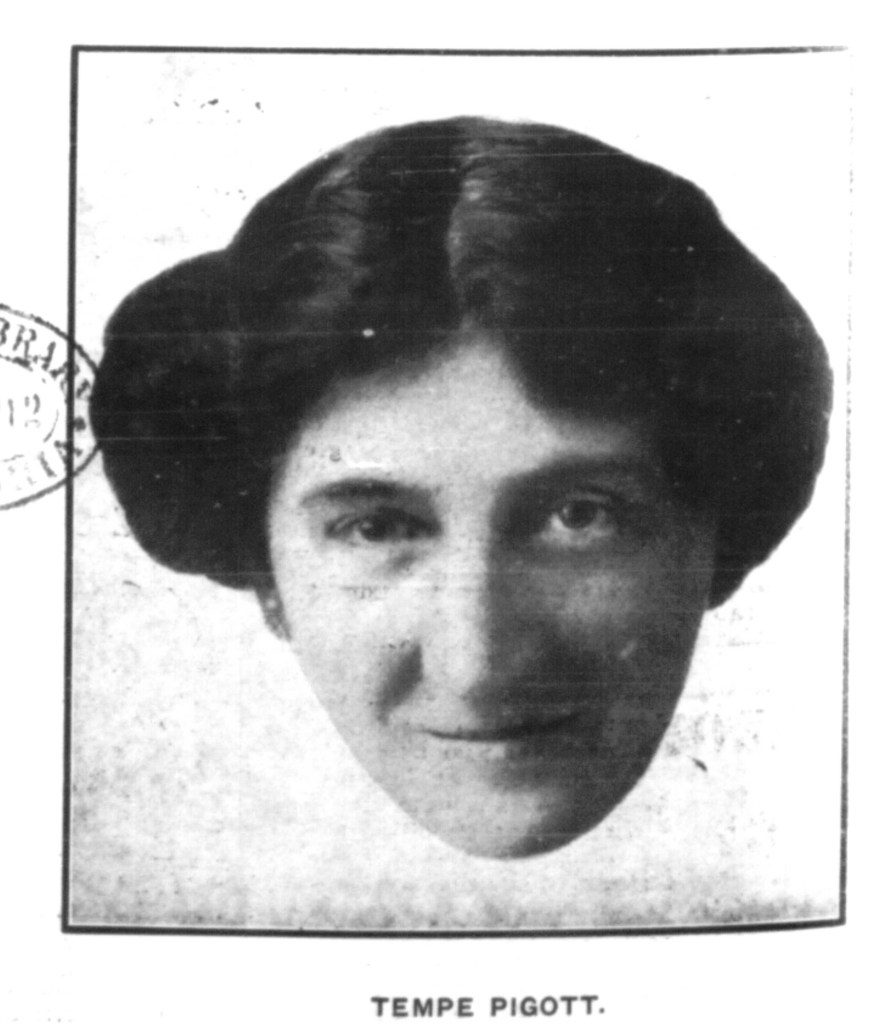
Above: Tempe Pigott, while performing in Melbourne in 1912.[2]Table Talk, 18 July 1912. Via State Library of Victoria

Tempe’s remote Australian birth

Florence Edith Tempe Pigott was born at Auburn station, about 450 kms north-west of Brisbane,[3]in Australia, a station means a large pastoral lease running livestock – like a ranch in North America in the Burnett district in Queensland, on 2 February 1867. Tempe was therefore 84 years old when she appeared in her last recorded film in 1951 and about 95 when she died in 1962. (See Note 1 below regarding her birth)

Tempe’s father was pastoralist[4]in Australia the word “Squatter” is also used Peter J Pigott, her mother was Lydia nee Clarke, the daughter of well known Queensland architect Francis Clarke. While working life on pastoral leases like Auburn was hard, the profits to be made were significant. Pigott could afford to go on an extended trip to England and Ireland in the mid 1860s, but when his business partner J M Murphy died in an accident, he hurried home.[5]Queensland Times, Ipswich Herald and General Advertiser (Qld) 28 Apr 1863, P3 and Maryborough Chronicle, Wide Bay and Burnett Advertiser (Qld)1 Mar 1865, P2 Via National Library of Australia’s … Continue reading The frontier of Tempe’s birth was also notoriously harsh and sometimes violent. Records of catastrophic clashes with Indigenous Australians do not mention Pigott or Auburn station, but they are found in nearby localities at this time. Another significant feature of life on properties like Auburn was its remoteness. Today, the nearest town is Chinchilla – comprising 6,500 people and about 100 kms to the south. However, when Pigott took up his lease at Auburn, Chinchilla did not exist, and Maryborough, 300 kms to the east was the nearest big town.

Photos of Auburn station are elusive. This shows the main homestead sometime in the 1920s. State Library of Queensland.[6]Auburn Station homestead. John Oxley Library, State Library of Queensland.

Life in Brisbane

Peter J Pigott died in November 1870 aged only 49, and soon after Lydia took her children back to Brisbane.[7]Like Tempe’s birth certificate, Peter Pigott’s death certificate remains elusive. However, his death notice appeared in The Brisbane Courier (Qld), 14 Nov 1870, P 2. Via National Library … Continue reading In 1874 Lydia married William Horsley, a merchant and Brisbane broker. Brisbane was a growing city but in 1900 its population of 120,000 was still only a quarter the size of the other major east coast cities – Melbourne and Sydney. Consequently its theatre scene was smaller and opportunities for those keen to pursue the stage were limited. Tempe’s first recorded appearance in amateur theatre was in a charity performance of the comedy New Men and Old Acres, in June 1885.

Tempe was 18 when she appeared in this Brisbane charity performance in 1885.[8]The Brisbane Courier,(Qld) 9 June 1885, P1. Via National Library of Australia’s Trove

In later interviews with journalists, Tempe revealed other aspects of her Brisbane life as a young adult. She said she was an accomplished tennis player, having become amateur women’s champion of Queensland. She was also a recreational rifle shooter, and had taken up women’s rowing. She also painted watercolours in her spare time.[9]Australian Town and Country Journal (Syd) 20 May 1914, P26 via National Library of Australia’s Trove While electoral rolls for the early 1900s listed her as a typist, we also know she taught elocution in Brisbane, advertising her services in local papers in 1904 and 1905 – a 14 week course cost 25 shillings. By this time she was living at a rather grand, gothic style, private hotel called Riversleigh on Brisbane’s North Quay, although her mother and step-father lived only a few streets away.

Tempe, not in character in a photo possibly taken when she was aged in her 30s.[10]Melbourne Punch, 11 July 1912 State Library of Victoria

Elocution and the theatre

In addition to making her own income, as the daughter of a successful pastoralist and step-daughter of a wealthy businessman, she would also have had a healthy degree of financial freedom and she certainly enjoyed connections with Brisbane’s elite. When 29 year old Tempe attended the Governor’s Ball in 1896, her attendance and attire was duly noted, [11]The Brisbane Courier (Qld.) 12 Sep 1896 P6 via National Library of Australia’s Trove and when she visited friends in Warwick or Gympie, the newspapers reported her “holidaying” in their social pages. Even when she returned to Australia in 1936 after 20 years in the US, she was still well enough connected to be invited to society events where “anecdotes of Hollywood were very much in demand”[12]The Sydney Morning Herald, 2 Sept 1936, P7 via National Library of Australia’s Trove – these included afternoon tea with Sydney’s Lady Mayoress and friends.[13]The Daily Telegraph (Syd) 15 Sept 1936, P9, via National Library of Australia’s Trove

In his study of selected character actors of Hollywood’s Golden Age, Axel Nissan respectfully describes Tempe as ‘the Eternal Landlady’ [14]See Axel Nissen: Accustomed to Her Face: Thirty-Five Character Actresses of Golden Age Hollywood. McFarland & Co, 2016 and that is indeed, the way we see her in many of her surviving films.[15]Although the available film role databases also list her by less flattering titles – such as ‘Old woman/Old Hag/Old Crone/Charwoman/Flower seller etc It appears she began to appear in these types of roles while performing in Australia.

Tempe playing a maid in the farce, A Dead Shot, a fundraiser for the Roma School of Arts in 1888.[16]Western Star and Roma Advertiser (Qld.) 2 June 1888
P3 via National Library of Australia’s Trove


At some stage in 1907, Tempe started to appear in professional performances. The first was probably with the Lillian Meyers Company – touring Australian cities and towns with a variety of drama and comedies. Thanks to her skill in elocution, she increasingly took on important character roles. For example, in Hobart in January 1908, in a new play about the ever popular Kelly Gang, she took the supporting role of Ned Kelly’s Irish mother, Ellen. Ellen Kelly was still alive at the time, and the Kelly story still resonated so strongly with Australians that it had been made into a feature film only a few years before.[17]Mercury (Tas) 2 Jan 1908, P7, via National Library of Australia’s Trove

Tempe’s character roles on the Australian stage included (left) Cora the maid in the comedy The Man on the Box, and (right) Scottish nurse Christine Grant in Nobody’s Daughter.[18]Melbourne Punch (Vic), 28 Aug 1913, P21 and Telegraph (Qld) 11 Nov 1911, P18, via National Library of Australia’s Trove

By 1911, she was now touring with the Hamilton-Plimmer-Denniston Company, in the comedy-drama Nobody’s Daughter, alternating with the comedy Lover’s Lane. In the latter, Tempe formed part of a “splendid gallery of portraiture” – which, after all, was the task of a character actor.[19]Table Talk (Vic) 13 Jul 1911, P21 via National Library of Australia’s Trove Tempe’s role as the old Scottish nurse Christine Grant in Nobody’s Daughter received very good reviews.

By 1912 Tempe was in regular work on the Australian stage, often performing for Sydney’s Little Theatre, between longer seasons at larger east coast theatres. However we gain some sense of why better paid overseas work may have been attractive from her surviving JC Williamson’s contract for the patriotic play The Man Who Stayed at Home. Her July 1915 contract was for the very modest sum of £6 per week, the equivalent perhaps of $600 in 2021 money.[20]Tempe Pigott, JC Williamson Ltd Contract, 23 July 1915, courtesy Australian Performing Arts Collection, Melbourne

In late April 1916, the Sydney Little Theatre farewelled her after a final performance in Hindle Wakes.[21]Sydney Morning Herald, 29 April 1916, P18, via National Library of Australia’s Trove

As the nasty gossip Mrs Candour, in School for Scandal, at Sydney’s Little Theatre in 1914. [22]The Sydney Mail (Syd) 17 Jun 1914, P15 via National Library of Australia’s Trove

Work in the US

In May 1916, Tempe boarded the SS Sierra for the US. Her travelling companion was Marie Irvine, a Brisbane journalist. Although it was now wartime and the usual reporting about an Australian actor travelling overseas to take on the world was muted, her hometown paper, the Brisbane Courier reported “Miss Pigott ranks with the best artists the Australian stage possesses…This esteemed artist cannot possibly fail to make a name in America…”[23]Brisbane Courier 13 May, 1916, P12, via National Library of Australia’s Trove.

The passenger manifest makes it clear her destination was New York and she seems to have succeeded in finding work soon after arrival. From late 1916 Tempe can be found in the cast lists of several plays touring US cities. The first of these was Peg O’ My Heart – where she took the role of the English Mrs Chichester, who educates a young New York girl to be a lady, in return for a large portion of an inheritance – a Pygmalion style story. The next four years of effort on the US stage, including a short season of Perkins in New York in 1918, finally saw her in Los Angeles, performing at the Writer’s Club.

Like so many of her contemporaries, the actual reasoning for Tempe’s move to the US had been a career and financial decision. And of Hollywood she said; “It was quite natural that I should gravitate towards Hollywood… More money may be made in a day in pictures than in a week on the stage; so, naturally, everyone is attracted to film work.”[24]The Sydney Morning Herald, 18 Aug 1936, P8 via National Library of Australia’s Trove All the same, as this writer has indicated, there is some likelihood Tempe had inherited some additional financial security.

Her first film was apparently the Famous Players Lasky’s The Great Impersonation, released in 1921, probably a lost film, although in interviews she nominated other films as her first, including Behold My Wife (1920).

58 year old Tempe Pigott, listed as a female character actor, in the Standard Casting Directory of 1925.[25]Standard Casting Directory, Feb 1925, via Lantern Digital Media Archive and the Internet Archive

Alex Nissan, who seems to have gone to the effort of finding and watching much of her work, writes: “in films there has to be someone to open the door and say so and so is calling, or make a drunken spectacle of themselves in a pubSuch an actress was Tempe Pigott.[26]Nissan, 2016, Chapter 25 All the same, definitive commentary about her thirty years of work in film is difficult, insofar as she sometimes played such minor character roles and her appearance is fleeting.

Tempe in one of her fleeting roles – as Mrs Hudson, Sherlock Holmes’ landlady, in A Study in Scarlett (1933)[27]screengrab from a copy on youtube

There is also the problem of mis-identification of Tempe, given that she was undoubtedly made up to look as aged and careworn as possible in many of her films. For example, the current version of the IMDB illustrates her profile with a photo that is arguably Dorothy Phillips made-up as an older woman.[28]See Photoplay July-Dec 1925. Via Lantern Digital Media Library & The Internet Archive

An unusually well-lit Tempe, as McTeague’s mother in Erich von Stroheim’s Greed (1924)[29]Screengrab from copy at the Internet Archive

Tempe as the maid to Princess Isobel (Billie Dove), in The Black Pirate , a two colour Technicolour action film featuring Douglas Fairbanks(1926)[30]Screengrab from copy at the Internet Archive

Some available examples of Tempe’s film work are linked in the references section below. Nissan notes that the earlier 1930s were a busy time for her,[31]she appeared in at least 35 films in 1930-36 and she made the transition to sound films successfully, when so many did not. Commenting on this herself on her return to Australia in 1936-7, Tempe suggested this was partly thanks to her expertise in elocution. “So much depends not only on the voice but on the pronunciation.” The journalist reported that Tempe ” had a beautiful speaking voice, fine diction and an easy manner…”[32]Telegraph, (Qld) 2 March 1937. P6. via National Library of Australia’s Trove In 1936 Tempe recalled “Talkies came upon us so suddenly…and it was pathetic to watch the falling of so many of the stars. Many of the women, and the men, too, merely had beautiful faces; often they could not speak English at all. If they did, it was sometimes harsh English, which could never be corrected.”[33]The Sydney Morning Herald, 18 Aug 1936, P8 via National Library of Australia’s Trove She had gone to some effort to avoid picking up an American accent, she said.[34]Wireless Weekly (Aust) 2 Oct, 1936, P18, via National Library of Australia’s Trove As her surviving sound films illustrate, her voice skills were particularly notable in a variety of British accents.

Tempe as Mrs Haggerty in the home front film Seven Days Leave (1930) [35]Screengrab from copy at the Internet Archive

Not all of her screen appearances were fleeting. Her extended supporting role as one of the working class London women in the Gary Cooper vehicle Seven Days Leave (1930), gained positive reviews – the film is based on J.M. Barrie’s bitter-sweet play The Old Lady Shows Her Medals. Some of her shorter appearances are still of characters important in film narratives – such as nurse Mrs Corney, who steals the ring from Oliver’s mother in Oliver Twist (1933), thus setting in train the series of events that make the story.

Tempe, with the castor oil bottle and Douglas Scott as Oscar in Night Work (1930).[36]Screengrab from copy at the Internet Archive

Tempe’s voice can be heard in this example from Night Work (1930), where she plays Clara the nurse, determined to give young Oscar his castor oil, enlisting Mr Musher (Eddie Quillan) to help.[37]Source – copy at the Internet Archive


Tempe also appeared in a role of substance in the very successful 1933 Fox film Cavalcade, based on a play by Noël Coward. A film in the style of the Forsyte Saga and Upstairs Downstairs, it was one of a string of Hollywood films that romanticized all things English, while also celebrating the challenges and successes of family life. It won several Academy Awards – for best Picture, best Director (Frank Lloyd) and best Art Direction. Alongside Tempe was fellow Australian Billy Bevan, also playing a role that required a working class English accent – something Hollywood studios often called upon Australians to perform.

A posed still of the main cast of the hugely successful Cavalcade (1933). A smiling Tempe (as Mrs Snapper) is standing at left rear.[38]Cinemundial, June 1933, P331, Via Lantern Digital Medial Library & the Internet Archive

Tempe returned to Australia for a visit in August 1936. She stayed on for about seven months, living with her cousins (on her mother’s side) at their comfortable home at Sydney’s Darling Point. She was widely interviewed for radio and newspapers, and gave talks at society events. She gave at least one radio performance as Sairey Gamp (a character from Charles Dicken’s Martin Chuzzlewit) for ABC radio. She even expressed a hope that she might appear in an Australian film. But she didn’t. She returned to Hollywood in March 1937. Unfortunately, given her age, she was stopped on return to the US. She was an alien (a non-US citizen), and was given a class “B” medical certificate, probably because her age (stated to be 68 but really 70) might normally suggest she would be unable to earn a living. However, in the end, the US accepted her, perhaps after some assurances from her agent or a studio.

Tempe in The White Angel (1936) – a creative telling of the Florence Nightingale.[39]Truth (Syd) 16 Aug 1936, P35, via National Library of Australia’s Trove

Did she lose her “currency” in the time she was away from Hollywood? It is difficult to be certain, but her film ouput seems to have slowed on her return to Hollywood. Her 30 year film career finally came to a close with a tiny role in the 1951 Douglas Sirk crime drama Thunder on the Hill, when she was aged 84, and again playing an “old crone,” according to the cast list at the IMDB.

Two key documents we might expect would help cast some light on Tempe’s later life are at least partly erroneous. As Alex Nissan notes, the 1940 US census shows Tempe was a lodger in a house in the heart of Hollywood by this time, and had only earned $500 in the year before the census.[40]Nissan, 2016, Chapter 25 But the document also gives her place of birth as England, and her age as 56. Her 1962 death certificate also stated she was an Englishwoman, born on 2 Feb 1884. In fact, she was 95 years old when she died. The certificate also reveals that she had broken her hip in a fall not long before her death.

Tempe (as a beggar) with fellow Australian C Montague Shaw in costume for The Pilgrimage Play (1950).[41]Los Angeles Evening Citizen News, 15 July 1950, P3, via Newspapers.com

We might view Tempe Pigott as another victim of Hollywood casting practices, however she also appears to have been quite conscious of what the studios required and was a willing participant in the transaction – and after all, she had returned to the US to do more of it in 1937. During her visit home to Australia she repeatedly said that Hollywood had a policy of “typing” actors. She alluded to an unnamed acquaintance [42]possibly fellow Australian William H O’Brien who was only ever offered butler roles. Because of this practice of typecasting she would never be offered “a grand dame to play”[43]Daily Telegraph (Syd) 4 Aug 1913, P12 via National Library of Australia’s Trove. But this appears not to have concerned her, as such grand dame parts were “very thankless… You just sail about” she observed.[44]Wireless Weekly (Aust) 2 Oct, 1936, P18, via National Library of Australia’s Trove

To the best of this writer’s knowledge Tempe did not marry[45]her death certificate states she was a widow, but no record of a marriage has come to light and she had no children. US papers reported her death in California in 1962, but remarkable though her very long career was, her passing was completely overlooked in Australia. She really should not have been so easily forgotten in her country of birth.


Note 1. The mystery of Tempe’s birth

There is no surviving Queensland birth certificate for Florence Edith Tempe Pigott, or if one exists, it has been mis-identified. While that was unusual in the Australian colonies, it is not unknown. But we know the details of her birth with a high degree of certainty from several other sources:
1. When she arrived in the US on the SS Sierra on May 29, 1916, and again on the SS Monterey on March 22, 1937, she variously gave her date of birth as 1872 and 1869. She named her place of birth – Auburn Queensland – on the 1937 ship’s manifest.

However, when she was born on 2 February 1867, her parents announced the birth of their (as yet unnamed) daughter in a prominent position in a number of major Australian newspapers, in New South Wales and Queensland, in February 1867.[46]The Sydney Morning Herald, 21 Feb 1867, P1 and The Brisbane Courier, 15 Feb, 1867, P2. Via National Library of Australia’s Trove


2. And on Tempe’s mother Lydia’s death certificate from 1912 (by now Lydia Horsley), her three surviving children from her first marriage to Peter J Pigott were clearly named, with their ages. This again confirms Tempe as the child born in 1867.

Enlargement of part of Lydia Horsley’s 1912 death certificate showing her 3 surviving adult children, including Tempe.

3. Also of interest, Tempe’s younger sibling Madaline, born in October 1868, did not have a birth certificate issued until 1871, confirming that the family were not very observant of obligations to complete official paperwork – but perhaps their isolation was also to blame.(On Madaline’s birth certificate Tempe is listed as a 3 year old) And as noted, there is no death certificate for Tempe’s father, Peter J Pigott, who died on 2 November 1870, while seeking treatment for an unspecified ailment. The absence of a death certificate is unusual.


Nick Murphy
December 2022


References

Primary Sources

  • Australian Performing Arts Collection, Arts Centre, Melbourne.
  • National Archives of Australia
  • Ancestry.com
  • Queensland; Births, Deaths & Marriages
  • California, Department of Public Health
  • Lantern, Digital Media Project at the Internet Archive
  • National Library of Australia, Trove.
  • Newspapers.com

Text

  • Queensland Government Intelligence & Tourist Bureau. Hotel And Boarding House Directory, 1912 (via Internet Archive)
  • William Brooks. The Central and Upper Burnett River District of Queensland centenary souvenir, 1848-1948, embracing the districts of Gayndah, Mundubbera, Eidsvold and Monto. 1948
  • Paul Michael (Ed) The American Movies. Garland Books, 1974.
  • Axel Nissen. Accustomed to Her Face: Thirty-Five Character Actresses of Golden Age Hollywood. McFarland & Co, 2016
  • Rosebud T Solis-Cohen. The Exclusion of Aliens from the United States for Physical Defects. Bulletin of the History of Medicine, Jan-Feb 1947, Vol 21, No 1, 33-50. Johns Hopkins University Press.

Films

Web: Ausstage Database

Web: The Files of Jerry Blake


This site has been selected for preservation in the National Library of Australia’s Pandora archive

Footnotes

Footnotes
1 The Wireless Weekly, 2 Oct 1936, P11, Via National Library of Australia’s Trove
2 Table Talk, 18 July 1912. Via State Library of Victoria
3 in Australia, a station means a large pastoral lease running livestock – like a ranch in North America
4 in Australia the word “Squatter” is also used
5 Queensland Times, Ipswich Herald and General Advertiser (Qld) 28 Apr 1863, P3 and Maryborough Chronicle, Wide Bay and Burnett Advertiser (Qld)1 Mar 1865, P2 Via National Library of Australia’s Trove
6 Auburn Station homestead. John Oxley Library, State Library of Queensland.
7 Like Tempe’s birth certificate, Peter Pigott’s death certificate remains elusive. However, his death notice appeared in The Brisbane Courier (Qld), 14 Nov 1870, P 2. Via National Library of Australia’s Trove
8 The Brisbane Courier,(Qld) 9 June 1885, P1. Via National Library of Australia’s Trove
9 Australian Town and Country Journal (Syd) 20 May 1914, P26 via National Library of Australia’s Trove
10 Melbourne Punch, 11 July 1912 State Library of Victoria
11 The Brisbane Courier (Qld.) 12 Sep 1896 P6 via National Library of Australia’s Trove
12 The Sydney Morning Herald, 2 Sept 1936, P7 via National Library of Australia’s Trove
13 The Daily Telegraph (Syd) 15 Sept 1936, P9, via National Library of Australia’s Trove
14 See Axel Nissen: Accustomed to Her Face: Thirty-Five Character Actresses of Golden Age Hollywood. McFarland & Co, 2016
15 Although the available film role databases also list her by less flattering titles – such as ‘Old woman/Old Hag/Old Crone/Charwoman/Flower seller etc
16 Western Star and Roma Advertiser (Qld.) 2 June 1888
P3 via National Library of Australia’s Trove
17 Mercury (Tas) 2 Jan 1908, P7, via National Library of Australia’s Trove
18 Melbourne Punch (Vic), 28 Aug 1913, P21 and Telegraph (Qld) 11 Nov 1911, P18, via National Library of Australia’s Trove
19 Table Talk (Vic) 13 Jul 1911, P21 via National Library of Australia’s Trove
20 Tempe Pigott, JC Williamson Ltd Contract, 23 July 1915, courtesy Australian Performing Arts Collection, Melbourne
21 Sydney Morning Herald, 29 April 1916, P18, via National Library of Australia’s Trove
22 The Sydney Mail (Syd) 17 Jun 1914, P15 via National Library of Australia’s Trove
23 Brisbane Courier 13 May, 1916, P12, via National Library of Australia’s Trove
24 The Sydney Morning Herald, 18 Aug 1936, P8 via National Library of Australia’s Trove
25 Standard Casting Directory, Feb 1925, via Lantern Digital Media Archive and the Internet Archive
26, 40 Nissan, 2016, Chapter 25
27 screengrab from a copy on youtube
28 See Photoplay July-Dec 1925. Via Lantern Digital Media Library & The Internet Archive
29, 30, 35, 36 Screengrab from copy at the Internet Archive
31 she appeared in at least 35 films in 1930-36
32 Telegraph, (Qld) 2 March 1937. P6. via National Library of Australia’s Trove
33 The Sydney Morning Herald, 18 Aug 1936, P8 via National Library of Australia’s Trove
34, 44 Wireless Weekly (Aust) 2 Oct, 1936, P18, via National Library of Australia’s Trove
37 Source – copy at the Internet Archive
38 Cinemundial, June 1933, P331, Via Lantern Digital Medial Library & the Internet Archive
39 Truth (Syd) 16 Aug 1936, P35, via National Library of Australia’s Trove
41 Los Angeles Evening Citizen News, 15 July 1950, P3, via Newspapers.com
42 possibly fellow Australian William H O’Brien
43 Daily Telegraph (Syd) 4 Aug 1913, P12 via National Library of Australia’s Trove
45 her death certificate states she was a widow, but no record of a marriage has come to light
46 The Sydney Morning Herald, 21 Feb 1867, P1 and The Brisbane Courier, 15 Feb, 1867, P2. Via National Library of Australia’s Trove