Above: Warner Bros photo credited to Schuyler Grail. Feb 1938, NBC radio announcer Buddy Twist interviewing Australian actress Mary Maguire. The interview is lost unfortunately, but Maguire went out of her way to speak with a cultivated accent during her Hollywood career (see audio clip below). Author’s collection.
There are few people who can find fault with US actress Kaitlyn Dever‘s contemporary Aussie accent in the 2025 Netflix series Apple Cider Vinegar. It is masterful. As Dever has explained, (see this episode of Entertainment Tonight for example) she put in a great deal of preparation and worked with dialogue coach Jenny Kent to perfect a 21st century Australian accent that rang true.
Broad – think of the late Steve Irwin (link). The accent is alive and well in the fantasyland of TV – listen to how every single “Australian” speaks in S4, Ep 6 of the TV series The Crown. Sometimes this has been called “Strine”.
General – Margo Robbie Vanity Fair clip (link). This is actually how most Australians living on the coastal urban fringe of the continent speak today. However, Robbie has also said that she had a dialogue coach when she first appeared on the Australian TV show Neighbours, to soften her Queensland accent (for Australian and British audiences).
Of course, accents don’t really fall into such easy categories. Those labels might be better thought of as markers on a continuum, with any one accent sitting somewhere along it. Also, unlike the variations in British and US accents – that are sometimes regional, variations in Australian accents are usually attributed to social class – particularly parenting and education. Of course, physical features such as the shape of the tongue and jaw also impacts how people speak.
In the nineteenth and early twentieth centuries, elocution lessons, (sometimes a part of a private school education but also available from private tutors) were designed to remove all vestiges of a colonial accent, be it from Australia, South Africa or somewhere else. In a short article on actor Judith Anderson, and others, Desley Deacon of ANU has pointed out how common elocution lessons were, and how important these were in opening up a performance career. The resulting accent, found all over the British Empire and beyond, dovetailed nicely with the “transatlantic accent” preferred in US 1930s sound films.
Jane E Southcott has written of concern amongst politicians and the efforts made in South Australian schools to improve Australian speech. She cites School Inspector Maughan reporting in 1912 that “a few minutes spent daily in the practice of pure enunciation would to much to eliminate what is known as ‘the Australian twang.'” Similar sentiments were undoubtedly felt throughout the rest of Australia.
1. Samples of classic Aussie accents – tending to broad.
The broader Australian accent still often appears in Australian-made films, continuing as part of a well established comedy tradition that has long worked on stage. It’s also used in contemporary advertising, and much loved by contemporary politicians, alongside acceptable slang words like “mate” and “g’day”. Yet, today, that’s not how most Australians speak – indeed it would take a conscious effort to speak like that all the time.
The broad accent rarely appeared in pre-war US and British films. Even in the late 1950s, John Meredyth Lucas commented that a distinctive Australian accent made casting very difficult for the TV series Whiplash. It was unattractive, he felt and by implication might have made sales of the series difficult. In a similar vein, when the US trade paper Harrison’s Reports reviewed Smiley (Aust:1956) they felt it was unlikely to be well received in the US because of the Australian accents. But when Jocelyn Howarth was being introduced to US audiences (as Constance Worth) in 1937, Photoplay magazine assured readers she was free of the “caricatured Australian accent.” The distinctive broad Australian accent still had a few outings – such as in MGM’s very self conscious The Man from Down Under (1943). It also occasionally slipped into other films – here are two examples:
Brian Norman (1908-1995) in Search for Beauty (1934)
Here Sydney-born Brian Norman, in his one and only film outing, forces some con-men to start morning exercises at the health farm. His broad Australian accent is unmistakable. He became a lawyer after returning from Hollywood. Audio from copy of film in author’s collection.
William Brian Molloy or “Brian Norman” in the Sydney Sun, 1 April 1934.
Lotus Thompson’s(1904-1963) one line as a random person at a ball, in Anthony Adverse (1936)
Lotus Thompson from Queensland was briefly a silent star of some standing in Australia and the US, but her career was all but over by 1930. She appeared in some uncredited extra parts in the 1930s. Her few words as an extra here – “Please talk about them” seem to have an noticeable Australian twang. Audio from copy of film in the author’s collection. Available through Warner Brothers Archive.
Photo-author’s collection c.1924.
Bill Kerr’s (1922-2014) exaggerated Aussie accent featured in his popular British comedy act The Man from Wagga Wagga. Click here for an example from 1951. But contrast this also with his real voice – as featured in an Australia soap commercial made with Joy Nichols (1925-1992) only a few years before.
Click on the image to go the 1946 commercial at the NFSA
2. Sample accents of former Australian vaudevillians who ended up in Hollywood
Although none of the following actors appear to have had elocution lessons and each had only limited formal educations, all arrived in Hollywood after very long careers on stage in Australia, the US and the UK – enough experience and time to give them an accent that might have come from anywhere.
Daphne Pollard (1891-1978) sings “The Ragtime Germ” for the stage review Zig-Zag! (UK: 1917).
Daphne Pollard (from Melbourne) had a very long career with other Australian child performers in Pollard’s Lilliputian Opera Company before branching out on her own. She first appeared in Hollywood films in the late 1920s. By the mid 1930s she had largely retired. She is credited with composing this song with Cass Downing and John T. Murray. Audio from recording in the author’s Collection. Photo from author’s collection c 1920.
Snub Pollard(1889-1962) also from Melbourne in Just My Luck (US: 1935).
The prolific Snub Pollard also had a long career with Pollard Lilliputian’s before moving into Hollywood films in 1915. In this clip Mr Smith (Pollard) and Homer Crow (Charles Ray) discover they have lost their money, whilst eating at a cheap diner famous for beating up any non-paying customers. With the coming of sound Snub Pollard could only find work as an extra – but worked to the end of his life. Audio from copy of film in the author’s collection. Film is still widely available. Photo – Exhibitor’s Trade Review (Dec. 1922 – Feb. 1923) via Lantern Digital Media Project.
Leon Errol(1881-1951) from Sydney and Paul Scardon (1875-1954) from Melbourne in Gentleman Joe Palooka(US: 1946).
Left: Leon Errol at right with (yes, fellow Australian-born) Joe Kirkwood Junior in Gentleman Joe Palooka (1946). At right, Paul Scardon in a screengrab from Today I Hang (1942).
Scardon had an Australian stage career before moving to the US in late 1905, appearing in US films from about 1911. In the audio clip he plays an uncredited role as a clerk whose records are being stolen by Knobby Walsh, played by Sydneysider Leon Errol (1881-1951)Copy of film in the author’s collection. The Joe Palooka films are widely available. Photo – Picture Play Weekly. April-Oct 1915. Via Lantern Digital Media Project.
3. Samples of Cultivated Aussie accents showing the importance of elocution
Wealthy Australians living on the continent’s coastal fringe often sent their children to private schools, the only schools that could provide a pathway to universities and better careers. Today these schools still put resources into a young person’s rounded personal development – now less commonly through “Speech” (elocution) classes, but still through public speaking, debating and by encouraging the performance arts. In the early twentieth century, for these middle class Australians, there was probably a self consciousness about accents, and therefore a desire to speak without any hint of a colonial upbringing.
John Wood(1909-1965) from Sydney and Mary Maguire(1919-1974) from Melbourne and Brisbane in a clip from Black Eyes (UK: 1939).
Wood had attended the prestigious Shore School, (Sydney Church of England Grammar School, at the same time as Errol Flynn) while Maguire had attended the Academy of Mary Immaculate in Melbourne, the city’s oldest Catholic girls’ school. Maguire almost certainly had additional speech and acting lessons in Hollywood, before moving to England in 1938. This film was set in pre-revolutionary Russia, the two young Australians play Karlo and Tanya. Interestingly, not long after, Wood told a journalist that Australian accents, presumably his, were preferred by some British producers to an Oxford accent.Copy of the film in the author’s collection. The DVD is widely available. Publicity photo of Maguire and Wood in An Englishman’s Home 1939, author’s collection.
Nancy O’Neil(1907-1995) from Sydney in a clip from Something always Happens (UK:1934).
O’Neil had attended Sydney Church of England Girls Grammar School before travelling to London to study at RADA in 1928. She appeared in film and on stage in England in the 1930s and like most of the other young Australian women in British films of the time, she sounds as English as everyone else. Obituaries for these women often claim they “came to England to lose their accent”. But of all Australians, those who had been to private schools probably already had a “drawing room accent” – meaning they had little accent to lose. Audio from copy of the film in the author’s collection. The film is available through Loving the Classics. Photo – Lux Soap Famous Film Stars card, c1933-4. Author’s Collection
Shirley Ann Richards (1917-2006) from Sydney as an Australian nurse in Dr Gillespie’s New Assistant (US: 1942), with US actor Richard Quine as an Australian doctor from Woolloomooloo (the Sydney suburb’s name is a source of great humour in the film).
Richards had a private school education at Ascham and The Garden School in Sydney and had the benefit of a mother who was an active member of the English Speaking Union. Later in life she also recalled the importance of the educated women who were close friends of the family. Although she is “laying it on with a trowel” in this clip, this is close to how she really spoke, even after 40 years in California. Audio from copy of film in the author’s collection. TCM currently have a collection of the Dr Gillespie films for sale. Photo – author’s collection.
4. Aussie accents – tending more general
The decline of the cultivated Australian accent in the last 50 years is one marker of change in the way Australian English is spoken. At the same time, the general Australian accent seems to have appeared more often in the post war period. However, as the first example demonstrates, the general Australian accent was well and truly in established use before the Second World War.
Jocelyn Howarth (as Constance Worth) (1911-1963) from Sydney in the excruciatingly awful The Wages of Sin (US:1936) .
In the sound clip here, Howarth makes no attempt to disguise her accent, which sounds bizarre alongside the broad American accents of her “family members,” who are lazy and won’t get little Tommy his milk. Audio from copy in the author’s collection. This film is still available from specialist DVD outlets. Photo of Jocelyn Howarth on her way to the US, 13 April 1936. Honolulu Star, via Newspapers.com.
Patti Morgan (1928-2001) from Sydney in Booby Trap (UK: 1957). In one of her few film roles, Patti Morgan’s voice seems firmly from Sydney.
Patti Morgan appeared in only a few British films, but continued her modelling and TV career with success. Audio from copy of film in author’s collection. The film is still available from Loving the Classics and Renown pictures. Photo of Patti on the cover of Pix, 6 Oct, 1945. Via National Library of Australia’s Trove.
5. Some other Aussies speak
Errol Flynn (1909-1959) in a 1959 episode of The Goodyear Theatre – The Golden Shanty (US 1959) (Click to watch). Although Flynn went along with the studio story he was Irish etc., he made almost no attempt to speak with anything other than his general Australian accent. In this case, it is ironic that one of his last performances was an adaptation of a popular Australian goldfields story by Edward Dyson.
One can watch his first, very wooden outing in film 25 years earlier, In The Wake of the Bounty (Aust 1933) here (Click to watch). His accent is the same. It is occasionally claimed he “picked up” his accent during his two years at an English boarding school.
Al Daff (1902-1991) the Australian-born senior executive with Universal Pictures, interviewed in 1975 (click to watch). His accent shows a blend of Australian and North American features, developed over a long time living in the US.
Florrie Forde (1875-1940) – a compilation of songs sung in the film Say it With Flowers (UK: 1934 (Click to watch). As Theatre historian Frank Van Straten notes, Forde identified as Australian all her life, and according to many, sounded so.
Much harder to find are examples of the blended accents of North Americans who now live in Australia, but here are a few:
Jane Badler (1953+) – Born in New York, actress Jane Badler moved to Australia in the late 1980s, where she now lives. She continues to act but also has a successful career as a jazz singer. Listen to her accent here, in a 2012 interview in London.
Bob Ansett (c1933+) – Born in Australia but Ansett spent many of his formative years in the US. He returned to Australia in 1965 to successfully start Budget rent a car. Listen to his accent here in a 2013 interview.
Producer Joe Schenck and Mary Maguire at a Los Angeles Turf Club Ball in June 1938. A publicity photograph that also hints at all that could go wrong in Hollywood. There has been plenty of speculation regarding Schenck’s relationship with other young actresses, but the exact nature of this relationship remains unknown.[1]5 months later, Schenck appeared in a similar photo at the races, squiring Hedy Lamarr Associated Press Photo in the author’s collection.
The 5 Second version There are numerous stories of starlets in Hollywood’s Golden Age whose careers were as much the result of parental hopes and dreams as their own, and this is another. Mary Maguire was born Ellen Theresa Maguire in Melbourne Australia in 1919. Her fame as Mary Maguire was extraordinary, and the publicity generated about her has tended to overshadow her indifferent performances in disappointing films in Australia and the US. Today she is also famous for a short-lived marriage to a much older British fascist sympathiser in 1939-1944. She redeemed herself in several later British films, but by the age of only 23 her career was over. She returned to the US with a new husband after World War II but could not resurrect her career. Deep unhappiness marred her later life and she died aged only 55, a result of acute alcoholism.
Eighteen year old Mary Maguire in Hollywood c1937. A Warner Bros photo. Author’s Collection.
Born in Melbourne, Australia, on February 22, 1919, Ellen Theresa Maguire was the second of five daughters parented by publicans Michael “Mick” Maguire and Mary Jane “Bina” nee Carrol. But in childhood she was known to all as Peggy, later adopting the name Mary. [2]Source: Victorian Births, Deaths and Marriages, Document ID 5295/1919. However in many accounts her birth name is incorrectly given as Helene.
Mary Jane “Bina” Maguire with her girls c1930. L-R: Mary “Lupe” (b1925), Joan (b1921), Patricia (b1916), Carmel (b1924), Ellen Theresa “Peggy” later Mary Maguire (b1919) Courtesy Norm Archibald.
Mick and Bina’s own upbringing is central to the story of their film star daughter, and their four other daughters. Mick Maguire was born and bred in the working class suburb of Richmond.[3]Born 6 June 1894 – Victorian Birth Certificate 15293/1894 Mick excelled at sports – becoming a very young player for Richmond Football Club at the age of 16, and dabbling in boxing in 1912-1915, with mixed success. In later life, Mick was to claim he was the Australian football code’s youngest ever player, and still later, that he had been Welterweight boxing champion of Australia. Neither claim was true. Mick also later claimed – incorrectly – that he had served in World War One.[4]A Maguire relative once told the author Mick was known through the extended family as a “blowhard.”
Mary Jane Carroll was four and a half years older than Mick.[5]Born 20 Dec 1889 – Victorian Birth Certificate 5084/1890 She had been born into a struggling farming family in the Wimmera region of Victoria. Her Irish mother and father gave up the herculean task of trying to make a farm pay and took up work with the Victorian Railways. In time, “Bina”[6]the origins of her family nickname now being forgotten would suggest she was also of Irish birth – perhaps she felt it preferable to admitting to her new, swell, friends in London that she had once lived a childhood in the remote Australian bush. In the early twentieth century almost all of her extended family had become hoteliers, as did she and Mick – an assured way to make money in the difficult times between the two wars.
Mick and Bina were both great self – promoters; as a few who knew them recalled in later life. On Bina’s passing in 1963, one old friend told a Brisbane paper – “she was a great contact woman and admitted quite frankly that she cultivated the ‘right’ people because that was the thing most likely to advance her daughter’s interests.”[7]Unidentified newspaper article, dated 24 June 1963. “Five Little Marrying Maguires” by Joyce Stirling. Likely to be The Courier Mail. Courtesy Loreto Convent Brisbane In 1940, one of Mick’s old drinking mates, Truth journalist Jim Donald, recalled Bina as “a sparkling and radiant personality in any class of company.” It was under her direction that “the family fortunes prospered.”[8]Truth (Syd) 14 July 1940, P18
A school enrolment from another era. Peggy Maguire’s (misspelled McGuire) enrolment record at the Academy of Mary Immaculate in Melbourne in 1923. Her pet name was good enough apparently, plus her father’s name and his hotel in Bourke Street! How different to the 21st Century where so much information is required to enrol a child in an Australian school. Courtesy Academy of Mary Immaculate. In Brisbane after 1934, the Maguire girls attended Loreto Convent.
Above: One of the many Carroll family hotels – the now de-licenced and forgotten Bay View Hotel in Kensington. Run by Mary Maguire’s auntie Alice, it was also where her maternal grandparents retired to. Mary visited them here before heading off to Hollywood in 1936. Photo – author’s collection.
In the 1910s and early 1920s, Mick and Bina held the licences to a series of increasingly important central city hotels in Melbourne – the Bull and Mouth, the Melbourne Hotel, the Metropol before moving to Brisbane to run that city’s premier hotel, The Bellevue in 1933. It was Bina who held the licence at the Bellevue[9]The Courier-Mail (Brisbane), 11 Jan 1940, P1 and there that she built her reputation as a society hostess – hosting film-star Jocelyn Howarth at afternoon tea[10]The Courier-Mail (Brisbane) 9 Nov 1933, P18, fussing about the visiting English cricket team[11]The Courier Mail (Brisbane) Feb 17, 1933 and running charity events attended by the state governor.[12]The Courier Mail (Brisbane) Nov 2 1933
Peggy,[13]who at this time was still known by her pet name appeared in her first film in 1933. This was a small bit part in Pat Hanna’sDiggers in Blighty, filmed in Melbourne. It was a background non-speaking role as a clerk, where she giggles at the soldier antics of Hanna, Joe Valli and George Moon. How did a 14 year old get the role? Although she had some experience in pantomime in Melbourne,[14]The Argus (Melb) 21 June 1930 it’s almost certain that the ever affable Maguires used their connections to get their daughter a break doing something she loved. In 1934, based largely on her looks and an ability to do a Irish accent of sorts – apparently her party piece – pioneer director Charles Chauvel cast Peggy as Biddy O’Shea, an Irish immigrant girl, in his panorama of Australian history Heritage.[15]The Courier Mail (Qld) 16 June 1934, P10
Peggy’s breakthrough role came on the heels of Heritage. Miles Mander, a British actor and director was hired by an Australian syndicate to make a movie, based very loosely on the 1934 novel The Flying Doctor, by Robert Waldron. Peggy won the part of Jenny Rutherford, with Hollywood actor Charles Farrell imported for the lead. In January 1935 she announced she was now calling herself Mary – a name more suited to a sophisticated film star. Today, the rarely seen finished product looks unconvincing and old-fashioned. Even in 1936 it attracted mixed reviews – The Sydney Morning Herald tried to be positive, but the reviewer complained about much, including the film’s endless scenes of “local colour… what amounts to tourist propaganda.”[17]The Sydney Morning Herald 21 Sep 1936, P4 The cameo appearance of Don Bradman delighted and annoyed reviewers in equal numbers.[18]Photos and posters from The Flying Doctor can be found here at The Ozmovie site
The Maguire family welcome Mary home after filming The Flying Doctor; from left – Lupe, Mary, Mick, Joan, Bina, British screen writer JOC Orton, Patsy and Carmel, April 1936 . Director Miles Mander had left hurriedly for the US a few days before, following a court case for speeding. Photo from Queensland Newspapers – John Oxley Library Collection, State Library of Queensland.
Whatever the reviewers said, the Maguires were immensely satisfied and the decision was made to pursue Mary’s acting career. Miles Mander had also been very encouraging – and assured them Hollywood was the place to go. Mick was to accompany Mary to the US as her personal manager, probably intent on bulldozing a path through any obstacles and clearly confident that he could make things happen as successfully as he had in Melbourne and Brisbane. There must have been discussions about the rest of the family following soon after, especially if, as expected, Mary made a go of it in Hollywood. Australian newspapers were delighted to report another young Australian seemed about to succeed in the US. 17 year old Mary was understandably apprehensive.[19]The Courier Mail (Bris) Aug 17, 1936, P25
The Governor-General Lord Gowrie and a very wide-eyed Mary Maguire, at an event just before her departure. What advice was he giving!?[20]The Mail (Adelaide), 8 Jan 1938, P1
Mary [21]or more correctly her father, as she was underage signed a contract with Warner Brothers soon after arriving in the US in August 1936, and over the next year she appeared in four films for the company. One was a small role in a main feature film,Confession, a vehicle for leading star Kay Francis. Her three other films were cinema program fillers, all produced by Brian Foy’s “B-film” unit, all running to less that 60 minutes, and all constructed around scripts that were not particularly original, being churned out in a matter of weeks.
Doris Weston, Thais Dickerson and Mary Maguire, photographed in October 1936, having just had their Warner Bros contracts approved in Court.[22]Mary outlived both these women. Weston made her last film in 1939 and died in 1960. Dickerson, as Gloria Dickson, died in a house fire in 1945 Source: Syndicated Press Photo. Author’s collection.
Even in 1937, these Warner Brothers B-films; That Man’s Here Again, Alcatraz Island and Sergeant Murphy, were underwhelming. Mary’s roles were limited and perhaps, as a few unkind reviewers noted, she just wasn’t as good as some of the others chasing acting careers at the time.[23]Warner Brothers out-take compilations, which include very short clips from some of these films, can be found here in Breakdowns of 1937 – see Mary briefly at 4:05 … Continue reading The film she made with Ronald Reagan, Sergeant Murphy, is perhaps the easiest of her B-films to find in specialist collections. Not withstanding the claims made since; there is not a shred of contemporary evidence she had an affair with Reagan during the making of the film.
By July 1937, the whole of the Maguire family were finally reunited in Hollywood. The license of the Bellevue had been sold and Bina had packed up the oldest girls for the voyage across the Pacific. It was timely, because Mary was recovering from a “nervous breakdown” – one of several she suffered while in the US. Older sister Patsy commented, perhaps a little unhelpfully; “You know, I think she was just lonely. When we arrived on Saturday she was so jittery she could scarcely speak. Now she’s a different person… You see, we’ve always been together and although dad has been marvellous, I think Mary has really missed us.”[24]The Mail (Adelaide) 10 Jul 1937, P2
One of a series of “boudoir style” photos of 19 year old Mary taken for Warner Bros in early 1938. For the time they would have been daring. This marked up copy from a US newspaper archive shows the editor was reducing the amount of breast shown for publication. Author’s collection.
With the assistance of studio public relations, Mary’s star seemed to be on the rise and she was enjoying extraordinary publicity, given her modest film output.[25]Back home the press described her as “Australia’s Mark Pickford” and “Australia’s Sweetheart.” Bina dutifully passed on everything she said and did to the Australian press, with a smattering of commentary. And at age 18, Mary was meeting all the people she had read about or watched on the screen, only a few years before. Some were extremely powerful figures – including millionaire racehorse owner Alfred Gwynne Vanderbilt II, newspaper baron William Randolph Hearst and his partner Marion Davies, and the head of Twentieth Century Fox, Joe Schenck. Despite all this exciting socialising, her closest real friend seems to have been fellow Warner’s actress Jane Bryan, who was about the same age and was also being groomed for ingénue parts.
Regarding her career, Mary dutifully wheeled out the same old story about her start to acting that others gave, including Australians like Jocelyn Howarth (now known as Constance Worth). This was that she had been offered work while on a casual visit to a studio, while she was really on her way somewhere else, like New York. It was nonsense of course. This story fitted in very nicely with the fantasy of the easy pathway to stardom regularly peddled in film fan magazines.[26]Presumably this story was courtesy a studio publicity department Mary went on to acknowledge that she had been acting on the screen in Australia – “since the age of twelve.”[27]Mary said this when interviewed by US journalist Harrison Carroll. Forecasting 1938. Broadcast by CBS on 1 Jan,1938. Library of Congress. Call Number RGA 6202 LC control no :00584434.
In late 1937 Mary declined a role in another B picture, Mystery House, and was promptly laid off by Warner Brothers, as the contract allowed. This generated more publicity, as was obviously intended – Mary was “on strike!” Australian papers reported. Her star was at its zenith by this time, and she (and almost certainly her parents) clearly believed she could bargain her way into better roles. In early April 1938 Mary obtained a new contract with Twentieth Century Fox, doubtless through her new friendship with the 62-year-old Joe Schenck – they had attended the 10th Annual Academy awards together. Gossip columnists speculated that a wedding might be imminent. Bina apparently joined in with the gossip.
Left -Another photo of Joe Schenck and Mary in March 1938. [28]Motion Picture Magazine, Feb-July 1938, page 81 via Lantern. Right – Truth reports on a letter from Bina about an impending marriage.[29]Truth (Bris) 3 July, 1938, P1“Joe regards me as a kid” Mary said of the relationship and she denied any plans to marry only a few days later.[30]The Argus (Melb) 6 July 1938, P1
Mary with Gracie Fields in Smiling Along (1938). Author’s Collection
Following a role in Fox’sMysterious Mr Moto, with Peter Lorre as the Japanese detective [31]the absurdity of Lorre, a Jewish émigré from fascist Europe playing a Japanese detective, who often disguises himself as a person of another ethnicity, in this case a German, could not have been … Continue reading she suddenly departed for Britain with her mother. Soon after arrival in London she gave a lengthy interview to journalist Mary St Claire. Her comments suggest she had very consciously taken on Warner Bros over the types of roles she was given. It was easy to “get a part in a film if you take anything given to you”, but she wanted parts where she could “express her own individuality.”[32]The Australian Women’s Weekly, 28 May 1938, P4
Her assignment was to appear in a Fox musical called Keep Smiling(later changed to Smiling Along) with Gracie Fields in the lead. In mid July, Joe Schenck travelled to London, officially for work, staying at Claridge’s hotel, not far from her apartment. We know nothing of the outcome of any meeting they had, except we do know that Fox dropped Mary’s contract in September 1938 and Schenck took no further interest in her or her career. It suggests a really serious “falling out.” It is easy to speculate that Schenck was expecting more than a friendly relationship with Mary, but there is no evidence – not even hints – to assist us.
After Smiling Along, Mary settled into British filmmaking, and with Bina’s supportive presence and a comfortable flat in Hayes Mews in Mayfair. Mary’s first film for the Associated British Picture Corporation (ABPC) was The Outsider, a remake. Mary received top billing with leading male player George Sanders, who played the charismatic but self-absorbed medico. Sanders’ role is Anton Ragatzy, a slightly oily foreigner of some sort, the type that inhabited British films for decades. Mary plays Lalage Sturdee, a beautiful “crippled” musician, whom he finally cures with the aid of a device he has invented, a type of stretching machine. By the time this film had been made, the whole family had relocated to London.
John Wood as Carlo and Mary Maguire as Tanya in Black Eyes. Screengrab from the author’s copy.
Mary’s second film for ABPC was Black Eyes, which was another remake – this one of a 1935 French film. But even for the time, it was a dull story – preoccupied with notions of class and with a predictable storyline. A highlight was playing against Sydney actor John Wood.
The two young Australians in the scene shown above. Audio grab from Author’s copy.
In May 1939 she began work on An Englishman’s Home(later titled Madmen of Europe in the US)for Aldwych films. The plot concerned an invasion of Britain (the threatening power is un-named, but clearly meant to be Germany) and starred Austrian-born Paul von Hernried, another refugee to Britain from fascism. It again featured John Wood, in what was to be his last film before returning to Australia.[33]After his return to Australia in 1939, Wood joined the Army and was posted to Singapore. He was captured in early 1942. He spent the next four years working tirelessly to maintain morale through … Continue reading
A little over two years after this photo was taken on the set of An Englishman’s Home, Paul Henreid (left) had simplified his name and was in Hollywood. John Wood (right) however, was to find himself a POW of the Japanese. Aldwych films publicity shot. Author’s collection.
Two of Mary’s sisters laze at Cannes while Bina looks on. [34]The Truth, 26 November 1944. Page 18
In early 1939, Mick and Bina took a lease on Villa Esterel near Cannes in the south of France, apparently oblivious to the rising political tensions in Europe. Explaining the Cannes sojourn in an interview in 1957, Bina said they had chosen it because “you simply have to meet the right people and at the right places.” As with the move from Melbourne to Brisbane, the motivation for travelling to Cannes appears to have been to advance opportunities for the girls, in this case, to find suitable husbands for them.[35]The Courier Mail (Bris) July 11, 1957, P11
In one of the few publicly released photos of the Maguires in Cannes, Lupe and Carmel laze about on the Villa’s sunny front steps, while Bina, wearing sunglasses, stands ominously and proprietorially behind two of her girls.
About the time she was filming An Englishman’s Home, Mary became engaged to Robert Gordon Canning, a wealthy and decorated British World War One veteran. It was, she later admitted, a whirlwind romance. Known to his close friends as “Bobbie”, he was a former Captain in the 10th Hussars and had earned the Military Cross for bravery in action at Arras in 1916. They were introduced to each other by Miles Mander, during a visit to England. At almost fifty-two, Bobbie was over thirty years Mary’s senior.
What did Mary see in this man who was older than her father? At the time, Mary said, “Bobbie conforms to my idea of the ideal man … when I met Bobbie, nothing else mattered.”[37]The Australian Women’s Weekly 26 Aug 1939, P33 There was however, another dimension to Bobbie that would have made him less attractive to some, although it did not discourage the Maguires. Bobbie was an opinionated, active and influential fascist. From 1934 until mid-1938, he was a senior figure in the British Union of Fascists (BUF) and was close to BUF leader, Oswald Mosley, although he had split from the movement in 1938.
At the time of the engagement, Bobbie was quoted as saying that she was the first actor he met who “didn’t talk shop.” He apparently also disliked “bridge and golf-playing women.” “I am neither,” Mary pointed out.[38]The Australian Women’s Weekly 26 Aug 1939, P33 The impending marriage was celebrated with a portrait of Mary by popular artist Vasco Lazzolo.
Mary Maguire, painted by Vasco Lazzolo c1939. Courtesy Norm Archibald.[39]Unfortunately, the original painting was lost in the 2009 “Black Saturday” bushfires
Mary was wise enough to publicly disassociate herself from Gordon Canning’s political extremism and virulent anti-Semitism. “I was given my big chance in Hollywood, where there are many Jews. It would be both ungrateful and unkind of me to ally myself because of marriage with the Fascist Party… I have no fascist sympathies and do not intend to take part in my fiancee’s political life.”[40]The Australian Women’s Weekly 29 Jul 1939, P28 She maintained the argument that she was not involved in his political activities, or at least, was largely ignorant of them, all her life. But looking back on the marriage in late 1944, she said of fascism; “I didn’t understand what it was all about.”[41]Truth (Brisbane) 26 Nov 1944 P12
In July 1939, towards the end of filming An Englishman’s Home, Mary became ill again. What seemed to start as another cold ended up very seriously. Maxwell Chance, a highly regarded Mayfair doctor, diagnosed her with acute pulmonary tuberculosis (TB) and immediately sent her to an exclusive nursing home to rest and “dry out.” It was a shock, an embarrassment, and it put an end to her acting for the time being, as well as her social life. Of course, the family did not publicly report her condition as TB, but rather as fatigue from “overwork” or “lung trouble” from working in the cold. The condition explains why she was carried to her wedding in an invalid chair. Her treatment for TB included “collapse therapy” a revolutionary procedure designed to deflate and rest the infected lung, using oxygen introduced by a pneumothorax needle. Mary lay on her side to have the needle inserted between her ribs, a treatment that was repeated every few weeks. Antibiotic treatment for TB was still years away.
Only a few weeks after the wedding, Britain found itself at war again. Unfortunately, nothing had changed Bobbie’s anti-Semitic opinions or his admiration for aspects of the German model of National Socialism. As a former member of the BUF, he was already under close observation and MI5 had developed a significant file on him and all those he associated with.
On Saturday 13 July, 1940, Bobbie was arrested and interned under the British government’s Emergency Powers (Defence) Act, Defence Regulation 18B. Understandably, Mary, now at home, was shocked when police arrived at their London flat to arrest Bobbie (although she should have had some warning, as others like Mosley and his friend retired Admiral Barry Domvile had already been arrested). She was later to indignantly complain that the Police suspected her of being disloyal; with allegations made that she had “flashed signals to submarines lurking off (her home at) Sandwich.”[42]Truth (Brisbane) 26 Nov 1944 P12
Mary and her baby, named Michael Robert. [43]The Sun (NSW) 5th June, 1941
Mary was well enough to escort Bobbie to the gates of Brixton prison, announcing that he had long since given up membership of “certain organisations.” A couple of weeks before he was interned, Mary had given Bobbie some good news. She was pregnant and was expecting early the following year. However, she was still continuing with her TB treatments. Her doctors feared the birth would be hazardous. On 3 February 1941, in the midst of the London Blitz, Mary gave birth to an eight-pound son. It was a difficult cesarean birth, aggravated by her weakness from the TB treatment and her petite size. Bobbie was briefly released from Brixton to attend to Mary and his new son.
It was Bina who passed on details of baby Michael’s birth, as she had after the wedding – for example that the birth had cost Bobbie £2,000. She then gave enthusiastic interviews to the press about the arrangements for the christening. “The baby will wear a christening robe made …from a beautiful old point lace robe which has been worn by his father’s mother, and has been in the Gordon Canning family for a hundred years.”[44]The Sydney Morning Herald 6 Feb 1941, P14
The reality for Mary was very different. With her husband interned, treatment for TB still ongoing and a new baby to care for, Maxwell Chance wrote to Bobbie’s lawyer in August 1941. It was a medical opinion that might be used to support an appeal for Bobbie’s release. Chance was clearly concerned about Mary’s health and state of mind, and it is worth quoting in full:
“Dear Mr Rollo, …I am glad… to send you an informal opinion about Mrs Gordon-Canning, because there is no doubt at all that her health is being severely and sadly affected both by the confiscation of her home at Sandwich and…by the prolonged separation from her husband.
Her nervous stability and mental balance were disturbed by the severity of her confinement six months ago. It involved, as you know, owing the the active lung trouble for which she still has to submit to regular and irksome treatments, a hazardous caesarean section followed by major surgical complications, which for a time endangered her life.
There is considerable disparity between their ages and though she is bound to her husband by ties of the strongest affection, she is an impressionable and impulsive young woman of great attraction with many acquaintances, eager to console her and lighten her loneliness.
I do not hold any brief for Captain Gordon Canning, but if this woman’s reason is to be preserved, and at the same time a happy marriage safeguarded, then on ordinary humanitarian grounds alone, I believe it is urgently necessary to rearrange his further detention under conditions whereby husband and wife may enjoy some measure at least of ordinary normal companionship… Maxwell Chance”
WHC Rollo was Bobbie’s lawyer, and also the father of Primula Rollo, the first wife of David Niven. The Committee reading this letter was reviewing Bobbie’s detention. It recommended release, but this was not to be. The Home Secretary, again acting on the advice of M15, decided to keep Bobbie in detention. [45]Source British National Archives. File KV 2-877/8 Maxwell Chance to WHC Rollo, 12 August 1941
Mary did return to work in the second half of 1941, although, as she was later to point out, it was difficult to get film work with a husband in gaol on suspicion of treason. The film she worked on was the 70-minute comedy-drama This was Paris. Ironically, the plot revolved around three or four key characters who are participants battling the activities of fifth columnists in France in 1940. Several of the players in the film, including Mary, would have been very well known to US audiences. Ben Lyon, a US actor, played Butch, a perpetually drunken reporter for an Australian newspaper called “The Sidney Chronicle.” [46]Despite the incorrect spelling, it is clearly meant to be a newspaper in Sydney, Australia he works for Mary played his girlfriend with a degree of ability and confidence not seen in many of her earlier films.
Mary Maguire’s first line as Blossum Leroy in her final film This Was Paris. Her boyfriend, Butch, a reporter for “The Sidney Chronicle” (sic) has come home drunk, with British spy Bill Hamilton in tow. Listen to that accent! Is she meant to be Australian? It’s worth noting that by the time she was in England, her accent was usually a refined one. Audio clip from copy in the author’s collection.
In wartime England, the joy of parenthood and the pleasure of working in film again was not to last for long. Over Christmas 1941 little Michael became ill. In February 1942, he succumbed to pneumonia – an operation failed. Even Bina was unable to put a positive spin on this awful event and could find little to say.
With the best medical support the Maguires could find, Mary slowly regained something of her former self, although distractions were difficult to find in the very desperate days of 1942. The war was not going well for the Allies.
A grainy photo of Mary performing in August 1942. [47]The Courier (Tunbridge Wells), August 7, 1942
Finally, in the middle of 1942 she felt strong enough to take up some acting again – this time in the theatre – a production of Bedtime Story, a “light comedy in 3 acts”, touring through southern England for a month. Based on the Cinderella story, it was well received by war weary audiences. Although looking thinner and wearing her black hair shorter, Mary was still a glamorous film star and the provincial English press were thrilled when she hit town. But Mary didn’t stay with the play – by the end of the year she had left and the production moved on to Glasgow. She did not return to the stage.
Another glittering wedding for the Maguires. Sydney Truth reports on the wedding of oldest Maguire daughter Patricia to Peter Aitken, youngest son of Lord Beaverbrook.[48]Truth, (Sydney) 1 November 1942. Some newspaper reports suggested Mick was serving in the British Army as an Officer’s batman at this time.
But there was some good news. Sometime, early in 1943, Mary met an up-and-coming US aeronautical engineer, Phillip Legarra. Four years her senior, Phil worked in England for North American Aviation on the highly successful P-51 Mustang fighter project. The Mustang, in its final form, was one of the finest US offensive fighters of the war. At the time they met, Phil was the company’s English representative. They fell in love.
Phil Legarra, c1943. [49]“Notes from England” Skyline Magazine, July-August 1943. North American Aviation, Author’s Collection.
Bobbie was amongst the internees released in August 1943. He stated at the time that he was determined to put his marriage “in order.”[50]Following a post-imprisonment interview conducted in late August 1943, two MI5 officers wondered if Bobbie was suffering “some form of mild mental derangement.” His eccentric behaviour … Continue reading Soon after, in a courageous step, Mary decided that honesty was the best policy, and she bared all to journalists, publicly making reference to her bout of TB for the first time. Phil and Mary’s plan was to marry and return to the US, where Mary could settle down and restart her Hollywood career and Phil could return to the aviation industry. Aware that not all her relatives in Australia would approve of a divorce, she tried to pre-empt their reactions. “Apart from the shock this is going to be to my grandparents in Melbourne, and also to many other of my Australian friends, I am unashamed of what I have done … It’s distressing, but that’s the way it is. I’m sure there are lots of people who won’t forgive me, but most women would do the same in similar circumstances.” To force Bobbie’s hand and give him no choice but to agree to a divorce, Mary took the unusual step of moving in with Phil, to a comfortable flat in Kensington. Mary said; “I am not apologising for falling in love with someone my own age. That is natural.”[51]Truth (Syd) 26 Nov 1944, P18 Uncharacteristically, Mick and Bina could find nothing to say publicly about the matter. They were obviously conflicted between their Catholic faith, the embarrassment of a looming divorce and their loyalty to a daughter whose marriage they had encouraged.
Phil and Mary married in March 1945 and left for California just as soon as they could. As newspapers of the time reported, Mary hoped to get a role in “Forever Amber”, a major “Gone With the Wind” style production based on a popular novel by Kathleen Winsor. But in Hollywood, things had changed. Her great mentor and family friend Miles Mander died suddenly in February 1946, only a few months after she returned. Richard Monter, her former agent, died in 1947. Many of Mary’s friends, like Marion Davies, had moved on. Tastes in filmmaking had also changed while she was away, and her hopes of returning to acting on the screen came to nothing. It is difficult to know whether Mary had simply lost her currency as an actress, or whether her reputation was so severely damaged by her past association with Bobbie Gordon-Canning that no one would consider employing her.
Mary and Phil were also denied the joy of parenthood. The female reproductive system is particularly vulnerable to TB – the damage the disease can do to the fallopian tubes can be irreparable and successful conception extremely difficult. While new post-war medicines probably cured her of the disease, it is highly likely her TB was the reason there were no successful pregnancies from their marriage. This would have been a bitter blow.
Mary and Phil must have been reassured though – the US aircraft industry, largely based in Southern California – employed hundreds of thousands of people at the war’s end, and the couple’s security and prosperity must have seemed assured by Phil’s connections and ability as an engineer.
Mary flew home to the US from Mick’s funeral in London. This airline manifest shows she was still travelling as an Australian in 1950. Mary often said she wanted to return to Australia, but never did. Her interest in flying dated to the 1930s. [52]This image has been modified from the original manifest. National Archives, via Ancestry.com
Mick Maguire died suddenly in England in June 1950. In 1957, Bina returned to Australia for a holiday. It was at this time she made her “you simply HAVE to meet the right people and at the right places” statement to explain her girls’ successful marriages. She was also reported to have said “if you want marry money, you have to go where money is.” When she died in 1963, there was another flurry of newspaper accounts. She was, said friends, a woman of “great personal charm and very clear purpose… a motivating force in the whole operation” said another friend. The article was correct in identifying Bina’s actions as driven by a fierce desire to give her daughters the things she had missed out on in her childhood.[53]Unidentified newspaper article, dated 24 June 1963. “Five Little Marrying Maguires” by Joyce Stirling. Likely to be The Courier Mail. Courtesy Loreto Convent Brisbane
Mary’s sisters – Carmel, Lupe and Joan Maguire (Patsy not shown) all achieved the “glittering marriages” their parents hoped for.[54]Press Association Photo taken in about 1938 Author’s collection
Mary and Phil settled into a comfortable home in the trendy beachside suburban development at Surfridge, near the airport. The houses in this development faced westwards and had views of the Pacific Ocean, a suburb in the rolling sand dunes popular with former Hollywood stars and the modestly wealthy. Unfortunately the suburb was reclaimed in the 1960s for Los Angeles airport redevelopment. Today, this area is a ghost-suburb; footpaths and streets without houses and palm trees shading what were once verdant gardens and green back yards, while runways are extended and more aircraft arrive.
Mary, Phil (obscured) and a niece of Phil’s, c1960. Courtesy Norm Archibald.
Mary died on 18 May, 1974 – aged only fifty-five.[55]In Australia, a general election was held on this day. Perhaps this explains why not a single Australian paper noted the passing of “Australia’s sweetheart.” Phil had died in 1971 – alcohol played a part in both their deaths. In her last years Mary lived in a small apartment on Pasadena Avenue in Long Beach. Built in 1922, it still stands and is one of the older apartment blocks in the area. In appearance it could be straight out of Nathaniel West’s classic expose of life of the margins of Hollywood – Day of the Locust.
A very grainy polaroid of a very thin Mary Maguire, now on her own in Long Beach, late in life. Courtesy Norm Archibald.
Most of Mary Maguire’s Melbourne has been demolished, including all of their former hotels. Left: However, she would recognise her old school the Academy of Mary Immaculate, in Nicholson Street, Fitzroy. Right: This stretch of Elizabeth Street between Bourke and Collins appears almost unchanged from her era. It would have been visible from windows at the rear of the Hotel Metropole. Author’s Collection.
Nick Murphy August 2018, revised February 2024
References
Special Thanks I met with Mary Maguire’s cousin Norm Archibald many times over a period of about 8 years. Norm was extremely generous with his family archive and I sincerely thank him.
Thanks also to
Writer Robert Gott, Editors Jane Cussen and Ingrid Purnell. Joe Henderson (National Archives, Kew, England), Dan Gulino (Radio was Better), Sandra Joy Aguilar (Director of Archives, Warner Bros Archive, University of Southern California), Dorothy Weekes (Academy of Mary Immaculate Melbourne), Sister Helen Salter (Loreto Convent Brisbane), Roland Week (Richmond Football Club), The Earl of Kimberley, Simone Cubbin. And Jo Mostyn nee Gardiner – Peggy Maguire’s school friend from Melbourne.
Don’t Call Me Girlie (1985) A film by Stewart Young and Andree Wright. Director Stewart Young, Script and Research by Andree Wright. Producer Hilary Furlong. Narrator: Penne Hackworth-Jones. Ronin Films
A History of Australian Film 1896-1940: Film Australia – The Pictures that Moved 1896-1920 (1968) Director Alan Anderson. Writer Joan Long – The Passionate Industry 1920-1930 (1973) Director Joan Long. Writer Joan Long – Now You’re Talking 1930-1940. (1979) Director Keith Gow. Script Keith Gow.
Books
Michael Adams (2019) Australia’s Sweetheart: The amazing story of forgotten Hollywood star Mary Maguire. Hachette Australia.
Olga Abrahams, (2007). 88 Nicholson Street; The Academy of Mary Immaculate 1857 – 2007, Academy of Mary Immaculate. ISBN 978 0 9589817 1 2.
Christopher Andrew (2009) Defend the Realm. The Authorized History of MI5. Alfred Knopf, New York. ISBN 978 0 307 26363 6
Daniel Bubbeo (2002) The Women of Warner Brothers: the lives and careers of 15 leading ladies. McFarland and Company, North Carolina. ISBN 0 7864 1137 6
Miles Mander (1935) To My Son, In Confidence. Faber and Faber, London
Janet McCalman (1998) Public and Private Life in Richmond 1900-1965. Hyland House. South Melbourne ISBN 1 86447 048 8
Brian McFarlane, Anthony Slide, 2003. The Encyclopedia of British Film. Methuen Publishing Ltd, London. ISBN 0 413 779301 9
Robert Murphy (Ed) (2008) The British Cinema Book. Palgrave Macmillan for the BFI, London. ISBN 978 1 84457 275 5
Andrew Pike & Ross Cooper (1998) Australian Film 1900–1977: A Guide to Feature Film Production, Melbourne: Oxford University Press.
Vincent Porter, (Ed) (2006). Walter C. Mycroft: The Time of My Life. The Memoirs of a British film Producer. Scarecrow Press, Maryland. ISBN 0 8108 5723 5.
Eric Reade (1979) History and Heartburn: The Saga of Australian Film 1896-1978, Harper and Row, Sydney. ISBN 0 06 312033X
Jeffery Richards: The Unknown 1930s: An alternative history of the British Cinema 1929-1939.B. Taurus
W. Brian Simpson, (2005) In the Highest Degree Odious: Detention without trial in Wartime Britain. Oxford University Press. 2005. ISBN 0-19-825949-2
John Wodehouse, The Fourth Earl of Kimberley, and Charles Roberts, (2001). The Whim of the Wheel: The Memoirs of the Earl of Kimberley. Merton Priory Press, Cardiff, England. ISBN 1 898937 45 1
Andree Wright, (1986). Brilliant Careers; Women in Australian Cinema. Pan Books, Sydney. ISBN 0 330 27065 6.
Angela Woollacott, (2001).To try her fortune in London. Australian women, Colonialism and Modernity. Oxford University Press, 2001. ISBN 9 780195 147193
This site has been selected for preservation in the National Library of Australia’s Pandora archive
Unidentified newspaper article, dated 24 June 1963. “Five Little Marrying Maguires” by Joyce Stirling. Likely to be The Courier Mail. Courtesy Loreto Convent Brisbane
Warner Brothers out-take compilations, which include very short clips from some of these films, can be found here in Breakdowns of 1937 – see Mary briefly at 4:05 and Breakdowns of 1938 see 4.10.
Mary said this when interviewed by US journalist Harrison Carroll. Forecasting 1938. Broadcast by CBS on 1 Jan,1938. Library of Congress. Call Number RGA 6202 LC control no :00584434.
the absurdity of Lorre, a Jewish émigré from fascist Europe playing a Japanese detective, who often disguises himself as a person of another ethnicity, in this case a German, could not have been lost on discerning audiences, even then
After his return to Australia in 1939, Wood joined the Army and was posted to Singapore. He was captured in early 1942. He spent the next four years working tirelessly to maintain morale through theatre performances. Although he survived it seems the experience broke his health. He died in 1965.
Following a post-imprisonment interview conducted in late August 1943, two MI5 officers wondered if Bobbie was suffering “some form of mild mental derangement.” His eccentric behaviour over the next ten years also suggests this. Bobbie blamed Jewish pressure on the Government for his internment while Barry Domvile blamed “judmas;” in his damaged mind a Jewish-Masonic conspiracy was responsible. Bobbie remained an unrepentant national socialist to his death in 1967. He can be seen here in a British Movietone newsreel.
In Australia, a general election was held on this day. Perhaps this explains why not a single Australian paper noted the passing of “Australia’s sweetheart.”
Above and below – Joan Winfield in 1942. Press photo, source unknown, in the author’s collection.
Joan Marie Therese MacGillicuddy was born in Melbourne in 1918, the second child of Dr Maurice and Nell MacGillicuddy, important figures in society and the local charitable community. Joan and her older sister Mary Mauricette (born in 1913 and called Billie by the family) had grown up with a love of performance and music. Maurice ran a well known and successful medical practice in the city and Richmond. Both girls gained fame in Melbourne as musicial prodigies – Mauricette was an accomplished pianist studying at the Melbourne Conservatorium of Music, while Joan, still a student at Catholic Ladies College, was a skilled violinist.
Joan and Mauricette as they appeared in The Advocate, the Melbourne Catholic newspaper. Note that Joan had won the Victorian Open Violin Championship for Under 25 years, not as is often claimed, “The Australian Violin championship.” All the same, it was a remarkable achievement for a 15 year old. The Advocate 26 July, 1934 and The Avocate, 26 March 1936 via The National Library of Australia’s Trove.
Joan also enjoyed the stage, and took a leading role in several pantomimes performed for charity. In 1930 she appeared in The Doll’s House Tea Party, with another aspiring actress, Peggy Maguire, who she would later meet again in Hollywood as Mary Maguire. Joan apparently enjoyed this so much she played the same role again in 1931.
Peggy Maguire is in the maid’s costume, 6th from the left. Joan MacGillicuddy appears to be in the centre, 8th from left. Via The National Library of Australia’s Trove – The Argus, 16 June, 1930
Life changed in 1936, when the family decided to travel to Britain so that Mauricette could continue her studies in music. John Meredyth Lucas (Joan’s husband after 1951) suggested the move was also because Maurice had discovered he had terminal cancer and wanted to make the most of his final years. After numerous parties and farewell concerts, the family departed Melbourne in April. In July 1937, Mauricette, now making a name for herself in London as a musician, was presented at court. Joan was studying “dramatic art,” – it was later reported to be at the Royal Academy of Dramatic Art. The family resided for a time at the Duke Street Mansion Apartments in Grosvenor Square and then in June 1939 sailed to New York on the SS Normandie.(Maurice’s sister lived in New York. He died there in August 1942)
The very young and fresh Joan Winfield in movie publicity shots. Above left: Joan and another Warner Bros. starlet, Faye Emerson, in a typical wartime publicity shot. The film they appeared in together was actually Lady Gangster and the cups they were pictured with an obvious studio stunt. [Hollywood Magazine Jan-April 1942, Via Lantern] Above right: Joan with Warren Douglas in Murder on the Waterfront. [Warner Bros Pressbook, 1943, Via Lantern]
According to John Meredyth Lucas, it was in New York sometime in 1941 that Joan was spotted by a Warner Bros. scout and offered the standard contract – the type that enabled a studio to “try out” new faces for up to seven years, but did not necessarily offer much in return. Merle Oberon described the studio system at this time as a “sausage machine,” an apt metaphor for its treatment of young stars like Joan. She was to be known professionally as Joan Winfield, a name plucked from Bette Davis‘ character in the 1941 film The Bride came C.O.D. It was claimed her spectacular swimsuit body made her a popular pin-up with allied troops, which is almost certainly another studio publicity story. However, it is the case that like many other actors, Joan did her bit entertaining servicemen passing through Hollywood. Australian actor Vincent Ball, then a Australian Air Force (RAAF) trainee in Canada, recalled meeting Joan at the Hollywood Canteen on a break from training. While the highlight was dancing with Deanna Durbin, it was Joan Winfield who took Ball and his Australian comrades under her wing, and arranged studio visits for them.
Above: Joan demonstrating makeup in Modern Screen, Jan-Nov 1944, via Lantern.
By the end of the 1940s, after years of completely unremarkable B-films for the likes of Warner’s prolific director “Breezy” Eason, (see the rather underwhelming 50 minute Murder on the Waterfront for example), Joan’s career had become confined to un-credited supporting roles, later in father-in-law Michael Curtiz‘s films. If this annoyed her or disappointed her, she never publicly said so.
Above: Joan Winfield as she appeared in The Des Moines Register (Iowa), 4 March 1945. Beauty, swimsuits and health were important features of Joan’s publicity, and for someone confined mostly to minor or un-credited roles, she enjoyed remarkable publicity. Via Newspapers.com.
This is probably because she found interests beyond acting. She became a US citizen and after several reported romances, married Hollywood writer – director – producer John Meredyth Lucas (son of director Wilfred Lucas and Bess Meredyth) in 1951. They had met on the set of the wartime drama The Gorilla Man, in 1943. Together they raised three children and Joan increasingly worked for charitable causes, continuing to take small film parts until 1957.
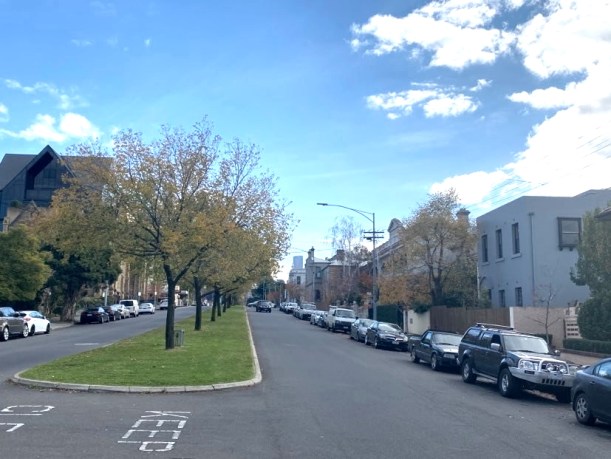
Hotham St East Melbourne in 2020. The last MacGillicuddy home in Melbourne, the grey building (the grey is an extension on the front of a Victorian building) on the right is now a private residence again. It looks out on a streetscape that has changed little since Joan revisited it in 1960. Author’s collection
Joan returned to Australia in 1959, while John was directing and writing scripts for the TV series Whiplash, an Australian “western” starring Peter Graves. They visited the beautiful MacGillicuddy home in Hotham Street, East Melbourne. Much to her horror, it had become a scruffy boarding house. But her old school nearby, Catholic Ladies College, was still operating and some of the nuns who taught Joan were there to greet her. In his autobiography, John recalled being deeply moved by the welcome given to his wife in the school’s best parlour. Sister Bernard held Joan’s hand for the entire visit and recounted what had happened to her classmates and all of the nuns.
Apparently a heavy smoker all her life, Joan died after a battle with cancer, aged only fifty-nine, in June 1978.
Above: Jane Darwell with Joan’s sister Dale Melbourne in Ibsen’s A Doll’s House c 1945. Author’s Collection.
In addition to singing, Joan’s sister Billie also took to acting, performing on stage in the United States in the mid 1940s, using the stage name Dale Melbourne. Independent producer James B Cassidy organised a tour of Ibsen’s A Doll’s House throughout North America in 1944-6 and apart from Billie in the role of Nora, it also featured well known actors Francis Lederer, Jane Darwell and Lyle Talbot (yes – the same Lyle Talbot who appeared in Plan 9 from Outer Space in 1957). Cassidy and Billie were married, until his untimely death in 1952.
Above: A Doll’s House advertised in The Vancouver Sun, 18 November 1944. Via Newspapers.com
In 1981 Billie married John Herklotz, a Californian businessman and philanthropist. She died in 1998 but remains well remembered at the University of California. The University’s Conference facility at the Centre for Neurobiology of Learning and Memory is named after her.
John Meredyth Lucas’s autobiography, with its entertaining accounts of making a pioneering TV series in Australia, was published shortly after his death in 2002. He is, of course, remembered for his own prolific and diverse body of work especially on television – which included writing, producing and directing Star Trek, The Six Million Dollar Man, Harry O and The Fugitive.
Lucas and Meredyth in an advertisement from EJ Carroll. The Green Room Magazine, 1 Oct, 1919, P9. Mitchell Library, State Library of NSW.
Note: Lucas’ parents, US actress and writer Bess Meredyth and director Wilfred Lucas, made three films in Australia in 1920-1 with Snowy Baker and local producer E. J. Carroll, one of which, The Man from Kangaroohas survived to the 21st Century.
Nick Murphy Updated July 2020
Further Reading
John Meredyth Lucas (2004) Eighty Odd Years in Hollywood: Memoir of a Career in Film and Television. McFarland and Co.