Celebrity recipes from Australia

The sad looking roast Wallaby shown above, is recipe No 2858, from the Australian supplement in Mrs Beeton’s Book of Household Management, 1890 edition. Ward, Lock and Co. (For a similar unappetising recipe, see Parrot Pie, below)

The following recipes appeared in Australian publications between 1890 and 1976. I have come across these over the last few years of reading vintage Australian papers etc, and felt in the spirit of Christmas cheer, I should share them.

Nick Murphy, December 2023


Pacific Grill, 1976, Dame Edna Everage

Dame Edna in The Australia Women’s Weekly, 29 April 1981, P43

AUTHOR’S COMMENT
I know someone who made this. It was for a Australian house party to celebrate Charles and Diana’s wedding in July 1981. Of course it was really just another excuse to get stuck into internationally-acclaimed, award-winning Australian wine.

INGREDIENTS
6 lovely plump pork sausages; Dripping; 6 large mushrooms; 6 golden slices of freshly tinned pineapple; Tomatoes, halved; salt and pepper to taste

METHOD & RECIPE
Fry up saussies in a little fat until browned all over (turn well to avoid those horrid grey tummies). Removed from fat keeping them nice and hot somewhere. In the same dripping (already flecked with deliciously crisp sausage oozings) fry the pineapple rungs on both sides until cooked through and soggy. Drain on kitchen paper and keep hot while you sizzle up the peeled mushrooms and tomatoes, adding a dollop of extra fat if necessary, but be careful they do not break. Thrust each hot plump sausage cheekily through the hole in each pineapple slice and garnish with halved tomatoes seasoned with salt and pepper. A spicy tomato sauce is optional. [1]Source: Dame Edna Everage/Barry Humphries (1976) Dame Edna’s Coffee Table Book. P76. Australasian Publishing Company


Baked Meat Ring, 1956, anon

AUTHOR’S COMMENT
In my Australian childhood, the importance of eating copious amounts of meat was taken for granted.
But why you would go to the bother of doing this, I can’t imagine.

ORIGINAL COMMENT
Here’s a hearty main-course dish – and no one would dream it’s made from “left-over” meat… A savoury treat :

INGREDIENTS:

1lb minced left-over meat; 1/2 cup milk; 1 minced onion; 1 dessertspoon Bonox; 1 egg; 1 cup breadcrumbs; 2 tablespoons chopped parsley; 2 finely chopped mint leaves; 1/4 teaspoon salt; pepper.

METHOD & RECIPE
Combine all the ingredients and mix thoroughly. Grease a small ring mould or loaf tin and pack the mixture into it. Bake in a moderate oven (350° F) for one hour. Turn out and serve with tomato sauce, and vegetables in season.[2]The Australian Women’s Weekly 25 Jan 1956, P36


Rabbit in aspic, 1946, Gwenda Wilson

Gwenda Wilson c1945. Australian Performing Arts Collection, Melbourne Australia.

AUTHOR’S COMMENT
Long before she became famous on BBC radio’s The Archers, Gwenda Wilson was making this
dish for guests in Australia.

ORIGINAL COMMENT
With nightly performances, matinees, and rehearsals, the Don Sharp’s (Gwenda’s husband) naturally have little time for entertaining, but they love having people in for Sunday night supper. Here are some of the dishes Gwenda serves her guests on such occasions…

METHOD & RECIPE
One rabbit, cut up and cooked with enough water to cover. Add few bacon rashers and small chopped onion. Season to taste. When cooked remove all bones. Measure liquid and dissolve 1 dessertspoon gelatine, 1 cup liquid. Place hard-boiled eggs and green peas around inside mould, then arrange cooked rabbit and pour over liquid, and leave to set. Turn out and garnish with parsley or chopped mint.” [3]The Argus (Melb) 8 Jan 1946 P8


Recipe for hair dye, 1940, Nancye Stewart
[Do not eat this – it is a home-made hair dye]

Nanyce Stewart, c1930. Australian Performing Arts Collection, Melbourne Australia.

AUTHOR’S COMMENT
This definitely belongs to the era when one made things rather than buying them, no matter how time consuming. Why a well known actor would spend time preparing this mixture rather than buying something off the shelf is unknown.

ORIGINAL COMMENT
Miss Nancye Stewart, well-known actress, tells how to darken grey hair with a simple home-made mixture. The Australian actress—whose artistry has won her many prominent theatrical roles gives the following advice on grey hair and how to darken it.

METHOD & RECIPE
FOR HAIR DYE
Anyone can prepare a simple mixture at home that will darken grey hair and make it soft and glossy. To a half-pint of water add one ounce of Bay Rum, a quarter ounce box of Orlex Compound, and 1 ounce Glycerine. These ingredients can be bought at any chemist’s at very little cost. Apply to the hair twice a week until the required shade is obtained. This should make a grey-haired person appear 10 to 20 years younger. It does not discolor the scalp, is not sticky or greasy, and does not rub off. [4]The Advertiser (Adel) 12 Sep 1940 P6


Eggs pickled in beetroot sauce, 1935, Elissa Landi

AUTHOR’S COMMENT
Another time consuming recipe – in this case for colouring hard boiled eggs, so they look a “gay shade of red.”
This is typical of celebrity recipes from Hollywood wheeled out by Australian papers at the time. Landi’s Hollywood career came to an end at about this time, after she refused a role.

ORIGINAL COMMENT
This is a dish particularly suitable for our climate. For the outdoor buffet luncheon, one of my pet recipes, says Elissa Landi, is for eggs pickled in beet juice.

METHOD & RECIPE
Boil about a dozen carefully scrubbed beets in a kettle of suited water. Pour off the liquid and cool. Have ready the desired number of cold hard-boiled eggs, and, after removing the shells, drop them in the cold beet water. Add a tablespoonful of vinegar several bay leaves, and some slices of onion. Let the eggs soak in this mixture, in the icebox, about 12 hours.

Then remove, allow to drain, and serve on crisp lettuce leaves. They should be a gay shade of red, and will taste as good as they look. [5]The Herald (Melb) 3 Oct 1935, P36


Fried Fish a la Russe, c 1931, Lupe Velez

AUTHOR’S COMMENT
Another recipe very much of its era – fried fish with a lot of cream, butter and fat.
Australian newspapers were likely given such tidbits on up and coming stars by US studios and Velez did not visit the country. Velez did work with Australian Leon Errol in the Mexican Spitfire series. The author finds it hard to believe she ate this very often, if at all.

ORIGINAL COMMENT
Lupe Velez, the fascinating talkie star, is an enthusiastic cook, and likes trying out new recipes. Here are some which she got from a celebrated New York chef. She made them for some of her friends, and she declares they were pronounced excellent. 

METHOD & RECIPE
Take two large slices of any large fish. Cut fillets, saving the skin and bones. Sprinkle fillets with pepper and salt, and pour over them one-third of a cup of white cooking wine.

Cover, and let stand thirty minutes. Drain and dip each piece separately in heavy cream, then in flour, and fry in deep fat.

Cook the skin and bones removed from fish with five slices of carrot, two slices of onion, a sprig of parsley, a bit of bay leaf, a few peppercorns, and two cups of cold water, until reduced to one cup of liquid.

Make a sauce of two tablespoons full of butter, three tablespoons full of flour, the fish stock, one-third of a cup of heavy cream, adding the yolks of two eggs, a dash of pepper and salt, and white wine to taste.

Arrange fish on a serving dish. Cover fish with a half-pound of sauteed mushrooms, and pour the sauce over it.[6]Table Talk (Melb) 9 Jul 1931 P32


The Candle Salad, c1930, Eileen Robinson

Eileen (Right) in her one film with Clara Kimball Young in 1920. Courtesy Margaret Leask

AUTHOR’S COMMENT
Eileen Robinson worked for several extended periods in the US. Unusual though it is, I tend to the view this recipe is real. The French dressing may have been a novelty in Australia at the time.

ORIGINAL COMMENT
From her extensive collection of recipes, gathered during world travels, Miss Eileen Robinson, of the Theatre Royal, supplies the following tasty dish, one which is exceedingly popular at luncheons in America. It is simple to prepare, and amply repays the trouble of making it.

METHOD & RECIPE
For each person allow a slice of pineapple and half a banana. Pare down the banana on the crooked side so that it will be straight and look like a candle. Set each section of banana into the hole in the pineapple, and place a maraschino cherry on top to represent the flame, pouring over a little paprika French dressing. Drain for a few moments, and then arrange individually on salad plates, with a garnish of lettuce.

To make the paprika French dressing take 6 tablespoons of pure olive oil, 2 tablespoons of vinegar or lemon juice, 1 teaspoonful of salt, ¼ teaspoonful of pepper, ½ teaspoonful of paprika. Pour the oil and vinegar (or lemon) into a bowl, add the dry ingredients, and beat with an egg beater until thoroughly mixed. Then serve as recommended.[7]Sunday Mail (Bris) 2 Feb 1930, P18


Parrot Pie, c1890, Mrs Beaton

AUTHOR’S COMMENT
The idea of eating Parakeets or Budgerigars in a pie stretches the imagination. They are quite small and mostly comprised of beak, feather and bone.
Still, the recipe was being prepared in England and possibly Mrs Beeton’s publishers were unclear about what a Parakeet was. (Mrs Beeton had died in 1865 but her publisher maintained the rights to use her name for many years)

INGREDIENTS
1 dozen paraqueets, a few slices of (underdone cold beef is best for this purpose), 4 rashers of bacon, 3 hard-boiled eggs, minced parsley and lemon peel, pepper and salt, stock, puff-paste.

RECIPE & METHOD
Line a pie dish with the beef cut into slices, over them place 6 of the paraqueets, dredge with flour, fill up the spaces with the egg cut in slices and scatter over the seasoning. Next put the bacon, cut in small strips, then 6 paraqueets and fill up with the beef, seasoning all well. Pour in stock or water to nearly fill the dish, cover with puff-paste and bake for one hour. Time- 1 hour. Sufficient for 5 or 6 persons. Seasonable at any time.[8]Mrs Beeton’s Book of Household Management, 1890. Ward, Lock and Co. P1259-1260

This site has been selected for preservation in the National Library of Australia’s Pandora archive

Footnotes

Footnotes
1 Source: Dame Edna Everage/Barry Humphries (1976) Dame Edna’s Coffee Table Book. P76. Australasian Publishing Company
2 The Australian Women’s Weekly 25 Jan 1956, P36
3 The Argus (Melb) 8 Jan 1946 P8
4 The Advertiser (Adel) 12 Sep 1940 P6
5 The Herald (Melb) 3 Oct 1935, P36
6 Table Talk (Melb) 9 Jul 1931 P32
7 Sunday Mail (Bris) 2 Feb 1930, P18
8 Mrs Beeton’s Book of Household Management, 1890. Ward, Lock and Co. P1259-1260

Gwenda Wilson (1921-1977) – from ‘Janie’ to ‘the Archers’

Enlargement of Gwenda Wilson, playing Margaret the nurse in the 1946 JC Williamson production of John Patrick‘s The Hasty Heart, with John Wood. Courtesy the Australian Performing Arts Collection, Melbourne Australia.

The five second version
When Melbourne-born Gwenda Wilson died in 1977, fans of the BBC radio series The Archers mourned the actor’s passing. For twenty years she had played Aunt Laura, a “crusty, bossy, but lonely widow,”[1]The Guardian 19 August 1977, P 14 via Newspapers.com a New Zealand interloper who had moved into the village of Ambridge, having inherited Ambridge Hall. One correspondent felt it would be difficult to find a replacement actor “who could exactly imitate (her) distinctive Antipodean whine and put such righteous indignation into the part.”[2]Birmingham City Post 23 August 1977 P4. Via British Library Newspaper Archive
In addition to her role in The Archers, she appeared occasionally on the British stage, on TV and in a handful of British films. Before she left Australia in late 1948, she had enjoyed six busy years on the stage and in radio in Australia. She was aged only 55 at the time of her death.

Gwenda Wilson, undated. Ritter-Jeppesen Studios, 107-111 Lonsdale Street, Melbourne. Frank Van Straten Collection, Melbourne.

Gwenda Olive Wilson was born in September 1921,[3]Gwenda Wilson, UK Death Certificate in Melbourne, Australia, to Albert Wilson, a furniture manufacturer, and Elsie nee Field. She grew up in the inner eastern suburb of Kew, and attended nearby Methodist Ladies College, where she developed a passion for performance. She won a scholarship to study music at the University of Melbourne, (she later said that her father had dreams of her being a soprano) but it is clear that her passion from a young age was acting. While at the University she regularly featured in amateur performances, including with the University’s Tin Alley Players. She also studied with speech and drama teacher Maie Hoban, in company with Patricia Kennedy, Coral Browne and others.[4]The Australasian (Melb), 24 Feb 1945 P16, Via National Library of Australia’s Trove

Gwenda Wilson, photographed by Athol Shmith, 1946. Australian Performing Arts Collection, Melbourne.

In 1942, having saved £20, she moved to Sydney. After some radio performances she won a breakthrough role as Janie, in the new US play of the same name, which opened at the Minerva Theatre in 1943.[5]ABC Weekly, Vol. 10 No. 21, 22 May 1948, P30. Via National Library of Australia’s Trove

Gwenda’s role as Janie was celebrated by Jim Russell, a cartoonist for Smith’s Weekly. [6]Smith’s Weekly 5 June 1943, P19. Via National Library of Australia’s Trove

Janie concerned a small town girl who hosts a party for US servicemen that gets out of control while her parents are absent – perhaps the idea was a novelty for Australian audiences at the time. On stage with Gwenda were well established Australian performers like Fifi Banvard, and new faces including Margo Lee and Betty McDowall.[7]It was directed by Melbourne-born Alec Coppel, who already had experience as a writer in England and had come back home in 1940. He later went on to a Hollywood career – writing numerous … Continue reading The play found an audience and it ran for two months – thus establishing Gwenda’s credentials, but it was generally dismissed by most as lightweight entertainment. One newspaper wrote that it was without “real character development, plot construction… (and had) the appeal…of a nice whopping chocolate soda.”[8]The Daily Telegraph, 9 May 1943, P23, Via National Library of Australia’s Trove

Gwenda repeated her breakthrough character Janie for radio in 1944 [9]ABC Weekly 27 May 1944, P12. Via National Library of Australia’s Trove

In October 1943, she took a leading role in Kiss and Tell, another play about modern youth from the US that had opened on Broadway only a few months before. It enjoyed a record 53 week run in Melbourne, and long runs in other Australian cities.[10]Viola Tait (1971) A Family of Brothers. P165 Heinemann 21 year old Gwenda gave a “finished and charming interpretation” as Corliss Archer.[11]The Argus (Melb) 13 Dec 1943 P6, Via National Library of Australia’s Trove It was while working on this play that she was caught up in the 1944 “theatrical dispute,” between JC Williamsons, the Australian theatrical monopoly, and Actor’s Equity, over conditions and the use of non-union performers. Gwenda was one of the striking performers issued with a writ to prevent them appearing in an Equity fund-raising performance. The strike was resolved after three weeks and the principle of the “closed shop” for the Australian theatre firmly established – so Equity succeeded.[12]For a contemporary account of the strike see The Age (Melb) 29 May 1944, P3. For a management view of the strike see Viola Tait (1971) A Family of Brothers. P172-175

In January 1945, Gwenda married former serviceman and Tasmanian-born actor Don Sharp.[13]Births Deaths & Marriages Victoria, Marriage certificate 1945/4791 The couple announced their plans to go to London to perform, even though the war was still on.[14]The Argus (Melb),13 Mar 1945, P7. Via National Library of Australia’s Trove In the meantime, there was no shortage of opportunity to perform in radio and on the stage, with Gwenda being heralded as “the new find.”(see Note 1)

Left: Gwenda and Madge Aubrey in Kiss and Tell c1943-45. Right: John Wood with Gwenda in The Hasty Heart c1946. J C Williamson Collection of Photos, via National Library of Australia’s Trove.

In mid 1947, Gwenda and Don joined a company formed to take The Hasty Heart and While the Sun Shines, to occupation forces in Japan. Don Sharp used his service connections to help establish the tour, John Wood, 2 years after his release from a Japanese POW camp, produced and took a leading role. Gwenda reprised her role as nurse Margaret. Also in the company was Wood’s English wife Phyl Buchanan. By late 1947 the Japan tour had concluded and the company returned to Australia. However, as Don Sharp explains in his 1993 interview with the London History Project, instead of returning, he made his way to England, by finding passages on various interconnecting cargo ships. Although Gwenda and Don seem to have maintained an cordial relationship in later years, this was apparently the end of the marriage.

Gwenda, as a leading young performer in Australia, had little trouble finding more work in Australia. She appeared on radio again, and in two Fifi Banvard productions at the Minerva Theatre in Sydney in 1948, Ah Wilderness and Philadelphia Story. But the truth was, as Don Sharp remarked, that the choice for post-war Australian performers was stark. They could either stay – meaning they would continue to work for JC Williamsons, or on radio, or if they were lucky in a rare Australian film. Alternatively, they could try their luck overseas – where the opportunities seemed boundless. Not surprisingly, in December 1948, Gwenda boarded the Shaw Saville ship Arawa for England, joining the great post-war exodus of Australian performers.

Gwenda (left) farewells John Wood (rear) and other Australians heading for England in September 1948. [15]ABC Weekly 18 Sept 1948, P14 Via National Library of Australia’s Trove

Newspaper reports of the doings of Australians in London were usually celebratory, sometimes tinged with nationalistic patter. After all, who wanted to read that someone, well known in Australia, struggled to find work in the heart of the Empire. In March 1949, Truth newspaper reported Gwenda as one of a number of “Sydney actors having a busy time in London,” while she lived with old friends John Wood and Phyl Buchanan.[16]Truth (Syd) 20 March 1949, P35. Via National Library of Australia’s Trove[17]For other articles like this see The Sydney Morning Herald, 14 Aug 1950, P3, Australian Actor Praised, The Newcastle Sun, 14 Jul 1951, P4 Film Role For Young Australian Actor, The Sun (Syd) 12 Nov … Continue reading

But an unusually frank report in a 1965 newspaper finally acknowledged that for many Australian actors, finding work in London was a constant challenge. Gwenda’s friend Betty McDowall described it as “tough as hell.”[18]The Canberra Times, 24 Apr 1965, P9. The struggle from Down Under to acting up top. Via National Library of Australia’s Trove All the same, records show Gwenda found small roles in films and on stage not long after she arrived. One of her first outings was a minor role in Ha’penny Breeze (1950). In his 1993 interview, Don Sharp outlined the extraordinary effort required to make this, his very first British film, which he helped write, produce and took a leading role in. Despite the effort, and Sharp’s later reputation as a British director of note, this film met with a mixed response. Gwenda also appeared in rep with Robert Raglan, touring Britain in Summer in December and Born Yesterday. She then had a small role on stage in London as a nurse in the farce To Dorothy a Son at the Savoy Theatre,[19]Theatre World, 1951, Vol 47, issue 313, via the Internet Archive and in the film Gift Horse, where she played a WREN.[20]The Sun (Syd)18 Oct 1951, P36, Film news from Hollywood and London, via National Library of Australia’s Trove

Screengrab of Joan Rice and Gwenda in Gift Horse, aka Glory at Sea (1952)

In May 1952, she married again, to Malcolm Halkeston MacDougal, a lawyer.[21]Chelsea News and General Advertiser, 9 May 1952, P1, Via British Library Newspaper Archive[22]Butterworth’s Empire Law List, 1961, P32. Butterworth’s. Via Google Books MacDougal, an Australian-born man standing well over 6 feet in height, gained some notoriety in 1953 when he was taken to court for “lightly boxing the ears” of several British Union speakers in Chelsea, apparently while in the company of Gwenda.[23]Chelsea News and General Advertiser, 3 July 1953, P1 The Shutterstock Photo Archive holds a photo of Gwenda on her wedding day, here. But it appears this marriage ended sometime in the late 1950s.[24]Eric Lambert’s 1965 book MacDougal’s Farm is apparently based on MacDougal’s experience as a wartime POW. Known in the army as “Big Mac,” MacDougal died suddenly in … Continue reading

There was coincidentally, another role in a film scripted by Don Sharp – Conflict of Wings in 1954, but it appears much of Gwenda’s modest output in the 1950s was on radio and in TV guest roles. While the reviews of her work are sparse, a few film roles are still accessible to us today – including the thoroughly unpleasant character Jean in the enjoyable and well acted B-film Dangerous Afternoon (1961).

Above – screengrabs from Dangerous Afternoon (1961) with Ruth Dunning as Letty and Gwen playing the nasty (and soon to be murdered) Jean. Screen grabs from copy in the author’s collection.

Gwenda first appeared as the character Aunt Laura on The Archers in May 1957. Non-Britons (including the present writer) are at a decided disadvantage regarding The Archers – for the simple reason most of us have not heard it. This radio drama of English rural life in the fictional village of Ambridge began in 1951, and is still running today, in 12 minute daily episodes on the BBC.[25]See the BBC’s website devoted to the Archers The series was broadcast for a while in Canada, Australia and other Commonwealth countries, but appears to have been dropped by most in the late 1960s.[26]William Smethurst (1988) The Archers. The true story : the history of radio’s most famous programme. P97-101. Michael O’Mara, London For those not familiar with the show and who cannot understand its popularity for 70 years, Lyn Thomas from the University of Sussex provides an explanation, here at the Conversation.com

Gwenda’s death from lung cancer in August 1977[27]UK General Register Office, Death Certificate Gwenda Olive Wilson or MacDougal was quite sudden and apparently unexpected. BBC producer Tony Shryane recalled losing a much loved colleague, mid show: “Gwenda and I had been friends for many years, even before she joined The Archers… She was a delightful artiste whose infectious gaiety made her popular with everyone and she had that indefinable Australian quality that kept her going at parties when everyone else was beginning to fade. When she died, I could not believe that her energy and enthusiasm would no longer be there to enliven our rehearsals and recordings.[28]William Smethurst (1988) The Archers. The true story : the history of radio’s most famous programme. P148-149. Michael O’Mara, London

Gwenda Wilson in the early 1970s. Photo from the Gwenda Wilson collection, Australian Performing Arts Collection, Melbourne, Australia. [29]The context and photographer is unknown

Many might have expected Aunt Laura would now be written out of the series, but fans need not have worried. Another Australian born actor, Betty McDowall, the same one who had appeared with Gwenda in Janie back in Sydney in 1942, immediately took over the role. Aunt Laura lived on for another eight years.


Note 1 – Some recipes from Gwenda.

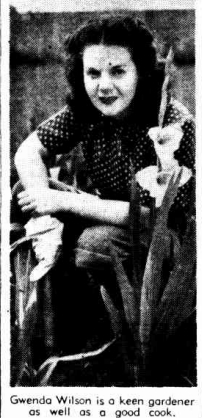
A lengthy article in Melbourne’s Argus newspaper in 1946 presented Gwenda as the “new theatrical find” and reported that her passions were cooking and gardening. Also listed were some of her favourite recipes which are included below. (The author has tried the Ham and Macaroni pie)


“With nightly performances, matinees, and rehearsals, the Don Sharps naturally have little time for entertaining, but they love having people in for Sunday night supper. Here are some of the dishes Gwenda serves her guests on such occasions:

HAM AND MACARONI PIE
Line a pie dish with macaroni which has been cooked till soft. Cover with minced ham (or any meat) and chopped parsley. Season to taste. Then layer of tomatoes. Moisten with a little stock or gravy. Cover with mashed potatoes to which has been added a little butter and milk. Glaze top with beaten egg and bake 15 to 20 minutes in hot oven.

RABBIT IN ASPIC
One rabbit, cut up and cooked with enough water to cover. Add few bacon rashers and small chopped onion. Season to taste. When cooked remove all bones. Measure liquid and dissolve 1 dessertspoon gelatine, 1 cup liquid. Place hard-boiled eggs and green peas around inside mould, then arrange cooked rabbit and pour over liquid, and leave to set. Turn out and garnish with parsley or chopped mint.”
[30]The Argus (Melb) 8 Jan 1946 P8 Young Actress is Hostess at Sunday Night Suppers


Nick Murphy
February 2022 and May 2023


Special Thanks

  • To Claudia Funder at the Australian Performing Arts Collection, Melbourne, who alerted me to their collection of photos and ephemera – that once belonged to Gwenda herself. After her early death, it found its way, via her friends, to the collection.

Further Reading

Text

  • Eric Lambert (1965) MacDougal’s Farm. Frederick Muller Ltd, London.

Media

  • Teddy Darvas and Alan Lawson. (2 November 1993). London History Project – Film, Television, Theatre, Radio. “Interview with Don Sharp” (8 parts)

Australian Dictionary of Biography, National Centre of Biography, Australian National University

Newspaper & Magazine Sources

  • National Library of Australia’s Trove
  • National Library of New Zealand, Papers Past
  • Newspapers.com
  • British Library Newspaper Archive
  • Lantern, the Media History Digital Library

Primary Sources

  • Familysearch.com
  • Ancestry.com
  • Victoria, Births, Deaths and Marriages
  • New South Wales, Births, Deaths and Marriages
  • General Register Office, HM Passport Office.

This site has been selected for preservation in the National Library of Australia’s Pandora archive

Footnotes

Footnotes
1 The Guardian 19 August 1977, P 14 via Newspapers.com
2 Birmingham City Post 23 August 1977 P4. Via British Library Newspaper Archive
3 Gwenda Wilson, UK Death Certificate
4 The Australasian (Melb), 24 Feb 1945 P16, Via National Library of Australia’s Trove
5 ABC Weekly, Vol. 10 No. 21, 22 May 1948, P30. Via National Library of Australia’s Trove
6 Smith’s Weekly 5 June 1943, P19. Via National Library of Australia’s Trove
7 It was directed by Melbourne-born Alec Coppel, who already had experience as a writer in England and had come back home in 1940. He later went on to a Hollywood career – writing numerous screenplays, including Vertigo (1958)
8 The Daily Telegraph, 9 May 1943, P23, Via National Library of Australia’s Trove
9 ABC Weekly 27 May 1944, P12. Via National Library of Australia’s Trove
10 Viola Tait (1971) A Family of Brothers. P165 Heinemann
11 The Argus (Melb) 13 Dec 1943 P6, Via National Library of Australia’s Trove
12 For a contemporary account of the strike see The Age (Melb) 29 May 1944, P3. For a management view of the strike see Viola Tait (1971) A Family of Brothers. P172-175
13 Births Deaths & Marriages Victoria, Marriage certificate 1945/4791
14 The Argus (Melb),13 Mar 1945, P7. Via National Library of Australia’s Trove
15 ABC Weekly 18 Sept 1948, P14 Via National Library of Australia’s Trove
16 Truth (Syd) 20 March 1949, P35. Via National Library of Australia’s Trove
17 For other articles like this see The Sydney Morning Herald, 14 Aug 1950, P3, Australian Actor Praised, The Newcastle Sun, 14 Jul 1951, P4 Film Role For Young Australian Actor, The Sun (Syd) 12 Nov 1953, P39 ACTOR SAYS OPPORTUNITY IN ENGLAND, News (Adel)10 Nov 1954, P2 SA actor gets film contract. Via National Library of Australia’s Trove
18 The Canberra Times, 24 Apr 1965, P9. The struggle from Down Under to acting up top. Via National Library of Australia’s Trove
19 Theatre World, 1951, Vol 47, issue 313, via the Internet Archive
20 The Sun (Syd)18 Oct 1951, P36, Film news from Hollywood and London, via National Library of Australia’s Trove
21 Chelsea News and General Advertiser, 9 May 1952, P1, Via British Library Newspaper Archive
22 Butterworth’s Empire Law List, 1961, P32. Butterworth’s. Via Google Books
23 Chelsea News and General Advertiser, 3 July 1953, P1
24 Eric Lambert’s 1965 book MacDougal’s Farm is apparently based on MacDougal’s experience as a wartime POW. Known in the army as “Big Mac,” MacDougal died suddenly in September 1962, without recounting his experiences himself. Lambert’s book was not well received
25 See the BBC’s website devoted to the Archers
26 William Smethurst (1988) The Archers. The true story : the history of radio’s most famous programme. P97-101. Michael O’Mara, London
27 UK General Register Office, Death Certificate Gwenda Olive Wilson or MacDougal
28 William Smethurst (1988) The Archers. The true story : the history of radio’s most famous programme. P148-149. Michael O’Mara, London
29 The context and photographer is unknown
30 The Argus (Melb) 8 Jan 1946 P8 Young Actress is Hostess at Sunday Night Suppers