Henry Matsumoto (1879-1934) Valet, Actor, Businessman

Henry Matsumoto, undated photo. Image courtesy of the National Archives of Australia. NAA: SP42/1, C1931/3848.

This article was originally published in On Stage, the online journal of Theatre Heritage Australia.

The Five second version.
‘Henry’ Kakusakuro Matsumoto, was born in Japan on 8 September 1879. He spent most of his adult life in Australia, and despite the fact he lived in a limbo-land of non-citizenship—a consequence of the racist White Australia policy—he appeared on stage in Australia in the 1910s, and in two Australian films made by Fred Niblo, followed by a stint on stage in the US. However, his footsteps through the historical record are faint. He was never interviewed and only rarely reviewed, and the Second World War swept away memories and cultural records of the Japanese in Australia. Fortunately, the National Archives of Australia hold very comprehensive files on ‘aliens’ who resided in Australia in the early twentieth century, and here we can meet Henry Matsumoto.[1]National Archives of Australia. SP42/1, C1931/3848, Henry Kakusaura Matsumoto

The Mail (Adelaide) reports on a ‘Jap Comedian’ with the Royal Banzai Troupe of Japanese Acrobats [2]26 April 1913, p6

When South Australia’s Daily Herald announced in November 1912 that Henry Matsumoto was the “first Japanese to appear on the Australian stage”, they were, or course, engaging in a piece of journalistic shorthand.[3]Daily Herald (Adelaide) 27 November 1912, p9 He wasn’t. The success of touring Japanese acrobats in Australia in the late nineteenth century was well known at the time and has been recorded by Mark St Leon.[4]St Leon (2011) pps155-6 In spite of discriminatory colonial and later national legislation, since labelled as the White Australia policy, there were in fact, a few performers of Asian backgrounds who achieved a degree of success in Australia. Most famous perhaps was Melbourne-born Rose Quong (1878-1972), whose journey to the stage has been documented by Angela Woollacott. The story of others of mixed race, including the celebrated dancer of the late nineteenth century, Saharet (1878-1964), is now also well documented, despite her lifelong efforts to hide her origins of Chinese-Australian ancestry.

Henry Matsumoto, undated photo, probably about the time of his arrival in Queensland in 1899. Image courtesy of the National Archives of Australia. NAA: SP42/1, C1931/3848.

Moving to Australia

Kakusakuro Matsumoto[5]He apparently adopted the first name ‘Henry’ on arrival in Australia arrived in Queensland in November 1899. He was employed as a clerk at the Yamato Company Store in Townsville, one of the colony’s first silk suppliers.[6]Killoran (2023) p153 Born in Osaka, a Japanese Treaty Port, he had probably acquired a high degree of fluency with English language before arriving in Townsville, which had a sizeable Japanese population working in the sugar and pearling industries.[7]Sizeable in the north of Queensland, but Armstrong (1973) p8 estimates there were never more than 3,000 Japanese in the entire colony Townsville even boasted a Japanese Consulate office at the time. Queensland’s delay in introducing restrictive immigration laws—as other Australian colonies had done—apparently benefited Henry.[8]See Neville Meaney (2007) p18-19

In 1901, only a few years after Henry’s arrival, Australia’s new Commonwealth Parliament passed the Immigration Restriction Act. In Alfred Deakin’s(1856-1919) words, the law’s stated intention was “the prohibition of all alien coloured immigration, and… by reasonable and just means, the deportation or reduction of the number of aliens now in our midst.”[9]Attorney-General Alfred Deakin, 12 September 1901 The law’s mechanisms for excluding “alien coloured immigration” included the infamous dictation test, applied when non-Caucasians arrived to seek entry to Australia. Exemptions could be granted, but the intention was avowedly to create a ‘White Australia.’

Henry’s National Archives file shows that in 1904 he left Townsville to work as a valet for pastoralist Philip Gidley King at Goonoo Goonoo station near Tamworth, in New South Wales. Then for the three years 1905-7 he was a valet in Sydney, to Sir Frederick Darley, one time Chief Justice and Lieutenant Governor. In 1908 he served as a valet for E.H.L. von Arnheim, Deputy Master of the Sydney Mint. These were impressive appointments, which also provided him with useful character references—just the sort of references required to support exemptions from provisions of the 1901 Act.

In 1909 Henry moved on again, apparently to establish his own import business – to cater for the fashion in oriental fabrics and ceramics—a contradiction indeed in a country wishing to exclude non-Caucasians. Henry also married Ada Maud White, an English dressmaker, in Melbourne, in December 1909. A daughter was born of the union in 1912, and a son in 1913. But the marriage did not mean that Henry became British or Australian. Rather, it meant Ada became a Japanese national.

A New Opportunity beckons

In July 1912, US actors Fred Niblo(1874-1948) and Josephine Cohan(1876-1916) arrived in Australia to launch a tour of American farces for J.C. Williamson, the first being George M Cohan’s Get Rich Quick Wallingford. Niblo and Cohan would have been quite aware that in New York, a Japanese American named Yoshin Sakurai had successfully taken the supporting role of Yosi the Japanese valet in 1911.[10]See Esther Kim Lee (2006), p14. However, Elizabeth Craft suggests a Korean actor “Du Gle Kim” first played the role in the US. Craft (2024) p100 The character of Yosi had not appeared in the original Wallingford stories by George Randolph Chester—it had been added to the play by Cohan.[11]Elizabeth Craft (2024) p236

As Josephine Lee argues, the more authentic use of real Asian actors on stage instead of Caucasians in ‘yellowface’ did not change the fact they were “onstage for the benefit of white spectators, and their performances strongly framed by assumptions about their racial and cultural difference.” They were “exotic novelties” she concludes.[12]Josephine Lee (2015) p63

Yoshin Sakurai playing Yosi in the US in 1911. [13]The Plain Dealer (Cleveland, Ohio) 16 October, 1911, p14

As Elizabeth Craft notes, the minor character of Yosi, valet to the con-man J Rufus Wallingford, both reinforced and undermined existing stereotypes. The character is mocked and dehumanised as ‘the Jap.’ However, when a resident of Battlesburg—the fictional town where the action of the play is set—assumes he is Chinese and makes an offensive comment, Yosi retorts in fluent English and appropriate US slang, “Go on, you big stiff.”[14]Elizabeth Craft (2024) p100

Melbourne Punch reported that Niblo had asked the Japanese consulate in Sydney for help in casting the part of Yosi and Henry Matsumoto had been nominated.[15]Punch (Melbourne) 21 Nov 1912, p42 The pragmatic Niblo obviously felt the previously unknown Henry could take the part. Table Talk noted Henry spoke “very fair English” and claimed he had previous stage experience in Japan. Henry’s skill with English was important, however, given the play was so dependent on distinctive US slang and mannerisms for comic effect.

During their three-year performance tour for J.C. Williamson, Niblo and Cohan presented eight comedies, all of which were a success.[16]The tour was extended three times; in December 1912, May 1913 and May 1914. The contracts survive in the Australian Performing Arts Collection In addition to Get Rich Quick Wallingford, Henry also appeared in speaking roles in Excuse Me! and Officer 666 although these were again minor roles—as a porter and valet.

The company toured all the Australian capitals and went to New Zealand twice. The travel to New Zealand meant the troupe left the country, and with their return, Henry was potentially exposed to the provisions of the Immigration Restriction Act—including the dictation test. But such was the influence of J C Williamson he was exempted at their request, and Henry breezed back into Australia with the rest of the cast.

Image courtesy of the National Archives of Australia. NAA: SP42/1, C1931/3848. F.J. Quinlan was a secretary of Australia’s External Affairs Department.

Poster for Excuse Me! showing Henry in another minor role. Image Courtesy Australian Performing Arts Collection.

In May 1915, Fred Niblo quickly directed film versions of Get Rich Quick Wallingford and Officer 666 for J.C. Williamson, using the stage cast. These were fairly unimaginative, static camera films. As Ralph Marsden has explained, J.C. Williamson turned to making films because they were concerned about the release of US-made films, based on plays to which Williamson’s already held the Australian stage rights. The Firm probably assumed that filmed plays might provide a means to safeguard their claim on the plays and provide income from distribution to less populous parts of the country.[17]Marsden (2009) p4

Existing credit lists show Officer 666 included Henry, and it is reasonable to conclude he also appeared in the (now lost) filmed version of Get Rich Quick Wallingford, made only a few weeks earlier.[18]Pike & Cooper (1980) p80 Writing in 2009, Ralph Marsden was obviously lucky enough to see all of the 40 minutes of Officer 666 that survives, but only a two minute clip is freely available to us today—and that clip does not include Henry. In the end, neither film proved successful at the Australian box office, and J.C. Williamson soon abandoned its filmmaking.

Niblo and Cohan finally wrapped up their tour in June 1915 and returned to New York, taking two promising young actors with them—Enid Bennett(1893-1969) and Pirie Bush(1889-1965). Did Henry Matsumoto also dream of an ongoing career on the stage? It would seem he did.

Henry Matsumoto about the time he appeared on stage in Australia c1912-1915
Image courtesy of the National Archives of Australia. NAA: SP42/1, C1931/384

In December 1915, Hugh Ward, the J.C. Williamson Manager who had previously contracted Fred Niblo and Josephine Cohan, returned to Australia with a new US acting partnership—Hale Hamilton and Myrtle Tannehill. Their repertoire again included the very popular Get Rich Quick Wallingford. Several Australians were on hand to reprise their supporting roles from the Fred Niblo-Josephine Cohan tour. But not Henry Matsomoto.

In October 1915, Sydney’s The Theatre Magazine reported that Henry had been cabled by Fred Niblo, urging him to come to New York for acting work.[19]The Theatre Magazine (Sydney) 1 October 1915, p16 He arrived in San Francisco on the SS Sierra in January 1916. On arrival in the US, Henry listed his profession as actor, and his contact in the US as Fred Niblo, care of George M Cohan, New York. For the very thorough US immigration records, Henry was also required to give his nationality. For this question he stated he was Australian, although this was not the case. As far as the Australian Government was concerned, he was Japanese—and there was no provision for dual citizenship at the time.

Back in Australia, the Hamilton-Tannehill performance of Get Rich Quick Wallingford failed to find another Japanese actor to take the role of Yosi. Instead, Frank Seegoolam was engaged. He was a former Officer’s cook from HMS Cambrian and later a personal cook for several wealthy Sydney families. Originally from Mauritius, then a British colony, Seegoolam was a British subject and thus his Australian residency could never be questioned.[20] National Archives of Australia. C1912/21405, Frank Seegoolam But in Get Rich Quick Wallingford the character of Yosi had to be changed to Hassan,[21]National Library of Australia. J.C. Williamson scrapbooks of music and theatre programmes, Sydney and Melbourne, 1905-1921. PROMPT Scrapbook 8 – Vol 3, p129 and presumably some of the dialogue was changed too.[22]The Daily Telegraph (Sydney) 2 September 1916, p2 The racial stereotype was simply transferred from one ethnic group to another.

Henry in the US 1916-1918

After his arrival in the US in January 1916, Henry disappears from the historical record in the US for about twelve months. He may have appeared on stage, but there is, so far, no record that he did. In later life he listed travelling salesman as one of his occupations, perhaps this is what he did in New York in 1916. However, in early 1917 Hale Hamilton and Myrtle Tannehill returned to New York and a revival of Get Rich Quick Wallingford was soon announced. In the cast was Henry Matsumoto, reprising his role as Yosi.

The Billboard announces Get Rich Quick Wallingfords revival featuring Hale Hamilton and Myrtle Tannebill, with Henry as Yosi. May 19, 1917.

The revival had a short run at two theatres in New York and by the end of May it was over. So too, apparently, was Henry’s acting career. He had returned to Australia by August 1918, when, National Archives records indicate, he had recommenced his import business and added teaching Japanese to his resume.

Quite a lot thinner and now 40 years old, Henry Matsumoto after his New York experience c1919. Image courtesy of the National Archives of Australia. NAA: SP42/1, C1931/3848

Henry Matsumoto had long abandoned his dreams of acting by 1934, but he was still required to apply for exemptions and permission to re-enter on his return to Australia from business trips to China and Japan. On his final trip to Japan in 1934, he became seriously ill after stopping over in Shanghai. He suffered a cerebral haemorrhage and died on 27 September while at the Osaka Imperial University Hospital, Japan. In the best traditions of reporting about the exotic East, Australian newspapers speculated that the well-known Sydney merchant had been poisoned by some ‘obscure poison’ while on the ship. Sydney’s Truth newspaper ran the headline:
“Tragic fate of popular Sydney Japanese. Scientists baffled. Did orient love potion send him mad?”
It claimed he had been seduced, drugged and robbed by a beautiful Filipino girl who had joined the ship in Manila—a type of Mata Hari story.[23]Truth (Sydney) 14 October 1934, p21 The story dragged on for months. It remains completely unclear whether there was any truth to this story at all.

Henry Matsumoto, business card, c1930. Image courtesy of the National Archives of Australia. NAA: SP42/1, C1931/3848.

Despite his early death, the ongoing prejudice and the endless legalities Henry Matsumoto endured, he remains someone we should celebrate. A minor but determined actor and a successful businessman, he never showed any interest in making his life anywhere but Australia, even though the country would not accept him as a citizen.

Following his death, Henry’s family showed no interest in moving either. Ada went through the process of regaining her British citizenship, and seven years later, after war broke out in the Pacific, the family changed their surname to Maxwell.

Twenty years after Henry’s death, probate on his estate was finally granted to his two children.


Nick Murphy
November 2025


Sources

Collections

  • Australian Performing Arts Collection, Arts Centre, Melbourne, Australia.
  • National Archives of Australia.

Text

  • J. Armstrong, ‘Aspects of Japanese Immigration to Queensland before 1900.’ Queensland Heritage, Vol 2, No 9, 1973. University of Queensland espace Library.
  • Elizabeth T Craft, Yankee Doodle Dandy. George M. Cohan and the Broadway Stage, Oxford University Press, 2024.
  • Tianna Killoran, The near north and the far north: The Nikkei community in North Queensland, 1885-1946. PhD Thesis, James Cook University, 2023.
  • Esther Kim Lee, A History of Asian American Theatre, Cambridge University Press, 2006.
  • Josephine Lee, ‘Stage Orientalism and Asian American Performance from the Nineteenth in the Twentieth Century’ in Rajini Srikanth & Min Hyoung Song, (eds.) The Cambridge History of Asian American Literature. Cambridge University Press; 2015
  • Ralph Marsden ‘Melbourne’s Forgotten Movie Studio’ in On Stage, Vol 10, No 2, 2009 (Part 1) and Vol 10, No 3, 2009 (Part 2) Theatre Heritage Australia.
  • Neville Meaney, Towards a New Vision, Australia and Japan across time, University of New South Wales Press, 2007
  • Andrew Pike & Ross Cooper, Australian Film 1900-1977, Oxford University Press, 1980.
  • Mark St Leon, Circus, The Australian Story, Melbourne Books, 2011.
  • Angela Woollacott, Race and the Modern Exotic. Three ‘Australian’ women on Global Display. Monash University Publishing, 2011

This site has been selected for preservation in the National Library of Australia’s Pandora archive

Footnotes

Footnotes
1 National Archives of Australia. SP42/1, C1931/3848, Henry Kakusaura Matsumoto
2 26 April 1913, p6
3 Daily Herald (Adelaide) 27 November 1912, p9
4 St Leon (2011) pps155-6
5 He apparently adopted the first name ‘Henry’ on arrival in Australia
6 Killoran (2023) p153
7 Sizeable in the north of Queensland, but Armstrong (1973) p8 estimates there were never more than 3,000 Japanese in the entire colony
8 See Neville Meaney (2007) p18-19
9 Attorney-General Alfred Deakin, 12 September 1901
10 See Esther Kim Lee (2006), p14. However, Elizabeth Craft suggests a Korean actor “Du Gle Kim” first played the role in the US. Craft (2024) p100
11 Elizabeth Craft (2024) p236
12 Josephine Lee (2015) p63
13 The Plain Dealer (Cleveland, Ohio) 16 October, 1911, p14
14 Elizabeth Craft (2024) p100
15 Punch (Melbourne) 21 Nov 1912, p42
16 The tour was extended three times; in December 1912, May 1913 and May 1914. The contracts survive in the Australian Performing Arts Collection
17 Marsden (2009) p4
18 Pike & Cooper (1980) p80
19 The Theatre Magazine (Sydney) 1 October 1915, p16
20 National Archives of Australia. C1912/21405, Frank Seegoolam
21 National Library of Australia. J.C. Williamson scrapbooks of music and theatre programmes, Sydney and Melbourne, 1905-1921. PROMPT Scrapbook 8 – Vol 3, p129
22 The Daily Telegraph (Sydney) 2 September 1916, p2
23 Truth (Sydney) 14 October 1934, p21

Josephine M Cohan & Fred Niblo’s 3 years in Australia

Above; Fred Niblo and Josephine M Cohan at the time they left Australia in 1915. Images and Poster for Excuse Me! courtesy Australian Performing Arts Collection, Melbourne. Below left; Fred and Josephine with their son Fred Junior.[1]The Stage Pictorial (Melb) April 1913, p59. State Library of Victoria

The Five Second Version

US husband & wife team Josephine M Cohan(1876-1916) and Fred Niblo(1874-1948) ran a hugely successful performance tour of Australia and New Zealand between July 1912 and June 1915, introducing George M Cohan’s breezy Broadway style to the Australian audiences. Today it might even be called “Josie and Fred’s excellent adventure” – it brought them great popularity in Australasia and they were feted wherever they went. As their surviving contracts with the JC Williamson organisation also show, they were very well paid while in Australia – their contracts being repeatedly extended. Josephine also made the long sea voyage back to New York to see her family twice during the tour, despite her increasingly frail health. In 1915, shortly before they wrapped up, Fred made two quickly filmed versions of their plays Get-Rich- Quick Wallingford and Officer 666 for JC Williamson. Fred took the leading comic roles he often played on stage, but Enid Bennett (1893-1969) took the parts usually taken by Josephine in the stage version. 22 year old Enid Bennett had regularly been Josephine’s stage understudy over previous three years.

Within a year of their return to New York, Josephine had died of the heart condition that had plagued her for so long. She was only 39. In early 1918 Fred Niblo married Enid Bennett and turned to live and work in California’s booming film industry, although not before JC Williamson’s made another attempt to bring him back to Australia, on an even larger contract. It was unsuccessful.

Josephine and Fred on tour in the US about the time they signed their Australian contract.[2]The Cleveland Leader (Ohio) 19 Mar 1912, p6

Off to Australia

In early March 1912, Hugh J Ward (1871-1941), a manager for the Australian theatrical firm JC Williamson[3]So large a concern in Australasia it was known as “The Firm” signed a six month contract with Fred Niblo and Josephine M Cohan, to lead an Australian tour of what was being heralded as the “Farce Comedy Company”. Ward, himself an actor and a US native, had a good sense of what would work in Australia, and may even have seen Fred and Josephine in the US while they toured the comedy The Fortune Hunter in 1911. The repertoire for Australia was anticipated to include other popular “American comedies”[4]Critic (Adelaide) 12 Nov 1913, p21 Officer 666, Excuse Me! and Get-Rich-Quick Wallingford – the latter authored by Josephine’s brother George M Cohan.(1878-1942)

Josephine’s stage credentials (Josie to those who knew her) were impressive and she was rightly promoted to Australians as one of “the best-known Broadway comediennes.” With her parents and brother George, she had come to prominence in a family vaudeville act called The Four Cohans.(You can read more about the Four Cohans here) She had married Fred Niblo in June 1901 and a son, Fred Junior, was born of the union in late January 1903. However, with the “breakdown” in her health [5]which included an increasing fatigue caused by the onset of heart disease the singing and dancing of vaudeville had proved too strenuous, and American comedy on the legitimate stage beckoned.[6]Critic (Adelaide) 12 Nov 1913, p21

Fred on the cover of Sydney’s The Theatre Magazine. November 1912 [7]State Library of Victoria

Australians were advised by JC Williamson publicity that Fred Niblo was a “New York Star-comedian.”[8]The Sydney Morning Herald, 4 May 1912 p18 This he was, although he had initially built his reputation as a monologist – his amusing lectures on world travel were well known.[9]See for example The Washington Post, 28 March 1909 pgSM3 After his marriage to Josephine he became increasingly associated with George M Cohan, as a performer and producer.

The Australian contracts

In addition to covering the couple’s first class travel, the six month contract with JC Williamson allowed for a joint salary of £120 per week, for a guaranteed minimum of at least 22 weeks. In todays terms, this is the equivalent of a 6 month salary of at least $AU 370,000, thus one can see why Fred and Josephine took the offer. By comparison, Enid Bennett’s August 1913 weekly salary was £5 per week and when her sister Marjorie Bennett was enticed back to Australia in 1920, her salary was £20 per week.[10]Based on contracts surviving in the Australian Performing Arts Collection. Salary conversions are based on the RBA inflation calculator However, an important distinction was that Niblo was producing (directing) the plays as well as taking leading roles. Ward was undoubtedly also aware that the contract with Josephine and Fred gave Williamson’s easy access to the works of George M Cohan.

Kingsclere apartments built 1912. One of Sydney’s earliest apartment blocks and home to Fred and Josephine in 1914.[11]Dictionary of Sydney

The degree of success the couple enjoyed in Australia is reflected in the fact that Josephine and Fred’s contract was renewed another three times – in December 1912 for a further 6 months, in May 1913 for 12 months and May 1914 for another 12 months. While it is clear that some provision was now made for Josephine’s regular absences from the stage,[12]when she did not perform the salary dropped to £100 per week by the time of the final contract of May 1914-May 1915, the salary had been negotiated up to £160 per week. Thus in their final year Josephine and Fred probably made the equivalent of $AU 900,000 in today’s money, assuming they again worked 40 weeks. That it was lucrative work was noted even at the time. In June 1913, on the first of several trips back to New York to see her son and family, Josephine told reporters in Honolulu how well it was going in Australia. The “pickings are good” she told the Honolulu Star-Bulletin, which went on to claim that “a harvest of golden sovereigns” awaited “high class performers” in Australia.[13]Honolulu Star-Bulletin 13 June 1913, p5

Josephine and Fred arrived in Sydney on 6 July 1912. In letters home to her parents, some of which were later published, Josephine commented on the couple’s warm reception on arrival in Sydney. And after a few days in a Sydney hotel (twenty years behind the times, Josephine thought) they moved into a large, comfortable apartment on Macquarie St, with city and sea views, and, much to Josephine’s delight, containing open wood fires. She commented, politely, on all the differences she observed – including the more casual customs and dress of Australians – “they are comical dressers, but they don’t know it… They stare at [Fred’s] evening suit and his gray dinner jacket.” She was impressed by many things, including the sights of winter swimming on Manly beach. “The girls… dress à la Annette Kellerman… [and] are wonderful swimmers.”[14]The Green Book Magazine (US), Vol 9, No 2, Jan-June 1913, pps 332-338

Josephine M Cohan in 1912[15]The Theatre 1 Sept 1912, p37

Get-Rich-Quick Wallingford was given a very enthusiastic reception when it opened in Sydney in August 1912. Australians embraced the irreverent humour of George M Cohan and managed its slang, despite endless press comments about how unfamiliar and difficult it was.[16]These were probably planted by The Firm Sydney’s Daily Telegraph told readers:

Mr. Fred. Niblo and his company carried all before them on Saturday night at the Criterion, in Mr. George M. Cohan’s comedy Get-Rich-Quick Wallingford. The performance was one of the smartest seen in Sydney for years…

Although the Williamson contract was primarily written for Fred Niblo, Josephine also created a distinctive and favourable impression. The Daily Telegraph felt her a most convincing actress – “very natural, even quiet in style, and yet very sure.”[17]The Daily Telegraph (Sydney) 5 Aug 1912, p11 The Sun went even further in praise of Josephine ;

The highest praise must be given to Miss Josephine Cohan (who is the sister of the author of the play) for her characterisation of the stenographer Fanny Jasper. It is the most difficult role in the piece. The other characters have straight-ahead parts to play. They are either crooks or “boobs.” But Fanny Jasper has to be, in the first instance, the one sharp-sighted “wise girl” among a town-full of simpletons, and after wards a complete convert to the worship of J. Rufus Wallingford.[18]The Sun (Sydney) 4 Aug 1912, p4

The following cast list for Get-Rich-Quick Wallingford in Melbourne in November 1912 shows the mix of local Australian actors (Lowden Adams, Beatrice Holloway, Enid Bennett, George Whitehead, H.H. Wallace and Robert Greig) and visiting US players (James H Manning, Edwin Lester, Harry Corson Clarke and Margaret Dale Owens). Henry Matsumoto(1879-1934), a Japanese-born, Sydney based merchant turned actor, played Yosi, Wallingford’s valet.

Wallingford opens in Melbourne in November 1912, but without Josephine.[19]National Library of Australia, J. C. Williamson Theatres General Theatre Programs, Prompt Collection[Click to enlarge]

Josephine’s declining health meant that when Get-Rich-Quick Wallingford opened in Melbourne, she was not in the cast. Instead Fanny Jasper was played by 28 year old Beatrice Holloway (1884-1964). A few months later, Josephine spoke enthusiastically about her new understudy, twenty year old Australian Enid Bennett, who she was training up. Enid was “a darling child, and I’ve…set my heart on making her a success.”[20]Sun (Sydney) 27 April 1913, p15 And she did. When Fred and Josephine left Australia on the Matson liner Ventura in June 1915, Enid packed up and went with them. By that time, Fred and Josephine had introduced eight new comedies to Australian audiences – including two more from the pen of George M Cohan – Seven Keys to Baldpate and Broadway Jones . All of these were directed by Niblo and all were a great success at the box office.

Poster and program for Excuse Me! in (left) Melbourne and (right) Sydney. Josephine Cohan is not listed on either program.[21]Marjorie Newton was her usual role Courtesy Australian Performing Arts Collection, Melbourne.
Josephine as Josie Richards and Fred in the title role of Broadway Jones. [22]The Theatre Magazine (Sydney) 1 Jan 1915

A few weeks before they departed, the always sensible Melbourne Age reported on the Cohan-Niblo tour of Australia:
The remarkably successful visit to Australia of Fred Niblo is nearing the close. During the three years Mr. Niblo has appeared before Australian audiences he has achieved an unbroken series of successes and an amount of popularity that few artists have enjoyed.[23]The Age (Melb) 24 May 1915 p14 But no mention was made of the films he was hurriedly making for JC Williamson during the day.

Fred Niblo’s first films

Before the couple left Australia in June 1915, Fred quickly directed two films for JC Williamson – Get-Rich-Quick Wallingford[24]a lost film and Officer 666, apparently using the stage cast and costumes.[25]W.J. Lincoln started work directing Wallingford, but was replaced by Niblo, possibly because of his chronic alcoholism It is more accurate to describe these as filmed plays – the camera was static – and sat in place of the audience. Pike & Cooper also describe these as “potted versions” of the plays, and without the snappy dialogue the Cohan plays were famous for, there is not much doubt these would only be palatable to those who had already seen the live show.[26]Pike & Cooper (1980) pps77-78 and 80

Josephine Cohan did not appear in either film – instead Enid Bennett took the leading female roles.

Screengrabs from Officer 666, showing left to right – Sydney Stirling & Enid Bennett, Fred Niblo in a rare Melbourne location shot, and Fred dressing as Officer 666.[Click to enlarge] [27]Screengrabs from Author’s copy of Pictures that Moved: Australian Cinema 1896-1920 (1968)

Writing of the short-lived JC Williamson film studio in Melbourne, Ralph Marsden has revealed a compelling reason for The Firm’s foray into filmmaking in 1915. They were concerned about the release of US-made films, based on plays to which Williamson’s already held the Australian stage rights. Writing in 2009, Marsden was obviously able to see all of the 40 minutes of Officer 666 that survives, but only a two minute clip is available to us today [view here]. Marsden wrote “The film’s strengths are in the performances of Fred Niblo, debonair and amusing, and Enid Bennett, a petite, graceful beauty with large expressive eyes who gives a relatively naturalistic interpretation as the ingénue.[28]Marsden (2009) p4

The films were not released until 1916, but being pale reflections of very popular stage shows, they were not a success at the Australian box-office. JC Williamson pulled out of film production soon after.

Fred and Josephine, and being in Australia

Over 1912-1915, the reviews of Fred Niblo and Josephine Cohan’s work in Australia and New Zealand were universally enthusiastic. However, the admiration for the couple was also shared by those who worked with them. Maurice Dudley, the troupe’s stage manager in 1915 spoke warmly of Niblo’s approach to delivering comedy on the stage. He described the methodical rehearsals and characterised Niblo as “the most unselfish comedian I have ever known….Mr Niblo doesn’t care who gets… [the laughs] as long as they’re got.”[29]Sun (Syd) 10 Jan 1915, p14 Fred Niblo was probably amongst the first actors to publicly explain the concept of stage “team work” in April 1914 – an idea new to many at the time.[30]The Theatre (Syd) 1 April 1914, p1

When the end of the tour was announced in 1915, Fred went to some effort to explain why the couple were leaving – simply because they could not stay away from their family or professional home indefinitely.[31]Josephine had collected their son Fred Junior on a trip home in September 1914, thus that source of anxiety had been removed

Bob Greig and Bea Holloway’s wedding in Melbourne in December 1912. Josephine and Fred stand at the rear, centre and right.[32]Punch (Melb) 26 Dec 1912 Fred was a witness on the marriage certificate, and gave Bea away.

It was Josephine who characterised the troupe as one “big family” [33]Critic (Adelaide) 12 Nov 1913, p21 and evidence suggests that a strong bond really did exist between some of the players. Young Australians Enid Bennett and Pirie Bush(1889-1965)[34]Pirie Bush was actually born in Wellington New Zealand, but had been with the Niblo-Cohan troupe in Australia from its inception travelled to New York with Fred and Josephine in June 1915.[35]The Age (Melb) 3 June 1915, p12 Lowden Adams(1881-1959) arrived in New York in October 1915. Henry Matsumoto, the Japanese born merchant who had taken some roles with Fred and Josephine in Australia, was convinced to try his luck in the US. At Niblo’s suggestion he travelled to the New York in January 1916 and reprised his role as Yosi in Get Rich Quick Wallingford. Robert Greig and Beatrice Holloway were also close friends and ten years later, after much deliberation, they also headed to the US. There, the talented Beatrice abandoned her career, while Bob Greig endured a film career playing butlers – as did Lowden Adams.

Fred and Josephine expressed their feelings on leaving Australia in a souvenir program printed just before their departure. A century later, they are still quite touching sentiments.

We meet, We part, Sometimes we remember.  We have played in every English-speaking country in the world. This is our longest absence from Broadway, and it has been all too short. It has been the most delightful engagement of our professional careers… In saying goodbye to our many friends, we do so with the sincerest regret.  The one hope that cheers us is that someday we may be able to return and renew an association that has been so thoroughly happy. 
Our memories of Australia will be pleasant always. May we hope that we will not be entirely forgotten.
Australia, 1915.

A page from the Niblo-Cohan souvenir program, 1915.[36]Farewell souvenir program, 1915. National Library of Australia

Josephine M Cohan died of her heart ailment at their apartment in the Hotel Belleclaire in New York on 14 July 1916, only a year after the return to the US. Fred and Fred Junior were by her side. George M Cohan felt the death of his sister so deeply he suffered a collapse on the day of the funeral.[37]New York Herald, 15 July, 1916, p5 Biographer Ward Morehouse, who interviewed George M Cohan in the early 1940s, noted that by then, he was estranged from Niblo. This writer wonders whether the mercurial George held Fred responsible for Josephine’s death.[38]Morehouse(1943) p20

Above: Enid Bennett in Cock O’ the Walk, with Janet Dunbar and Rita Otway, 1916. Author’s Collection

In New York in early 1916, Enid Bennett went on stage in a supporting role in the comedy Cock O’ The Walk, a vehicle for popular comedian Otis Skinner. At about the same time she also appeared in her first film, A Princess of the Dark for Thomas H. Ince and Triangle Studios.

In 1918, Fred Niblo and Enid Bennett married.[39]Some Australians were unkind about the marriage. As late as 22 December 1947, journalist Jim Donald of the Sydney Daily Mirror publicly and incorrectly stated Josephine and Fred had divorced before … Continue reading Only a few months later, JC Williamson’s made a sterling effort to get Fred and Enid back to Australia. This time, the salary on offer was an extraordinary £200 per week for two years – an eyewatering sum for the time. The surviving files in the Performing Arts Collection suggest they seriously considered it.

However, in the end Fred and Enid turned this down. Hollywood beckoned, and both went on to long careers there. In addition to their contributions to cinema, they also raised three children and built a landmark home in the Hollywood hills. They never returned to Australia, but they maintained some of their old friends from Australia – and welcomed new ones.


Nick Murphy
November 2025


References

Collections

  • Australian Performing Arts Collection, Arts Centre Melbourne. Thank you, as always, to Claudia Funder, Collection Access Manager.

Australian Dictionary of Biography, National Centre of Biography, Australian National University.

Other Online Sources

Text

  • Frank Cullen (Ed) Florence Hackman & Donald McNeilly (2007) Vaudeville Old & New. An Encyclopedia of Variety Performers in America, Vol 2. Routledge Taylor & Francis
  • Ward Morehouse (1943) George M Cohan, prince of the American Theater. J. B. Lippincott Co
  • Andrew Pike & Ross Cooper (1980) Australian Film 1900-1977. Oxford University Press/AFI
  • Hal Porter (1965) Stars of Australian Stage and Screen. Rigby
  • Michael & Joan Tallis(1999) The Silent Showman. Sir George Tallis, the man behind the world’s largest entertainment organisation of the 1920s. Wakefield Press.
  • Clive Unger-Hamilton(Ed) (1980) The Entertainers. Harrow House Editions
This site has been selected for preservation in the National Library of Australia’s Pandora archive

Footnotes

Footnotes
1 The Stage Pictorial (Melb) April 1913, p59. State Library of Victoria
2 The Cleveland Leader (Ohio) 19 Mar 1912, p6
3 So large a concern in Australasia it was known as “The Firm”
4, 6 Critic (Adelaide) 12 Nov 1913, p21
5 which included an increasing fatigue caused by the onset of heart disease
7 State Library of Victoria
8 The Sydney Morning Herald, 4 May 1912 p18
9 See for example The Washington Post, 28 March 1909 pgSM3
10 Based on contracts surviving in the Australian Performing Arts Collection. Salary conversions are based on the RBA inflation calculator
11 Dictionary of Sydney
12 when she did not perform the salary dropped to £100 per week
13 Honolulu Star-Bulletin 13 June 1913, p5
14 The Green Book Magazine (US), Vol 9, No 2, Jan-June 1913, pps 332-338
15 The Theatre 1 Sept 1912, p37
16 These were probably planted by The Firm
17 The Daily Telegraph (Sydney) 5 Aug 1912, p11
18 The Sun (Sydney) 4 Aug 1912, p4
19 National Library of Australia, J. C. Williamson Theatres General Theatre Programs, Prompt Collection
20 Sun (Sydney) 27 April 1913, p15
21 Marjorie Newton was her usual role
22 The Theatre Magazine (Sydney) 1 Jan 1915
23 The Age (Melb) 24 May 1915 p14
24 a lost film
25 W.J. Lincoln started work directing Wallingford, but was replaced by Niblo, possibly because of his chronic alcoholism
26 Pike & Cooper (1980) pps77-78 and 80
27 Screengrabs from Author’s copy of Pictures that Moved: Australian Cinema 1896-1920 (1968)
28 Marsden (2009) p4
29 Sun (Syd) 10 Jan 1915, p14
30 The Theatre (Syd) 1 April 1914, p1
31 Josephine had collected their son Fred Junior on a trip home in September 1914, thus that source of anxiety had been removed
32 Punch (Melb) 26 Dec 1912
33 Critic (Adelaide) 12 Nov 1913, p21
34 Pirie Bush was actually born in Wellington New Zealand, but had been with the Niblo-Cohan troupe in Australia from its inception
35 The Age (Melb) 3 June 1915, p12
36 Farewell souvenir program, 1915. National Library of Australia
37 New York Herald, 15 July, 1916, p5
38 Morehouse(1943) p20
39 Some Australians were unkind about the marriage. As late as 22 December 1947, journalist Jim Donald of the Sydney Daily Mirror publicly and incorrectly stated Josephine and Fred had divorced before her death.

“The finest actress in Australia”- Gwen Day Burroughs (1888-1968)

Above: Gwen Burroughs, in a rare colour Rexona advertisement in 1918.[1]Theatre Magazine, 1 November 1918, via State Library of Victoria In 1923, Fred Niblo described her as “the finest actress in Australia.”[2]The Los Angeles Times, 8 Aug 1923, P27 via Newspapers.com
Gwen Burroughs c 1908.[3]Punch (Melb) 29 Oct 1908, P17, via National Library of Australia’s Trove
 
The Five Second Version
Gwen Burroughs (or Gwen Day Burroughs more often in later life) was born into a non-theatrical family in Melbourne, Australia.  She was on stage for JC Williamsons, the Australian theatre monopoly, from her late teens, usually in ingénue roles. She made close friendships with Enid Bennett and Fred Niblo, and benefitted by appearing in support of touring players Nellie Stewart, Marie Tempest and Ethel Irving. She travelled to the US to perform in 1923, and although she returned to Australia, her 1930s New York stage work established her reputation. After 1936, she worked continually in radio in Britain, with only occasional returns to the stage. She appeared in one 1915 Australian film that has not survived.
She was probably engaged to actor Lewis Willoughby, but the couple parted company in 1918, and Gwen announced her intention to “divorce” him in 1923. Fred Niblo’s ringing endorsement about her skills as an actor dates from the same time.
Interviewed in 1947 for Radio Who’s Who, she listed one of her recreations as “sea travel,” which was fortunate, as she is amongst the best travelled Australian actors of the era. She died in London in 1968.


Australian career

Born in Melbourne, Australia, in 1888, she was named Gwendoline Helena Burroughs at birth, adopting “Day Burroughs” later in life.[4]Victoria Births Deaths & Marriages, Gwendoline Helena Burroughs, Cert 23469/1888 Her mother was Lizzie nee Harwood, her father was Thomas Melbourne Burroughs, a successful ship chandler (supplier) who turned his hand to being a grazier in 1906. Gwen attended Methodist Ladies College in Kew, where she appears to have excelled in the creative arts.

22 year old Gwen Burroughs while in the Nellie Stewart Company, in 1910.[5]The Mirror (Perth, WA) 21 Jan 1910, P15. Via National Library of Australia’s Trove

At the age of twenty she was associated with amateur theatricals at Melbourne’s Savage Club,[6]The Argus (Melb) 31 Oct 1908, P20 Via National Library of Australia’s Trove and by 1909, she was appearing professionally on Nellie Stewart’s (1858-1931) long Australian tour, playing (she later recalled) “in the funniest little out of the way places imaginable”[7]Sydney Mail, 29 Mail 1912, P21 Via National Library of Australia’s Trove – in Sweet Kitty Bellairs – where she reportedly also understudied the star. While Nellie Stewart’s own hefty autobiography contains only passing reference to Gwen, the young actor’s exposure to her – and then British actress Ethel Irving (1869-1963), was profound.[8]Irving toured Australia with the London Comedy Company in 1911-1912 “You have no idea what encouragement I have received from those two women,” she said. Early interviews also noted the influence of theatrical entrepreneur George Musgrove (1854-1916) on her career.[9]See The Sun (Sydney) 5 May 1912, P15, Via National Library of Australia’s Trove

Gwen as Iras in Ben Hur, a 1912 play based on the Lew Wallace novel.[10]The Town and Country Journal, 8 May 1912, P27, via National Library of Australia’s Trove

Gwen’s great success in ingénue roles made her a regular subject of newspaper interviews early in her career. At 1.72cms (5’8″) in height she was taller than many of her contemporaries, with flashing dark brown eyes and black hair, and a clear, well modulated voice suited to the stage, almost certainly the product of elocution lessons that middle class Australians so valued. By 1913, some newspapers went so far as to predict this “modest Australian” would someday “be a star.”[11]see for example The Mail (Adelaide) 29 March 1913, P12, Via National Library of Australia’s Trove Like so many Australian actors of the era, she was also developing plans to go to overseas to work, “some day, soon.”[12]Sydney Mail, 29 Mail 1912, P21 Via National Library of Australia’s Trove That plan appears to have been delayed by the outbreak of war in 1914 – but she stayed very busy. The Ausstage database entry for Gwen, which is not definitive, lists about twenty stage shows in Australia between 1911 and 1918.

Fred Niblo’s production of the farce The Seven keys to Baldpate in Melbourne in 1915 included his future wife Enid Bennett and Gwen Burroughs. The two women became friends.[13]J.C. Williamson scrapbooks of music and theatre programmes, 1905-1921.PROMPT Scrapbook 8 – Vol 3, P41, Via National Library of Australia’s Trove

Sylvia Bremer, Enid Bennett and Fred Niblo were colleagues and friends in the Australian theatre world and their assistance would be invaluable when she tried to establish herself in the US.[14]See her glowing comments about them in The Lone Hand, 7 April 1919, P23, via National Library of Australia’s Trove

Gwen as the wicked blackmailer Myra, with Fred Niblo, in The Seven Keys to Baldpate, 1915.[15]Theatre Magazine (Syd)1 Oct 1914, P20-21 a two page spread – hence the crease, Via State Library of Victoria

Gwen’s one Australian movie appearance was in Monte Luke’s 1915 For Australia, a now lost film made by JC Williamson’s. Loosely based on the sinking of the German raider SMS Emden by the Australian ship HMAS Sydney in late 1914, film historians Andrew Pike and Ross Cooper note that despite the topicality of the script, it was not a success.[16]Andrew Pike and Ross Cooper (1980) Australian Film 1900-1977 P74. Oxford University Press/AFI The JC Williamson film studio was an experiment and it closed later that year.


Enter Lewis Willoughby 1915

Sometime in late 1914 or early 1915, Gwen met newly arrived English [17]or possibly Canadian born actor Lewis Willoughby.[18]Not to be confused with Australian theatre manager George Willoughby (Dowse) (1869-1951) Interviewed at length by Melbourne’s Table Talk in late 1914,[19]Table Talk (Melb)19 Nov 1914, P32-33, Via National Library of Australia’s Trove Willoughby had a great deal to say about acting and many other things, but was also intrigued by the young democracies of Australia and New Zealand – where women could vote. Did they exercise their right to vote? And what was the attitude of Australian women to the suffragette movement, he wondered.[20]At the time, women could not vote in the UK He spent the next three years touring and performing in Australia and New Zealand – sometimes with Gwen.[21]See for example, reports in The Sydney Morning Herald 8 Apr 1916, P19 and The Register (Adelaide) 17 Jan 1917, P6 Via National Library of Australia’s Trove

In April 1917, after a successful tour of New Zealand, Gwen and Lewis joined Marie Tempest’s (1862-1942) company in Melbourne.[22]Sunday Times (Sydney)1 Apr 1917, P17 Via National Library of Australia’s Trove Tempest was then part the way through a world performance tour. A few years later, Gwen acknowledged Tempest as one of her mentors in a long, self authored article for Australia’s Triad magazine, although her commentary on Tempest’s and Ethel Irving’s various concerns with their weight was not entirely diplomatic.[23]The Triad 11 Apr 1921, P35-36, Via National Library of Australia’s Trove

Lewis Willoughby and Gwen Burroughs, c 1915. Photos by May and Mina Moore, copyright held by the State Library of Victoria. [24]State Library of Victoria

Gwen and Lewis’ marriage was first mentioned in a newspaper report in September 1915.[25]See The National Advocate (Bathurst, NSW) 10 Sep 1915, P1. Via National Library of Australia’s Trove It would be easy to dismiss this as a muddled up account, except that shipping manifests in 1918 indicate the couple reported each other as dependent spouses when travelling to the US that year.[26]See shipping manifests – SS Sonoma, 9 Jan 1918 for Lewis Willoughby and SS Ventura 13 May 1918 for Gwen Willoughby via Ancestry.com Yet there appears to be no corresponding marriage certificate in Australia or New Zealand, suggesting that while they may have intended to marry, they never actually did so. See also Note 1 below, regarding Lewis’ English wife and family


Establishing herself internationally

In early 1918, Gwen and Lewis Willoughby apparently reached a decision to work in the US – and Lewis went first.[27]Variety 26 April 1918, Vol 50 Issue 9, P39, via the Internet Archive He found employment quite soon after arriving in California. In March 1918, Moving Picture World announced he would be appearing in the film Treasure of the Sea, with Edith Storey (1892-1967) – this marked the start of his modest film career as an actor and director.[28]Moving Picture World, 23 March 1918, P1682, via Lantern Digital Media History Project 30 year old Gwen “Willoughby” then arrived in California in May 1918, determined to seek work in films – in “Vampire” parts, it was reported. [29]This may have been intended to be “Vamp” roles. See Table Talk (Melb) 2 May 1918, P12, Via National Library of Australia’s Trove But she only stayed in the US for a few months – returning home in August. It seems this was also the end of her relationship with Willoughby (See Note 1 below). Over the next decade she continued to use the name Willoughby when travelling to the US, which probably relates to the documents she first presented.

On stage in Sydney again, she was soon proving herself a well established favourite with audiences and demonstrating considerable versatility – for example, in early 1919 she was performing Ibsen and musical comedy at the same time.[30]The Mirror (Sydney)17 Jan 1919, P10 Via National Library of Australia’s Trove

Gwen – well enough known to advertise Rexona soap for almost a decade. Note the use of Day Burroughs as a surname.[31]The Bulletin, Feb 14, 1914. P47. Via National Library of Australia’s Trove

In 1921, she met Enid Bennett’s younger sister Marjorie Bennett, who had been enticed back to Australia by JC Williamson’s to perform in farces and musicals, and the two performed together with English comedian Joseph Coyne in His Lady Friends.[32]The Sydney Morning Herald 28 Feb 1921, P4 Via National Library of Australia’s Trove They also appeared together in Johnny Get Your Gun.[33]New Zealand Theatre and Motion Picture, 22 May 1922, P37, Via The Internet Archive Probably with encouragement from the Bennetts, in March 1923, she made a second trip to California, arriving there at about the same time as Marjorie.[34]Sunday Times (Sydney) 18 Mar 1923, P27, Via National Library of Australia’s Trove

Although she again travelled using the name Gwen Willoughby, this time the passenger list contained no contact details for a husband. Instead, a pencilled annotation on the passenger list shows she was to stay with Enid Bennett and family. And soon after arrival she announced again that she planned to get roles in films, and that she was also looking forward to “getting a divorce” from Willoughby. She hoped this would “give me a new start all around.”[35]The San Francisco Examiner 10 April 1923, P13, Via Newspapers.com. However, as with a marriage certificate, no records of a divorce have been found. In her 1921 piece for The Triad, she made the following unusual comment about publicity that actors sometimes face – that hangs awkwardly at the end of the article: “any divorce case, any breach of promise case, is dissected to the most minute detailPeople are inclined to forget that the same unfortunate occurrences may thrust themselves into the very best regulated families…”[36]The Triad 11 Apr 1921, P35-36, Via National Library of Australia’s Trove But the article made no direct reference to Lewis Willoughby.

In California there were no film offers, but she was offered a role in the bedroom farce Getting Gertie’s Garter, with Marjorie Bennett, probably courtesy the rousing endorsement from Fred Niblo – who announced that Gwen was “the finest actress in the whole of Australia.” [37]Los Angeles Evening Express 4 Aug 1923, P12. via Newspapers.com. The Billboard however, quoted him as saying she was “an excellent actress” See The Billboard 25 August 1923, Vol 35 Issue … Continue reading However, after running for 11 weeks at the Egan Theatre, the play ended up in court for its “indecency.”[38]Variety 13 Sept 1923, Vol 72 Issue 4, P12, via the Internet Archive It was also very good publicity – and in the photo below, none of the cast look very worried. Changes were apparently made to the script by order of the court.[39]The Los Angeles Evening Post Record, 27 Oct, 1923, P5, via Newspapers.com The play then ran on for another four weeks.

The cast, not looking very worried about a court appearance for alleged obscenity, with Gwen Burroughs in the big hat, fifth from the left.[40]The Los Angeles Times 7 Sep 1923, P9, via Newspapers.com

In 1924, Gwen toured up and down the US east coast, some of the time appearing in the popular mystery The Last Warning, the entertaining tale of a haunted theatre. In June she appeared in One Helluva Night on Broadway with a group of actors calling themselves the “Cheese Club”. It was a one-night comedy performance, their intention was to run a play so bad it would be entertaining, and according to the New York Times the Cheese Club achieved this object – “a play so crazy in spots that it is funny.”[41]The New York Times Theater reviews. 1920-1926, P392. Via The HathiTrust But it was not funny enough to run again, apparently.

Gwen returned to Australia again in March 1926.

Gwen – second from the left in a big hat, again, on her return to Australia. February 1926.[42]Newcastle Sun, (NSW) 27 Feb 1926, P58, via National Library of Australia’s Trove

In Australia she toured in another string of JC Williamson’s productions, including The Last of Mrs. Cheyney and Brown Sugar. Then, in late 1927 Gwen Day Burroughs[43] as she now usually was titled travelled to London by the ship Cathay, apparently still restless, or determined to test out new opportunities. By 1928 she was in a supporting role in the comedy Her Past, first at the Lewisham Hippodrome, and then moving to the Shaftesbury and Prince of Wales Theatres in 1929.[44]See The Stage Thursday 29 November 1928, P18 and JP Wearing (2014) The London Stage 1920-1929: A Calendar of Productions, Performers, and Personnel P646, Rowman and Littlefield Publishers But then, again, there was another change. In October 1930, Gwen “Willoughby” arrived in New York, with a contract to appear in a US version of the Frank Harvey play The Last Enemy – which opened at the Schubert Theatre in November. Reviews were mixed and the play only ran for a few nights. Not so Ivor Novello’s The Truth Game, which opened in New York a month later, with Gwen in a supporting role. It ran for over 100 performances, and was described by one journalist as “a nice clean, diverting evening in the theatre.”[45]See New York’s Daily News, 29 Dec 1930, P174, via Newspapers.com Active on the New York and US east coast stage for six years, she was now usually described as a “highly competent” member of a supporting cast – but she was no longer a leading player.


Gwen advertising makeup in 1914. [46]The Theatre Magazine, 1 June 1914, via State Library of Victoria

A career on British radio

In December 1936, Gwen Willoughby sailed back to England again. And finally, she settled down in the one place to build a career. As early as 1934, Gwen had appeared in US radio dramas[47]For example, on Hearst’s WIN radio in New York – see The Nassau Daily Review, April 20, 1934, P19 via NYS Historic Newspapers and in England, radio also became her speciality – for the next 35 years. The BBC’s very thorough list of actors and programs notes her first broadcast performance in 1937, with more than three hundred and eighty entries to 1968.[48]based on Radio Times reports Her radio career is also noteworthy for its variety.

Gwen’s experience in the US meant American roles became her speciality. Her work included original entertainments such as He’s Got Rhythm (based on the life of Cole Porter), Saddle Song (the life of Gene Autry) and Banjo Eyes (the life of Eddie Cantor). There were also radio versions of films such as Mr Deeds Goes to Town (1939) and Sunny Side Up (1939).[49]It was not uncommon for studios to licence radio versions of their popular films When war broke out, her work switched to BBC forces radio. By the late 1940s she was a regular performer for The Children’s Hour and narrated The Woman’s Hour.

By the 1950s, there were even a few Australian authored plays and radio programs that made use of her talents. In 1950 for example, the BBC ran a ten part serial based on Rolf Boldrewood’s bushranger novel Robbery Under Arms – with numerous London-based Australian actors in the cast, including John Wood, Dorothy Alison, Gwenda Wilson, Don Sharp and Gwen. The C19th Australian novel The Mystery of a Hansom Cab was serialised, (Gwen played the character role of Mother Guttersnipe) and in 1958 Vernon Harris’s series The Flying Doctor required voice artists, presumably capable of distinctive Australian accents.[50]It was made into a popular TV series a year later In 1959, she appeared in the live play Kookaburra. Set in rural Queensland c1910, it was a “kind of Australian ‘Oklahoma'”[51]The Stage, 22 Oct 1959, P38. Via British Library Newspaper Archive and featuring fellow Australians Maggie Fitzgibbon (1929-2020) and Bettina Dickson (1920-1994). It ran for a short time regionally and then at London’s Princes Theatre, where it met with mixed reviews.[52]The Age (Melb) 28 Nov 1959, P4, via Newspapers.com

In March 1955, 67 year old Gwen returned to Australia, to see her younger sister Adele and her family, and probably to test out whether she wanted to stay long term. She found work as a regular in a series of one hour radio dramas directed by Henry Cuthbertson for the Australian Broadcasting Commission (ABC).[53]The Argus (Melb),1 Jul 1955, P13 via National Library of Australia’s Trove She stayed for ten months, but was back in London by January 1956. She continued her British radio career almost to the time of her death in 1968. Amongst her last performances was a celebrated dramatization of E M Forster’s A Passage to India, which also featured Sybil Thorndyke (1882-1976).

For many years Gwen lived alone at Collingwood House on Dolphin Square in London. She died in a Kensington nursing home on 3 April 1968.

This writer has yet to find photos of Gwen Burroughs taken after 1927. This one was taken in 1909 [54]Table Talk (Melb) 14 Jan 1909, P19 Via National Library of Australia’s Trove

Note 1- Lewis Willoughby (c 1876-1968)

Lewis Willoughby, who before his Australian experience had performed and designed for the theatre in London and Glasgow, already had a family – artist wife Vera and two children – in England,[55]The Stage, 14 March 1912, P24, via British Library Newspaper Archive[56]JP Wearing (2014) The London Stage 1900-1909: A Calendar of Productions, Performers, and Personnel, P264, Rowman and Littlefield Publishers but later went on to a long personal and professional relationship with US based, British-born actress Olga Petrova (Muriel Harding). He appeared in her play Hurricane in 1923 at New York’s Frolic Theatre – in the same year Gwen arrived to stay with the Bennetts in California. Lewis and Olga married in September 1939, following the death in England of his first wife, artist Vera Willoughby, in May*. He died in Florida in 1968. In the US, his name was generally spelled Louis.

*The claim that Vera Willoughby was born in Hungary is wrong. She was born in England as Vera Christie, but she also used the name Vera Petrovna during the 1920s.[57]Also see a relevant V&A Museum item record entry here Her father was British mathematician James Robert Christie (1814-1879).


Nick Murphy
June 2022

References

  • Text:
    • Cyrus Andrews (1947) Radio Who’s Who. Pendulum Publications, London
    • Andrew Pike & Ross Cooper (1980) Australian film 1900-1977, P224-226. Oxford University Press/AFI
    • Eric Porter (1965) Stars of Australian Stage and Screen. Rigby
    • Anthony Slide (2002) A biographical and autobiographical study of 100 silent film actors and actresses. University of Kentucky.
    • Nellie Stewart (1923) My Life’s Story. John Sands, Sydney
    • JP Wearing (2014) The London Stage 1900-1909: A Calendar of Productions, Performers, and Personnel, Rowman and Littlefield Publishers
    • JP Wearing (2014) The London Stage 1920-1929: A Calendar of Productions, Performers, and Personnel, Rowman and Littlefield Publishers
Lewis Willoughby in Trapped by the Mormons.
  • Newspaper & Magazine Sources
    • National Library of Australia’s Trove
    • State Library of Victoria
    • Newspapers.com
    • New York State Historic Newspapers Project
    • The HathiTrust
    • British Library Newspaper Archive
    • National Library of New Zealand’s Papers Past
    • Internet Archive Library
  • Primary Sources
    • Familysearch.com
    • Ancestry.com
    • Victoria, Births, Deaths and Marriages
    • General Register Office, HM Passport Office.

This site has been selected for preservation in the National Library of Australia’s Pandora archive

Footnotes

Footnotes
1 Theatre Magazine, 1 November 1918, via State Library of Victoria
2 The Los Angeles Times, 8 Aug 1923, P27 via Newspapers.com
3 Punch (Melb) 29 Oct 1908, P17, via National Library of Australia’s Trove
4 Victoria Births Deaths & Marriages, Gwendoline Helena Burroughs, Cert 23469/1888
5 The Mirror (Perth, WA) 21 Jan 1910, P15. Via National Library of Australia’s Trove
6 The Argus (Melb) 31 Oct 1908, P20 Via National Library of Australia’s Trove
7, 12 Sydney Mail, 29 Mail 1912, P21 Via National Library of Australia’s Trove
8 Irving toured Australia with the London Comedy Company in 1911-1912
9 See The Sun (Sydney) 5 May 1912, P15, Via National Library of Australia’s Trove
10 The Town and Country Journal, 8 May 1912, P27, via National Library of Australia’s Trove
11 see for example The Mail (Adelaide) 29 March 1913, P12, Via National Library of Australia’s Trove
13 J.C. Williamson scrapbooks of music and theatre programmes, 1905-1921.PROMPT Scrapbook 8 – Vol 3, P41, Via National Library of Australia’s Trove
14 See her glowing comments about them in The Lone Hand, 7 April 1919, P23, via National Library of Australia’s Trove
15 Theatre Magazine (Syd)1 Oct 1914, P20-21 a two page spread – hence the crease, Via State Library of Victoria
16 Andrew Pike and Ross Cooper (1980) Australian Film 1900-1977 P74. Oxford University Press/AFI
17 or possibly Canadian born
18 Not to be confused with Australian theatre manager George Willoughby (Dowse) (1869-1951)
19 Table Talk (Melb)19 Nov 1914, P32-33, Via National Library of Australia’s Trove
20 At the time, women could not vote in the UK
21 See for example, reports in The Sydney Morning Herald 8 Apr 1916, P19 and The Register (Adelaide) 17 Jan 1917, P6 Via National Library of Australia’s Trove
22 Sunday Times (Sydney)1 Apr 1917, P17 Via National Library of Australia’s Trove
23, 36 The Triad 11 Apr 1921, P35-36, Via National Library of Australia’s Trove
24 State Library of Victoria
25 See The National Advocate (Bathurst, NSW) 10 Sep 1915, P1. Via National Library of Australia’s Trove
26 See shipping manifests – SS Sonoma, 9 Jan 1918 for Lewis Willoughby and SS Ventura 13 May 1918 for Gwen Willoughby via Ancestry.com
27 Variety 26 April 1918, Vol 50 Issue 9, P39, via the Internet Archive
28 Moving Picture World, 23 March 1918, P1682, via Lantern Digital Media History Project
29 This may have been intended to be “Vamp” roles. See Table Talk (Melb) 2 May 1918, P12, Via National Library of Australia’s Trove
30 The Mirror (Sydney)17 Jan 1919, P10 Via National Library of Australia’s Trove
31 The Bulletin, Feb 14, 1914. P47. Via National Library of Australia’s Trove
32 The Sydney Morning Herald 28 Feb 1921, P4 Via National Library of Australia’s Trove
33 New Zealand Theatre and Motion Picture, 22 May 1922, P37, Via The Internet Archive
34 Sunday Times (Sydney) 18 Mar 1923, P27, Via National Library of Australia’s Trove
35 The San Francisco Examiner 10 April 1923, P13, Via Newspapers.com.
37 Los Angeles Evening Express 4 Aug 1923, P12. via Newspapers.com. The Billboard however, quoted him as saying she was “an excellent actress” See The Billboard 25 August 1923, Vol 35 Issue 34 P118, via The Internet Archive
38 Variety 13 Sept 1923, Vol 72 Issue 4, P12, via the Internet Archive
39 The Los Angeles Evening Post Record, 27 Oct, 1923, P5, via Newspapers.com
40 The Los Angeles Times 7 Sep 1923, P9, via Newspapers.com
41 The New York Times Theater reviews. 1920-1926, P392. Via The HathiTrust
42 Newcastle Sun, (NSW) 27 Feb 1926, P58, via National Library of Australia’s Trove
43 as she now usually was titled
44 See The Stage Thursday 29 November 1928, P18 and JP Wearing (2014) The London Stage 1920-1929: A Calendar of Productions, Performers, and Personnel P646, Rowman and Littlefield Publishers
45 See New York’s Daily News, 29 Dec 1930, P174, via Newspapers.com
46 The Theatre Magazine, 1 June 1914, via State Library of Victoria
47 For example, on Hearst’s WIN radio in New York – see The Nassau Daily Review, April 20, 1934, P19 via NYS Historic Newspapers
48 based on Radio Times reports
49 It was not uncommon for studios to licence radio versions of their popular films
50 It was made into a popular TV series a year later
51 The Stage, 22 Oct 1959, P38. Via British Library Newspaper Archive
52 The Age (Melb) 28 Nov 1959, P4, via Newspapers.com
53 The Argus (Melb),1 Jul 1955, P13 via National Library of Australia’s Trove
54 Table Talk (Melb) 14 Jan 1909, P19 Via National Library of Australia’s Trove
55 The Stage, 14 March 1912, P24, via British Library Newspaper Archive
56 JP Wearing (2014) The London Stage 1900-1909: A Calendar of Productions, Performers, and Personnel, P264, Rowman and Littlefield Publishers
57 Also see a relevant V&A Museum item record entry here

Enid Bennett (1893-1969) – The Australian who kept her accent

Above: Enid Bennett in Fred Niblo’s Strangers of the Night (1923). She was at the height of her Hollywood popularity. Sadly it is a lost film. Via Wikipedia Commons. See below for full frame photo.

The 5 second version

Born Enid Eulalie Bennett, York, Western Australia, Australia, 15 July 1893,
Died Malibu, California, USA 14 May, 1969. Busy on stage in Australia 1910-1915. Also appeared in Fred Niblo’s two Australian films before working in the US. Most active in Hollywood between 1917-1927, during which time she gained great attention. Some later minor roles in sound films and worked until her death for the Christian Science Church. Married to Fred Niblo 1918-48.

Enid Bennett, a young Australian who arrived in the US with Fred Niblo and Josephine Cohan in June 1915, hardly qualifies as “a forgotten Australian actor.” She received widespread publicity in the early 1920s and was, at the time, one of Hollywood’s premier stars. Many of her films still exist and she has been the subject of numerous biographies since her death in 1969.

In Australia 

enid bennet about 1910
Above: Enid Bennett photographed by May and Mina Moore, C 1910, about the time she began to develop a reputation in Australia.  State Library of Victoria, via National Library of Australia’s Trove.

She was born Enid Eulalie Bennett to Francis Bennett and Nellie nee Walker at York, Western Australia in 1893. She had an older brother  – Francis Reginald (1891-1917) and a younger sister Marjorie Esme (1896-1982), and two step siblings. Having attempted to open his own school in the inland town of York, about 100 kms east of Perth , Western Australia, her father Francis Bennett became the founding Principal of Guildford Grammar School in 1896. It wasn’t for very long unfortunately. He apparently took his own life in 1898 while suffering the increasingly debilitating effects of locomotor ataxia. Nellie, who seems to have been the school matron, then married the school’s new Principal Alexander D Gillespie in 1898. Two children were born of this union – Catherine Fanny (1901-1978) and Alexander David (born 1903). But Gillespie also died only a few years later.

Enid Bennett’s career can be traced through early performances first in Western Australia and then under the tutelage of Julius Knight. In 1910 visiting US performer Katherine Gray had also encouraged her to pursue a career on stage. In the eastern states she performed in Everywoman with British actress Hilda Spong and another up and coming Australian, Dorothy Cumming, in 1911. However, her major breakthrough was to find work with Fred Niblo and his wife Josephine Cohan, on their extended tour of Australia. About the same time Nellie moved the family back to Sydney, where she had been born, eventually settling down in Rose Bay. 

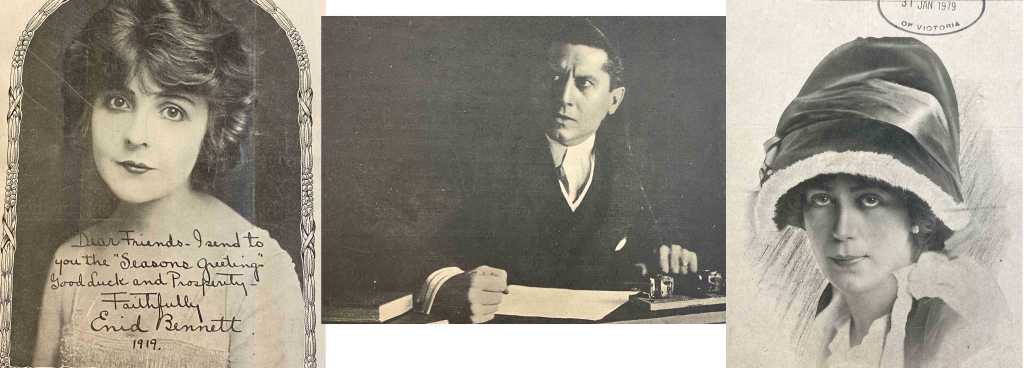
Above: L-R Enid, Fred and Josephine. Such was the fame of the Niblo-Cohan troupe during their three years in Australia, that they regularly featured in Australian papers, and interest continued even after they departed in 1915. These are covers of Sydney’s The Theatre Magazine. Left: January 1920, Centre: November 1912, Right: March 1914.  Via State Library of Victoria

Moving to the US

Niblo was effusive about the Australian performers in his company, and young Enid Bennett in particular. In early 1915 he told Perth’s Sunday Times; Miss Enid Bennett is a splendid actress, and the Perth people will watch her career with interest and pride,” noting how well she had filled in for Josephine Cohan when she was (often) indisposed. The Niblo-Cohan troupe traveled Australia for three years, despite Josephine’s declining health. In June 1915 Niblo, Cohan and 22 year old Enid packed up and headed for the US on the Matson liner Ventura.

Above: Enid and Fred Niblo performing together in the comedy The Travelling Salesman in Sydney, in March 1915. Theatre Magazine, 1 March 1915. Via State Library of Victoria.

Before they departed, Niblo quickly made two filmed versions of popular plays for J.C.Williamson’s – Get Rich Quick Wallingford and Officer 666.  According to film historians Andrew Pike and Ross Cooper, the surviving reels of Officer 666 “reveal a crude production doggedly faithful to the stage.” These were Niblo’s first efforts as a director – he was to significantly refine his skills in Hollywood. Watch a clip from Officer 666 here

Soon after arriving in the US, Enid Bennett appeared in a supporting role in Henry Arthur Jones‘ comedy Cock O’ The Walk, a vehicle for popular comedian Otis Skinner being performed in east coast US cities, including New York. At about the same time she also appeared in her first film, A Princess of the Dark for Thomas H. Ince and Triangle Studios.

Enid Bennett first play in US
Above: Enid Bennett in her first US play, Cock O’ the Walk, with Janet Dunbar and Rita Otway, in early 1916. Author’s Collection
A princess of the dark
Above: Thomas Ince marketing his latest star in March 1917. “El Paso Times”, 2 March 1917. Via Newspapers.com

Enid’s sister Marjorie was to claim that the family pressured her to join Enid in the US, to keep her company.  But the early years in Hollywood appear to have a degree of excitement about them even if the transition to work in the US was tough. Sylvia Bremer‘s biographer Ralph Marsden reproduces one photo showing a happy Bremer, Enid and Marjorie Bennett swimming together at California’s Arrowhead Springs, in 1917. According to Theatre historian Desley Deacon, the success of these young Australian women inspired others, including Judith Anderson.

In Australia in late 1917 Nellie, Catherine and Alexander received some catastrophic news. The family’s oldest son, Frank Reginald, had been killed in fighting at Passchendaele, Belgium on 9 October 1917, not long after being promoted to Lieutenant. Nellie’s few letters held in Frank’s Australian military file reflect the deep grief the family must have felt. Soon after, Enid’s two step-siblings packed up and departed for the US on the SS Ventura.

Above: Enid Bennett in The Theatre Magazine, 2 April, 1917. Via State Library of Victoria

Enid and Fred Niblo married in late February 1918 – his first wife Josephine Cohan had died in July 1916. The impending wedding was almost certainly the main reason for the Bennett family’s arrival in the US a few months before. But there the family stayed, all building careers for themselves in the US. For a few years in the early 1920s, Catherine enjoyed a career in comedy films, often with Monty Banks. Alexander Bennett is reported to have become an accountant. Marjorie, the reluctant actress, would eventually build a remarkable career in Hollywood character roles from the late 1940s, after a long career on stage, including two years performing back in Australia (1921-23).

The Niblo-Bennett wedding in 1918. All of the family were in attendance. The Green Room, 1 June 1918, P23. Via State Library of New South Wales.

Catherine and Enid Bennett, c 1924. Photoplay magazine, July-Dec 1924, P57. Via Lantern, Media History Digital Library.

Fred Niblo’s first US directing experience was The Marriage Ring, with Enid in a leading role, in 1918. He had learned a lot since the days of his Australian film experience; he went on to direct until the early 1930s and the first years of sound film. Kevin Brownlow has documented Niblo’s work on one of his most famous films – Ben Hur, a Tale of the Christ made in 1925. Like Enid, he also took on small acting roles in sound films later in life. He died in 1948.

Enid Bennett was busy – her most prolific period was the ten years between 1917-1927. There were some stand-out roles in films that still survive. These included Robin Hood in 1922 with Douglas Fairbanks, The Sea Hawk with fellow Australian Mark McDermott, and The Red Lily with Ramon Novarro, both in 1924, the latter also being directed by Niblo.

1923 comedy silence of the night

Above – The author’s favourite photo of Enid Bennett as  she appeared in Fred Niblo’s Strangers of the Night (1923). Via Wikipedia Commons  (which has more than 50 public domain images of her).

Enid later in Life

Did she retire? Well, not exactly. As noted below, Enid continued to act until the early 1940s. A great Hollywood hostess, she earned a reputation for entertaining, and sometimes newspapers published her favourite recipes. In addition, she had another and more significant interest. By 1930, Enid Bennett was an active Christian Scientist, in company with many Hollywood actors – including Mary Pickford, Joan Crawford, Ginger Rogers and Dick Powell.

She remained so to the end of her life, and there is plenty of evidence she devoted much of her time and expertise in front of the camera and microphone in the cause of the church, particularly after the death of her first husband Fred Niblo, in 1948. She regularly appeared on radio and TV, sometimes credited as Enid Bennett Niblo, hosting short Christian Science programs on healing, including Light of Faith and How Christian Science heals.

Melbourne Age Aug 18 1956
Above: The Melbourne Age, 18 August 1956, reporting on Enid’s work as a Christian Scientist but already seriously muddled up about her connection to Australia. (If she ever lived in St Kilda, Melbourne it wasn’t for very long.) Via newspapers.com

Enid and Fred had three children in the 1920s – Loris, Peter and Judith. They also parented Niblo’s son Fred Junior, from his marriage with Josephine. Late in life, Enid married family friend and former film director Sidney Franklin. But Enid Bennett’s ashes were interned next to Fred Niblo’s after her sudden death in May 1969.

Marjorie Bennett outlived all her siblings. She died in Hollywood in 1982, working almost to the end of her life.


Enid Bennett’s accent

Although most famous as a silent star, what interests this writer is her accent, as evidenced by her voice in the talkies she appeared in between 1931 and 1941. It is not the very broad and theatrical accent often heard when an “Australian voice” is used in Hollywood films, or a faux-British one, but the authentic accent of many middle-class Australians living on the coastal fringe.

Why accents evolve and vary as they do is well beyond the scope of this article, but it is safe to note that Bennett’s accent is a feature of her ethnicity, social standing and education. Desley Deacon has also established that middle-class girls like Bennett often attended schools of acting and elocution as a first step on the path to acting on stage and screen. Her accent and vocabulary is clearly one of middle Australia, perhaps tending a little to the broad accent on pronunciation of certain words  – See more on accents here.

It is also notable that Enid Bennett plays essentially the same role in all these films – usually an earnest and thoroughly decent mother figure. Here are some examples:


The Big Store (1941)

In this well known Marx Brothers comedy,  Bennett plays an unnamed store clerk in the millinery department. Nasty Miss Peggy Arden (played by Marion Martin) makes life very hard for her. (Harpo Marx then plays a clever trick on Miss Peggy – which is the point of the scene.)

The Big Store 1941

Above: Screen grab of 48 year old Enid Bennett in her final film role – the Marx Brothers film The Big Store, of 1941. The film is widely available on DVD. Author’s collection.

Strike Up the Band (1940)

Mickey Rooney and Judy Garland star in this cheerful Busby Berkeley musical. In this scene Bennett is welcoming Jimmy, although he soon learns he is not allowed to play at her daughter Barbara’s birthday.

strike up the band
Above: This is Rooney as Jimmy Connors, with Enid Bennett playing Mrs Morgan and June Preisser as her daughter Barbara Morgan. Strike Up The Band, 1940. Author’s collection.

Meet Dr Christian (1939)

This is the first of six Dr Christian films made between 1939 and 1941, starring (and partly written by) Danish actor Jean Hersholt, as the sensible small town Doctor. Enid Bennett plays the Mayor’s wife, but her role is not reprised in the later films. In this scene she is talking to her husband.

Enid Bennett in Meet Dr Christian
Above: Screen grab of Enid Bennett as Mrs Hewitt in Meet Dr Christian. This film is widely available, and apparently now  in the public domain. Author’s Collection.

Waterloo Bridge (1931)

Waterloo Bridge was based on the play of the same name by Robert Sherwood. In this scene Mrs Wetherby (Enid Bennett) welcomes her son Roy’s new girlfriend Myra (Mae Clarke) and insists she stays, not yet knowing she is really a prostitute. When Myra admits this later to Mrs Wetherby, she is unbelievably nice about it, although naturally she doesn’t think marriage is a good idea.

waterloo bridge 1931
Above: Screen grab of Enid Bennett from Waterloo Bridge (1931). The film is still available from TCM. Author’s Collection.

Skippy (1931)

Director Norman Taurig won the Academy Award for Best Director for this film. Jackie Cooper‘s character might be regarded as tiresome today, but in 1931 the film was immensely popular. Enid Bennett plays Skippy’s mother and Dr Herbert Skinner’s wife. A sequel was made with many of the actors reprising their roles, including Bennett.

This is a sound clip from the beginning of the film, where the Skinners are having breakfast while Skippy is still lying in bed upstairs pretending to get dressed.

Skippy 1931, Breakfast scene
Above: Screen grab of Willard Robertson and Enid Bennett as Skippy’s parents, in the breakfast scene that begins the film. Skippy is available from TCM. Author’s Collection


Nick Murphy
February 2020

Further Reading

Online

  • Film – Robin Hood 1922 – on Youtube and Internet Archive
  • Film clip –Officer 666 National Film and Sound Archive
  • State Library of Victoria
  • State Library of New South Wales
  • National Library of Australia – Trove.
    • May and Mina Moore Collection
    • The Daily News, 3 Aug 1910. Page 3
    • The Lone Hand, 1 August 1913. Pages 326-7
    • The Leader, (Vic) 30 Dec 1911. Page 27
    • Sunday Times  21 Mar 1915. Page 25
    • The Catholic Paper – Freeman’s Journal, 10 Dec 1931. Page 3
    • The Age, 18 August 1956. Page 11
  • Peter Niblo (2006) –Remembering My Father, Fred Niblo  The Silents are Golden website
  • Australian Live Performance Database
    AusStage – Enid Bennett
    Austage – Majorie Bennett
  • Newspapers.com
    • Boston Globe. 13 July 1916. (This extraordinary newspaper article attributes Josephine Cohan’s death to “Too much dancing” rather than heart disease, which it was)
    • New York Tribune. 2 August 1915. P9
    • El Paso Times 2 March 1916 P9
    • Los Angeles Times. 30 Oct 1935. P13

Text

  • Kevin Brownlow (1968) The Parade’s Gone By. University of California Press.
  • Desley Deacon (2008) “Cosmopolitans at Home: Judith Anderson and the American aspirations of J C Williamson’s Stock Company Members” in Robert Dixon, Veronica Kelly (Eds) Impact of the Modern: Vernacular Modernities in Australia 1870s-1960s. University of Sydney.
  • Desley Deacon (2013) Australasian Journal of Victorian Studies. Vol 18, No 1 “From Victorian Accomplishment to Modern Profession: Elocution Takes Judith Anderson, Sylvia Bremer and Dorothy Cumming to Hollywood, 1912-1918
  • Desley Deacon (2019) Judith Anderson: Australian Star, First Lady of the American Stage. Kerr Publishing.
  • Al Kemp, Tina Kemp (2002) Enid Bennett A Forgotten Star : Life of a Jazz Actress
    Pen Productions Media/Publishing. [Book could not be sourced for this narrative]
  • Ralph Marsden (2016) Who was Sylvia? An autobiography of Sylvia Breamer. Screencrafts Productions.
  • Andrew Pike and Ross Cooper (1980) Australian Film 1900-1977. Oxford University Press
  • Hal Porter (1965) Stars of Australian Stage and Screen. Rigby
  • Scott Wilson (2016) Resting Places: The Burial Sites of More Than 14,000 Famous Persons.  Third Edition. McFarland and Co.

This site has been selected for preservation in the National Library of Australia’s Pandora archive