
34 year old Ted McNamara from Australia and 26 year old Sammy Cohen from the USA seemed to be a promising comedy team, who appeared together in Raoul Walsh’s What Price Glory in 1925. 3 years later this title was used as a motto on Ted’s grave. Source PicturePlay Magazine, 1927, Via Lantern Digital Media Project.

Teddy in a photo dated to 1914. University of Washington, Sayre (J. Willis) Collection, Public domain images, via Wikimedia Commons
Born September 19, 1893, in a small cottage in the Melbourne suburb of Prahran, Teddy or later just Ted (Edward Joseph) McNamara was the fourth child born to Patrick, a baker, and his wife Eliza nee Butler. He spent a large part of his childhood and adolescence on long overseas tours with Pollards Lilliputian Opera Company, developing and refining a reputation as a skilled character comedian. Two older sisters – Alice, born in 1888 and Nellie (Ellen) born in 1891, also went on the stage with Pollards.
Following 22 years on stage, Teddy enjoyed a prominent but very short Hollywood career. Over the three years 1925-1928 he appeared in a dozen films, mostly made by the Fox studio, and some of which survive today. His sudden death in early 1928 robbed Hollywood of a future film comedy partnership, as Fox had teamed him several times with Sammy Cohen, another comedian also emerging in Hollywood. The two comedians first appeared together in supporting roles in Raoul Walsh‘s film version of the popular play, What Price Glory in 1925.

Teddy enjoying success in the cinema. Motion Picture Magazine, July 8, 1927. Via Lantern Digital Media Project
Growing up with Pollards

Above: Teddy while performing in Vancouver. Vancouver Daily World, 3 Jan 1914, P11. via newspapers.com
Teddy was barely 10 years old when he joined Alice and Nellie on the SS Changsa for his first extended Pollard company tour overseas, in January 1903. Performing through Asia and then onto and across North America, this Pollard troupe did not return to Australia until April 1904. And then, after only three months at home, Teddy joined another Pollard tour, departing Australia in July 1904, without his sisters – who stayed in Melbourne, possibly to care for their ailing mother. This tour was away until February 1907, almost 30 months. The rotating program of musical comedies included HMS Pinafore, A Gaiety Girl, The Lady Slavey and the like. And of Teddy we know that while outwardly shy, he was also a joker, popular with his fellow performers and a favourite with the public.
It is tempting to judge this form of apprenticed child employment by 21st century standards – but it has no equivalent today in the economies of Western democracies. More importantly, we might wonder about the impact of these extended performance tours on the development of a young person.

Above: University of Washington, Special Collections. JWS21402. Teddie stands at the rear, clutching the pole. Taken sometime in 1905 or 1906, not all of Pollards Lilliputian Opera Company are in this shipboard photo.
In the photograph of the 1904-7 troupe shown above, which can be enlarged at its University of Washington Library home (here), we can recognise Teddy and some of the other Pollard performers. Their experiences would end up being very mixed. A smiling 13 year old Teddy McNamara can be seen at the rear, right & holding the pole, behind Harold Fraser (later Hollywood’s Snub Pollard). Willie Thomas leans out to the left at rear. Within a few years Willie had left the stage and become a butcher. The Heintz twins, Johnny and Freddie sitting in the foreground, look bored and disengaged. Freddie later struggled to build a stage career, but Johnny gave it up and became a baker in Australia. Future Hollywood director Alf Goulding, looking very dapper in suit and cap, stands at right; Charles Pollard steadies Daphne Pollard at left. Both Alf and Daphne remained friends and would experience great success on stage and in film later in life. Leah Leichner beams with happiness in the centre front row. Three years later Arthur Pollard would send her home early from his Indian trip.
Like many of the Pollards performers, Teddy saw his future in the United States and he returned again on a third Pollards North American tour departing Australia in July 1907. At the end of this tour, in early 1909, Charles Pollard announced his retirement as manager and came home with most of the company to Australia. But 16 year old Teddy joined a few of the older performers and stayed on in North America for a while. In July 1910, Teddy was performing with some of the old Pollards players in British Columbia. In 1912, Nellie Chester, Charles Pollards sister and one time partner, decided to establish a new company, now with adolescents (as required by the new Australian Emigration laws prohibiting children from travelling outside Australia to perform). Both Teddy and Nellie joined up again. Their mother had died in 1904. It seems sister Alice dutifully kept house for her father in Melbourne, and became a seamstress.


Teddy McNamara as a featured player with Nellie Chester’s final Pollard troupe in North America. Note that the word “Lilliputian” was no longer used in the company title. Left – Vancouver Daily World 23 May 1913. Right – Teddy with Queenie Williams – Marysville Daily 27 Jan 1916. Via California Digital Newspaper Collection.

Pattie (later Patsy) Hill back in Australia. The Call, (WA) 22 July 1927. Via National Library of Australia’s Trove
In 1912 there was a new repertoire of musicals to take on tour across Canada and the western USA – including Sergeant Brue, The Toymaker and later the company’s own original, Married by Wireless. The Australian dominated company was active touring North American cities, on and off, until about 1920, by which time the remaining performers had gone their separate ways and the Chester-Pollard company began to turn to building mechanical amusement machines. Not surprisingly, in the hot-house environment of a touring company, romances between these young Australian actors blossomed. Star performer Queenie Williams married Ernest, one of company manager Nellie Chester’s sons. And in November 1913, while in Edmonton, Canada, Teddy married fellow Melbourne performer Pattie Hill (Phyllis Esther Pattie Hill). In 1914, a daughter was born of the union. Sadly, neither marriage lasted very long. Pattie and her daughter returned to Melbourne in 1915 – a divorce was granted in Australia ten years later. Pattie insisted Teddy had promised to regularly send money and follow her home when he could finish his commitments, but never did.

In the US and Canada, Teddy’s reputation as a clever comedian grew with these Pollard performance tours. A lengthy interview in The San Francisco Call of 1906 had revealed Teddy as a reluctant interviewee, alongside Daphne Pollard, the skilled self-promoter. But reviews of his adult performances were universally enthusiastic and became more effusive over the years. 19 year old Teddy had “few peers as a character comedian” reported The Vancouver Daily World in September 1912. By July 1916, The Victoria Daily Times predicted that he would “soon have his name written among the few strikingly clever comedians.” Indeed, it might really have been so.
By the early 1920s Teddy was based in New York. Nellie Chester’s Pollard troupe had finally come to an end and her sons had turned to manufacturing amusement machines. Teddy was now established as a headline act on his own, and he continued to gain roles in variety and a range of musical comedies across the US. In private life he had a new partner, also an actor, and in 1923, a new baby daughter.

Ted McNamara headlines in Battling Butler on the Keith circuit. Evening Star, Washington DC, 27 December, 1925. Via Newspapers.com
To Hollywood

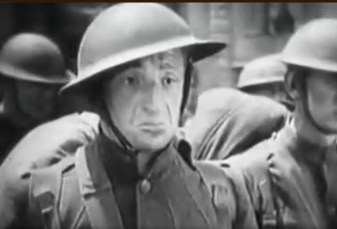
Screen grabs of Ted McNamara and Sammy Cohen on the screen – in Fox’s What Price Glory, 1926. The film is still widely available on DVD. Author’s Collection.
Now known as Ted, he was cast as part of the comic relief in Raoul Walsh‘s filmed version of the popular play What Price Glory in early 1926. (His first film had been Shore Leave, a romance). What Price Glory, a First World War Army – buddy film and a vehicle for Victor McLaglen and Edmund Lowe, was to be Ted’s breakthrough role. Using some easily recognised ethnic stereotypes, his was a supporting role as Irish-American soldier Private Kiper, alongside Sammy Cohen playing the Jewish-American Private Lipinsky. The story goes that Walsh had seen Ted on stage in New York and offered him the part. That is likely, as Ted had completed a long run of Battling Butler at the Selwyn and later Times Square Theatre in New York.

Ted and Sammy Cohen in What Price Glory. Dolores del Rio plays Charmaine tending the bar. Exhibitors Herald, 27 November 1926, P24, via Lantern Digital Media Project.
Seen today, the male stereotypes in What Price Glory appear well-worn at best, but the film was well received at the time and Ted must have been pleased with his work and the change of direction it represented. In his survey of military comedy films, Hal Erickson notes that Fox promoted the two comedians based on the film’s success, and as a response to MGM’s comedy team of Karl Dane and George K Arthur. The partnership was repeated several times, including in 1927’s The Gay Retreat, another film set against World War One, where Sammy Nosenbloom (Cohan) and Ted McHiggins (Ted) join the army to look after their employer.


Ted McNamara and Sammy Cohen in Upstream. Screen grabs from a copy on YouTube.
This writer’s favourite of the surviving Ted McNamara films is John Ford‘s 1927 film Upstream, a copy of which was found in New Zealand in 2009. Set in a theatrical boarding house, Ted McNamara and Sammy Cohen play Callahan and Callahan, two tap dancers, secondary comedic characters. The plot is slight and John Ford purists are unlikely to find much to enjoy in it, but it is one of those silent films that has stood the test of time – with every scene containing some sort of industry in – joke and Ford’s skill as a director already evident. Ted’s skills as a comic are also well displayed here.
Ted McNamara’s final film, Why Sailors Go Wrong, was about two rival cabbies who end up on the tropical island of Pongo-Pongo, again with Sammy Cohen as a foil. The film is a reminder of the very ordinary standard of some film comedies of the day, with its slender plot and “low comedy” situations – including sea-sickness, arranged marriages to unattractive island women, implied nudity and jokes about bird droppings. Within a few years, the Hayes office had been established to rid Hollywood of this sort of unrefined fare.
Ted died in February 1928, before the film was released. The stated cause of death was pneumonia, but as film historian Thomas Reeder notes, film gossip was that alcohol also played a part. Reeder quotes Ted’s contemporary Jimmy Starr as saying “Ted was pretty much of a drunk. Success had merely provided him with more money for booze.” Starr recalled that on a rainy night a drunken Ted had fallen into a gutter. “He just lay there.” Ted’s fondness for drink was also noted by Pattie Hill, who repeatedly mentioned his excessive drinking in her divorce petition.
According to newspaper accounts, Ted McNamara was farewelled at his funeral by many of his old Pollard colleagues – including Daphne Pollard, Alf Goulding and Billy Bevan, a testimony to his popularity with the company. What Price Glory was chosen as a motto for Ted’s monument at the Calvary Cemetery in California.
Sammy Cohen continued appearing in films, although he never established an effective comedy partnership again. Pattie Hill became Patsie Hill in Australia, married baritone Vernon Sellars and enjoyed a very long association with Australian theatre and radio.
Note 1
Nellie McNamara had a lengthy stage career of her own. In addition to travelling with Alice on Pollard tours in 1901-2 and 1903-4, Nellie also trained as a contralto and performed on the stage in Australia between 1909 and 1912, with significant acclaim, using the stage name Nellie Mond. The Victorian Premier Mr Murray heard her sing in April 1910, and declared he was quite sure that if given the chance, “she would distinguish herself and charm the public.” She did charm the public for several years, but in mid 1912 she threw it all away to join Teddy again, and Nellie Chester’s final Pollard tour of the US.
Years later Nellie explained to Everyone’s magazine that while a singer in Melbourne, her teacher had taken her to meet Madame Melba, who “nearly scared me out of my wits. She said ‘The voice is all right but for heaven’s sake, make her get rid of that awful Australian accent.’ ” As well as revealing a sharp wit, this anecdote appears to explain why she did not pursue a career as a classical singer. She married US vaudevillian Don Clinton and in 1920 returned to Australia to perform with him on Harry Clay’s circuit.
Nick Murphy
August 2020
Further Reading
Text
- Gillian Arrighi (2017) The Controversial “Case of the Opera Children in the East”: Political Conflict between Popular Demand for Child Actors and Modernizing Cultural Policy on the Child. “Theatre Journal” No 69, 2017. Johns Hopkins University Press.
- Gillian Arrighi, National Library of Australia. Child Stars of the Stage.
- Patricia Erens (1984) The Jew in American Cinema. Indiana University Press
- Hal Erickson (2012) Military Comedy Films: A Critical Survey and Filmography of Hollywood Releases Since 1918. McFarland
- Thomas Reeder (2017) Mr. Suicide: Henry Pathé Lehrman and The Birth of Silent Comedy. Bear Manor Media
Films
- Upstream (1927) Entire film on Youtube
- What Price Glory (1926) -3 minute extract on Youtube
- Poor quality copies of Shore Leave (1925) can also be found on social media.
Federal Register of Legislation (Australia)
University of Washington, Special Collections.
Sayre (J. Willis) Collection of Theatrical Photographs.
This invaluable resource contains numerous photos of the Pollard’s Troupes.
The Australian Variety Theatre Archive: Popular Culture Archive, 1850-1930. Clay Djubal and others
Lantern Digital Media Project
- Fox Folks, 1926.
- Picture Play, 1927
- Motion Picture, July 8, 1927
National Library of Australia’s Trove
- The Age (Melb) 19 April 1910
- The Prahran Telegraph (Melb) 26 Oct 1912
- The Age (Melb) 10 Jan 1914
- The Bulletin (Aust) Vol. 41 No. 2083 (15 Jan 1920)
- Everyone’s (Aust) 10 March, 1920
- The Journal (SA) 8 Jan 1921
- The Telegraph (Qld) 11 May 1926
- The Call, (WA) 22 July 1927
- Saturday Journal (SA) 14 Jan, 1928
- The Daily News (WA) 23 Mar 1928
Newspapers.com
- The Oregon Daily Journal, 30 Jan 1904.
- The San Francisco Call, Sun, Mar 4, 1906
- The Vancouver Daily World, 21 September 1912.
- Vancouver Daily World, 23 May 1913
- The Evening Times Star and Alameda Daily Argus (CA), 10 Feb 1914
- Spokane Chronicle (WA) 18 Sept 1914
- Marysville Daily Appeal, (CA), 27 Jan, 1916.
- The Victoria Daily Times, 27 July 1916
- Spokane Chronicle (WA) 27 Sept 1917
- Star Tribune (Minneapolis) 21 May 1922
- Daily News (New York) 15 Sept 1925
- Evening Star, Washington DC, 27 December, 1925.

This site has been selected for archiving and preservation in the National Library of Australia’s Pandora archive


 Not all of the performers in this final “adult” Pollard troupe enjoyed the success in the US that Ina did. Arriving in the US in 1914, Freddie Heintz struggled to find an ongoing career – renaming himself Freddie Garland (doubtless dropping his German surname because of the war) and then Freddie Steele. He crossed the border to join the Canadian Army in 1918 and was briefly married in the 1920s. He ended his days working as a handyman in Freeport, New York. His twin brother Johnnie Heintz would have no more of the life of the travelling performer – he stayed at home and became a pastry chef in Adelaide. An older brother who had also once been a performer for Pollard’s, Oscar Heintz, moved to Portland, Oregan in about 1910 and became a manager for Neon Manufacturing.