Eileen Robinson by Hollywood photographer Max Munn Autrey, c1935. The ‘bright reports’ of Eileen’s early US successes came about courtesy of letters she sent home to her father in Sydney in 1921. Photo courtesy Margaret Leask.
The Five Second Version
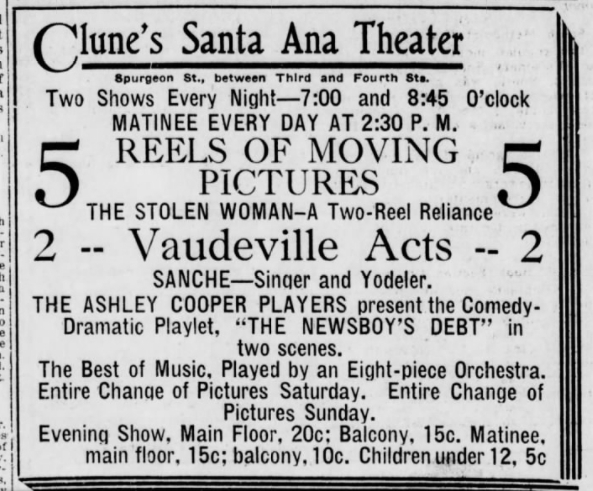
The only daughter of Sydney publisher Herbert E.C. Robinson (1857-1933) and Augusta Dahlquist (1862-1914), Eileen was “a young actress with an exceptionally charming personality across the footlights” reported one newspaper after her first professional appearance in 1914.[1]Sunday Times (Sydney)19 Apr 1914 P22 Great success was predicted for her. In 1919 she went to the US, where her older brother Cecil Robinson (aka Ashley Cooper) and niece (Dulcie Cooper) had been performing for more than a decade. She again earned good reviews, but extended returns to visit and perform in Australia every few years meant it was difficult for her to build career momentum in the US.
Her close friend and professional collaborator for a decade, US actress Theresa Carmo,(1906-1990) worked with her in the US and joined her on two extended Australian trips – in 1929-1931 and 1935-1936. Their collaboration included scripting and performing original material for the stage and on radio.
In 1923 she bore a daughter, Peggy, to US actor Alan Brooks (Irving Hayward) (1888 – 1936), but their marriage was short- lived. She died in Sydney in 1955.

At the time of her travel overseas in 1919, Eileen Robinson was spoken of as one of the new generation of successful Australian actresses. She was a direct contemporary of Sylvia Breamer(1897-1943), Dorothy Cumming (1894-1983) and a friend of Judith Anderson(1897-1992), all of whom would make successful careers in the United States. As Andree Wright has noted, “At the time, [these film success] stories convinced readers that ‘with very few exceptions, every Australian who ha[d] ever gone to America ha[d] succeeded beyond expectations.“[2]Andrée Wright (1986) Pps18-19. The inserted quote is from Picture Show, 2 August 1919

Born Eola Eileen Trilby Robinson in Sydney in October 1896, to Herbert Robinson (or “HEC” as he was known – after his initials), a well known map maker and publisher, and his wife Augusta nee Dahlquist.[4]The Daily Telegraph (Syd) 30 Oct 1896, P1 Eileen’s schooling was at Astraea College in Chatswood.[5]Sydney Morning Herald, 26 Nov 1941, P9 While she was still young, her much older brother Cecil (born 1880) threw in his career as a draftsman in Sydney to pursue the stage. In 1905, Cecil [6]later using the name Herbert Robinson and then Ashley Cooper took his young family to the US, spending some years establishing himself.
While a career on the stage continued to be viewed with some suspicion in many Australian homes, it clearly had great credibility in this family. Both Augusta and HEC Robinson were friends of actress Nellie Stewart and Eileen became a good friend of Nellie’s daughter Nancye. Eileen was also known within the family as “Trilby,” a name found in the novel and play popular at the time of her birth.

By 1912, Eileen was attending classes with well known actor Walter Bentley – later moving to Douglas Ancelon and Stella Chapman’s dramatic school. [7]Daily Telegraph (Syd) 28 March 1914, P14 As Desley Deacon has noted, in the early twentieth century, such acting and elocution schools served a much broader purpose than just knocking off vestiges of a colonial accent. It also taught girls marketable skills and instilled discipline.[8]See Deacon (2013)

Eileen’s first professional outings were in productions at Sydney’s Little Theatre, in The Gay Lord Quex in April 1914, followed by a short season in George Bernard Shaw’s Fanny’s First Play. The latter was “her first important role, (where she) scored a decided success. She hit off the Cockney mannerisms very well indeed, and gave the character the required note of impudent familiarity.”[10]The Daily Telegraph (Syd), 12 May 1914, P14

Eileen’s first contract with JC Williamson’s was for a 1916 revival of the very popular Get Rich Quick Wallingford, on £5 per week – a modest salary but still more than twice the Australian “minimum wage” of the time. [12]JC Williamson’s contracts, Australian Performing Arts Collection, Melbourne By the end of World War 1, she had almost three years of strong stage experiences performing in Australia under her belt, including tours with visiting actors like Marie Tempest (1864-1942) and Margaret Wycherly (1881-1956). Like so many of her contemporaries at this time, Eileen embarked for the US in early 1919. She travelled with Nancye Stewart – the adventure being described as a “six month holiday.”[13]See The Daily News (WA)1 Mar 1919, P3

In later years there were oblique references to how hard it was to establish herself.[15]The Sun (Syd) 7 Aug 1921, P17 However, in early 1920 she was offered a small role on Broadway in Trimmed in Scarlet, with Maxine Elliott. The New York Tribune dismissed it as the “silliest play of the season”, which may explain its short run.[16]New York Tribune, 3 Feb 1920, P11 Enthusiastic Australian newspaper reports claimed she appeared in films for Famous Players–Lasky, a claim now difficult to verify, but she is known to have found a supporting role in Mid-Channel, a film with popular cinema actor Clara Kimball Young(1890-1960).[17]Sydney Mail, 4 Aug 1920, P13 By extraordinary chance, this film has survived.[18]It can be seen here

There was a brief mention in one Australian magazine that although she enjoyed the novelty of “picture acting”, she preferred the legitimate stage.[19]Everyone’s.(Aust) 10 August 1921, P5 Her one outing in film was rarely mentioned again.
However, it was Eileen’s work in the the play John Ferguson, first at San Francisco’s Columbia Theatre in early 1921 and then on tour, that brought her greatest acknowledgement.[20]6 weeks of touring is mentioned in Variety, March 11, 1921, P28 An oft-cited review in the San Francisco Call reported “Eileen Robinson, young, beautiful, clever, plays the role of Hannah, daughter of John Ferguson. All eyes are turned on her the moment she enters the stage. Her voice contains that undefined something that attracts respectful attention. She is a most finished actress. In her principal scene her interpretation of her part is such that when the tenseness of the moment was over the audience broke into the most enthusiastic applause of the evening. Miss Robinson scored every moment during the rest of the play.”[21]San Francisco Call, 1 February 1921, P4
Eileen’s father passed this and similar wonderful reviews on to the Sydney papers. Also of interest to Australians was the fact that well-known Queensland actor, Tempe Pigott, was in the John Ferguson cast. Eileen wrote to her father that she was “having a glorious time” and was “enjoying herself immensely.”[22]The Daily Telegraph (Syd) 21 May 1921 P8 She ended her US experience with a series of performances at the Denham Theatre in Colorado. By August 1921, she was back in Sydney.

Almost immediately she went on stage with comedian Bert Gilbert, touring on the Tivoli circuit. At the same time she reassured journalists that she would soon return to the US. This seems to have been because, while in the US, she had met US writer and actor Alan Brooks (Irving Hayward) and the couple apparently sustained a long distance relationship for more than six months.[23]The Daily Mail (Qld) 4 Mar 1922, P11, mentions she will soon marry She departed Australia again, in April 1922, taking the SS Osterley, bound straight for Southampton, England, because Brooks was now presenting his own play Dollars and Sense throughout Britain. Eileen joined him onstage on tour, and the couple married in Paddington in January 1923.
By June 1923, she was back in Australia yet again, with Brooks, and despite being pregnant, she appeared with him on the Tivoli circuit for the opening weeks of an Australian season of Dollars and Sense. Newspapers reported he was “very proud” of his wife. Eileen was “splendid” he told Australians.[24]The Sun (Syd) 9 Jun 1923, P6 A daughter, Peggy, was born of the union in Sydney in July 1923. Several months later, they departed for the US- first Brooks, followed a few months later by Eileen and baby Peggy.
Eileen reappeared on the US stage in San Francisco in early 1926, in the comedy A Man’s Man. Sometime in 1926 or 1927 she met Theresa Carmo, an actress about ten years her junior, who was making a name for herself in ingenue roles. As subsequent events show, the two became trusted friends.

In early 1929, Eileen and Theresa were on stage together in the comedy One Wild Night at Los Angeles’ Theater Mart, when they decided to pack up and move to Australia. We don’t know the context or exact reason for this dramatic move – perhaps Eileen wanted to see her father again, or perhaps they thought the depression would be easier to manage in Australia.[26]It wasn’t, although Carmo did tell one Australian paper that conditions were very bad in the US. See Truth (Bris), 12 Jan 1930 P25 Eileen’s marriage to Alan Brooks had come to an end by this time.[27]The Los Angeles Times 15 Jul 1928, P44 (See Note 1 below)

Within a few weeks of arriving in Australia in August 1929, Eileen and Theresa were on stage at Sydney’s Tivoli, in a sketch they had written themselves, You’re Another. Eileen’s father escorted Nellie Stewart to watch the show from a box. Eileen announced that she was “tickled to bits! I’ve got lots of flowers and bottles of champagne… America is a dry country!” [29]This was a reference to Prohibition in the US. Daily Telegraph (Syd) 20 Aug 1929, P5 Eileen and Theresa’s US acting credentials meant that they were welcomed and feted by the city’s society and theatrical leaders. For radio, Theresa sang – occasionally in other languages, accompanying herself on the ukulele.[30]The Wireless Weekly, 27 Sept 1929, P54 For the press, Eileen provided recipes from the US and entertaining stories of Hollywood – including a lengthy description of Marion Davies’ 36 bedroom mansion.[31]Poverty Bay Herald (NZ) 12 Oct 1929, P12

By November 1929 they were appearing with Yvonne Banvard in her touring comedy company. However, by the end of 1930, their stage appearances had come to an end – presumably by choice rather than a lack of opportunity, as they were popular performers. In April 1931 they returned to the US. But this was not to be the end of their Australian connection – as in July 1935, Eileen and Theresa were back in Sydney again.
In the intervening four years, Eileen and Theresa ran an acting studio and children’s Little Theatre in Hollywood, providing elocution and preparing children for performance.[32]Sydney Morning Herald 14 Aug 1935, P7 and The Australian Women’s Weekly, 14 Sept, 1935, P25

Courtesy Margaret Leask.
They titled this “The Theatre of Youth.” Although details of the enterprise are sparse, Eileen’s family records confirm that the enterprising pair constructed their own little theatre, with seating for 70. “Three performances were given every month with different casts and programs.”[33]Margaret Leask (2023) In 1938, Eileen took some pride in telling Australians that Hollywood actress Lynn Bari had once been her student.[34]The Sydney Morning Herald, 22 Dec 1938, P21 Others may have included David Holt and Dorothy Gray.[35]Wireless Weekly, April 10, 1936, P21

When Eileen and Theresa arrived in Sydney again in July 1935, their focus was firmly on radio performance. Together they wrote and performed radio adaptions of popular stories and performed a stream of their own original material – whose titles hint at a range of content – The Lady’s Maid,[36]Australian Women’s Weekly 14 Sept 1935, P28 Therese and Me, the Fairy Clown [37]The Daily Telegraph 11 Feb 1936, P12 and College Daze [38]Sydney Mail, 11 Mar 1936, P34 all for Sydney radio station 2GB. It was a remarkable period of creative collaboration, but sadly only one of Eileen’s short skits has survived – a short solo piece probably designed for radio.

Eileen and Theresa’s collaborative radio work came to an end in 1936. Their final broadcast together seems to have been in early May 1936 and soon after this, Theresa went back to the California. In family correspondence there is evidence of a falling out between Theresa and Eileen, but why or over what is no longer known.[39]Personal communication, Margaret Leask to the author, December 2023

After the death of her father, Eileen took an increasing role in company matters for HEC Robinson Ltd, but she still maintained an interest in the theatre. In 1937, she opened a Little Playhouse in the HEC Robinson Ltd building at 221 George Street Sydney. [40]The Sydney Morning Herald, 1 Apr 1937, P18 She had by this time, renovated her father’s old apartment on the top floor, and this became her home.[41]The Sydney Morning Herald 18 Jan 1936, P11

Unfortunately relationships within the family were unhappy in later years, and Eileen was estranged from her daughter at the time of her early death in January 1955. In the post war period she sometimes styled herself Eileen Robinson-Brooks, [43]The Sydney Morning Herald, 19 Dec 1950, P2 and was, more often than not, publicly associated with company business. The following photograph from 1945 concerned her plans to publish books about geography to ensure children enjoyed the subject at school. “Geography should be a wonderful adventure in a child’s education,” she said. [44]The Daily Telegraph(Syd)11 Jan 1945, P16

On her return to the US, Theresa Carmo went back to acting for the stage and radio. However, during the early 1940s she changed career and become membership secretary of the Press and Union League Club in San Francisco, a position she held for many years. Interestingly, she stayed connected to some of the Australians she had met through Eileen, even though the former partners were estranged. The 1940 US census shows her boarding with Tempe Pigott, the Queensland-born actor who was, by then 73 years old, but working on regardless.[45]Tempe told the census collector she was 56, and born in England. When Eileen died, it was mutual friend Judith Anderson who told Theresa. Theresa then set about rebuilding the connection with Eileen’s daughter Peggy and her family, later welcoming them on visits to the US and sending letters and presents. Eileen’s granddaughter Margaret Leask recalls her very fondly. Theresa died in California in 1990.[46]Personal communication, Margaret Leask to the author, December 2023
Note 1: Alan Brooks
Brooks appeared in several films in the late 1920s and early 1930s, but his reputation was also built on his work as a writer and vaudeville performer. He also appeared in a number of Broadway performances between 1909 and 1932 and he gained some notoriety when he appeared in Mae West’s scandalous production The Pleasure Man in New York in October 1928. It ran for two performances at the Biltmore Theatre before being shut down by Police, with West and the actors being dragged to court.[47]Times Union (New York) 2 Oct 1928, P1 The experience appears to have done his career little harm. Brooks died of tuberculosis at the National Vaudeville Association’s sanitorium at Saranac Lake, in September 1936, having spent several miserable years in “rest cure.”[48]Variety, 7 Oct 1936, P62
Note 2: Theresa Carmo
Theresa Carmo was born Theresa Maria Perry, probably in Oakland, California in October 1906, although some sources state the Azores, Portugal. She married in 1951 but her husband died in 1954. She had no children. Theresa is reported to have been in episodes of the Lux Radio Theatre in the late 1930s. [49]Including Confession, a 1938 episode – which can be heard at the Internet Archive, here
Nick Murphy
December 2023
References
Special Thanks
- Margaret Leask, Eileen’s grand daughter. Margaret holds Eileen Robinson’s archive, which includes many of the photos used here. Sincere thanks for her willingness to share some of these, and the long conversation.
- Claudia Funder at the Performing Arts Collection, Melbourne Australia.
- Fellow researcher Jean Ritsema in the US
Theatre Heritage Australia
- Margaret Leask, Paper presented 16 July 2023 for Theatre Heritage Australia. You Never Know Where Stories Will Take You.
New South Wales, Births Deaths & Marriages
- Birth Certificate 1923 Peggy Hayward (Brooks)
HM Passport Office, General Register Office (UK)
- Marriage certificate 1923 Hayward – Robinson
Clay Djubal and others: Australian Variety Theatre Archive
Films
Australian Dictionary of Biography, National Centre of Biography, Australian National University
- Ross Cooper, ‘Stewart, Eleanor Towzey (Nellie) (1858–1931)’, published first in hardcopy 1990, accessed online 30 November 2023.
- Anne-Marie Gaudry, ‘Banvard, Yvonne (Fifi) (1901–1962)’, published first in hardcopy 1993, accessed online 26 November 2023.
- Martha Rutledge, ‘Lynton, Nancye Doris (1893–1973)‘, published first in hardcopy 2000, accessed online 22 November 2023.
- G. P. Walsh, ‘Robinson, Herbert Edward Cooper (1857–1933)’, published first in hardcopy 1988, accessed online 15 November 2023.
Text
- Desley Deacon (2019) Judith Anderson, Australian Star, First Lady of the American Stage. Kerr Publishing, Melbourne.
- Desley Deacon. Australasian Journal of Victorian Studies. Vol 18, No 1 (2013)
From Victorian Accomplishment to Modern Profession: Elocution Takes Judith Anderson, Sylvia Bremer and Dorothy Cumming to Hollywood, 1912-1918 - Andree Wright (1986) Brilliant Careers. Pan Books, Australia
Primary Sources
- City of Sydney, Archives & Resources
- National Library of Australia, Trove
- State Library of New South Wales
- State Library of Victoria
- National Library of New Zealand, Paperspast
- Ancestry.com
- Newspapers.com
- Lantern Digital Media Library@ the Internet Archive

Footnotes
| ↑1 | Sunday Times (Sydney)19 Apr 1914 P22 |
|---|---|
| ↑2 | Andrée Wright (1986) Pps18-19. The inserted quote is from Picture Show, 2 August 1919 |
| ↑3 | The Triad (Aust) 10 June 1921, P24. Photo has been filtered |
| ↑4 | The Daily Telegraph (Syd) 30 Oct 1896, P1 |
| ↑5 | Sydney Morning Herald, 26 Nov 1941, P9 |
| ↑6 | later using the name Herbert Robinson and then Ashley Cooper |
| ↑7 | Daily Telegraph (Syd) 28 March 1914, P14 |
| ↑8 | See Deacon (2013) |
| ↑9 | Freeman’s Journal (Syd) 27 Sept 1919, P1 |
| ↑10 | The Daily Telegraph (Syd), 12 May 1914, P14 |
| ↑11 | State Library of Victoria |
| ↑12 | JC Williamson’s contracts, Australian Performing Arts Collection, Melbourne |
| ↑13 | See The Daily News (WA)1 Mar 1919, P3 |
| ↑14 | The Bulletin (Aust) 26 Nov 1914, P45 |
| ↑15 | The Sun (Syd) 7 Aug 1921, P17 |
| ↑16 | New York Tribune, 3 Feb 1920, P11 |
| ↑17 | Sydney Mail, 4 Aug 1920, P13 |
| ↑18 | It can be seen here |
| ↑19 | Everyone’s.(Aust) 10 August 1921, P5 |
| ↑20 | 6 weeks of touring is mentioned in Variety, March 11, 1921, P28 |
| ↑21 | San Francisco Call, 1 February 1921, P4 |
| ↑22 | The Daily Telegraph (Syd) 21 May 1921 P8 |
| ↑23 | The Daily Mail (Qld) 4 Mar 1922, P11, mentions she will soon marry |
| ↑24 | The Sun (Syd) 9 Jun 1923, P6 |
| ↑25 | The Los Angeles Times, 15 Jul 1928, P44 |
| ↑26 | It wasn’t, although Carmo did tell one Australian paper that conditions were very bad in the US. See Truth (Bris), 12 Jan 1930 P25 |
| ↑27 | The Los Angeles Times 15 Jul 1928, P44 |
| ↑28 | Daily Pictorial (Syd) 8 Feb 1931, P19 |
| ↑29 | This was a reference to Prohibition in the US. Daily Telegraph (Syd) 20 Aug 1929, P5 |
| ↑30 | The Wireless Weekly, 27 Sept 1929, P54 |
| ↑31 | Poverty Bay Herald (NZ) 12 Oct 1929, P12 |
| ↑32 | Sydney Morning Herald 14 Aug 1935, P7 and The Australian Women’s Weekly, 14 Sept, 1935, P25 |
| ↑33 | Margaret Leask (2023) |
| ↑34 | The Sydney Morning Herald, 22 Dec 1938, P21 |
| ↑35 | Wireless Weekly, April 10, 1936, P21 |
| ↑36 | Australian Women’s Weekly 14 Sept 1935, P28 |
| ↑37 | The Daily Telegraph 11 Feb 1936, P12 |
| ↑38 | Sydney Mail, 11 Mar 1936, P34 |
| ↑39, ↑46 | Personal communication, Margaret Leask to the author, December 2023 |
| ↑40 | The Sydney Morning Herald, 1 Apr 1937, P18 |
| ↑41 | The Sydney Morning Herald 18 Jan 1936, P11 |
| ↑42 | See The Australian Women’s Weekly 29 Jul 1944 P12 |
| ↑43 | The Sydney Morning Herald, 19 Dec 1950, P2 |
| ↑44 | The Daily Telegraph(Syd)11 Jan 1945, P16 |
| ↑45 | Tempe told the census collector she was 56, and born in England. |
| ↑47 | Times Union (New York) 2 Oct 1928, P1 |
| ↑48 | Variety, 7 Oct 1936, P62 |
| ↑49 | Including Confession, a 1938 episode – which can be heard at the Internet Archive, here |