Above: Johnnie and Freddie Heintz, sit distracted on the ground in front of older children of the Pollard Lilliputian Opera Company, while on the long performance tour of 1904-1907.[1]University of Washington Sayre (J. Willis) Collection of Theatrical Photographs, via Wikimedia Commons

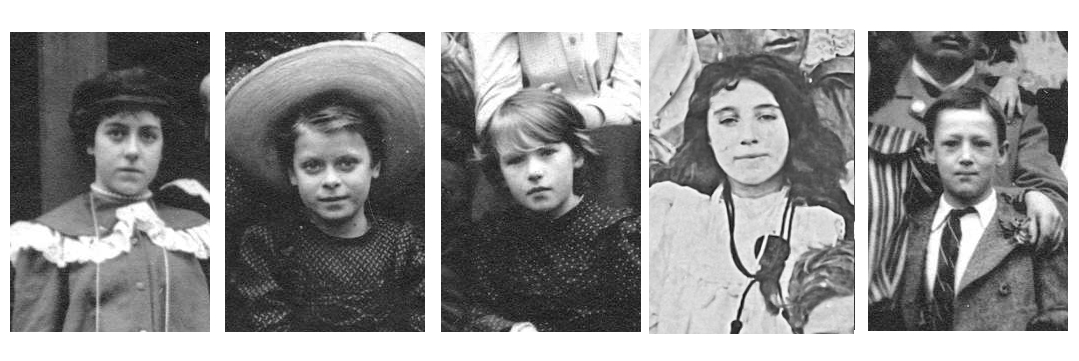
Until quite recently, accounts of the Pollards Lilliputian Opera Company have tended to be of a celebratory and nationalistic nature, coloured by the success of a few of its Australian graduates. At the time, a great effort was made to represent the company [2]or more correctly – companies, as the troupes changed over time as a type of travelling educational institution,[3]Democrat and Chronicle (New York), 9 March 1902, p.10 while all sorts of spurious claims were made regarding the qualifications of the adults accompanying the children.(See for example, the account at left from the Chicago Tribune, 19 May 1902. Click to enlarge)
We have few records from the child performers themselves. Only one Lilliputian was interviewed in any depth, much later in life. The experience of Freddie and Johnnie Heintz, related below, shows a childhood spent with Pollards was much less spectacular than the prevailing stereotype suggests.
Maggie Moore on Child Actors

In 1904, during one of her many performance tours of Australia, popular US born actress Maggie Moore (1851-1926) wrote an article on the valuable experience the stage provided for children. The piece in The Australasian Stage Annual was entitled “Tales of Tiny Thespians,” and it was unusually long for a magazine devoted almost exclusively to short articles about the legitimate stage.[5]The magazine appeared at Christmas time each year. The State Library of Victoria holds editions of 1900-1906 It made the point repeatedly, that a career on stage provided children, especially those from poorer families, with an education, personal development and a worthwhile career.
She told readers;
Recently a law in England was passed to prevent young children going upon the stage. Oh! The pity of it! How many tiny mites will have a cold, cruel Christmas – no sunshine, no laughter, no shillings for mother at the end of the week. Who knows, perhaps they will be hungry. Nothing to eat on Christmas day, nothing to put in the empty stockings.[6]The Australasian Stage Annual, 1904 p14, State Library of Victoria
Moore’s intention was completely serious here – there was no tongue-in-cheek, 21st century humour going on.

The article was peppered with personal anecdotes, many of them about working class urchins who were venturing on stage for the first time, but still in need of a bath or a face wash, and whose speech she rendered into that peculiar and patronising style favoured by writers of the time, sometimes bordering on caricature;
[Moore] And tell me why you are called ‘Ginger’? What is your proper name?
“Oh! Me oder name: that’s Sonny… Yes me mudder always called me Sonny. It’s only since I went dancin’ in the pubs dat I’ve been ‘Ginger'”
[Moore] Your mother is dead is she?
“Yes” And tears came to his eyes…[8]The Australasian Stage Annual, 1904 p26, State Library of Victoria
Maggie Moore on “Joe and Jim O’Reilly”
Maggie Moore also recounted working with a pair of four year olds in a pantomime, who she named as Joe and Jim O’Reilly. “Joe was very quiet and always very tidy, Jim was a terror.” The boys fought to collect the flowers thrown at the end of one particular song to put on “daddy’s drave” (grave). Paid sixpence as tea-money, on one occasion they missed a cue because they spent the money instead on seeing another panto at a nearby theatre. But she reassured readers they had now grown up and were at work, although aged only fourteen. “The stage was their school until they lost their childish tricks, and I am sure both will be good, clever men when they get older.” [9]The Australasian Stage Annual, 1904 p22, State Library of Victoria
Did Joe and Jim O’Reilly really exist? Perhaps they did… in some other form.
Freddie and Johnnie Heintz
In the same year that Moore wrote her article, a Fitzroy widow was considering the future for her twin boys, Freddie and Johnnie Heintz. Annie Heintz lived in a small cottage in Kerr St Fitzroy, but had lost her husband John, a baker, in 1901.[10]Leader (Melb) 2 March 1901, p44 Despite the era’s significant mortality rate with childbirth (and with the birth of twins particularly), Mrs White, an experienced local midwife, had assisted in a successful delivery of Annie Heintz’s twins at home in December 1895. But by the time of John Heintz’s death there were six children aged under 12 in the Heintz family – it must have been a financial strain. Annie’s oldest son, Ernest, soon joined the thriving boot trade of inner Melbourne, but another son, Oscar, had turned in a different direction and in 1901, aged 10, had joined Pollards Lilliputian Opera Company. This arrangement generated a modest but steady income for the family.

Freddie and Johnnie join the Pollards
Like their older brother Oscar, Freddie and Johnnie developed an interest in performing. Ethel Monte Punshon (1882-1989) met them later in life and recounted that following the death of their father, the Heintz twins sold sweets outside Melbourne theatres, where they were also observed to be entertaining mimics.[11]See Tessa Morris-Suzuki’s bio of Punshon (2024), p80
The enthusiasm for an adventure performing musical comedy with the Pollards also affected other children living in Kerr St, Fitzroy. The girls of the neighbouring Trott and Bennetto families had already toured with the Pollards by 1904. The Topping girls had too – they also lived nearby, just around the corner in Fitzroy Street. Without a doubt, these children also knew each other from the very small playground and crowded classrooms of the nearby Bell Street School in Fitzroy.


Coincidentally, in early 1904, the Pollard company’s musical conductor, Ernest Wolff (1874-1948), attempted to induce some of the Pollard parents to join a new break-away juvenile company he was planning, with higher rates of pay on offer. The tall, good looking and over confident Ernest Wolff personally visited many of the parents in April, and convinced them that that their existing contracts with the proprietors of Pollards (Charles Pollard (1858-1942) & Nellie Chester nee Pollard(1861-1944) were not binding. It is clear from surviving Supreme Court records that Annie Heintz had accepted Wolff’s offer to employ Oscar. However on May 4, after Oscar missed some rehearsals, Charles Pollard visited Annie Heintz. He assured her the original contract with him was valid and said, ominously, that the matter would be soon be going to Court. Annie quickly backed down, re-engaged with Pollards, and it was soon after this that she also signed up Freddie and Johnnie to join the next Pollards troupe. Other parents who had been lured by the promise of higher salaries also re-committed to Pollards.
When the matter went to the Supreme Court on May 13, Wolff abandoned his plan.[13]Supreme Court Victoria 1904/329 Pollard & Anor V Wolffe and see also contemporary reports – including Nanaimo Daily News (British Columbia, Canada) July 7, 1904, p3 The court records reveal some of the details of the Pollards operations. Oscar Heintz’s salary, paid to Annie, was 10 shillings per month for the first six months and £1 per month thereafter, on a two year contract.(The contract was due to expire in December 1904 – but it was subsequently renewed)
So, in July 1904, a new Pollard troupe departed Melbourne. The performance tour first took in Queensland (where some of their musical comedies were tested out), then on to Manila, Japanese ports and finally to North America. On board were Freddie and Johnnie, and their older brother Oscar, and all of the other children Wolff had attempted to “poach”. The very familiar Pollard repertoire of musical comedies included A Runaway Girl, The Belle of New York, A Gaiety Girl, The Geisha and HMS Pinafore. Although the troupe was predominantly made up of girls, the Heintz twins joined a small group of boys who took the leading comic character roles.

Compulsory Education and the Pollards
In the Heintz children’s hometown of Melbourne, compulsory education for all children aged between 6 and 15 had been legislated in 1872. But there was often non-compliance with child labour laws [15]See Wilcox and Anderson and the Education Act also allowed for legitimate “exemptions,” such as “that a child is under efficient instruction in some other manner.” This “some other manner” is also what the Pollard management claimed when they took Wolff to court – they stated they were contracted to “properly provide for, maintain and clothe… [the children] and teach and educate [them] in the profession of the stage.” The court found in the Pollards favour and by implication, approved of the contracts.[16]Supreme Court Victoria 1904/329 Pollard & Anor V Wolffe

Freddie and Johnnie’s first tour with Pollards did not to return to Australia until February 1907, an extraordinary 32 months away from home. Older brother Oscar was not with them when they returned. Aged 16, he simply stayed on in Portland, Oregon and built a new, non-theatrical life for himself in the US.
After four months back in Fitzroy, Freddie and Johnnie joined the next Pollards trip, which departed Australia in late July 1907, and which followed a similar route to the last, most of the time being spent in North America. In early 1909, fifteen months later, they returned to Australia. The Heintz twins had, by now, spent most of the last five years on the road.
In 1909, following Charles Pollard’s retirement,[18]The Telegraph (Qld.)17 Apr 1909 p8 the youngest member of the Pollard family, Arthur Hayden Pollard (1873-1940), organised another troupe and the Heintz boys joined up, once again. However, within six months the trip had collapsed disastrously and Australian newspapers were carrying news of the accusations of Arthur Pollard’s cruelty towards his charges.

Amongst numerous complaints from children that surfaced while the troupe was in India, Freddie Heintz claimed he had been repeatedly struck by Arthur Pollard. Through the pages of the Madras Times, Pollard attempted to defend himself; “Yes, I have boxed Fred’s ears, and smacked him on the proper place several times, but never without good cause for doing so.”[20]as reported in The Daily News (Perth) 9 March 1910, p7 Other child performers had reportedly been roughly treated, or confined to bread and water, or had their hair cut, or were punished in other ways. Arthur Pollard clearly had a temperament completely unsuited to managing children, even if Freddie Heintz was a difficult youngster. Pollard subsequently made off with the proceeds of the tour and 18 year old performer Irene Finlay, whom he later bigamously married. Stuck in India, it took several months for Freddie and Johnnie Heintz -and the rest of the troupe – to get home.[21]See Gillian Arrighi (2017) and Kirsty Murray (2010) for accounts of this
In Australia after 1909
In Australia again, Freddie and Johnnie joined the Juvenile Comic Opera Company being organised by J C Williamsons to tour Australian cities. Some of the company members were former Pollards players (Ivy Moore, Ivy Ferguson, Florrie Allen as well as the Heintz boys) and the musical comedies performed were from the familiar popular repertoire favoured by Pollards. There the similarities ended however. JC Williamsons took their responsibilities to educate seriously – they could scarcely do otherwise in Australia, with its pioneer laws regarding education. It was at this time that Monte Punshon, the troupe’s teacher, met the Heintz twins.[22]In Arthur Pollard’s ill-fated troupe, 17 year old Ruby Ford had been nominated as the “schoolmistress” – she later claimed this was a ruse so that Pollard could fulfil his … Continue reading

Monte Punshon recalled that neither of the Heintz boys attended her morning classes, but they did develop a strong rapport with her. And it was Johnny who confided to Monte that neither of them had ever learned to read or write, an awful inditement of life for some of the Pollard children. Monte even recounted the experience of sitting on a train, with Freddie dictating a letter for her to write, a love letter to a girlfriend – too difficult for him to write himself.[24]Tessa Morris-Suzuki (2024), p79-81 The claim carries more weight when considered with fellow Pollards performer Irene Goulding‘s comments. Interviewed late in life she expressed regret for her limited education, a consequence of a childhood spent on performance tours.
For unrelated reasons, JC Williamsons comic opera company folded, and Monte Punshon’s brief relationship with the twins came to an end. Also at about this time, Johnny left the stage for good. He became a baker and settled in Adelaide. Freddie however, stayed on the stage in variety, but seems to have drifted for a while. On New Year’s morning 1913, he found himself in serious trouble for swearing at a policeman. He was near his home in Kerr Street, so ran inside after the incident, but was pursued by angry police. He then made things worse by throwing a chair at them. In court a few days later, he explained he had been drinking too much with friends. He was fined 20 shillings.[25]The Herald (Melb) 3 Jan 1913, p6
Freddie seeks a career in the US
In Maggie Moore’s 1904 article, the ultimate measurement of success for a juvenile performer was to find work overseas. Of one, unnamed and perhaps imaginary former child actor, now in the US, she wrote; “You should have seen [his]… mother’s face when I called to see her… and what pride she spoke of her boy and the money he had sent her for Christmas.”
Perhaps with a similar dream, but likely at the invitation of Nellie Chester[26]who had set up a new musical comedy troupe in the US comprising ex-Pollards players Freddie left Australia in June 1914. He soon teamed up with some familiar Pollard names – Teddy McNamara, Nellie McNamara and Queenie Williams, to tour the old popular favourites like The Mikado and also their own shorter, snappier musical spectaculars – such as A Millionaire for a Day and Married by Wireless – with smaller casts and an increasing emphasis on mechanical effects.

Like other performers during the Great War, Freddie dropped the surname Heintz for stage purposes, and went by the less German sounding surname Garland. Although the adult Pollards continued on for a short time, in March 1918 Freddie left the stage and travelled north to join the Canadian army. His military record shows he saw service in France for several months, but in January 1919, with the war over, he was sentenced to 21 days of the notoriously degrading “Field Punishment No1” for carrying out his sentry duties in a “slovenly manner.” He was “demobbed” in April 1919 and returned to the US and back to vaudeville. Whatever his weaknesses as a soldier, throughout his military service, Freddie dutifully sent most of his pay home to his mother Annie, still living at the little cottage in Kerr St, Fitzroy. Sadly, Annie died in June 1919, a victim of the Influenza pandemic.

Freddie Garland becomes Freddie Steele
In 1922, Freddie re-launched his career again. He was now “Freddie Steele,” and he had allegedly been “adopted” by vaudevillian Lillian Steele and her husband Harry Hoffman, becoming part of their song, dance and comedy act, performing Love Lessons on the Loew circuit.[29]A ridiculous account of his background appears in The Birmingham News (Alabama) May 29, 1922, p2. A more sober announcement appeared in The Vaudeville News, May 19, 1922 p12 This teaming with Lillian Steele continued on and off over the next few years and was apparently a successful partnership.
By 1926 Freddie was appearing in a variety-illusion act called In China on the Pantages circuit.[30]The Edmonton Bulletin (Canada) Feb 19, 1926, p16 Then in 1927, he appeared at the Schubert Theatre in Fog, a mystery melodrama – a complete change of pace for a song and dance man. He was now Freddie Garland again, perhaps to avoid confusion with others.

In 1925 Freddie married Sophie Russell, a fellow performer from New York, whilst touring through West Virginia. The marriage had failed within a few years – by the time of the 1930 US census he described his status as single. We might assume that Freddie continued to perform in the 1930s, but his footprints in the historical record are faint and there seems little evidence of any significant activity on stage. With the rise of radio, the onset of the depression and then the booming popularity of the talkies, Freddie’s career as a jobbing vaudevillian meant he was particularly vulnerable. According to the 1940 US census, by that year he was boarding with the Emil Coretty family in Freeport, on Long Island, New York, and was now a handyman.
By the late 1940s, Freddie Heintz had moved on, perhaps in search of new opportunities. He was living at the Natick Hotel in Los Angeles when he was accidentally struck and killed by a car, in July 1949. His death certificate stated he was a clerk, although newspapers of the time had also reported he was a “newsboy.”[32]Daily News (Los Angeles) July 20, 1949, p29
A glance at the real and complex lives of the tiny thespians
In Maggie Moore’s view, from 1904, stage experiences beckoned invitingly for children. And for a few young people, membership of troupes like the Pollards really did change their lives, despite the absence of formalised education. Ted McNamara, Alf Goulding and Harold Fraser (Snub Pollard) all built impressive careers in the US. However, in terms of their personal lives, there was often much less success. After the death of his first wife, Alf Goulding remarried a further five times. Snub Pollard married three times but died alone in 1962, while Ted McNamara married twice before his early and unhappy death in early 1928. John Cherry (1887-1968), who often used the stage name Jack Pollard, is perhaps the most successful of the ex-Pollards boys – creating a long career on the legitimate stage on the US east coast while enjoying a stable relationship.
Gillian Arrighi has characterised the juvenile Pollards players as “caught in an industrial theatre complex.”[33]Arrighi (2017) p157 Some degree of awareness of this might explain why a number of Freddie’s contemporaries from Pollards chose not to pursue careers on stage. Roy Smith became an electrician in the US, while Willie Thomas became a butcher in Australia. Both Johnnie and Oscar Heintz left the stage.

For women, societal norms made the pathway to the stage as an adult challenging and their careers were sometimes abandoned after marriage. However, many ex-Pollard girls successfully established themselves on stage. For example, using skills learned with Pollards, Maie Martyn (1893-1982) and Elsie Morris (1896-1966) both became popular male impersonators in Australia, specialising in the pretentious upper class “swell” or “toff” character. The Heintz’s neighbours from Fitzroy, Alice (1885-1970) and Ethel (1889-1985) Bennetto, also built successful stage careers in Australia. Alice went on to enjoy a long career as the personal and professional partner of comedian Elton Black. Ethel even appeared in an Australian film – Does the Jazz lead to Destruction? (1919)
But of all the tiny thespians with Pollards, it was Daphne Trott (Pollard), also from Kerr Street Fitzroy, who arguably achieved the greatest success – taking into account her stage successes on Broadway and in London, and her later Hollywood screen roles. It is worth noting that when interviewed by film historian Sam Gill in the 1970s, Daphne recalled that when first approached, she didn’t want to take the “step down” from the stage to appear in Keystone comedy films! It took until the late 1920s for her to see the value in acting for the screen.[35]Sam Gill, personal information, January 2026
Of Oscar and Johnnie Heintz

Oscar Heintz died suddenly in Portland, United States in 1939, aged only 48. He had studied, graduated and married by 1915, and had two sons. At the time of his death he was a manager for Ramsay Neon Signs, a company that survives in Portland today. In late 1929 he visited Australia to see his surviving sisters Annie and Eva.[36]The Oregonian, Oct 10, 1929, p6

John (no longer Johnnie in adulthood) Heintz died in Adelaide, Australia in 1945 as a result of myocarditis. He was 49 years old. He had married in 1918 and had a daughter who predeceased him.[37]The News (Adelaide) 29 Aug 1945 p3
Nick Murphy
March 2026
References
Thanks to A J McKirdy for her kind assistance.
and Claudia Funder, at the Australian Performing Arts Collection, Melbourne.
- Gillian Arrighi, ’The Controversial “Case of the Opera Children in the east”: Political Conflict between Popular Demand for Child Actors and Modernizing Cultural Policy on the Child’, Theatre Journal, 69, Johns Hopkins University Press, 2017, pp.153–173
- Gillian Arrighi and Victor Emeljanow (eds), Entertaining Children: The Participation of Youth in the Entertainment Industry, Palgrove MacMillan, New York, 2014. Chapter 3. ‘Children and Youth of the Empire: Tales of Transgression and Accommodation’, pp.51-71
- Peter Downes, The Pollards. A family and its child and adult opera companies in New Zealand and Australia 1880–1910, Steele Roberts, Aotearoa, New Zealand, 2002
- Sally Howes, Irene Smith (nee Goulding) interview, Cassette 616, Australian Performing Arts Collection, Art Centre Melbourne, 1985
- Kirsty Murray, India Dark, Allen and Unwin, 2010
- Tessa Morris-Suzuki (2024) A Secretive Century. Monte Punshon’s Australia. Melbourne University Publishing.
- Kate Rice, Performing the Past podcast; Episode 4: So and So and Such and Such, Arts Centre, Melbourne, 2021, https://soundcloud.com/arts-centre-melbourne/performing-the-past-episode-3-so-and-so-and-such-and-such
- Ann Wilcox & Margaret Anderson. Lost Jobs: Children at Work. Old Treasury Building Museum (Online), accessed online 7 February 2026.
Museum of Australian Democracy
Australian Dictionary of Biography, National Centre of Biography, Australian National University
- Janet McCalman, ‘Brenan, Jennie Frances (1877–1964)’ published first in hardcopy 1979, accessed online 7 Feb 2026.
- Samuel Furphy, ‘Punshon, Ethel May (Monte) (1882–1989)’, published first in hardcopy 2012, accessed online 7 February 2026.

Footnotes
| ↑1, ↑14, ↑17 | University of Washington Sayre (J. Willis) Collection of Theatrical Photographs, via Wikimedia Commons |
|---|---|
| ↑2 | or more correctly – companies, as the troupes changed over time |
| ↑3 | Democrat and Chronicle (New York), 9 March 1902, p.10 |
| ↑4 | State Library of Victoria. Coppin Collection MS 8827 |
| ↑5 | The magazine appeared at Christmas time each year. The State Library of Victoria holds editions of 1900-1906 |
| ↑6 | The Australasian Stage Annual, 1904 p14, State Library of Victoria |
| ↑7 | State Library of Victoria |
| ↑8 | The Australasian Stage Annual, 1904 p26, State Library of Victoria |
| ↑9 | The Australasian Stage Annual, 1904 p22, State Library of Victoria |
| ↑10 | Leader (Melb) 2 March 1901, p44 |
| ↑11 | See Tessa Morris-Suzuki’s bio of Punshon (2024), p80 |
| ↑12 | Australian Performing Arts Museum |
| ↑13 | Supreme Court Victoria 1904/329 Pollard & Anor V Wolffe and see also contemporary reports – including Nanaimo Daily News (British Columbia, Canada) July 7, 1904, p3 |
| ↑15 | See Wilcox and Anderson |
| ↑16 | Supreme Court Victoria 1904/329 Pollard & Anor V Wolffe |
| ↑18 | The Telegraph (Qld.)17 Apr 1909 p8 |
| ↑19 | Leader (Melb) 2 Apr 1910, p23 |
| ↑20 | as reported in The Daily News (Perth) 9 March 1910, p7 |
| ↑21 | See Gillian Arrighi (2017) and Kirsty Murray (2010) for accounts of this |
| ↑22 | In Arthur Pollard’s ill-fated troupe, 17 year old Ruby Ford had been nominated as the “schoolmistress” – she later claimed this was a ruse so that Pollard could fulfil his contractual obligations to parents |
| ↑23 | The Advertiser (Adelaide) 14 April 1911, p2 |
| ↑24 | Tessa Morris-Suzuki (2024), p79-81 |
| ↑25 | The Herald (Melb) 3 Jan 1913, p6 |
| ↑26 | who had set up a new musical comedy troupe in the US comprising ex-Pollards players |
| ↑27 | The Times-Herald (Vallejo, CA) Feb 6, 1916 p3 |
| ↑28 | The Oregonian (Portland) July 25, 1922 p6 |
| ↑29 | A ridiculous account of his background appears in The Birmingham News (Alabama) May 29, 1922, p2. A more sober announcement appeared in The Vaudeville News, May 19, 1922 p12 |
| ↑30 | The Edmonton Bulletin (Canada) Feb 19, 1926, p16 |
| ↑31 | Poughkeepsie Eagle-News (New York) Jun 26, 1928 p12 |
| ↑32 | Daily News (Los Angeles) July 20, 1949, p29 |
| ↑33 | Arrighi (2017) p157 |
| ↑34 | Prompt Scrapbook National Library of Australia |
| ↑35 | Sam Gill, personal information, January 2026 |
| ↑36 | The Oregonian, Oct 10, 1929, p6 |
| ↑37 | The News (Adelaide) 29 Aug 1945 p3 |