Snub Pollard, the jobbing extra, writes to his family

Above: Snub Pollard in 1937. He made over 600 film and TV appearances between 1915 and 1962. Many of those made after the coming of sound were as an uncredited player. Australian Performing Arts Collection, Melbourne.


Snub Pollard with two unnamed female friends in San Francisco, 1937. He sent this photo to his nephew in Australia. Australian Performing Arts Collection, Melbourne.

Snub Pollard, born Harold Fraser in North Melbourne, Australia, in 1889, enjoyed a very long career on stage and in the US cinema.(See more about his professional life here) At the height of his success as a film comedian, he returned to Australia on a two month visit in 1923. He was well established at the Hal Roach studio, and told an Australian newspaper that he had a contract with Roach until 1927. Everything seemed to be going well. He was newly married, financially secure – to such an extent he could spend £2000 on a new house in Carlton for his mother.[1]He also paid for her to visit California the following year

Most of his letters home, surviving at the Australian Performing Arts Collection in Melbourne, are addressed to his brother George or to his nephew, also named Harold, who lived in Portarlington, a pretty seaside town south of Melbourne. The collection of letters mostly date from after this visit home, from the 1930s -1950s, by which time he was appearing in supporting or uncredited roles. His letters give no hints about his change in fortunes – the transition from being a major silent screen comedian of the early 1920s to jobbing extra [2]an actor who is taking any work to maintain their career is never mentioned. The correspondence is too late to cover the mid 1920s when Snub left Roach and set up his own production company, which then failed. However, there are other insights to be had from reading his correspondence.

Snub Pollard returns to Australia. At left is Snub and his new wife meeting the head of Amalgamated Pictures in Melbourne. At right, Snub greeted on arrival by his large extended family.[3]Table Talk, 22 March 1923, via State Library of Victoria

This writer has often wondered how strongly expat Australians working in Hollywood and Britain identified with their new cultural contexts and whether they maintained any sort of Australian identity. The evidence in the correspondence is that although Snub became a US citizen, he still regarded himself as an Australian and Australia as “home”. When he watched US newsreel footage showing the catastrophic 1939 bushfires near Melbourne, he said he felt homesick,[4]Australian Performing Arts Collection, Pollard collection, Letter 24 March 1939 when he went swimming or enjoyed the hot weather [5]APAC, Letter 25 May 1939 he thought it was because he was Australian. He said he read Australian newspapers at the RKO studios to keep up with the news.[6]APAC, Letter 25 May 1939

Snub’s trip home in 1923 remained a powerful memory. The very joyful time spent with brother George and his family at Portarlington seems to stayed with him for the rest of his life.“…Portarlington has a warm spot in my heart” he wrote.[7]APAC, Letter 18 September 1939 Even as late as 1949, he expressed his desire to visit again, “then we will all go swimming together” [8]APAC, Letter 17 February 1949 but soon after he complained that there were now no longer direct ships between California and Australia, “so that’s that” – meaning it was too much effort to travel to Vancouver to catch one.[9]APAC, Letter 14 March 1949

Snub posted a number of film publicity photos home to his nephew, including this one showing him in drag and without his trademark mustache. Unfortunately there is no notation as to what this film is. Australian Performing Arts Collection.

As might be expected, the topics covered in his letters include the mundane, like the weather in Los Angeles and how the seasons in California are the opposite to Australia’s, the opening of the baseball season, and comments about horse racing – a shared family interest that went back to Snub’s father. He also loved receiving family photos and regularly asked for more. He often listed the other family members he had just written to – it’s clear he took his family correspondence seriously.

Only sometimes does professional news feature in Snub’s letters, but several observations can be made from what he wrote. Westerns seem to have given him greatest pleasure; he mentions appearing in films with cowboy stars like Bob Steele and Tex Ritter and occasionally he mentioned the film titles by name. However, he worried that these Westerns might not be shown in Australian cinemas and therefore his family may not see them. Although he did not say so, these Westerns were second features, made quickly and on small budgets, usually with a running time of 60 minutes.

A photo sent home to Snub’s nephew in Australia. Tex Ritter with sometime sidekick Snub aka Peewee Pollard, cowboy stars of the late 1930s. Australian Performing Arts Collection, Melbourne.

Interviewed in 1973, Tex Ritter seemed to suggest he had a role in Snub’s appearance as his sidekick in a dozen of his westerns made between 1936 and 1938. “I had seen Snub in his own little comedies when I was a kid. He was always one of my favourite comedians when I was growing up…I convinced them to put the old mustache back on him because a lot of people my age would remember him.”[10]John Booker (2017) The Happiest Trails. P142-3. Ent Books. The interview was conducted by Grant Lockhart during Tex Ritter’s last UK tour in May 1973

The film Snub mentioned most often in letters sent during the period 1943-44 is the Pete Smith film Self Defence, one of a string of 10 minute comedy shorts made at MGM.[11]APAC postcards, 12 June 1943, 26 May 1944, 21 June 1944, 4 Nov 1944 Unfortunately, it appears to be lost, although other Smith shorts have survived. Snub makes the point in one letter that as an extra, he didn’t really know how good his part would be until he started work on the picture.[12]APAC Letter 14 March 1949 This may explain why he appears to have little awareness of the significance of some of the films he appeared in – such as the now classic sci-fi film The Day the Earth Stood Still, in 1951 or the musical Singin’ in the Rain in 1952. In May 1948, he wrote of working on a Bing Crosby film for two weeks in San Francisco, although what this was seems difficult to identify now – possibly it was A Connecticut Yankee in King Arthur’s Court. [13]APAC Letter 15 May 1948

Snub Pollard without makeup. c1940s. Australian Performing Arts Collection

One of the most significant matters alluded to by Snub was his involvement in the Screen Extras Guild, an association he joined in the later 1940s. [14]APAC Letter 23 March 1949 He was on the board of directors of the Guild by March 1949 and remained so for at least ten years, in company with another Australian actor, perennial Hollywood butler William H O’Brien.[15]Valley Times (CA) 14 Jul 1952, P4 via newspapers.com While there is no evidence his politics were as radical as those of another famous Australian-born unionist in the US, Harry Bridges of the International Longshoremen’s Association, the activities of the SEG were designed to protect the rights of worker members who might otherwise easily be exploited. SEG’s efforts included demanding health and welfare benefits for extras [16]Los Angeles Times, 1 June 1955, P16. via newspapers.com and refusing compromising conditions to employment.[17]The Fresno Bee (CA) 24 March 1949 via newspapers.com Snub’s first travel in a commercial aircraft was on SEG business in 1949. He wrote about the experience at some length and posted the United Airlines information packet home to his nephew.

The technology Snub often wrote about in the later 1940s was television – as he was beginning to be employed in TV shows and started to see his old comedies replayed. He seemed to have lived in hope that the new medium might see him making comedies again in his old makeup, and he wrote that he had some good proposals. Television in Australia was still being planned when he wrote to his nephew to explain how the exciting new medium worked: “you sure will like it. After dinner you go in your front room, turn on the television set and see all the pictures you want to, even Snub Pollard comedies.” [18]APAC letter 4 Jan, 1952 “Yes television over here is great I see a lot of my old comedies…”[19]APAC Letter 15 (possibly) July 1952 Television began in Australia in late 1956, when to fill screen time, Australian TV stations no doubt turned to the readily available work of silent comedians like Snub.

A photo sent to Australia in the early 1950s. On the back Snub wrote “this is… from a television picture I was in recently. What do you think of the girl?” What the TV program was, remains unknown. Australian Performing Arts Collection.

Of Snub’s personal life, the surviving letters tell us only a little. After the Second World War he lodged with old friends, including a director of some of his old comedies.[20]But he does not say who the ex director was. APAC Letter 13 May 1949 He spent Christmas and festive occasions with friends and still received fan mail. He had married three times, but by 1944 could assure his family he was no longer married and by 1946 had apparently decided he wanted to stay single.[21]APAC Postcards 30 Sept 1944 and 30 April 1946

Occasionally Snub sent small gifts home in a parcel – combs and pens. He also sometimes posted the comic sections of US newspapers to his nephew, and forwarded on postcards he had been sent by fans, that tickled his fancy. Several of these were fairly risqué for the time, and might tell us something about Snub’s own sense of humour.

A 1948 postcard that had been sent to Snub by a US fan with the annotation “Im wondering about your trip here last year” and sent on to his Australian nephew. “Sure is a funny one” Snub added. Australian Performing Arts Collection, Melbourne.

Snub Pollard did not return again to see his family, but stayed in California.[22]Several Australian newspapers announced he had returned for a performance tour in 1931, however, there is no other evidence of this Although he never stated it directly, there is a sense of regret about this in his letters. However, he had spent most of his life at a remove from his family – first travelling the world with the Pollard child performers, then with older ex-pollard players, and then in Hollywood, which had more than a sprinkling of former Australian vaudevillians amongst them. Snub worked almost to the time of his death in 1962.

Snub Pollard on a holiday, late in life. c1950s. Australian Performing Arts Collection, Melbourne

NOTE 1

The collection consist of postcards, photos, Christmas cards and letters, the majority are dated between 1939 and 1953. Correspondence from the war years are all postcards. The recipient of most is Harold Fraser, the son of Snub’s older brother George. The Australian Performing Arts Collection purchased this collection in the early 1990s. As noted, Snub wrote to all his family, and we must assume this is only a partial record.


Thanks

  • Claudia Funder, Australian Performing Arts Collection, Melbourne, who convinced me to leaf through their Snub Pollard Collection.
  • Kevin Summers and Geoffrey Wright, whose patient persistence demonstrated that I was wrong and Snub Pollard did indeed appear as a taxi driver in The Day the Earth Stood Still (1951)

Further Reading

  • John Booker (2017) The Happiest Trails. P142-3. Ent Books.
  • Kevin Brownlow (1968) The Parade’s Gone By… University of California Press.
  • Ted Holland (1989) B western actors encyclopedia; Facts, photos and filmographies for more than 250 familiar faces. McFarland & Co
  • Kalton C Lahue and Sam Gill (1970) Clown princes and court jesters. Some great comics of the silent screen. A S Barnes
  • Brent Walker (2013) “Mack Sennett’s Fun Factory: A History and Filmography of his Studio and His Keystone and Mack Sennett Comedies, with Biographies of Players and Personnel” McFarland & Co
  • Matthew Ross. Lost Laugh Magazine, Number 13.

This site has been selected for preservation in the National Library of Australia’s Pandora archive

Footnotes

Footnotes
1 He also paid for her to visit California the following year
2 an actor who is taking any work to maintain their career
3 Table Talk, 22 March 1923, via State Library of Victoria
4 Australian Performing Arts Collection, Pollard collection, Letter 24 March 1939
5, 6 APAC, Letter 25 May 1939
7 APAC, Letter 18 September 1939
8 APAC, Letter 17 February 1949
9 APAC, Letter 14 March 1949
10 John Booker (2017) The Happiest Trails. P142-3. Ent Books. The interview was conducted by Grant Lockhart during Tex Ritter’s last UK tour in May 1973
11 APAC postcards, 12 June 1943, 26 May 1944, 21 June 1944, 4 Nov 1944
12 APAC Letter 14 March 1949
13 APAC Letter 15 May 1948
14 APAC Letter 23 March 1949
15 Valley Times (CA) 14 Jul 1952, P4 via newspapers.com
16 Los Angeles Times, 1 June 1955, P16. via newspapers.com
17 The Fresno Bee (CA) 24 March 1949 via newspapers.com
18 APAC letter 4 Jan, 1952
19 APAC Letter 15 (possibly) July 1952
20 But he does not say who the ex director was. APAC Letter 13 May 1949
21 APAC Postcards 30 Sept 1944 and 30 April 1946
22 Several Australian newspapers announced he had returned for a performance tour in 1931, however, there is no other evidence of this

Tempe Pigott (1867-1962)-the busy Hollywood character actor


Above: Tempe Pigott playing a charwoman, in the early technicolor film Becky Sharpe, 1935. She was 68 years old and well and truly typecast.

The 5 second version.
Florence Edith Tempe Pigott was aged almost 50 when she arrived in the US in mid 1916, an unusually late start in life for an Australian actor interested in working overseas. She was born on a remote Queensland pastoral station in 1867 but had lived most of her early life comfortably in Brisbane. A teacher of elocution and long active in amateur theatre, she started professional work in about 1907. (See Note 1 below regarding her birth)

Tempe went on to be one of the busiest Australian actor exports of her generation. But when she died in California in 1962, her death certificate recorded very few details accurately. It listed her birthplace as England and gave her date of birth as 2 February 1884. Without family to correct details the real story of her remarkable career – with more than 70 film credits and numerous stage appearances, has been obscured. She was to be typecast for her entire Hollywood career. Speaking disparagingly of film producers, she once said ‘When they want a drunken fishwife, they know where to apply.[1]The Wireless Weekly, 2 Oct 1936, P11, Via National Library of Australia’s Trove


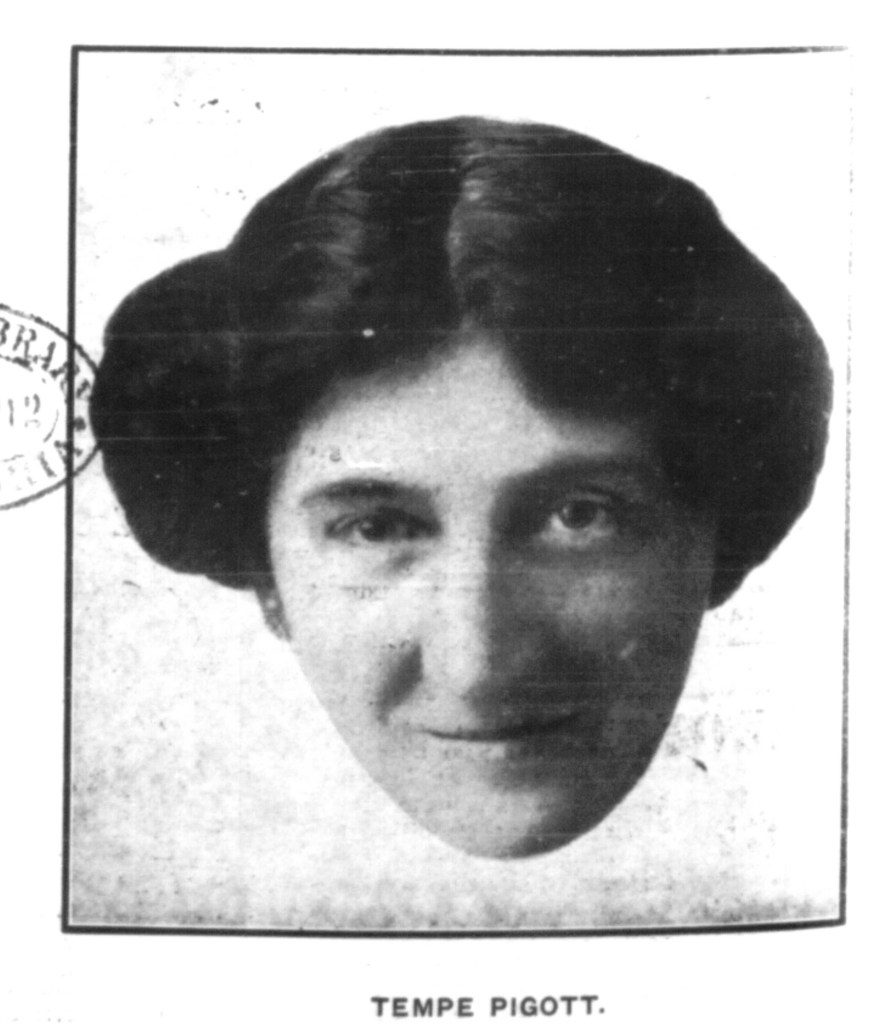
Above: Tempe Pigott, while performing in Melbourne in 1912.[2]Table Talk, 18 July 1912. Via State Library of Victoria

Tempe’s remote Australian birth

Florence Edith Tempe Pigott was born at Auburn station, about 450 kms north-west of Brisbane,[3]in Australia, a station means a large pastoral lease running livestock – like a ranch in North America in the Burnett district in Queensland, on 2 February 1867. Tempe was therefore 84 years old when she appeared in her last recorded film in 1951 and about 95 when she died in 1962. (See Note 1 below regarding her birth)

Tempe’s father was pastoralist[4]in Australia the word “Squatter” is also used Peter J Pigott, her mother was Lydia nee Clarke, the daughter of well known Queensland architect Francis Clarke. While working life on pastoral leases like Auburn was hard, the profits to be made were significant. Pigott could afford to go on an extended trip to England and Ireland in the mid 1860s, but when his business partner J M Murphy died in an accident, he hurried home.[5]Queensland Times, Ipswich Herald and General Advertiser (Qld) 28 Apr 1863, P3 and Maryborough Chronicle, Wide Bay and Burnett Advertiser (Qld)1 Mar 1865, P2 Via National Library of Australia’s … Continue reading The frontier of Tempe’s birth was also notoriously harsh and sometimes violent. Records of catastrophic clashes with Indigenous Australians do not mention Pigott or Auburn station, but they are found in nearby localities at this time. Another significant feature of life on properties like Auburn was its remoteness. Today, the nearest town is Chinchilla – comprising 6,500 people and about 100 kms to the south. However, when Pigott took up his lease at Auburn, Chinchilla did not exist, and Maryborough, 300 kms to the east was the nearest big town.

Photos of Auburn station are elusive. This shows the main homestead sometime in the 1920s. State Library of Queensland.[6]Auburn Station homestead. John Oxley Library, State Library of Queensland.

Life in Brisbane

Peter J Pigott died in November 1870 aged only 49, and soon after Lydia took her children back to Brisbane.[7]Like Tempe’s birth certificate, Peter Pigott’s death certificate remains elusive. However, his death notice appeared in The Brisbane Courier (Qld), 14 Nov 1870, P 2. Via National Library … Continue reading In 1874 Lydia married William Horsley, a merchant and Brisbane broker. Brisbane was a growing city but in 1900 its population of 120,000 was still only a quarter the size of the other major east coast cities – Melbourne and Sydney. Consequently its theatre scene was smaller and opportunities for those keen to pursue the stage were limited. Tempe’s first recorded appearance in amateur theatre was in a charity performance of the comedy New Men and Old Acres, in June 1885.

Tempe was 18 when she appeared in this Brisbane charity performance in 1885.[8]The Brisbane Courier,(Qld) 9 June 1885, P1. Via National Library of Australia’s Trove

In later interviews with journalists, Tempe revealed other aspects of her Brisbane life as a young adult. She said she was an accomplished tennis player, having become amateur women’s champion of Queensland. She was also a recreational rifle shooter, and had taken up women’s rowing. She also painted watercolours in her spare time.[9]Australian Town and Country Journal (Syd) 20 May 1914, P26 via National Library of Australia’s Trove While electoral rolls for the early 1900s listed her as a typist, we also know she taught elocution in Brisbane, advertising her services in local papers in 1904 and 1905 – a 14 week course cost 25 shillings. By this time she was living at a rather grand, gothic style, private hotel called Riversleigh on Brisbane’s North Quay, although her mother and step-father lived only a few streets away.

Tempe, not in character in a photo possibly taken when she was aged in her 30s.[10]Melbourne Punch, 11 July 1912 State Library of Victoria

Elocution and the theatre

In addition to making her own income, as the daughter of a successful pastoralist and step-daughter of a wealthy businessman, she would also have had a healthy degree of financial freedom and she certainly enjoyed connections with Brisbane’s elite. When 29 year old Tempe attended the Governor’s Ball in 1896, her attendance and attire was duly noted, [11]The Brisbane Courier (Qld.) 12 Sep 1896 P6 via National Library of Australia’s Trove and when she visited friends in Warwick or Gympie, the newspapers reported her “holidaying” in their social pages. Even when she returned to Australia in 1936 after 20 years in the US, she was still well enough connected to be invited to society events where “anecdotes of Hollywood were very much in demand”[12]The Sydney Morning Herald, 2 Sept 1936, P7 via National Library of Australia’s Trove – these included afternoon tea with Sydney’s Lady Mayoress and friends.[13]The Daily Telegraph (Syd) 15 Sept 1936, P9, via National Library of Australia’s Trove

In his study of selected character actors of Hollywood’s Golden Age, Axel Nissan respectfully describes Tempe as ‘the Eternal Landlady’ [14]See Axel Nissen: Accustomed to Her Face: Thirty-Five Character Actresses of Golden Age Hollywood. McFarland & Co, 2016 and that is indeed, the way we see her in many of her surviving films.[15]Although the available film role databases also list her by less flattering titles – such as ‘Old woman/Old Hag/Old Crone/Charwoman/Flower seller etc It appears she began to appear in these types of roles while performing in Australia.

Tempe playing a maid in the farce, A Dead Shot, a fundraiser for the Roma School of Arts in 1888.[16]Western Star and Roma Advertiser (Qld.) 2 June 1888
P3 via National Library of Australia’s Trove


At some stage in 1907, Tempe started to appear in professional performances. The first was probably with the Lillian Meyers Company – touring Australian cities and towns with a variety of drama and comedies. Thanks to her skill in elocution, she increasingly took on important character roles. For example, in Hobart in January 1908, in a new play about the ever popular Kelly Gang, she took the supporting role of Ned Kelly’s Irish mother, Ellen. Ellen Kelly was still alive at the time, and the Kelly story still resonated so strongly with Australians that it had been made into a feature film only a few years before.[17]Mercury (Tas) 2 Jan 1908, P7, via National Library of Australia’s Trove

Tempe’s character roles on the Australian stage included (left) Cora the maid in the comedy The Man on the Box, and (right) Scottish nurse Christine Grant in Nobody’s Daughter.[18]Melbourne Punch (Vic), 28 Aug 1913, P21 and Telegraph (Qld) 11 Nov 1911, P18, via National Library of Australia’s Trove

By 1911, she was now touring with the Hamilton-Plimmer-Denniston Company, in the comedy-drama Nobody’s Daughter, alternating with the comedy Lover’s Lane. In the latter, Tempe formed part of a “splendid gallery of portraiture” – which, after all, was the task of a character actor.[19]Table Talk (Vic) 13 Jul 1911, P21 via National Library of Australia’s Trove Tempe’s role as the old Scottish nurse Christine Grant in Nobody’s Daughter received very good reviews.

By 1912 Tempe was in regular work on the Australian stage, often performing for Sydney’s Little Theatre, between longer seasons at larger east coast theatres. However we gain some sense of why better paid overseas work may have been attractive from her surviving JC Williamson’s contract for the patriotic play The Man Who Stayed at Home. Her July 1915 contract was for the very modest sum of £6 per week, the equivalent perhaps of $600 in 2021 money.[20]Tempe Pigott, JC Williamson Ltd Contract, 23 July 1915, courtesy Australian Performing Arts Collection, Melbourne

In late April 1916, the Sydney Little Theatre farewelled her after a final performance in Hindle Wakes.[21]Sydney Morning Herald, 29 April 1916, P18, via National Library of Australia’s Trove

As the nasty gossip Mrs Candour, in School for Scandal, at Sydney’s Little Theatre in 1914. [22]The Sydney Mail (Syd) 17 Jun 1914, P15 via National Library of Australia’s Trove

Work in the US

In May 1916, Tempe boarded the SS Sierra for the US. Her travelling companion was Marie Irvine, a Brisbane journalist. Although it was now wartime and the usual reporting about an Australian actor travelling overseas to take on the world was muted, her hometown paper, the Brisbane Courier reported “Miss Pigott ranks with the best artists the Australian stage possesses…This esteemed artist cannot possibly fail to make a name in America…”[23]Brisbane Courier 13 May, 1916, P12, via National Library of Australia’s Trove.

The passenger manifest makes it clear her destination was New York and she seems to have succeeded in finding work soon after arrival. From late 1916 Tempe can be found in the cast lists of several plays touring US cities. The first of these was Peg O’ My Heart – where she took the role of the English Mrs Chichester, who educates a young New York girl to be a lady, in return for a large portion of an inheritance – a Pygmalion style story. The next four years of effort on the US stage, including a short season of Perkins in New York in 1918, finally saw her in Los Angeles, performing at the Writer’s Club.

Like so many of her contemporaries, the actual reasoning for Tempe’s move to the US had been a career and financial decision. And of Hollywood she said; “It was quite natural that I should gravitate towards Hollywood… More money may be made in a day in pictures than in a week on the stage; so, naturally, everyone is attracted to film work.”[24]The Sydney Morning Herald, 18 Aug 1936, P8 via National Library of Australia’s Trove All the same, as this writer has indicated, there is some likelihood Tempe had inherited some additional financial security.

Her first film was apparently the Famous Players Lasky’s The Great Impersonation, released in 1921, probably a lost film, although in interviews she nominated other films as her first, including Behold My Wife (1920).

58 year old Tempe Pigott, listed as a female character actor, in the Standard Casting Directory of 1925.[25]Standard Casting Directory, Feb 1925, via Lantern Digital Media Archive and the Internet Archive

Alex Nissan, who seems to have gone to the effort of finding and watching much of her work, writes: “in films there has to be someone to open the door and say so and so is calling, or make a drunken spectacle of themselves in a pubSuch an actress was Tempe Pigott.[26]Nissan, 2016, Chapter 25 All the same, definitive commentary about her thirty years of work in film is difficult, insofar as she sometimes played such minor character roles and her appearance is fleeting.

Tempe in one of her fleeting roles – as Mrs Hudson, Sherlock Holmes’ landlady, in A Study in Scarlett (1933)[27]screengrab from a copy on youtube

There is also the problem of mis-identification of Tempe, given that she was undoubtedly made up to look as aged and careworn as possible in many of her films. For example, the current version of the IMDB illustrates her profile with a photo that is arguably Dorothy Phillips made-up as an older woman.[28]See Photoplay July-Dec 1925. Via Lantern Digital Media Library & The Internet Archive

An unusually well-lit Tempe, as McTeague’s mother in Erich von Stroheim’s Greed (1924)[29]Screengrab from copy at the Internet Archive

Tempe as the maid to Princess Isobel (Billie Dove), in The Black Pirate , a two colour Technicolour action film featuring Douglas Fairbanks(1926)[30]Screengrab from copy at the Internet Archive

Some available examples of Tempe’s film work are linked in the references section below. Nissan notes that the earlier 1930s were a busy time for her,[31]she appeared in at least 35 films in 1930-36 and she made the transition to sound films successfully, when so many did not. Commenting on this herself on her return to Australia in 1936-7, Tempe suggested this was partly thanks to her expertise in elocution. “So much depends not only on the voice but on the pronunciation.” The journalist reported that Tempe ” had a beautiful speaking voice, fine diction and an easy manner…”[32]Telegraph, (Qld) 2 March 1937. P6. via National Library of Australia’s Trove In 1936 Tempe recalled “Talkies came upon us so suddenly…and it was pathetic to watch the falling of so many of the stars. Many of the women, and the men, too, merely had beautiful faces; often they could not speak English at all. If they did, it was sometimes harsh English, which could never be corrected.”[33]The Sydney Morning Herald, 18 Aug 1936, P8 via National Library of Australia’s Trove She had gone to some effort to avoid picking up an American accent, she said.[34]Wireless Weekly (Aust) 2 Oct, 1936, P18, via National Library of Australia’s Trove As her surviving sound films illustrate, her voice skills were particularly notable in a variety of British accents.

Tempe as Mrs Haggerty in the home front film Seven Days Leave (1930) [35]Screengrab from copy at the Internet Archive

Not all of her screen appearances were fleeting. Her extended supporting role as one of the working class London women in the Gary Cooper vehicle Seven Days Leave (1930), gained positive reviews – the film is based on J.M. Barrie’s bitter-sweet play The Old Lady Shows Her Medals. Some of her shorter appearances are still of characters important in film narratives – such as nurse Mrs Corney, who steals the ring from Oliver’s mother in Oliver Twist (1933), thus setting in train the series of events that make the story.

Tempe, with the castor oil bottle and Douglas Scott as Oscar in Night Work (1930).[36]Screengrab from copy at the Internet Archive

Tempe’s voice can be heard in this example from Night Work (1930), where she plays Clara the nurse, determined to give young Oscar his castor oil, enlisting Mr Musher (Eddie Quillan) to help.[37]Source – copy at the Internet Archive


Tempe also appeared in a role of substance in the very successful 1933 Fox film Cavalcade, based on a play by Noël Coward. A film in the style of the Forsyte Saga and Upstairs Downstairs, it was one of a string of Hollywood films that romanticized all things English, while also celebrating the challenges and successes of family life. It won several Academy Awards – for best Picture, best Director (Frank Lloyd) and best Art Direction. Alongside Tempe was fellow Australian Billy Bevan, also playing a role that required a working class English accent – something Hollywood studios often called upon Australians to perform.

A posed still of the main cast of the hugely successful Cavalcade (1933). A smiling Tempe (as Mrs Snapper) is standing at left rear.[38]Cinemundial, June 1933, P331, Via Lantern Digital Medial Library & the Internet Archive

Tempe returned to Australia for a visit in August 1936. She stayed on for about seven months, living with her cousins (on her mother’s side) at their comfortable home at Sydney’s Darling Point. She was widely interviewed for radio and newspapers, and gave talks at society events. She gave at least one radio performance as Sairey Gamp (a character from Charles Dicken’s Martin Chuzzlewit) for ABC radio. She even expressed a hope that she might appear in an Australian film. But she didn’t. She returned to Hollywood in March 1937. Unfortunately, given her age, she was stopped on return to the US. She was an alien (a non-US citizen), and was given a class “B” medical certificate, probably because her age (stated to be 68 but really 70) might normally suggest she would be unable to earn a living. However, in the end, the US accepted her, perhaps after some assurances from her agent or a studio.

Tempe in The White Angel (1936) – a creative telling of the Florence Nightingale.[39]Truth (Syd) 16 Aug 1936, P35, via National Library of Australia’s Trove

Did she lose her “currency” in the time she was away from Hollywood? It is difficult to be certain, but her film ouput seems to have slowed on her return to Hollywood. Her 30 year film career finally came to a close with a tiny role in the 1951 Douglas Sirk crime drama Thunder on the Hill, when she was aged 84, and again playing an “old crone,” according to the cast list at the IMDB.

Two key documents we might expect would help cast some light on Tempe’s later life are at least partly erroneous. As Alex Nissan notes, the 1940 US census shows Tempe was a lodger in a house in the heart of Hollywood by this time, and had only earned $500 in the year before the census.[40]Nissan, 2016, Chapter 25 But the document also gives her place of birth as England, and her age as 56. Her 1962 death certificate also stated she was an Englishwoman, born on 2 Feb 1884. In fact, she was 95 years old when she died. The certificate also reveals that she had broken her hip in a fall not long before her death.

Tempe (as a beggar) with fellow Australian C Montague Shaw in costume for The Pilgrimage Play (1950).[41]Los Angeles Evening Citizen News, 15 July 1950, P3, via Newspapers.com

We might view Tempe Pigott as another victim of Hollywood casting practices, however she also appears to have been quite conscious of what the studios required and was a willing participant in the transaction – and after all, she had returned to the US to do more of it in 1937. During her visit home to Australia she repeatedly said that Hollywood had a policy of “typing” actors. She alluded to an unnamed acquaintance [42]possibly fellow Australian William H O’Brien who was only ever offered butler roles. Because of this practice of typecasting she would never be offered “a grand dame to play”[43]Daily Telegraph (Syd) 4 Aug 1913, P12 via National Library of Australia’s Trove. But this appears not to have concerned her, as such grand dame parts were “very thankless… You just sail about” she observed.[44]Wireless Weekly (Aust) 2 Oct, 1936, P18, via National Library of Australia’s Trove

To the best of this writer’s knowledge Tempe did not marry[45]her death certificate states she was a widow, but no record of a marriage has come to light and she had no children. US papers reported her death in California in 1962, but remarkable though her very long career was, her passing was completely overlooked in Australia. She really should not have been so easily forgotten in her country of birth.


Note 1. The mystery of Tempe’s birth

There is no surviving Queensland birth certificate for Florence Edith Tempe Pigott, or if one exists, it has been mis-identified. While that was unusual in the Australian colonies, it is not unknown. But we know the details of her birth with a high degree of certainty from several other sources:
1. When she arrived in the US on the SS Sierra on May 29, 1916, and again on the SS Monterey on March 22, 1937, she variously gave her date of birth as 1872 and 1869. She named her place of birth – Auburn Queensland – on the 1937 ship’s manifest.

However, when she was born on 2 February 1867, her parents announced the birth of their (as yet unnamed) daughter in a prominent position in a number of major Australian newspapers, in New South Wales and Queensland, in February 1867.[46]The Sydney Morning Herald, 21 Feb 1867, P1 and The Brisbane Courier, 15 Feb, 1867, P2. Via National Library of Australia’s Trove


2. And on Tempe’s mother Lydia’s death certificate from 1912 (by now Lydia Horsley), her three surviving children from her first marriage to Peter J Pigott were clearly named, with their ages. This again confirms Tempe as the child born in 1867.

Enlargement of part of Lydia Horsley’s 1912 death certificate showing her 3 surviving adult children, including Tempe.

3. Also of interest, Tempe’s younger sibling Madaline, born in October 1868, did not have a birth certificate issued until 1871, confirming that the family were not very observant of obligations to complete official paperwork – but perhaps their isolation was also to blame.(On Madaline’s birth certificate Tempe is listed as a 3 year old) And as noted, there is no death certificate for Tempe’s father, Peter J Pigott, who died on 2 November 1870, while seeking treatment for an unspecified ailment. The absence of a death certificate is unusual.


Nick Murphy
December 2022


References

Primary Sources

  • Australian Performing Arts Collection, Arts Centre, Melbourne.
  • National Archives of Australia
  • Ancestry.com
  • Queensland; Births, Deaths & Marriages
  • California, Department of Public Health
  • Lantern, Digital Media Project at the Internet Archive
  • National Library of Australia, Trove.
  • Newspapers.com

Text

  • Queensland Government Intelligence & Tourist Bureau. Hotel And Boarding House Directory, 1912 (via Internet Archive)
  • William Brooks. The Central and Upper Burnett River District of Queensland centenary souvenir, 1848-1948, embracing the districts of Gayndah, Mundubbera, Eidsvold and Monto. 1948
  • Paul Michael (Ed) The American Movies. Garland Books, 1974.
  • Axel Nissen. Accustomed to Her Face: Thirty-Five Character Actresses of Golden Age Hollywood. McFarland & Co, 2016
  • Rosebud T Solis-Cohen. The Exclusion of Aliens from the United States for Physical Defects. Bulletin of the History of Medicine, Jan-Feb 1947, Vol 21, No 1, 33-50. Johns Hopkins University Press.

Films

Web: Ausstage Database

Web: The Files of Jerry Blake


This site has been selected for preservation in the National Library of Australia’s Pandora archive

Footnotes

Footnotes
1 The Wireless Weekly, 2 Oct 1936, P11, Via National Library of Australia’s Trove
2 Table Talk, 18 July 1912. Via State Library of Victoria
3 in Australia, a station means a large pastoral lease running livestock – like a ranch in North America
4 in Australia the word “Squatter” is also used
5 Queensland Times, Ipswich Herald and General Advertiser (Qld) 28 Apr 1863, P3 and Maryborough Chronicle, Wide Bay and Burnett Advertiser (Qld)1 Mar 1865, P2 Via National Library of Australia’s Trove
6 Auburn Station homestead. John Oxley Library, State Library of Queensland.
7 Like Tempe’s birth certificate, Peter Pigott’s death certificate remains elusive. However, his death notice appeared in The Brisbane Courier (Qld), 14 Nov 1870, P 2. Via National Library of Australia’s Trove
8 The Brisbane Courier,(Qld) 9 June 1885, P1. Via National Library of Australia’s Trove
9 Australian Town and Country Journal (Syd) 20 May 1914, P26 via National Library of Australia’s Trove
10 Melbourne Punch, 11 July 1912 State Library of Victoria
11 The Brisbane Courier (Qld.) 12 Sep 1896 P6 via National Library of Australia’s Trove
12 The Sydney Morning Herald, 2 Sept 1936, P7 via National Library of Australia’s Trove
13 The Daily Telegraph (Syd) 15 Sept 1936, P9, via National Library of Australia’s Trove
14 See Axel Nissen: Accustomed to Her Face: Thirty-Five Character Actresses of Golden Age Hollywood. McFarland & Co, 2016
15 Although the available film role databases also list her by less flattering titles – such as ‘Old woman/Old Hag/Old Crone/Charwoman/Flower seller etc
16 Western Star and Roma Advertiser (Qld.) 2 June 1888
P3 via National Library of Australia’s Trove
17 Mercury (Tas) 2 Jan 1908, P7, via National Library of Australia’s Trove
18 Melbourne Punch (Vic), 28 Aug 1913, P21 and Telegraph (Qld) 11 Nov 1911, P18, via National Library of Australia’s Trove
19 Table Talk (Vic) 13 Jul 1911, P21 via National Library of Australia’s Trove
20 Tempe Pigott, JC Williamson Ltd Contract, 23 July 1915, courtesy Australian Performing Arts Collection, Melbourne
21 Sydney Morning Herald, 29 April 1916, P18, via National Library of Australia’s Trove
22 The Sydney Mail (Syd) 17 Jun 1914, P15 via National Library of Australia’s Trove
23 Brisbane Courier 13 May, 1916, P12, via National Library of Australia’s Trove
24 The Sydney Morning Herald, 18 Aug 1936, P8 via National Library of Australia’s Trove
25 Standard Casting Directory, Feb 1925, via Lantern Digital Media Archive and the Internet Archive
26, 40 Nissan, 2016, Chapter 25
27 screengrab from a copy on youtube
28 See Photoplay July-Dec 1925. Via Lantern Digital Media Library & The Internet Archive
29, 30, 35, 36 Screengrab from copy at the Internet Archive
31 she appeared in at least 35 films in 1930-36
32 Telegraph, (Qld) 2 March 1937. P6. via National Library of Australia’s Trove
33 The Sydney Morning Herald, 18 Aug 1936, P8 via National Library of Australia’s Trove
34, 44 Wireless Weekly (Aust) 2 Oct, 1936, P18, via National Library of Australia’s Trove
37 Source – copy at the Internet Archive
38 Cinemundial, June 1933, P331, Via Lantern Digital Medial Library & the Internet Archive
39 Truth (Syd) 16 Aug 1936, P35, via National Library of Australia’s Trove
41 Los Angeles Evening Citizen News, 15 July 1950, P3, via Newspapers.com
42 possibly fellow Australian William H O’Brien
43 Daily Telegraph (Syd) 4 Aug 1913, P12 via National Library of Australia’s Trove
45 her death certificate states she was a widow, but no record of a marriage has come to light
46 The Sydney Morning Herald, 21 Feb 1867, P1 and The Brisbane Courier, 15 Feb, 1867, P2. Via National Library of Australia’s Trove