


Above: University of Washington, Special Collections, JWS24555. (Enlargement) Reproduced with permission. The Commonwealth of Australia was 4 years old when this photo of the Pollard’s Lilliputian Opera Company was taken in the Philippines in late 1904 or early 1905. Close examination of the original (here) suggests the children are posing with chained prisoners. The children include front row, 1st from left: Leah Leichner, 2L Teddy McNamara, 6L Freddie Heintz, 1st from Right: Harry Fraser (later Snub Pollard), 2R Johnnie Heintz, 4R Daphne Pollard. Standing in the rear at left is Oscar Heintz.
On 30 June 1901, The San Francisco Call announced the impending arrival of an exciting troupe of young Australians, Pollard’s Lilliputian Opera Company from Melbourne. While the paper assured readers they were all extremely talented, it explained they were “all children of the poorer classes”, one performer being “picked up on the streets,” it was claimed.
Over the period 1898-1909, Charles Pollard (1858-1942) and his sister Nellie Chester (1861-1944) took travelling troupes of children overseas, overwhelmingly girls and mostly residents of the inner suburbs of Melbourne, to perform musical comedies at colonial outposts in South East Asia and then through the cities of Canada and the USA. One tour was away for over two years. These troupes were always known as Pollard’s Lilliputian Opera Company, although they had a continually changing mix of new and seasoned performers. The children were indentured to the Pollards in a way we would find unthinkable today – and even then, Pollard tours sometimes caused controversy, most notably in 1909-1910 when Arthur Hayden Pollard‘s (1873-1940) tour to India collapsed in scandal.

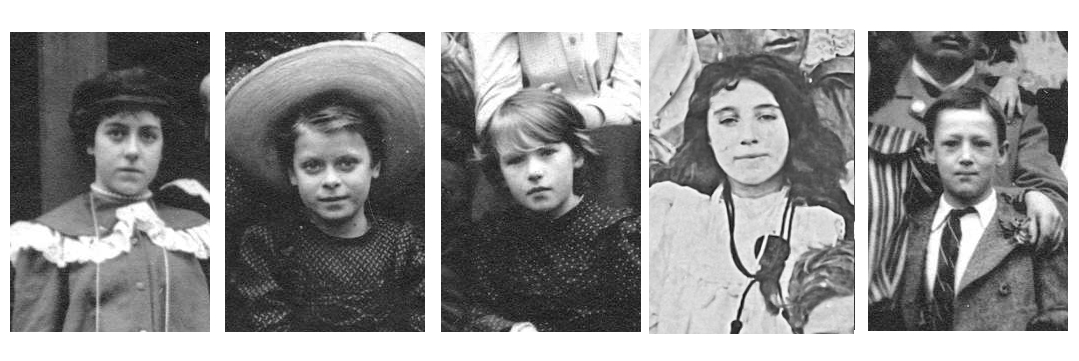
Pollard’s performers in Vancouver 1903. Left to right: Ivy and Daphne Trott (Pollard), Irene Finlay, Leah Leichner, Willie Thomas all from inner Melbourne. The photo of Leah is enlarged from the Australian Performing Arts Collection and used with permission. Other photos are from a group photo via Vancouver As It Was: A Photo-Historical Journey (click to follow the link) reproduced with permission.
The Pollard’s performers were generally the children of unskilled and semiskilled workers; bakers, boot-makers, tailors, plumbers, ironmongers, carriers, cab-drivers and fruiterers. Several parents were bookmakers, the Trott girls (Ivy Trott and Daphne Pollard) were the children of a french polisher, Midas Martyn‘s father was a bookbinder. They were almost all children from families living in modest cottages built in close proximity to light industry – and they particularly hailed from Fitzroy, Collingwood and Abbotsford. Some lived in such close proximity to each other it is inconceivable they were not acquainted before they signed up.
- Alice Catherine Bennetto
Born Fitzroy, Victoria, Australia, 5 October 1885
Died Auckland New Zealand, 22 January 1970 - Ethel Grace Bennetto
Born Fitzroy, Victoria, Australia 22 December 1889
Died Auckland New Zealand, June 1985 - Queenie Williams also known as Ina Williams (Alfreda Ina Williams)
Born Footscray, Victoria, Australia, 17 November 1896
Died Los Angeles, California, USA, 9 June 1962
- Irene Finlay
Born Brisbane, Queensland, Australia,16 August 1891
Died Auckland New Zealand, 2 August 1962
- Alf Goulding (Alfred John Goulding)
Born Richmond, Victoria, Australia, 26 January 1885,
Died Hollywood, California, USA, 25 April, 1972.
- Freddie & Johnnie Heintz
Born Fitzroy, Victoria, Australia, 3 December 1895
Johnnie died Adelaide, South Australia, 28 August 1945
Freddie died Los Angeles, California USA, 19 July 1949
- Irene Loftus (Irene Goulding)
Born Collingwood, Victoria, Australia, 7 October, 1888
Died, Melbourne, Victoria, Australia, 1987
- Leah Leichner (Leah Caroline Cohen)
Born Fitzroy, Victoria, Australia, 9 July 1890
Died Hong Kong, China, 16 May 1957.
- Elsie Morris (Elsie Lavinia Morris)
Born South Melbourne, Victoria, Australia, 26 June 1896
Died Sydney, New South Wales, Australia, 1 November 1966
- Ted (or Teddy) McNamara (Edward Joseph McNamara)
Born Prahran, Victoria, Australia, 19 September 1893
Died Ventura, California, USA, 3 Feb 1928
- W. (Will) S. Percy (Stratford Strettle Percy)
Born Melbourne, Victoria, Australia, 23 December 1872
Died England, 19 June 1946
- Daphne Pollard (Daphne Trott)
Born Fitzroy, Victoria, Australia, 19 October 1891,
Died Los Angeles, California, USA. 22 February 1978.
- Snub Pollard (Harold Hopetown Fraser).
Born North Melbourne, Victoria, Australia, 9 November 1889,
Died Los Angeles, California, USA, 19 January, 1962.
- Harry Quealy (Henry Joseph Quealy)
Born Brisbane, Queensland, Australia, 2 July 1876,
Died Sydney, New South Wales, Australia, 25 July 1927.
- Nellie Quealy ( Nellie Finlay or Robins)
Born New Zealand c 1885,
Died Saranac Lake, New York, USA, 14 July 1936.
- Willie Thomas (William Thomas) and Emma Thomas
William born Collingwood, Victoria, Australia, 1 January 1889,
Died Boulder, Western Australia, 1969.
Emma born Collingwood, Victoria, Australia, 12 January 1885,
Died Sunshine, Victoria, 1963.
And here are sketch accounts of Ethel Naylor and the Topping sisters:
Ethel Naylor


Born in Williamstown, Victoria in 1896, Ethel Naylor travelled on the July 1907- April 1909 Pollard’s tour to North America. In July 1909, she also departed on Pollard’s Indian tour, this time with her older sister Nellie. The girls were the daughters of bookmaker Joseph Naylor and Alice nee Kennedy.
Their family life had been very difficult – Joseph suffered such serious mental illness that he was hospitalised in the asylum at Kew in 1905. He died there in 1907. Of his seven children, only Ethel, Nellie and one other sibling survived childhood – an experience enough to test the sanity of anyone. His widow Alice found life hard, and she drifted between residences. The only contact Truth newspaper could find for her when the Pollard’s Indian tour returned in 1910 was Alice’s workplace address – which was the famous Lucas’ Town Hall Cafe, in Swanston Street, Melbourne, now where the Capital Theatre stands.
Above right: Ethel Naylor featured in the Oroville Daily Register (California), 24 Jan 1916. Via Newspapers.com


The 3 story Town Hall Cafe (centre) and the Talma Photographers building, Swanston Street, Melbourne, from the Town Hall corner, c.1899. State Library Victoria, Gwyn James Collection, H93.466/6. (The Talma Building still stands)
Ethel did perform on stage again, and with significant success. In July 1912 Nelly Chester raised another Pollard’s troupe for touring the US. This time the players were older, and no longer described as Lilliputians, or children, so as to comply with the 1910 Emigration Act. However, many were former Pollard’s players, including Ethel. She did well with the “Pollard’s Juvenile Troupe” that travelled through the United States and Canada. Like many of the performers on this final tour, Ethel stayed on in the US. By the late 1920s she had well and truly changed direction and was working as a registered nurse at the General Hospital in Aberdeen, Washington state. She married in 1932.
Minnie, Nellie and May Topping
Henry Topping was a plumber, and with his wife Mary Ann, nee Plant, they parented seven children. The family lived in and around the northern end of Fitzroy Street, a north-south street that runs the length of the suburb of Fitzroy. They lived a few hundred metres from the Trott and Heintz families in nearby Kerr Street. Minnie (born 1885), Nellie (born 1888) and May (born 1890) Topping all appeared with Nellie Chester and Charles Pollard’s troupes. All three children travelled together on the 1901-1902 tour to North America, and May and Minnie again in 1902-3.


Minnie and May Topping, photographed in 1909. The Gadfly (Adelaide), 20 January 1909, Via the National Library of Australia’s Trove. Photo of the northern end of Fitzroy St, looking south, from the footpath outside the Topping’s now demolished home. Author’s collection.
The Topping sisters moved across to the other Pollard’s Liliputian (consistently spelled with two rather than 3 “L”s) Company in 1907 – this company was run by Tom Pollard and performed exclusively throughout Australia and New Zealand. They are unusual in that respect – as most players did not do this. We can assume they found the extended North American travel with Charles Pollard and Nellie Chester too arduous.


Minnie Topping, who had proved to be a very popular performer, left the Australian stage in 1913, after marrying a Queensland pastoralist. May continued to perform with the Lionel Walsh – Phil Smith company until her marriage in 1923. By this time, the family home (the girls lived here until they married) was at 521 Canning Street Carlton North, a building that still stands. (Left- author’s collection)
We know a little more of the Topping family life because in 1899, a long suffering Mary Ann took Henry Topping to court to force him to support the family, and the Melbourne Herald reported the case. He was a drunken and violent husband and Mary Ann and the children had left him because of this. By way of a somewhat lame explanation, Henry explained that he was not a certified plumber, and had only made 2 shillings so far that week. The court found in favour of Mary Ann and ordered Henry to support his family. Of the black eyes he had inflicted on Mary Ann, the court had nothing to say.
George (born 1881), another of the Topping children, was an Australian Rules Footballer for Carlton, and later an AFL Umpire. The girls’ youngest brother, Albert, was killed soon after arriving on the Western front in August 1916.


Nick Murphy
December 2020
Special Thanks
- University of Washington Special Collections, for permission to use the photos of the troupe. Their collection of photos of the Pollard’s troupes while on tour in North America is invaluable.
- To Jean Ritsema, in Michigan, for her research efforts in North America.
Fiction
In the absence of meaningful contemporary interviews with these performers, two works of fiction are highly recommended – that help give some sense of the context, motivation and everyday lives of young Australian performers.
- Kaz Cooke (2017) Ada. Comedian, Dancer, Fighter. Viking /Penguin. A fictional account of Ada Delroy’s life.
- Kirsty Murray (2010) India Dark. Allen and Unwin. A fictional work inspired by the Pollard Tour of India in 1909-1910.
The Australian Performing Arts Collection, Arts Centre Melbourne, holds an interview with Irene Goulding, a former Pollard performer, made in 1985.
General Reading
- Gillian Arrighi & Victor Emeljanow (Eds) (2014) Entertaining Children: The Participation of Youth in the Entertainment Industry, Chapter 3, Palgrave MacMillan.
- Gillian Arrighi (2017) The Controversial “Case of the Opera Children in the East”: Political conflict between popular demand for child actors and modernizing cultural policy on the child”. Theatre Journal 69, (2017) John Hopkins University Press.
- Kirsty Murray (2010) India Dark. Allen and Unwin.
[Note: While written as a novel for teenagers, this beautiful book is closely based on the events of Arthur Pollard’s troupe in India and is highly recommended] - Justine Hyde’s blog Hub and Spoke which includes an interview with Kirsty Murray about India Dark.
- Leann Richards (2012) Theatrical Child Labour Scandal Stage Whispers website.
Birth certificates, Ships manifests, Voting rolls, Census details etc sourced from
- Familysearch.org
- Ancestry.com
- Public Records Office Victoria
- Births, Deaths and Marriages (Vic)
Regarding May, Nellie and Minnie Topping
- Via National Library of Australia’s Trove.
The Herald (Vic) 16 Mar 1899, P1
The Australian Star (NSW) 3 Sept 1901, P7
Table Talk (Vic) 16 Feb, 1905, P16
The World’s News (NSW) 26 Oct 1907,
Evening Telegraph (Qld) 31 Aug 1908, P4
The Gadfly (SA) 20 Jan 1909, P8 - Peter Downes (2002) The Pollards, A Family and its child and adult opera companies in New Zealand and Australia 1880-1910. Steele Roberts, Aotearoa

