


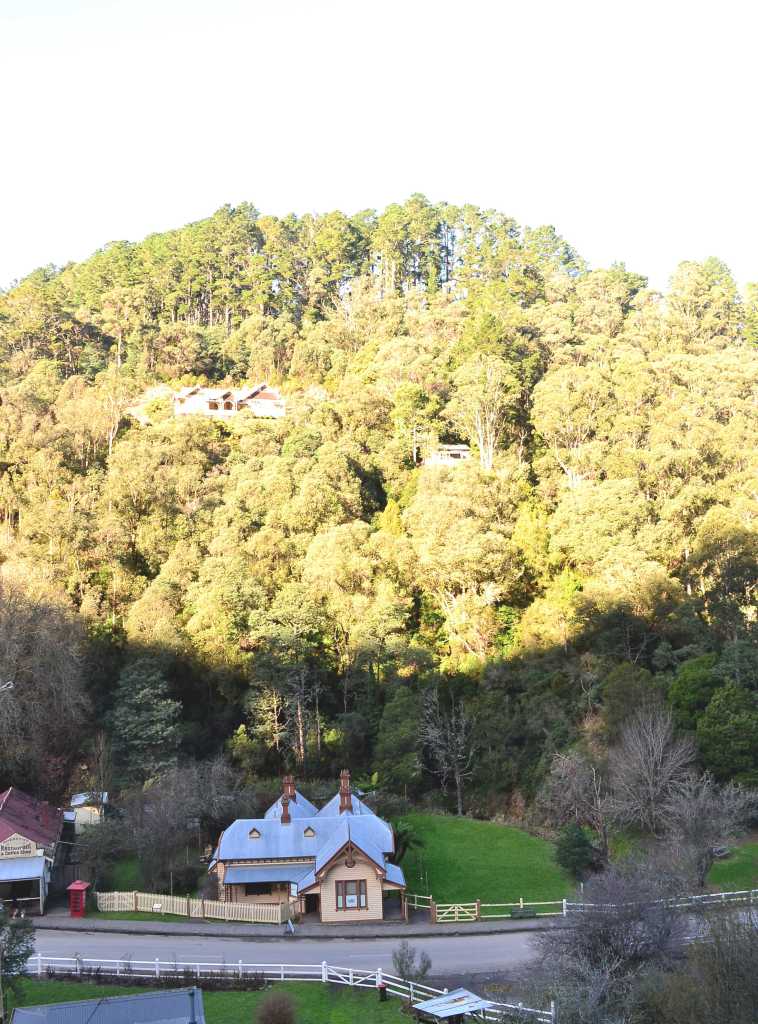
Cropped undated image of Suzanne Bennett, The New York Public Library Digital Collections, Billy Rose Theatre Division. The remoteness of the town of Walhalla can be seen in the background photo, author’s collection, June 2022. Her family home in the settlement of Maiden Town was on the now forested ridge to the right.
The Five Second Version
Suzanne Bennett is amongst the best known of the Australian actors who sought a career on stage in New York in the 1920s. She grew up in a remote mining town before moving to Melbourne Australia, as a young adult. She endured deep personal unhappiness, including the loss of a child and an unhappy wartime marriage, followed by a battle to be recognised as a young actor-singer. Following a move to the US in 1922, a successful career on the New York stage blossomed. A second marriage to fellow Australian Sir Hubert Wilkins (1888-1958) in 1929 marked a new phase of her life. Lady Suzanne Wilkins lived most of her later life in New York, but died in California 1974.


She was born Susannah Catherine Evans in Walhalla, Victoria, Australia in January 1893,[1]Birth Certificate, Susannah Catherine Evans, 8187/1893, 3 January 1893 the second of five children of John Evans and Alice nee Whitlow, a local Walhalla girl. John Evans was variously described on his children’s birth certificates as a miner or mine engine driver, but on his 1913 death certificate he was described as a mine manager. The family home was actually in Maiden town, a settlement on the ridge east of, and overlooking Walhalla.[2]The family home in Maiden town was repeatedly noted in John Evans’ will and probate documents
At the time of Susannah Evans’ birth, Walhalla was a bustling gold-mining town of 3000 people, set in a narrow valley in mountainous country. The town was remote and access was difficult. Even when the narrow gauge railway finally arrived in Walhalla in 1910, it still took 3 hours of slow train travel up steep gradients and around sharp corners to cover the 50 kilometres to Moe, the nearest mainline station.[3]Watson (1980) Part 1 The surrounding eucalyptus forests were so dense that when a USAAF fighter crashed near Walhalla in March 1942, the wreckage was not found for seven years. [4]The Argus (Melb) 1 Jan 1949, p1
Mains electricity finally arrived in the town at the end of the twentieth century and mobile phone service finally reached the area in 2018.[5]Personal information, Star Hotel Walhalla, 2022 But in other respects the town was fortunate. When the last local mine closed in 1917, an extraordinary 75 tonnes of gold had been recovered from Cohen’s reef, that ran under the valley.


Suzanne’s mother Alice had died of pneumonia in Walhalla in 1901, four months after the birth of her youngest child, Arthur. Although Suzanne’s own early experiences in Walhalla are lost to us today, a tantalising glimpse is given in one letter she wrote as a 10 year old to The Weekly Times. She and her siblings attended Walhalla Primary School No 957 and her letter describes the challenge of schooling near to a constantly operating quartz stamper battery. She wrote of her favourite subjects at school – reading, writing and geography. She explained that one of her duties was milking the family cow – morning and night, and tending to the family’s chickens.[7]Weekly Times (Melb) 28 Nov 1903, p8
Sometime after 1910, the children of the Evans family began to move out of remote Walhalla and settle in Melbourne. But a birth certificate for a child named Mona Sinclair Evans, born in St Kilda in May 1911, suggests a deeper and more tragic story.[8]Birth Certificate, Mona Sinclair Evans, 15435/1911, 22 May 1911 The document lists Susannah Catherine Evans, a 19 year old from Walhalla, as the mother. Sadly, no father’s name is given – and the difficult consequences of being a single parent newly arrived in a big city from the country can only be imagined. [9]While it is conceivable that there was more than one Susannah Catherine Evans from Walhalla – Births, Deaths & Marriages records do not reveal another person of this name and age Even more tragically however, Mona Evans died 10 months later, of gastro-enteritis and heart failure.[10]Death Certificate, Mona Sinclair Evans, 3139/1911, 27 March 1912 Susannah’s given name does not appear on the death document, but “Evans” is listed and her occupation is listed as a domestic servant. This experience of single parenting in the early 20th century was not uncommon. What is noteworthy is how unsympathetic society was, yet how stoically women often dealt with the situation. Whether it coloured Susannah Evans’ view of parenting we do not know.
Thus the evidence suggests that Susannah’s early life in Melbourne was not as she liked to represent it in later years. Jeff Maynard’s short article Suzanne, Lady Wilkins: The Lost Autobiography includes some of Suzanne’s own unpublished memoir, written in the early 1950s. This states that she moved to Melbourne to study singing at the University of Melbourne in 1912. It is impossible to verify this or her claim that Nellie Melba encouraged her. However, it is quite possible that she met Melba – in fact there are numerous examples of the great singer providing advice to aspiring young singers.[11]The Argus (Melb) 21 Oct 1955, p9
The lives of Susannah’s siblings also help us understand the challenges the family faced as they moved away from Walhalla. In February 1913, her oldest sister Edith married Bert Guy, a butcher, in Gore Street, Fitzroy, an inner suburb of Melbourne. Brother John had a stint at coal mining before working for the New South Wales railways. He became a railway linesman, and died in an industrial accident in 1928. Youngest brother George appears to have been a miner and later a farm labourer. Father of the family, John Evans, whose health had almost certainly been weakened by years of work in mining, succumbed to chronic pneumonia in August 1913, aged only 48. He left a modest inheritance to his children. But he had built no great wealth from years spent gold mining.
In 1915 Suzanne Evans married Sergeant Oscar Bennett.[12]Table Talk (Melb) 7 Oct 1915, p13 See Note 2 below regarding Oscar Bennett.
Bennett had just joined the Australian army and was about to be sent overseas. (She had adopted the spelling Suzanne by this time). It was a whirlwind romance and marriage – she was later to say she had only known Bennett a few weeks before he left for the Great War. Like so many Australian soldiers, he was not to return home until mid-1919. Suzanne lived through the war in boarding houses, including a very grand one at 20 Burnett Street, St Kilda – a building that still stands today. To support herself she sometimes worked as a typist, while appearing on stage at night – reportedly with the Rigo Grand Opera Company, later for Hugh D.McIntosh in the chorus for Tivoli shows.


Unfortunately, Suzanne’s marriage was much less successful than her developing stage career. In October 1920 Suzanne attempted to divorce Oscar, on the grounds he had repeatedly “left her without support.“ At the time, this claim was apparently stronger grounds for action than his alleged adultery, and alleged violence towards her when drunk. Her action failed, Oscar’s insistence that she “give up the stage” and “live a proper life” apparently found approval in the St Kilda court.[14]The Argus (Melb) 6 Oct 1920, p9 Two years later however, Oscar was named as co-respondent in another suit and a divorce was finally granted.[15]The Ballarat Star, 21 Feb 1922, p3 She had not given up the stage in the meantime, but it had obviously been a difficult seven years. One can only admire her stoicism in keeping on. She kept Suzanne Bennett as her name, in spite of all.
For a time she was a pupil of music teacher Grace Miller Ward (the wife of theatre entrepreneur Hugh Ward, who had also discovered soprano Gladys Moncrieff) and it seems Suzanne had her heart set on a career as a singer.[16]Table Talk (Melb) 19 Oct 1922, p28 With Ward’s encouragement, she planned a future in the US, or Europe, and had saved enough to travel. She departed Sydney for California on the SS Niagara in October 1922. Also on board was Australian soprano Nellie Leach, with whom she “teamed up” for a while.


On arrival in California, Suzanne enjoyed a rush of publicity, apparently based on her part in the Melbourne Herald newspaper’s “Beauty Quest” competition. A woman from North Carlton named Betty Tyrrell had won it, Suzanne didn’t even place in the final six.[18]The Herald (Melb) 4 Aug 1922, p13 and 12 Aug 1922, p1 However, on 22 November, the San Francisco Examiner told its readers the pretty Australian woman (accompanied by a large photo) had won the competition from a field of 500. A day later, the San Francisco Chronicle claimed she had won from a field of 1000. By July 1923, the Chicago Tribune was reporting that she had won numerous beauty contests. It was all extraordinary publicity for a 29 year old, although throughout her life she proved adept at self-promotion, and handling the press.


Another clue to her success might be found in the Niagara’s manifest. Here Suzanne listed Victoria White (Mrs Hyman White), formerly of Melbourne, as her contact in New York. Some of Victoria White’s extended family were immersed in show-business, and included writer/producer Bert Levy, now based in Hollywood, and actor Albert Whelan, working in Britain.


The result of her efforts was a leading role in The Dancing Girl, following the departure of English actress Gilda Leary, to whom she had been understudy.[21]New York Clipper, 11 July 1923 Her career was well and truly launched and for the next six years she appeared in a string of roles in plays. The Broadway Internet data base lists 9 New York performances for her between 1923 and 1929, but contemporary newspapers show there were more – including shows that were toured through cities of the eastern USA. She was well known and extremely busy.


These productions were a mix of melodramas and musical revues. It would be nice to report that the reviews of this young Australian’s performances were all wildly enthusiastic, but the truth is, they were as varied as one would realistically expect. However, the performances did bring her into regular contact with influential and well connected figures in the theatre world. For example she appeared in Port O’London, a three act London underworld play, which also featured Basil Rathbone, who remained a life-long friend. The play ran for only a month in 1926 at Daly’s 63rd Street Theatre, despite very positive reviews.


A more important event occurred in her life in mid 1928, when she met the South Australian explorer Hubert Wilkins, fresh from his groundbreaking cross-arctic flight from Point Barrow, Alaska to Norway. Wilkins had already been given a knighthood by the British Government and on arrival in New York was welcomed as a celebrity. Simon Nasht‘s insightful biography of Wilkins explains the context of their first meeting – Suzanne was asked to attend a New York event to help welcome a fellow Australian. At first, she thought him rude and arrogant, until she realized he was just painfully shy. He came to several of her shows, they danced and had dinners, and they fell in love. The couple married in Ohio in August 1929, but not before Suzanne had suffered a debilitating bout of rheumatic fever. Nasht reminds his readers just how serious the disease was before the development of antibiotics, and it seems likely it also meant the end of Suzanne’s active career on the stage. Hubert was continuously by her side during her recovery.


Wilkins’ life is very well documented although the importance of his work is only recently being appreciated in his homeland. A short summary of his extraordinary achievements and life-long interest in world-wide meteorological study is provided by the Australian Dictionary of Biography. But what role was there for Suzanne Bennett in this relationship? There were endless newspaper accounts reporting the amount of time the couple spent apart – and how she coped. It made for very good copy but the truth is probably found in a comment about the marriage cited by Nasht – that she made in a public address given sometime in 1937. “There are many drawbacks…yet there is always a fascination with the work that my husband has given his whole life to create… If in some small way I can be instrumental in helping him to achieve the ultimate goals, I shall not feel my sacrifice has been in vain.” With similarly inquisitive minds, a shared sense of self reliance and adventure, they were probably more suited to each other than reporters would ever know.
While continuing to sing and occasionally to perform, and sometimes to say she wanted “a career of her own,” Suzanne took a great interest in supporting Hubert’s work. [24]The Daily Telegraph (Sydney) 4 Feb 1937, p7 She even suggested (unsuccessfully) a role for herself as cook on the submarine Nautilus in 1929. But she did write to, speak to and perhaps even sing to Hubert via radio.
In 1936 she travelled to Norway to meet Hubert and she joined him on the first trans-Atlantic passenger flight of the airship Hindenburg in May. Suzanne returned twice to Australia, in 1938 and again in 1955, notably spending time with her younger sister Mabel. Later in life she took up portrait painting with considerable success, and continued to show a keen interest in things and people Australian.[25]The Australian Women’s Weekly, 21 Aug 1963, p8 When Indigenous Australian singer Harold Blair visited New York in 1951, she was on hand to greet him.[26]Examiner (Tasmania) 21 March 1951, p10


Suzanne Bennett’s biography became muddled late in life, and after her death. For example, The Anaheim Bulletin provided an obituary on 10 December 1974, but her stated age was wildly incorrect and her connection to Nellie Melba much exaggerated. This may not be the fault of the newspapers reporting her death – on her 1929 marriage certificate she claimed to be aged only 28. She was really 36.


Lady Suzanne Wilkins died in December 1974, at the age of 81, at a nursing home in Anaheim, California. Hubert had died suddenly in November 1958, living just long enough to learn that a US submarine had traversed the Arctic under the ice, as he had once tried to do. In both cases, their ashes were scattered by the US Navy at the North Pole, a testimony to the high esteem with which they were held in their adopted country.
Strangely, this writer cannot find any evidence that Suzanne or her husband ever became US citizens, although Hubert worked for the US government in a variety of capacities during World War II (and Suzanne talked of US citizenship in the late 1930s). While based for much of their lives in New York, it seems telling that in 1939, when she and Hubert had purchased a farm in a secluded corner of north-east Pennsylvania, they chose to call it Walhalla.[28]The Argus (Melb) 10 Sept 1944, p7
One can only admire the spirit still evident in Walhalla today. It now has a permanent population of about 20, but while many other Australian goldrush towns have long since disappeared, this little town has survived. It is worth a visit.
Note 1 – The Prince of Wales?
After they were seen dancing together in New York in October 1924, several US and Australian newspapers associated Suzanne Bennett romantically with Edward, Prince of Wales.[29]Truth (Sydney) Jan 18, 1925 ·Page 5 But this seems to be just another story – there is no other evidence supporting a romantic attachment to Edward.
Note 2 – Oscar Bennett and family
Oscar Bennett was youngest son of Solomon Bennett a successful and wealthy merchant, of Toorak, Melbourne. Oscar had attended several elite private schools and was probably, what was regarded (matrimonially) as “a catch.” After joining the army in 1915, he transferred to the Australian Flying Corps in early 1916. At the time of the divorce from Suzanne he worked for Henry Gibson & Co, a large Melbourne real estate firm.
Oscar’s older brother was (Lt Colonel) Gershon Berendt Bennett, a dentist who also had an illustrious military career. Gershon was friend of Bertha Monash, the only child of Australia’s leading wartime General, (Sir) John Monash. Gershon and Bertha married in 1921. Gershon was “treated as a son” by Monash according to his biographer Roland Perry. Suzanne would have been quite aware of this connection, Monash being held in very high esteem by the Australian public.

Nick Murphy
28 August 2020, Revised 11 October 2024
Further Reading
- Film
- British Movietone newsreel – Footage of Hubert and includes Suzanne
- Newsreel footage of Sir Hubert and Lady Wilkins interviewed after their Hindenburg flight in 1936 [Unedited footage which showcases the couple’s drifting accents]
- British Pathe – Search for Lost Russian Fliers. Suzanne stands next to Hubert in 1936
- Text
- Malcolm Andrews (2011) Hubert who? War hero, polar explorer, spy : the incredible life of unsung adventurer Hubert Wilkins. ABC Books.
- Stuart E. Jenness (2004) Making of an Explorer George Hubert Wilkins and the Canadian Arctic Expedition, 1913-1916. McGill Queen’s University Press.
- Greg Hansford (2018) In Days of Gold: The Pioneers of old Walhalla. G Hansford, Newborough, Vic.
- Simon Nasht (2007) The Last Explorer: Hubert Wilkins Australia’s Unknown Hero. Hachette Australia
- Lowell Thomas (1961) Sir Hubert Wilkins, His World of Adventure. McGraw Hill.
- Stephen E Watson (1980) Rails to Walhalla, Parts 1 & 2. Oakdale Printing.
- Australian Dictionary of Biography, National Centre of Biography, Australian National University
- The Ohio State University Library holds all of Hubert Wilkins papers, and some created by Suzanne. The Collection inventory, held in the Byrd Polar and Climate Research Center, can be consulted here.
- Netfield Publishing
Jeff Maynard (2022) Suzanne, Lady Wilkins: The Lost Autobiography
- National Portrait Gallery (UK)
holds five photos of Suzanne Wilkins that can be viewed here.
- Walhalla Tourism – Walhalla and Mountains Tourism
- Walhalla Heritage and Development League – Historic Walhalla.
- Original documents sourced from
- Birth, Deaths and Marriages Victoria -For her birth certificate, see Susannah Catherine Evans, document 8187/1893
- Familysearch.org – Shipping manifests
- Public Records Office Victoria – divorce records


Footnotes
| ↑1 | Birth Certificate, Susannah Catherine Evans, 8187/1893, 3 January 1893 |
|---|---|
| ↑2 | The family home in Maiden town was repeatedly noted in John Evans’ will and probate documents |
| ↑3 | Watson (1980) Part 1 |
| ↑4 | The Argus (Melb) 1 Jan 1949, p1 |
| ↑5 | Personal information, Star Hotel Walhalla, 2022 |
| ↑6 | State Library of Victoria photo |
| ↑7 | Weekly Times (Melb) 28 Nov 1903, p8 |
| ↑8 | Birth Certificate, Mona Sinclair Evans, 15435/1911, 22 May 1911 |
| ↑9 | While it is conceivable that there was more than one Susannah Catherine Evans from Walhalla – Births, Deaths & Marriages records do not reveal another person of this name and age |
| ↑10 | Death Certificate, Mona Sinclair Evans, 3139/1911, 27 March 1912 |
| ↑11 | The Argus (Melb) 21 Oct 1955, p9 |
| ↑12 | Table Talk (Melb) 7 Oct 1915, p13 |
| ↑13 | Sunday Times (Sydney), 7 May 1922 |
| ↑14 | The Argus (Melb) 6 Oct 1920, p9 |
| ↑15 | The Ballarat Star, 21 Feb 1922, p3 |
| ↑16 | Table Talk (Melb) 19 Oct 1922, p28 |
| ↑17 | Los Angeles Times, 17 December 1922 |
| ↑18 | The Herald (Melb) 4 Aug 1922, p13 and 12 Aug 1922, p1 |
| ↑19 | The Californian, 22 December 1922 |
| ↑20 | The Philadelphia Inquirer 16 September 1923 |
| ↑21 | New York Clipper, 11 July 1923 |
| ↑22 | Chicago Tribune, 22 July 1923, p58 |
| ↑23 | Daily News (New York) 31 August, 1929 |
| ↑24 | The Daily Telegraph (Sydney) 4 Feb 1937, p7 |
| ↑25 | The Australian Women’s Weekly, 21 Aug 1963, p8 |
| ↑26 | Examiner (Tasmania) 21 March 1951, p10 |
| ↑27 | Australian Women’s Weekly 17 Sept 1938, p3 |
| ↑28 | The Argus (Melb) 10 Sept 1944, p7 |
| ↑29 | Truth (Sydney) Jan 18, 1925 ·Page 5 |